Bright Data vs Oxylabs: Which Proxy Provider Wins in 2026?
Our Bright Data vs Oxylabs comparison covers pool size, pricing, speed, and features so you can choose the best proxy provider for your 2026 scraping project.
⚡ Quick Verdict
Both Bright Data and Oxylabs sit at the top of the enterprise proxy market, but they serve slightly different buyers. Bright Data wins on raw network size (400M+ residential IPs vs 175M+), product breadth, and AI/agent tooling. Oxylabs wins on residential proxy speed, latency, and customer support responsiveness. If you need the biggest possible pool and want scraping APIs, datasets, and a cloud browser all under one account, Bright Data is the safer default. If you are EU-based, latency-sensitive, or want a more straightforward support experience, Oxylabs is the smarter call.
The Bright Data vs Oxylabs decision is one of the most common proxy debates in 2026. Both sit at the top of the enterprise market, both have 175M+ to 400M+ IPs, both charge premium rates, and both earn 9.3/10 on Proxyway. At this point, picking one can feel arbitrary.
It is not arbitrary. This Oxylabs vs Bright Data comparison surfaces real differences in pool size, pricing structure, product scope, latency, and compliance posture. Choosing wrong means overpaying for tools you do not use — or hitting a network ceiling when your scraping project scales.
This comparison pulls pricing directly from both providers’ official pages and Proxyway’s independent benchmarks. No padding, no affiliate spin. The goal is to give you a concrete answer based on your actual use case.
Bright Data was founded in 2014 (originally Luminati Networks) and serves 20,000+ organizations including Fortune 500 companies. Oxylabs launched in 2015 in Vilnius, Lithuania and now serves 15,000+ clients globally. Both hold a 9.3/10 rating on Proxyway — the industry’s most respected independent benchmark publication.
What Are Bright Data and Oxylabs?
Bright Data is an enterprise web data platform headquartered in Israel. Founded in 2014, it started as a proxy network and has since expanded into a full data acquisition stack: proxies (residential, ISP, datacenter, mobile), scraping APIs, a cloud browser, SERP data, pre-built datasets, and AI agent infrastructure. It claims the largest residential proxy pool in the market at 400M+ monthly IPs across 195 countries. Customers include Deloitte, McDonald’s, Nokia, and Oxford University. See our full Bright Data review for a deeper dive on features and pricing.
Oxylabs is a premium proxy and web scraping platform based in Vilnius, Lithuania. Founded in 2015 inside the Tesonet accelerator, it offers the same core product categories as Bright Data: residential, mobile, ISP, and datacenter proxies, plus a Web Scraper API suite, Web Unblocker, Scraping Browser, and datasets. Its residential pool sits at 175M+ IPs. Proxyway benchmarks rank Oxylabs’ residential proxies as the fastest tested, with an average response time of 0.65 seconds globally. Read our full Oxylabs review for a standalone breakdown.
- Bright Data — 400M+ residential IPs, 1.3M+ ISP IPs, 1.3M+ datacenter IPs, 7M+ mobile IPs. Full scraping product stack. AI/agent tools (Web MCP, Agent Browser). One unified billing account.
- Oxylabs — 175M+ residential IPs, 20M+ mobile IPs, 2M+ dedicated datacenter IPs (claimed world’s largest), ~1.3M ISP IPs. Web Scraper API suite (Web, SERP, E-Commerce), Web Unblocker, Scraping Browser. 3-day refund policy.
Company Background & Competitive History
These two companies have a history beyond friendly competition. In August 2025, Oxylabs successfully invalidated four Bright Data patents in court — a notable data point that signals how seriously both companies take their IP position in the market. Despite this legal skirmish, both continue to hold a 9.3/10 Proxyway rating, making them the joint top-rated providers in independent benchmarks as of 2026.
Bright Data earned Proxyway’s “Most Innovative Provider 2023” and “Best Platform for Proxies 2024” awards. Oxylabs earned “Best Enterprise Provider” repeatedly, most recently in 2025. These awards reflect genuinely different strengths — innovation and platform breadth for Bright Data, enterprise-grade reliability and support for Oxylabs.
Who Is Each Provider For?
✓ Ideal Users for Bright Data
- Data teams needing maximum pool size — Bright Data’s 400M+ residential IPs means lower IP reuse and higher success rates on heavily-guarded targets like Amazon, LinkedIn, and Instagram.
- Teams that want one platform for everything — Residential proxies, SERP API, pre-built scrapers, cloud browser, and AI agent tools all bill from a single account balance.
- AI and LLM developers — Bright Data’s Web MCP server, Agent Browser, and video/audio training datasets are purpose-built for AI agent use cases in 2025–2026.
- Fortune 500 and enterprise procurement teams — Bright Data is ISO 27001 certified, GDPR compliant, and AWS/Azure Marketplace listed. It has named enterprise customers and supports Okta SSO.
- Teams wanting PAYG with no monthly minimum — Every product offers pay-as-you-go pricing, including residential proxies at $8/GB.
✓ Ideal Users for Oxylabs
- Latency-sensitive scraping — Oxylabs’ residential proxies averaged 0.65 s globally in Proxyway’s April 2025 benchmark — faster than Bright Data’s 1.12 s average.
- EU-based teams — Oxylabs is headquartered in Lithuania and particularly strong across European geo targets. EU residential latency averaged 0.60 s.
- Teams that want dedicated account management — Oxylabs assigns a named account manager to enterprise clients with a two-minute observed live chat response time.
- Buyers who need a 3-day refund safety net — Oxylabs explicitly offers a 3-day refund policy. Bright Data does not publish a refund policy.
- Developers starting small — Oxylabs datacenter proxies offer 5 free IPs with no credit card, and shared datacenter starts at $12/month for 10 IPs.
✗ Not Ideal For
Skip both providers if you:
- Need proxies for consumer-grade budgets — both start at premium rates and both require KYC for residential access
- Are an individual freelancer with personal-use scraping projects — Bright Data explicitly requires business-related use; Oxylabs also enforces KYC
- Want to scrape Google search results without extra setup — both providers restrict Google by default and redirect you to their SERP API products
- Need mobile proxies on a budget — both are significantly more expensive than providers like Decodo or IPRoyal
Features Compared
Both platforms cover the same high-level product categories. The differences in Bright Data and Oxylabs residential proxies, datacenter pools, and scraping APIs show up in depth, scale, and which tools are most mature.
Residential Proxies — Side by Side
| Feature | Bright Data | Oxylabs |
|---|---|---|
| Pool size | 400M+ monthly IPs | 175M+ IPs |
| Countries | 195 | 195 |
| Avg. response time (global) | 1.12 s (Proxyway benchmark) | 0.65 s (Proxyway benchmark) |
| Success rate (infrastructure) | 98.96% (global gateway) | 99.90% (global) |
| Geo targeting | Country, state, city, ZIP, ASN | Country, state, city, ZIP, ASN, coordinates |
| IPv6 pool | ~150K IPs with fallback | Not specified |
| Sticky sessions | Yes (session-based) | Yes (up to 24 hours) |
| Protocols | HTTP, HTTPS, SOCKS5, QUIC (HTTP/3) | HTTP, HTTPS, SOCKS5 (UDP in beta) |
| PAYG available | Yes — $8/GB | No (subscription required) |
| Dedicated residential IPs | Yes (exclusive pool per domain) | Not offered |
| Ethically sourced | Yes — explicit opt-in peers; KYC enforced | Yes — EWDCI member; handbook published |
Datacenter & ISP Proxies
| Feature | Bright Data | Oxylabs |
|---|---|---|
| Datacenter pool | 1.3M+ IPs (shared & dedicated) | 2M+ IPs (dedicated — claimed largest) |
| DC countries | ~98 countries | 188 countries (dedicated) |
| DC response time | ~0.26 s avg (rotating) | ~0.25 s avg (rotating) |
| DC PAYG | Yes — $0.60/GB | Yes — ~$0.42/GB (newer) |
| ISP pool | 1.3M+ static IPs | Available (per-IP, ~20 self-serve countries) |
| ISP entry price | $1.30/IP (1,000-IP shared tier) | $1.60/IP (10-IP starter) |
| Mobile pool | 7M+ IPs (3G/4G/5G) | 20M+ IPs |
Scraping APIs & Advanced Tools
| Tool | Bright Data | Oxylabs |
|---|---|---|
| Web Unlocker / Unblocker API | Web Unlocker API — from $1/1K results | Web Unblocker — pricing JS-rendered |
| Cloud browser | Browser API (Scraping Browser) — from $5/GB | Scraping Browser — Puppeteer/Playwright compatible |
| SERP API | SERP API — from $1/1K req | SERP Scraper API — from $49/mo (Micro plan) |
| Pre-built scrapers | 250+ site-specific scrapers — from $1.50/1K records | E-Commerce Scraper API (Amazon, Walmart, etc.) |
| Datasets marketplace | Yes — 250+ domains, from $250/100K records | Yes — available |
| AI/agent tools | Web MCP server, Agent Browser, Agent Skills | AI Studio (low-code) |
| Compliance/certifications | ISO 27001, GDPR, SOC, WIPO Alert, TAG | EWDCI member, KYC enforced |
Key difference on scraping tools: Bright Data’s pre-built scraper library covers 250+ specific websites and charges per successfully delivered record — you pay only for what works. Oxylabs’ scraper APIs are more structured by use case (Web, SERP, E-Commerce) but equally capable. Bright Data’s AI agent tooling (MCP server, Agent Browser) is further ahead as of mid-2026.
How Each Platform Works
Both platforms follow a similar setup flow. Here is what the experience looks like from signup to first request:
Step 1: Sign Up and Verify
Both providers require account registration. For residential and mobile proxies, both require KYC verification before access is granted. Bright Data allows limited no-KYC residential access to 200+ whitelisted websites while verification is pending. Oxylabs requires KYC before any residential use. Datacenter proxies on Oxylabs can be tested immediately with 5 free IPs and no credit card.
Step 2: Choose Your Product and Plan
Bright Data uses a “Zones” system — each project gets its own proxy zone with independent spend limits, usage statistics, and access controls. This is powerful for teams running multiple scraping projects simultaneously. Oxylabs uses a more straightforward dashboard where you select your product and plan tier. Both support sub-users with separate usage tracking.
Step 3: Configure Targeting
Both platforms support country, state, city, ASN, and ZIP code targeting on residential proxies. Oxylabs adds coordinate-level targeting. Bright Data adds dedicated IP pools per domain (useful when you need the same IPs to return to a site repeatedly). Both support sticky sessions for maintaining session state across requests.
Step 4: Integrate via Credentials or IP Whitelist
Both providers give you a gateway address plus username/password credentials. Oxylabs’ residential gateway is pr.oxylabs.io:7777 — the same endpoint handles both residential and mobile proxies. Bright Data’s Proxy Manager (open-source, downloadable) adds rotation control on top of the standard gateway. Both support Puppeteer, Playwright, and Selenium via their cloud browser products.
Step 5: Monitor Usage and Scale
Bright Data sends email notifications at 85% of balance consumed. Oxylabs provides a Cost Explorer in the dashboard that breaks down monthly spend per product. Both provide invoices and usage dashboards. Bright Data’s unified billing means one plan commitment applies across all products — residential, datacenter, browser API, and scrapers all draw from the same pool.
Bottom line: Oxylabs has a simpler, more linear setup experience. Bright Data’s Zones system is more powerful for multi-project teams but adds a learning curve. Both can be up and running in under 30 minutes for a developer familiar with proxy authentication.
Bright Data vs Oxylabs Pricing Comparison
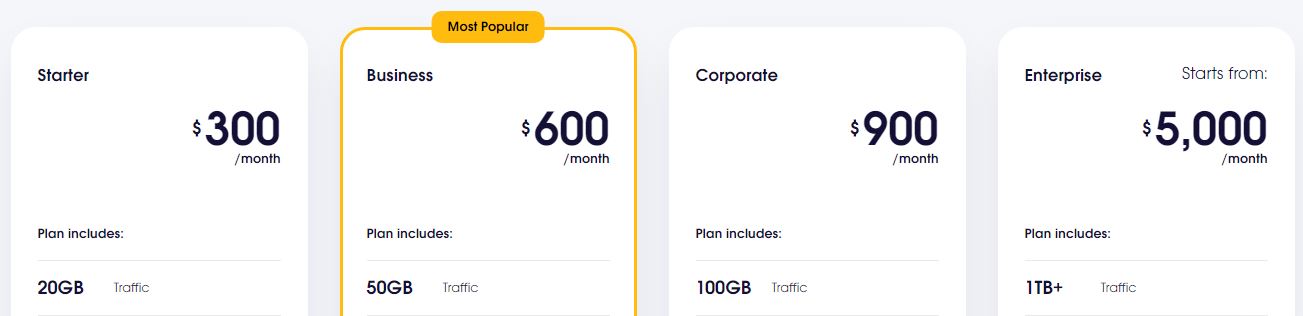
Pricing is where the two providers diverge most clearly. Bright Data has more flexible entry points (PAYG on everything), while Oxylabs requires a subscription for residential proxies but starts lower on datacenter products.
Residential Proxy Pricing
| Plan | Bright Data | Oxylabs |
|---|---|---|
| Entry / PAYG | $8/GB (no minimum) | $6/GB — $30/mo for 5 GB (no PAYG) |
| ~$500/mo tier | $7/GB — $499/mo for ~71 GB | Contact sales for tiers above starter |
| ~$1,000/mo tier | $6/GB — $999/mo for ~166 GB | JS-rendered slider — verify live |
| ~$2,000/mo tier | $5/GB — $1,999/mo for ~399 GB | JS-rendered slider — verify live |
| Enterprise | Custom, $2,000+/mo, 1 TB+ residential | Custom (contact sales) |
| Active promo | RESIGB50 — 50% OFF for 3 months (drops PAYG to $4/GB) | proxyway35 — 35% off first purchase |
Datacenter & ISP Pricing
| Product | Bright Data | Oxylabs |
|---|---|---|
| DC shared (per IP) | $1.40/IP (10 IPs) → $0.90/IP (1,000 IPs) | $1.20/IP (10 IPs entry) |
| DC dedicated (per IP) | $2.20/IP (10 IPs) → $1.30/IP (1,000 IPs) | $2.25/IP (3 IPs starter) |
| DC rotating (per GB) | $0.60/GB (PAYG) → $0.42/GB ($1,999/mo) | $0.65/GB — $50/mo for 77 GB entry |
| ISP shared (per IP) | $1.80/IP (10 IPs) → $1.30/IP (1,000 IPs) | $1.60/IP (10 IPs) → $1.30/IP (100 IPs) |
| Mobile (per GB) | ~$8/GB (equalized with residential) | $7.50/GB (4 GB starter at $30/mo) |
Pricing note: Bright Data subscription plans are minimum monthly commitments, not caps. If you use more than your plan’s included GB, you are charged at your per-GB rate for the overage. Oxylabs mobile and residential plans removed pay-as-you-go in early 2026, so you must commit to a monthly plan. Bright Data still offers PAYG on residential at $8/GB — useful if your volume is unpredictable.
Scraping API pricing:
- Bright Data Web Unlocker API: $1.50/1K results (PAYG) → $1/1K results ($1,999/mo plan)
- Bright Data Browser API: $8/GB (PAYG) → $5/GB ($1,999/mo plan)
- Bright Data pre-built scrapers: $1.50/1K records (PAYG), with promo code APIS25 giving 25% off for 3 months
- Oxylabs Web Scraper API: from $49/mo (Micro plan covering Web, SERP, and E-Commerce APIs); ~$1.60/1K results
Trial and refund terms: Both offer a 7-day free trial for verified companies. Oxylabs also explicitly offers a 3-day refund policy. Bright Data offers a first-deposit match up to $500 for new signups and a 7-day trial, but does not publish a refund policy — contact [email protected] for billing disputes. For a full breakdown of every Bright Data tier, see our Bright Data pricing guide.
Pros & Cons
Bright Data Pros ✓
- Largest residential pool in the market: 400M+ monthly IPs — 2.3x bigger than Oxylabs
- PAYG on everything: Residential, datacenter, browser API, scrapers — no forced commitment
- Full product stack under one account: Proxies + scrapers + datasets + AI tools, single billing
- AI/agent tooling: Web MCP server, Agent Browser, video/audio data for LLM training
- ISO 27001 certified: Enterprise compliance requirements met out of the box
- Promo RESIGB50: 50% off residential for 3 months — drops PAYG from $8 to $4/GB
- First-deposit match: Up to $500 credit match for new signups
- Dedicated residential IPs: Exclusive pool per domain — unique feature not offered by Oxylabs
Bright Data Cons ✗
- Slower residential proxies: 1.12 s avg vs Oxylabs’ 0.65 s in Proxyway benchmarks
- Aggressive KYC: Freelancers must complete a video call; only business projects approved
- No published refund policy: Must contact compliance team for billing disputes
- Complex onboarding for beginners: Zones system and multi-product billing can overwhelm new users
- Google blocked by default: Even with full KYC, residential proxies redirect Google queries to SERP API
- Subscription plans do not roll over: Unused GB does not carry to the next month
Oxylabs Pros ✓
- Fastest residential proxies tested: 0.65 s global avg, 0.60 s EU avg (Proxyway April 2025)
- Largest datacenter pool: 2M+ dedicated IPs across 188 countries
- 3-day refund policy: Explicit and accessible
- 5 free datacenter IPs: Start testing without a credit card
- Named account managers: Enterprise clients get a dedicated contact with ~2 min response time
- Coordinate-level targeting: Residentials support GPS coordinate targeting — not offered by Bright Data
- Product insurance: Proxy products come with insurance (unique in the industry)
- Simpler dashboard: Cleaner UX for teams that do not need the full Zones system
Oxylabs Cons ✗
- No residential PAYG: Subscription required for residential; removed in early 2026
- Smaller residential pool: 175M+ vs Bright Data’s 400M+
- Less advanced AI tooling: AI Studio is early-stage vs Bright Data’s production Web MCP
- JS-rendered pricing: Many pricing tiers require visiting the live dashboard to confirm
- Fewer pre-built scrapers: Bright Data’s 250+ site-specific scrapers outpace Oxylabs’ offering
- Google restricted by default: Same restriction as Bright Data
Bottom Line: Bright Data wins on scale and product breadth. Oxylabs wins on speed, support, and simplicity. If you are running scraping projects where raw IP volume matters most, Bright Data is the better default. If you value sub-second latency and want a dedicated human to answer questions, Oxylabs is worth the slightly smaller pool.
How They Compare to Decodo
To give you a wider frame of reference, here is how each provider stacks up against Decodo (formerly Smartproxy) — a budget-friendly alternative that scores 9.3/10 on Proxyway and is often recommended as a first step down from enterprise pricing.
Bright Data vs Decodo
| Feature | Bright Data | Decodo |
|---|---|---|
| Residential pool | 400M+ IPs | 115M+ IPs |
| Countries | 195 | 195+ |
| Residential entry price | $8/GB (PAYG) | $3.49/GB (PAYG plan, entry tier) |
| Pre-built scrapers | 250+ targets | Limited (no comparable product) |
| AI/agent tools | Web MCP, Agent Browser | Not offered |
| KYC requirement | Yes (strict — video call for freelancers) | Less strict |
| ISO 27001 | Yes | No |
| Proxyway rating | 9.3/10 | 9.3/10 |
| Best for | Enterprise scale; full stack data acquisition | Budget-conscious teams; SMB scraping |
Winner for pool size: Bright Data | Winner for price: Decodo (3.5x cheaper at entry) | Winner for compliance: Bright Data | Winner for beginners: Decodo
Oxylabs vs Decodo
| Feature | Oxylabs | Decodo |
|---|---|---|
| Residential pool | 175M+ IPs | 115M+ IPs |
| Residential response time | 0.65 s (global avg) | ~1.0 s (estimated) |
| Residential entry price | $30/mo for 5 GB ($6/GB) | $3.49/GB (PAYG) |
| Free datacenter trial | 5 free IPs, no credit card | 3-day free trial |
| Refund policy | 3-day refund | 3-day refund |
| Named account manager | Yes (enterprise) | No |
| Product insurance | Yes (unique) | No |
| Best for | Enterprise latency-sensitive scraping | Mid-market teams on a budget |
Winner for speed: Oxylabs | Winner for price: Decodo (significantly cheaper PAYG) | Winner for enterprise features: Oxylabs | Winner for SMBs: Decodo
🏆 Choose Bright Data or Oxylabs When:
- Your project requires 50+ GB of residential traffic per month
- You are scraping heavily-protected sites (Amazon, LinkedIn, Instagram) at scale
- Enterprise compliance certifications (ISO 27001, EWDCI) are a procurement requirement
- You need a complete stack: proxies + scraping APIs + datasets in one account
- Dedicated support and named account managers are important to your team
🔍 Choose Decodo Instead When:
- You need residential proxies under $5/GB without enterprise-level commitment
- You are prototyping or running lower-volume scraping projects
- KYC friction is a blocker — Decodo has a lighter onboarding process
- Your team does not need the full AI/agent tooling stack
- Budget is a primary constraint and you can accept a smaller IP pool
Ratings Breakdown
Here is our side-by-side evaluation of both providers across the six key dimensions that matter for proxy buyers:
| Category | Bright Data | Oxylabs | Notes |
|---|---|---|---|
| Network Size & Coverage | 4.9/5 | 4.6/5 | Bright Data’s 400M+ vs 175M+ residential pool; both cover 195 countries |
| Speed & Latency | 4.2/5 | 4.8/5 | Oxylabs wins — 0.65 s vs 1.12 s residential avg in Proxyway benchmarks |
| Pricing & Value | 4.0/5 | 4.0/5 | Tie — Bright Data has PAYG flexibility; Oxylabs is cheaper at $30/mo entry |
| Product Breadth | 4.9/5 | 4.4/5 | Bright Data’s 250+ scrapers, MCP server, datasets, and AI tools lead |
| Ease of Use | 3.9/5 | 4.3/5 | Oxylabs has simpler dashboard; Bright Data’s Zones system adds complexity |
| Support & Reliability | 4.5/5 | 4.7/5 | Oxylabs’ named account managers and 2-min live chat edge out Bright Data |
| Overall Rating | 4.7/5 | 4.6/5 | Both excellent; Bright Data leads on scale, Oxylabs on speed and support |
Rating Summary: Bright Data and Oxylabs are the two strongest proxy providers in 2026, and they are genuinely close at this level of the market. Bright Data pulls ahead on the dimensions that matter most for large-scale data acquisition: network size, product completeness, and AI-readiness. Oxylabs leads where precision and reliability under pressure matter most: latency, support responsiveness, and dedicated datacenter coverage. The right choice depends on whether you are optimizing for scale or speed.
Which Provider Is Legit, Safe & Worth It?
Legitimacy & Safety
- ✓ Both are well-established companies — Bright Data (2014) and Oxylabs (2015) have been operating for a decade. Neither is a fly-by-night operation. Bright Data serves 20,000+ organizations; Oxylabs serves 15,000+.
- ✓ Bright Data is ISO 27001 certified — Independently audited information security management. Also GDPR compliant, SOC certified, and a WIPO Alert partner.
- ✓ Oxylabs is an EWDCI member — The Ethical Web Data Collection Initiative (part of i2Coalition) is the industry’s main ethical sourcing body. Oxylabs also published its Residential Proxy Acquisition Handbook publicly.
- ✓ Both enforce KYC — Residential proxy access requires verified identity. This is a signal that both providers take compliance seriously and do not simply sell to anyone.
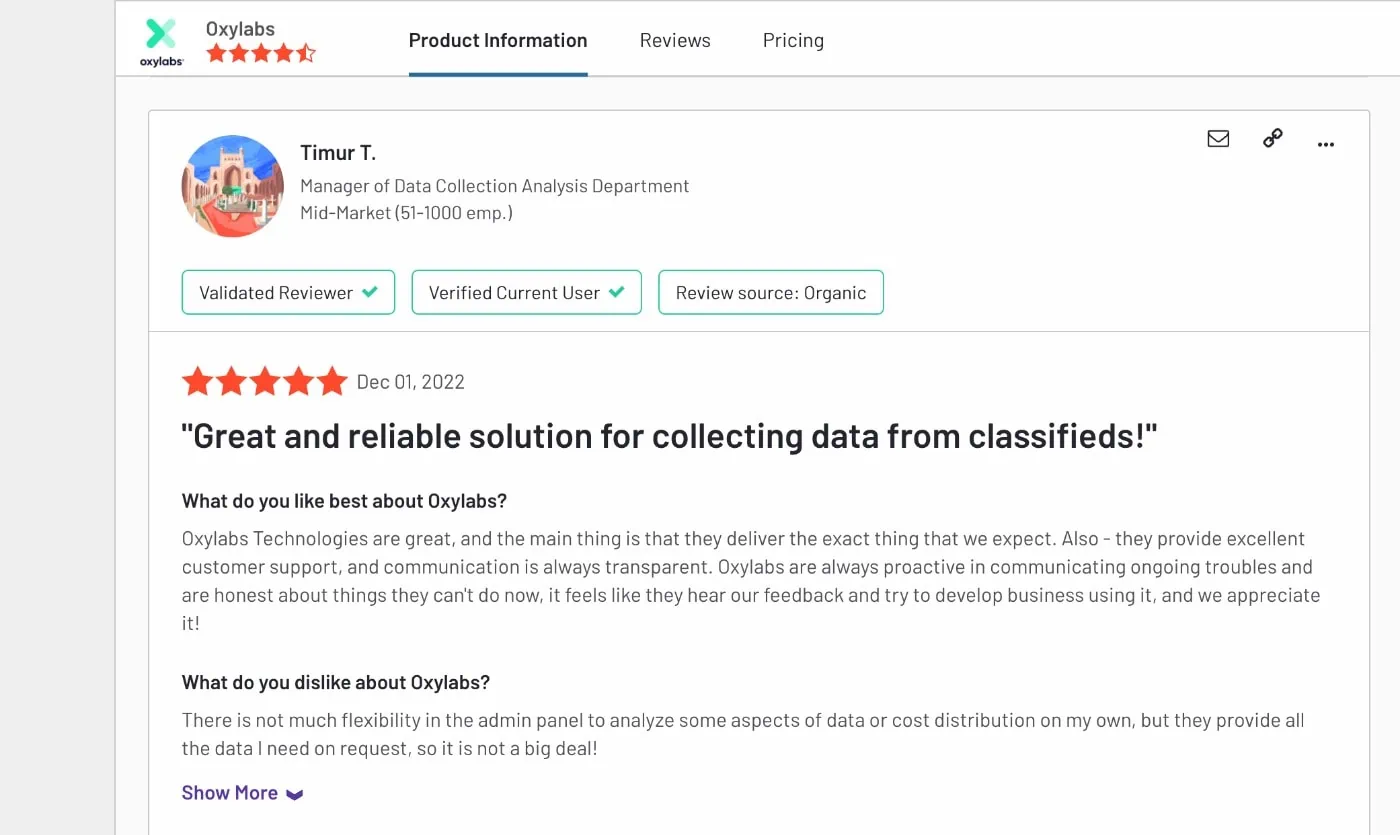
- ✓ Strong third-party ratings — Bright Data: Trustpilot 4.6/5, G2 4.6/5, Capterra 4.8/5. Oxylabs: Trustpilot 4.7/5 (1,100+ reviews), G2 4.5/5 (414+ reviews).
- ✓ Proxyway-tested performance — Both providers’ claims are independently verified by Proxyway’s proxy benchmarking lab, not self-reported only.
Long-Term Reliability
Both providers have demonstrated multi-year stability. Bright Data survived rebranding from Luminati Networks in 2021 without losing customers. Oxylabs has grown from a 17m² office in Vilnius to a global platform serving Fortune 500 companies, with annual OxyCon conferences. Both have enterprise SLAs — Bright Data advertises 99.99% uptime, Oxylabs matches that across residential and datacenter products.
Reality check: At these price points, you are paying for infrastructure that works reliably at scale — not for the cheapest possible access to residential IPs. If your project does not genuinely need 99.9%+ success rates on protected targets, you can get 80–90% of the performance at 30–40% of the cost from providers like Decodo or IPRoyal. Only move to Bright Data or Oxylabs when you have validated that the lower-cost alternatives are genuinely holding your project back.
Worth It? Final Verdict
✓ YES — Choose Bright Data If:
- You need 50+ GB/month of residential traffic with the largest possible pool
- You want all proxy types, scraping APIs, and AI tools under one billing account
- Enterprise compliance (ISO 27001, GDPR) is a non-negotiable requirement
- You are building AI agents that need web data access infrastructure
- You want PAYG flexibility with no monthly minimum on residential proxies
- You can use the RESIGB50 promo to test at $4/GB for three months
✓ YES — Choose Oxylabs If:
- Residential proxy speed is your top priority — you need sub-second response times
- You are EU-based and want a provider with strong European coverage and support
- You need a dedicated account manager and expect human support at scale
- The 3-day refund policy matters to your procurement process
- You need the world’s largest dedicated datacenter pool (2M+ IPs)
- You want coordinate-level geo targeting on residential proxies
Our Recommendation: For most teams choosing between these two, Bright Data is the safer default. The 400M+ residential pool means lower IP reuse, higher success rates on protected sites, and more headroom to scale. The unified billing system and PAYG availability make it easier to start without locking into a high monthly commitment. Use the RESIGB50 promo code to get 50% off for three months and run a real test. If you are EU-based, latency-sensitive, or find Bright Data’s KYC process too restrictive for your use case, Oxylabs is an equally excellent choice — just be prepared to commit to a monthly plan for residential traffic.
Bright Data vs Oxylabs — Frequently Asked Questions
Is Bright Data better than Oxylabs for residential proxies?
It depends on what “better” means for your project. Bright Data has a larger pool — 400M+ vs 175M+ monthly IPs — which means lower IP reuse and potentially higher success rates on heavily-scraped targets. Oxylabs has faster residential proxies: an average response time of 0.65 seconds globally vs Bright Data’s 1.12 seconds in Proxyway’s April 2025 benchmark. For raw scale and product breadth, Bright Data wins. For speed and support, Oxylabs wins.
Which provider is cheaper — Bright Data or Oxylabs?
It depends on usage volume and how you buy. Bright Data offers PAYG residential proxies at $8/GB with no monthly minimum — useful if your volume is unpredictable. Oxylabs removed PAYG for residential in early 2026 but starts at $30/mo for 5 GB ($6/GB). At the $499/month tier, Bright Data gives you ~71 GB at $7/GB. Oxylabs’ tiers above the starter require checking their live pricing slider. Both offer promo codes: Bright Data’s RESIGB50 gives 50% off residential for 3 months; Oxylabs’ proxyway35 gives 35% off the first purchase.
Do both Bright Data and Oxylabs require KYC?
Yes, both require KYC for residential and mobile proxy access. Bright Data is notably strict — freelancers must complete a video call and only business-related projects are approved. Oxylabs also enforces KYC before residential access is granted. Both providers offer limited no-KYC pathways: Bright Data allows access to 200+ whitelisted sites without KYC; Oxylabs offers 5 free datacenter IPs with no credit card required.
Which provider has the largest proxy pool?
Bright Data has the largest residential pool: 400M+ monthly IPs. Oxylabs advertises 175M+ residential IPs — still one of the largest in the market, but about 2.3x smaller than Bright Data. For datacenter proxies, Oxylabs claims the world’s largest dedicated datacenter pool at 2M+ IPs across 188 countries. Bright Data’s datacenter pool sits at 1.3M+ IPs across ~98 countries.
Can I use Bright Data or Oxylabs to scrape Amazon?
Yes, both work for Amazon scraping, and both have pre-built tools specifically designed for it. Oxylabs’ E-Commerce Scraper API includes Amazon as a primary target. Bright Data’s pre-built scraper library covers Amazon products in its 250+ target catalog. In Proxyway benchmarks, Oxylabs achieved a 95.76% success rate on Amazon with residential proxies. Bright Data’s residential proxies hit 96.75% on Amazon. Both significantly outperform datacenter proxies on Amazon (which are largely blocked by Amazon).
Does Bright Data or Oxylabs work for Google scraping?
Both providers restrict Google scraping by default via residential proxies and redirect users to their dedicated SERP API products. Bright Data’s SERP API starts from $1/1K requests. Oxylabs’ SERP Scraper API is included in the Micro plan at $49/mo. These APIs return structured JSON results from Google, Bing, and other search engines, and are the compliant way to collect SERP data at scale from either provider. See our best SERP API providers guide for a broader comparison.
Which provider has better customer support?
Oxylabs edges ahead on support. Enterprise clients get a named account manager who is reachable by email and chat — a 2-minute live chat response time was observed in testing. Oxylabs also holds OxyCon, an annual industry conference. Bright Data has a larger support infrastructure (400+ employees, 6-language dashboard, WhatsApp and Telegram channels) but does not match the named account manager model that Oxylabs provides to enterprise clients.
What is the difference between Bright Data’s Web Unlocker and Oxylabs’ Web Unblocker?
Both are AI-powered APIs that handle CAPTCHA solving, browser fingerprinting, and bot detection bypass automatically — you send a URL and get back the page content. The core function is identical. Bright Data’s Web Unlocker API charges $1.50/1K results on PAYG, dropping to $1/1K at the $1,999/mo tier. Oxylabs’ Web Unblocker pricing requires checking the live dashboard. The main practical difference is that Bright Data’s is more mature and has a longer track record, while Oxylabs’ integrates tightly with its Scraping Browser for more complex JS-heavy targets.
Do Bright Data and Oxylabs offer free trials?
Both offer 7-day free trials for verified companies. Bright Data additionally offers a first-deposit match up to $500 and gives Web Scraper API users 1,000 free requests for one week with no credit card required. Oxylabs offers 5 free datacenter IPs with no credit card and a 3-day refund policy on paid plans. Bright Data does not publish an explicit refund policy.
Are Bright Data and Oxylabs ethically compliant?
Both take ethical sourcing seriously. Bright Data requires explicit opt-in from peers in its residential network, enforces strict KYC, is ISO 27001 certified, and voluntarily cut 10% of its pool to remove unethical sourcing partners. Oxylabs is a member of the EWDCI (Ethical Web Data Collection Initiative) and has published its Residential Proxy Acquisition Handbook publicly. Both comply with GDPR and enforce use-case restrictions on their networks.
What is the cheaper alternative to both Bright Data and Oxylabs?
Decodo (formerly Smartproxy) is the most commonly recommended alternative. It scores 9.3/10 on Proxyway — the same as both Bright Data and Oxylabs — and offers residential proxies from approximately $3.49/GB on PAYG, compared to $8/GB at Bright Data and $6/GB at Oxylabs. The trade-off is a smaller pool (115M+ IPs) and less comprehensive enterprise tooling. For budget-conscious teams that do not need the full product stack, Decodo is a logical starting point. Our Bright Data alternatives guide covers more budget options including IPRoyal and Webshare.
Which provider is better for AI agents and LLM use cases?
Bright Data is significantly ahead on AI/agent infrastructure. It offers a production-ready Web MCP server that connects AI agents to the web, an Agent Browser product, and video/audio datasets specifically for LLM training. Oxylabs has AI Studio, a low-code interface for building scrapers, but it is not positioned as a dedicated AI agent infrastructure product. If your use case involves building or powering AI agents that need to browse and extract web data, Bright Data’s tooling is more mature as of mid-2026.
Final Verdict
Bright Data and Oxylabs are the two best proxy providers in the market as of 2026. Both share a 9.3/10 Proxyway rating, both serve enterprise clients at scale, and both offer a comprehensive product stack that goes well beyond raw proxy access. The decision between them comes down to your specific priority: raw network scale and product completeness (Bright Data) versus speed, support responsiveness, and EU positioning (Oxylabs).
If you are still undecided, the practical answer is to use both free trials. Bright Data gives you a 7-day trial plus a $500 first-deposit match. Oxylabs gives you a 7-day trial plus 5 free datacenter IPs and a 3-day refund window. Run your actual scraping target through each and let the performance data make the call for you.
✓ Bright Data — What We Love
- 400M+ residential IPs — the largest pool available
- PAYG on every product, no monthly minimums
- One unified billing account across all tools
- AI/agent infrastructure (Web MCP, Agent Browser)
- 250+ pre-built site-specific scrapers
- ISO 27001 certified — enterprise-ready compliance
- RESIGB50 promo: 50% off residential for 3 months
✗ What Could Be Better
- No residential PAYG on Oxylabs — subscription required since early 2026
- Bright Data’s pricing complexity and mandatory KYC process create real friction for new users
- Both providers have high minimum commitments compared to budget alternatives like Decodo or IPRoyal
- Support quality varies significantly by plan tier — enterprise clients get named account managers, but lower-tier users rely on standard ticketing
Ready to Start with the Best Proxy Platform?
Bright Data’s 400M+ IP network, unified billing, and free 7-day trial make it the easiest way to validate enterprise-grade proxy infrastructure for your project.
Start Bright Data Free Trial →