
Infatica Review:
A Solid All-Rounder or Just Another Proxy Provider?
This Infatica review covers residential, mobile, ISP, and datacenter proxies — with benchmark success rates, pricing, and a verdict on the 11-product suite.
⚡ Quick Verdict
Infatica is a mid-market proxy provider that punches above its weight on performance but below it on pool size. Founded in Singapore in 2019, it now offers 11 products spanning residential, mobile, ISP, datacenter proxies, and scraper APIs — giving it a breadth that rivals much larger names. Third-party benchmarks put its US residential success rate at 99.35% and its UK response time as the fastest in its price class. The trade-offs: its residential pool is around 15M distinct IPs (not the 35M advertised), regional performance dips in Brazil and India, and you need KYC verification just to view ISP and dedicated DC pricing — before you even buy anything.
Web scraping, SERP monitoring, residential proxies, mobile IPs
Every Infatica review you find will quote the same headline stat: 35 million residential IPs. Then you buy in, run your first batch, and discover the real pool you’re drawing from is a fraction of that number. Proxy marketing is full of inflated claims, and separating fact from fiction takes time most buyers don’t have.
Infatica sits in a tricky position. It advertises 35M+ residential IPs but independent benchmark data from ProxyWay puts the distinct count closer to 15 million. That’s still a substantial pool. And here’s what the headline number misses: in ProxyWay’s April 2025 testing, Infatica had the fastest UK residential response time in its price tier and hit 99.35% success in the US. Pool size alone doesn’t tell the whole story.
This Infatica review is built on the brand’s own published pricing (post the February 2025 price cut), ProxyWay’s April 2025 benchmark data, and hands-on product research across all 11 of its proxy types and scraper APIs. No sponsored claims. No recycled spec sheets.
The provider has grown fast since 2019 — adding rotating datacenter proxies in April 2025, IPv6 residential proxies in November 2025, and two new data APIs (YouTube and AI Search). Whether that breadth translates into depth is exactly what this review examines.
What Is Infatica?
Infatica is a Singapore-headquartered proxy provider and web data collection platform that launched in 2019. It started as a residential proxy business and has since expanded into one of the more complete mid-market proxy suites available — covering all major proxy types plus a set of scraper APIs. As of 2026, it counts 3,000+ clients and processes 300M+ daily requests.
The platform covers:
- Residential proxies — 35M+ advertised IPs (ProxyWay benchmark: ~15M distinct) across 195 countries
- Premium IPv6 Residential proxies — 500K+ IPs, launched November 2025
- Mobile proxies — 5M+ IPs across 100+ countries
- Static ISP proxies — 150K+ IPs, unlimited traffic, billed per IP/month
- Shared datacenter proxies — 500K+ rotating IPs, bandwidth billing
- Dedicated datacenter proxies — 200K+ IPs, unlimited traffic, billed per IP/month
- Web Scraper API — JS rendering, geotargeting, domain-specific scrapers
- SERP Scraper — Google, Bing, Yahoo scraping with CSV/JSON/XLSX export
- Custom Scraping as a Service — enterprise data extraction on request
- YouTube Data API — video/audio download, metadata and subtitles collection
- AI Search Data API — queries ChatGPT, Gemini, and Perplexity simultaneously
Company Background & Evolution
Infatica was incorporated as a Singapore entity (INFATICA PTE. LTD., UEN: 201925927G) in 2019, with additional legal entities in Hungary (Infatica KFT) and the United Kingdom (INFATICA LTD.). Despite the Singapore HQ, the ownership and core team are largely Eastern European in background. By 2022, the company was actively seeking investment — attracting backing from the venture capital firm behind SOAX — and has grown to 25–50 employees.
The company is transparent about its IP sourcing. It operates a peer-to-business SDK model: app developers embed the Infatica SDK, which borrows device bandwidth with user consent in exchange for ad-free monetization. Infatica drew criticism in 2021 for placing the SDK in browser extensions, and has since moved away from that approach. Its ethical sourcing practices are now documented in a published “Infatica Handbook” PDF and backed by four ISO certifications.
The product roadmap has been busy. Rotating datacenter proxies arrived in April 2025, IPv6 residential IPs in November 2025, and two new data APIs (YouTube and AI Search) followed shortly after. That’s a faster build-out than most providers in the same price tier.
Who Is Infatica For?

✓ Ideal Users
Infatica’s breadth of products and its full-feature access policy — where advanced targeting and API tools are available to all paying customers, not just enterprise accounts — make it a good fit for a wide range of use cases:
- Web Scrapers and Data Engineers — Need high-success residential IPs for e-commerce, job boards, or competitor monitoring. Infatica’s 99.35% US success rate and top benchmark performance on Amazon (95.44%), Google (94.43%), and Instagram (95.50%) make it a viable choice.
- SERP Monitoring Teams — The dedicated SERP Scraper handles Google, Bing, and Yahoo with built-in proxy rotation and exports to CSV, XLSX, or JSON. Pairs with the residential IP pool for clean results.
- Market Intelligence and Price Aggregation — Domain-specific scrapers for Amazon, eBay, Walmart, Target, and AliExpress let e-commerce teams monitor pricing without building custom scrapers.
- Ad Verification Agencies — Country, city, and ASN targeting down to ZIP level lets you verify ad delivery in specific locations. Combined with ISP proxies for a clean residential-style IP, this is a strong ad-verification setup.
- Recruitment and Lead Generation Firms — Indeed and LinkedIn scrapers are built into the Web Scraper API. City and ISP-level targeting helps reach location-specific candidate or company data.
- Developers and Agencies Needing Multiple Proxy Types — If your workflow spans residential, mobile, ISP, and datacenter IPs, Infatica gives you all four under one account rather than maintaining separate vendor relationships.
✗ Not Ideal For
Skip Infatica if you:
- Primarily target Brazil or India at scale — success rates drop to 91.54% and 92.55% respectively in benchmark testing
- Need the absolute largest IP pool available — Bright Data (150M+) and Oxylabs (175M+) are larger by a factor of 10
- Want to buy ISP or dedicated DC proxies without uploading identity documents — KYC is mandatory before you can even see pricing
- Need to top up bandwidth mid-cycle — Infatica’s plans auto-renew but do not allow mid-cycle top-ups on subscription tiers
- Are on a very tight budget for mobile proxies — $8/GB PAYG is on the higher end of the market; see our NodeMaven proxies review for a quality-filtered alternative
- Need rollover (non-expiring) bandwidth — ProxyEmpire is the only major provider that lets unused traffic carry over to the next cycle
Infatica Features & What You Get
Infatica’s feature set stands out for two reasons: the breadth of products and the democratic access policy. Advanced targeting, API tool integration, and session controls are available at all paid tiers — not locked behind enterprise contracts.
Core Proxy Networks
- Residential Proxies: 35M+ advertised IPs (~15M distinct per ProxyWay), 195 countries, targeting down to country, state, city, ZIP, ISP, and ASN level
- Premium IPv6 Residential: 500K+ IPv6 IPs, 195 countries, city and ISP-level targeting — launched November 2025 for high-performance IPv6 scraping
- Mobile Proxies: 5M+ IPs across 100+ countries, including a mix of mobile carrier and Wi-Fi networks (not exclusively carrier IPs)
- Static ISP Proxies: 150K+ IPs in 28+ countries, unlimited traffic, billed per IP/month, bypasses reCAPTCHA and Cloudflare with residential-style IPs
- Shared Datacenter: 500K+ rotating IPs globally, bandwidth billing from $0.60/GB — Infatica’s most affordable entry point
- Dedicated Datacenter: 200K+ IPs in 45+ countries, unlimited traffic, billed per IP/month
Supported Protocols & Authentication
- Protocols: HTTP, HTTPS, and SOCKS5 (TCP only — UDP not supported on SOCKS5)
- Authentication: Username/password or IP whitelist
- Concurrency: Unlimited concurrent sessions on all tiers
- Port configuration: Up to 1,000 ports per Proxy List, up to 20 Proxy Lists simultaneously
Targeting & Session Control
- Country, state, city, ZIP, ISP, and ASN targeting on residential and mobile proxies
- Rotation options: every request, 5–60 minute intervals, sticky sessions, or no interval
- Configurable peer-unavailability behavior: rotate immediately, wait 5 seconds, or keep retrying — useful for scraping pipelines with low peer availability
- Gateway servers in US, Asia, and Europe
What “full feature access” actually means: Most proxy providers gate advanced targeting (city, ZIP, ASN) or API integration behind higher-tier or enterprise plans. Infatica gives these to all paying customers. If you’re on the $96/month 25 GB residential plan, you get the same feature set as an enterprise customer — just less bandwidth.
Scraper APIs
- Web Scraper API: JavaScript rendering, Ajax support, geotargeting across 150 locations, no CAPTCHA handling required, domain-specific scrapers for Amazon, eBay, Walmart, Target, AliExpress, Indeed, and LinkedIn
- SERP Scraper: Scrapes Google, Bing, Yahoo, and other search engines; backed by the 35M+ IP pool; CSV, XLSX, JSON export
- Custom Scraping as a Service: Enterprise data extraction — contact sales for pricing
- YouTube Data API: Video/audio download (MP4/MP3), metadata, subtitles, and comments collection
- AI Search Data API: Single request hits ChatGPT, Gemini, and Perplexity simultaneously, returning raw answers with sources, citations, and full traceability
Compliance & Security
- ISO 27001 (information security), ISO 22301 (business continuity), ISO 27701 (privacy), ISO 20000-1 (IT service management)
- GDPR-compliant IP sourcing with published ethical code
- 256-bit SSL encryption on all connections and transactions
- Network status page at status.infatica.io for real-time uptime monitoring
- KYC identity verification (via Veriff) required for ISP and dedicated datacenter purchases
Add-ons & Extras
- Proxy Reseller Program — start reselling in 3 steps with your own margin
- Referral / affiliate program — up to 30% commission
- Infatica SDK for app developers — monetize apps by contributing device bandwidth
- Free Proxy Checker tool at infatica.io/proxy-checker
- 24/7 live chat support with a stated 4-hour SLA response time
How Infatica Works (Step-by-Step)
Getting from signup to a working proxy connection is straightforward, though the path varies slightly depending on which product you’re buying. Here’s the standard flow for residential proxies:
Step 1: Create Your Account
Register at dashboard.infatica.io with an email address and password. Email verification is required. For standard residential, mobile, or shared datacenter proxies, there’s no KYC required at this stage — you can purchase and start using them immediately after registration. Note: if you want ISP or dedicated datacenter proxies, you’ll need to complete identity verification (via Veriff) before you can even view their pricing pages.
Step 2: Choose a Product and Plan
Navigate to the Pricing section and select your proxy type. Infatica uses a wallet system for some payment methods — add funds to your account first, then purchase a plan. This is required if you’re paying with cryptocurrency or Bitcoin. For card and PayPal payments, you can buy directly. Trials are available for residential ($4 for 7 days), mobile ($8 for 7 days), IPv6 residential ($6 for 7 days), and shared datacenter ($3 for 7 days).
Step 3: Create a Proxy List in the Dashboard
After purchase, go to the Services tab (not the Products tab — the Products tab is only for buying new services). Create a Proxy List, select your targeting options (country, city, ZIP, ASN, ISP), set your rotation interval, and choose your authentication method. The dashboard builds a proxy list of up to 1,000 ports per list. You can maintain up to 20 Proxy Lists simultaneously, each with different configurations.
Step 4: Connect Your Tool or Script
Export the proxy list and paste the credentials into your scraping tool, antidetect browser, or automation script. Infatica supports HTTP, HTTPS, and SOCKS5 (TCP only). Code integration guides are available in the documentation for Go, React, JavaScript, Python, NodeJS, C/C++, C#, and Ruby. You can also use the API gateway endpoint instead of a proxy list if that fits your workflow better.
Step 5: Monitor Usage and Manage Traffic
Track bandwidth consumption from the Services tab in the dashboard. Usage analytics show consumption but are limited — you cannot set custom date ranges, and success rate tracking is not built into the dashboard. When your bandwidth plan runs out, the system auto-renews if you have a saved payment method. If no payment method is saved, service pauses until you top up manually.
Bottom line: Infatica’s setup is clean and fast for standard proxy types. The main friction point is the dashboard navigation — the Products tab is for purchasing, the Services tab is for managing what you already have. That distinction trips up new users. Once you know it, everything else is straightforward. Plan for the wallet top-up step if you want to pay with crypto.
Infatica Pricing & Plans
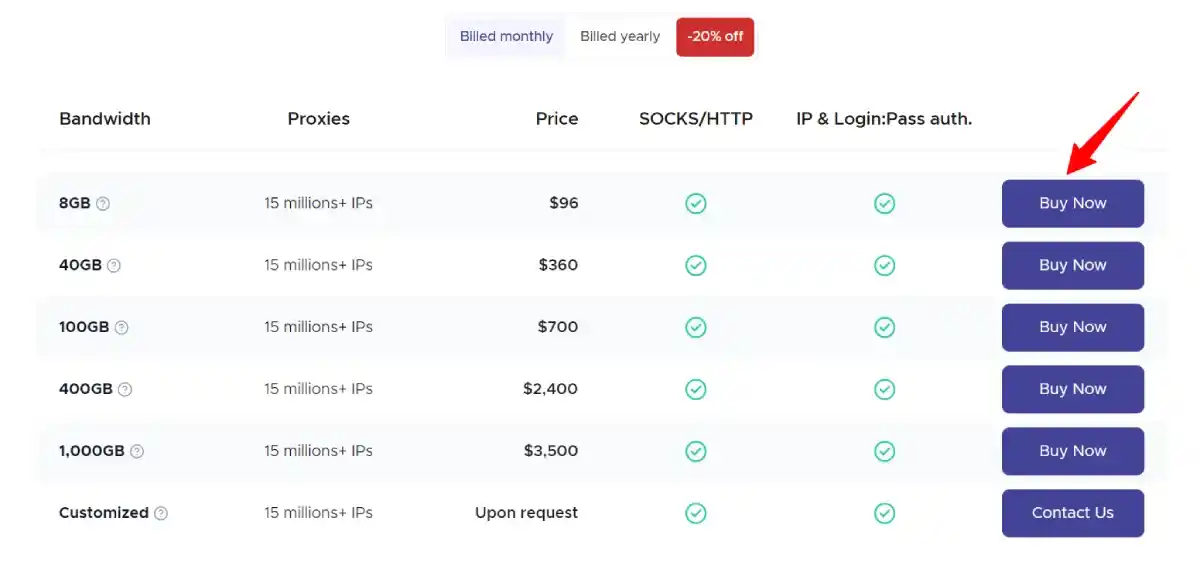
Infatica uses bandwidth billing (per GB) for residential, IPv6 residential, mobile, and shared datacenter proxies. ISP and dedicated datacenter proxies are billed per IP address per month with unlimited traffic. Annual plans get a flat 20% discount across all bandwidth products. Prices below reflect the post-February 2025 pricing cut, which reduced lower-tier residential rates by up to 50%.
Residential Proxy Plans (Monthly)
| Bandwidth | Price per GB | Monthly Total |
|---|---|---|
| Pay As You Go | $4.00/GB | Metered |
| 25 GB | $3.84/GB | $96 |
| 100 GB | $3.60/GB | $360 |
| 241 GB (Popular) | $2.90/GB | $700 |
| 500 GB | $2.70/GB | $1,350 |
| 1,000 GB | $2.60/GB | $2,600 |
Mobile, Datacenter & ISP Proxy Plans
| Product | Starting Price | Trial Available | Billing Model |
|---|---|---|---|
| Mobile Proxies | $8.00/GB PAYG; $45 for 6 GB | 7 days / $8 | Per GB (bandwidth) |
| Premium IPv6 Residential | $6.00/GB PAYG; $144 for 25 GB | 7 days / $6 | Per GB (bandwidth) |
| Shared Datacenter | $0.60/GB PAYG; $29 for 50 GB | 7 days / $3 | Per GB (bandwidth) |
| Static ISP Proxies | $1.95–$3.00 per IP/month | No trial (KYC required) | Per IP, unlimited traffic |
| Dedicated Datacenter | $1.00–$1.50 per IP/month | No trial (KYC required) | Per IP, unlimited traffic |
Important pricing notes:
- Bandwidth subscription plans cannot be topped up mid-cycle. When your traffic runs out, the system auto-renews if a payment method is on file
- Annual plans get 20% off — for example, the equivalent of 241 GB/month becomes 2,892 GB/year at $2.32/GB ($6,720 total)
- ISP and dedicated datacenter exact per-country pricing is only visible after KYC identity verification in the dashboard
- Crypto payments require pre-loading your Infatica Wallet first, then purchasing from that wallet balance
Trial options by product:
- Residential: 7-day trial for $4.00
- Mobile: 7-day trial for $8.00
- Premium IPv6 Residential: 7-day trial for $6.00
- Shared Datacenter: 7-day trial for $3.00
Payment methods: Visa, Mastercard, American Express, PayPal, EPS, Discover, Google Pay, Apple Pay, cryptocurrency/Bitcoin (via Infatica Wallet), and bank transfer for enterprise accounts.
Infatica Proxies: Pros & Cons
Pros ✓
- Strong US and EU performance: 99.35% US success rate, fastest UK residential response time in its price tier (ProxyWay, April 2025)
- 11 products under one account: Residential, mobile, ISP, DC, and five scraper APIs — fewer vendor relationships to manage
- Full features for all tiers: City, ZIP, ASN targeting and API integration are not enterprise-only — every paying customer gets them
- Four ISO certifications: ISO 27001, 22301, 27701, 20000-1 — more certifications than most mid-market providers
- Competitive residential pricing post-2025 cut: 25 GB at $3.84/GB, 241 GB at $2.90/GB — reasonable for the success rates delivered
- Very affordable shared datacenter: $0.60/GB PAYG, $29 for 50 GB — among the cheapest rotating DC options available
- Active development: Two new proxy types and two new APIs added in 2025 alone
- Annual discount: Flat 20% off across all bandwidth products for annual billing
- 24/7 live chat support: 4-hour SLA response time stated; ProxyWay notes responsive support
- Ethical sourcing transparency: SDK-based, consent-driven IP sourcing with a published handbook
Cons ✗
- KYC just to view ISP and dedicated DC pricing: Identity verification via Veriff is required before you can even see per-country pricing — described as “baffling” by ProxyWay
- Regional performance variability: Brazil success rate 91.54%, India 92.55% in benchmark testing — meaningful drops for LATAM and South Asia work
- No mid-cycle top-up: Bandwidth plans auto-renew but cannot be supplemented mid-cycle if you run out early
- Pool size gap: Advertised 35M residential IPs; ProxyWay’s distinct IP benchmark recorded ~15M — a significant discrepancy buyers should account for
- Limited dashboard analytics: No custom date range for usage data, no success rate tracking within the dashboard
- Confusing navigation: Products tab is for buying; Services tab is for managing — new users consistently confuse the two
- Mobile proxy price is high: $8/GB PAYG is on the steeper end compared to residential at $4/GB
- Small mobile US pool: Only ~37K US mobile IPs according to ProxyWay — thin for large-scale US mobile work
Bottom Line: Infatica’s strength is its combination of strong US/EU performance, complete feature access at all tiers, and a growing product suite that covers far more than residential proxies. Its weaknesses are structural: the KYC wall on ISP pricing, regional performance inconsistency, and a residential pool that’s smaller than advertised. If your target markets are the US, UK, and Western Europe, and you want one provider for multiple proxy types, Infatica delivers solid value at its price point.
Infatica vs Competitors: How It Stacks Up
Infatica sits in the mid-market residential proxy segment alongside a competitive field. Here’s how it stacks up against its two closest named competitors. If you’re also evaluating budget-focused providers, our IPRoyal proxies review covers a lower-cost alternative worth considering.
Infatica vs Bright Data
| Feature | Infatica | Bright Data |
|---|---|---|
| Residential Pool | 35M+ advertised (~15M distinct) | 150M+ IPs |
| Countries | 195 | 195+ |
| Residential Starting Price | $4.00/GB PAYG | $8.40/GB (Pay-As-You-Go) |
| Residential 25 GB Plan | $3.84/GB ($96/month) | $6.30/GB ($157/month) |
| Mobile Proxies | $8.00/GB PAYG | $8.40/GB PAYG |
| ISP Proxies | $1.95–$3.00/IP/month (KYC required) | $1.80–$2.50/IP/month |
| Scraper APIs | Yes (5 API products) | Yes (SERP, Web Unlocker, DC) |
| ISO Certifications | 4 (27001, 22301, 27701, 20000-1) | SOC 2 Type II, ISO 27001 |
| KYC for ISP/DC | Yes (to view pricing) | No KYC requirement |
| Overall Rating | 4.2/5 | 4.7/5 |
Winner for Pricing: Infatica (roughly half the per-GB cost of Bright Data at comparable tiers) | Winner for Pool Size: Bright Data (150M+ vs ~15M distinct) | Winner for Scraper API Breadth: Infatica (5 APIs vs 3) | Winner for Overall Score: Bright Data
Infatica vs Smartproxy / Decodo
| Feature | Infatica | Smartproxy / Decodo |
|---|---|---|
| Residential Pool | 35M+ advertised (~15M distinct) | 100M+ IPs |
| Countries | 195 | 195+ |
| Residential Starting Price | $4.00/GB PAYG | $4.00/GB PAYG |
| Residential 25 GB Plan | $3.84/GB ($96/month) | ~$3.50/GB ($87.50/month) |
| Mobile Proxies | $8.00/GB PAYG (5M+ IPs) | $8.50/GB PAYG (separate plan) |
| Shared Datacenter | $0.60/GB PAYG | $1.80/GB PAYG (DC proxies) |
| ISP Proxies | $1.95–$3.00/IP/month | $2.50–$3.50/IP/month |
| Scraper APIs | 5 API products | Site Unblocker + SERP API |
| Traffic Expiry | Expires monthly (auto-renews) | Expires monthly |
| US Success Rate (ProxyWay) | 99.35% | ~99.4% |
| Overall Rating | 4.2/5 | 4.7/5 |
Winner for Datacenter Pricing: Infatica ($0.60/GB shared DC vs $1.80/GB) | Winner for API Breadth: Infatica (5 products) | Winner for Residential Pool Size: Decodo (100M+ vs ~15M distinct) | Winner for Overall Score: Decodo | Winner for Dashboard UX: Decodo
🏆 Choose Infatica When:
- You need multiple proxy types under one account and don’t want multiple vendor relationships
- You want scraper APIs alongside raw proxies — especially the AI Search Data API or YouTube Data API
- Your primary targets are US, UK, and Western Europe where Infatica performs at benchmark-top levels
- You need shared datacenter proxies at the lowest available per-GB rate
- ISO certifications and formal ethical sourcing are requirements for your compliance team
🔍 Choose Competitors When:
- You need the largest possible residential IP pool — Bright Data (150M+) or Decodo (100M+) beat Infatica by a significant margin
- Brazil, India, or APAC are primary target markets — success rates drop noticeably in those regions
- You want to buy ISP or dedicated DC proxies without identity verification
- You need a more polished dashboard with advanced analytics and custom date range filtering
- US mobile IP coverage at scale matters — only ~37K distinct US mobile IPs recorded in ProxyWay testing; NodeMaven and ProxyEmpire have stronger US mobile pools
Infatica Ratings Breakdown
Here’s our category-by-category evaluation based on ProxyWay’s April 2025 benchmark data, published pricing as of May 2026, and hands-on product research:
| Category | Score | Notes |
|---|---|---|
| Pool Size & Coverage | 3.8/5 | 195 countries is solid. But ~15M distinct residential IPs (ProxyWay) is much smaller than the 35M+ advertised. US mobile pool (~37K IPs) is thin for high-volume work. |
| Performance | 4.4/5 | 99.35% US success rate, fastest UK response time in price tier. Drops to 91.54% in Brazil and 92.55% in India. Top benchmark on Amazon, Google, and Instagram targets. |
| Pricing & Value | 4.2/5 | Post-2025 residential price cuts make it competitive. Shared DC at $0.60/GB is a standout. Mobile at $8/GB is pricier. Annual 20% discount adds value for committed users. |
| Product Breadth | 4.6/5 | 11 products including two new data APIs in 2025. One of the most complete suites in the mid-market segment. Full features available to all tiers — no enterprise gating. |
| Dashboard & UX | 3.7/5 | Products/Services navigation split is confusing. No custom date ranges in analytics. No success rate dashboard tracking. Wallet system adds friction for crypto payments. |
| Customer Support & Trust | 4.3/5 | 24/7 live chat with 4-hour SLA. Four ISO certifications. Publicly published ethical code. Network status page. KYC requirement for ISP/DC proxies is the main friction point. |
| Overall Rating | 4.2/5 | Strong all-rounder for US/EU-focused scraping and multi-product proxy needs. Not the pick for LATAM/APAC scale or pure pool-size requirements. |
Rating Summary: Infatica scores highest on product breadth and performance — exactly the combination that makes it appealing for teams that need multiple proxy types and strong success rates in primary English-speaking markets. The dashboard UX and pool size scores drag the overall number below where the raw performance data would place it. If the dashboard were improved and pool size claims were more accurate, Infatica would challenge Decodo more directly on overall ratings.
Is Infatica Legit, Safe & Worth It?
Legitimacy & Safety
- ✓ Incorporated in three jurisdictions — Singapore (HQ), Hungary, and the UK. Legal entities are publicly registered and verifiable. Not a fly-by-night operation.
- ✓ Four ISO certifications — ISO 27001, ISO 22301, ISO 27701, and ISO 20000-1. These require formal audits and ongoing compliance. Most mid-market proxy providers hold zero.
- ✓ Published ethical code — Infatica’s sourcing practices, GDPR compliance, and user opt-in mechanisms are documented publicly in the Infatica Handbook PDF. The SDK-based model is consent-driven.
- ✓ Proxyway rating of 8.7/10 — One of the more credible third-party proxy review sites, with hands-on benchmark testing. G2 shows 4.8/5 from user reviews.
- ✓ Venture-backed with visible growth trajectory — Backed by the VC firm behind SOAX, 3,000+ clients, 7 years in operation since 2019.
- ✓ 256-bit SSL on all connections and transactions — Standard, but confirmed on both the proxy network and billing side.
Long-Term Reliability
Infatica has operated continuously since 2019 — 7 years in a market where providers frequently disappear or get acquired. The active development pace (two new products in 2025) and the ISO certification maintenance both require ongoing investment, suggesting this is not a company planning to exit the market quietly. The venture capital backing from a reputable firm in the proxy space adds to the stability picture.
That said, Infatica is still a 25–50 employee company. It’s substantially smaller than Bright Data or Oxylabs, which have hundreds of employees and enterprise contracts with global companies. The operational risk is lower than a pure startup, but higher than an established enterprise vendor. Plan accordingly for critical, high-volume production deployments.
Reality check: Infatica’s residential pool size claims (35M+) materially exceed what independent benchmarking has verified (~15M distinct IPs). This is common in the proxy industry — providers count total IPs including recurring contributors rather than unique live IPs at any given time. The performance data from ProxyWay is more useful than the advertised number. For your target markets and use cases, test with a trial before committing to a large plan.
Worth It? Final Verdict
✓ YES, Infatica Is Worth It If:
- Your primary markets are the US, UK, and Western Europe — where it performs at benchmark-top levels
- You want multiple proxy types (residential, mobile, ISP, DC) plus scraper APIs from one provider
- ISO certifications and published ethical sourcing are requirements for your compliance or legal team
- You need shared datacenter proxies at sub-$1/GB pricing
- You want full access to advanced targeting features without paying enterprise rates
- You’re running web scraping, SERP monitoring, ad verification, or market intelligence workflows
✗ NO, Look Elsewhere If:
- Brazil, India, and APAC are primary target regions — success rates drop significantly in benchmark testing
- Maximum residential pool size is your top priority — Bright Data and Oxylabs are 10x larger
- You want to evaluate ISP or dedicated DC proxies without submitting identity documents
- You need detailed usage analytics with custom date ranges and success rate tracking in the dashboard
- You need to top up bandwidth plans mid-cycle without waiting for auto-renewal
Our Recommendation: Infatica earns its 4.2/5 overall rating on the strength of its US/EU performance, product breadth, and ethical sourcing framework. For teams that primarily scrape in English-speaking markets and want residential, mobile, and scraper APIs under one roof without paying Bright Data prices, Infatica represents solid value — especially after the February 2025 pricing cuts brought residential rates down by up to 50% at lower tiers.
Start with the $4 residential trial or the $3 shared datacenter trial. Run a few hundred requests against your actual target domains and check your success rates. If they match the benchmark numbers, you have a reliable proxy partner with a better ethical sourcing story than most in its price class.
Infatica Review: Frequently Asked Questions
What is Infatica and what proxy types does it offer?
Infatica is a Singapore-based proxy provider and web data collection platform founded in 2019. It offers 11 products across six proxy types — residential, Premium IPv6 residential, mobile, static ISP, shared datacenter, and dedicated datacenter — plus five scraper APIs including a Web Scraper API, SERP Scraper, Custom Scraping as a Service, YouTube Data API, and AI Search Data API. With 195 countries covered and 3,000+ clients, it sits in the mid-market segment between budget providers and enterprise-focused options like Bright Data and Oxylabs.
What is Infatica pricing and how much does it cost?
Infatica uses several billing models depending on the product type:
- Residential proxies: $4.00/GB PAYG; $3.84/GB for 25 GB ($96/month); down to $2.60/GB at 1,000 GB ($2,600/month)
- Mobile proxies: $8.00/GB PAYG; $7.50/GB for 6 GB ($45/month)
- Shared datacenter: $0.60/GB PAYG; $29 for 50 GB
- Static ISP proxies: $1.95–$3.00 per IP per month (unlimited traffic)
- Dedicated datacenter: $1.00–$1.50 per IP per month (unlimited traffic)
Annual plans save 20% across all bandwidth products. Trials start at $3 for 7 days (shared DC) and $4 for 7 days (residential).
Does Infatica have a free trial?
Infatica does not offer a free trial, but paid trials are available and very affordable. Residential proxies can be tested for 7 days for $4.00. Shared datacenter proxies have a 7-day trial for $3.00. Mobile proxies cost $8.00 for a 7-day trial, and Premium IPv6 residential is $6.00 for 7 days. These trial prices give you a meaningful amount of bandwidth to test real-world performance against your actual target domains before committing to a monthly plan.
How do Infatica residential proxies perform in benchmark tests?
Based on ProxyWay’s April 2025 benchmark testing of Infatica’s residential proxies:
- US success rate: 99.35% — among the top performers in its price tier
- Brazil success rate: 91.54% — noticeably lower for LATAM work
- India success rate: 92.55% — similar drop for South Asia
- UK response time: Fastest in Infatica’s price tier in ProxyWay’s test
- Real-target performance: Amazon 95.44%, Google 94.43%, Instagram 95.50% (averaged across tested locations)
These numbers make Infatica a strong choice for US and EU-focused scraping, but less competitive for LATAM and APAC work at scale.
Is Infatica legitimate and ethically sourced?
Yes. Infatica uses a peer-to-business SDK model — app developers embed the Infatica SDK, which borrows device bandwidth from users who have opted in, in exchange for ad-free monetization. The company has published its ethical code in the Infatica Handbook PDF and holds four ISO certifications: ISO 27001 (information security), ISO 22301 (business continuity), ISO 27701 (privacy management), and ISO 20000-1 (IT service management). It was previously criticized in 2021 for placing the SDK in browser extensions, and has since moved away from that sourcing avenue. The provider is GDPR-compliant and maintains a public Trust Center page.
How does Infatica compare to Bright Data for residential proxies?
Bright Data has a much larger residential IP pool (150M+ vs ~15M distinct on Infatica), a more polished platform, and generally higher overall scores (4.7/5 vs 4.2/5). However, Infatica’s residential proxies cost roughly half as much — $3.84/GB at 25 GB versus around $6.30/GB from Bright Data at a comparable tier. Infatica also offers a broader scraper API suite (5 products) and four ISO certifications. If budget is a constraint and your primary markets are the US and EU, Infatica delivers comparable performance at a meaningfully lower price. If you need the largest possible pool or enterprise-grade SLAs, Bright Data is the stronger choice.
What countries does Infatica’s residential proxy network cover?
Infatica’s residential proxy network covers 195 countries. Targeting is available down to country, state, city, ZIP code, ISP, and ASN level on all paying tiers. The pool is strongest in Latin American and Southeast Asian countries by raw IP count (Brazil leads with 1.1M+ IPs, followed by Vietnam and China), though success rates in those regions are lower than in the US and UK. Countries available for mobile proxies span 100+, while ISP proxies are available in 28 countries across North America, Europe, South America, and Asia.
Does Infatica require KYC identity verification?
It depends on the product. Standard residential, mobile, IPv6 residential, and shared datacenter proxies do not require KYC — you can register, pay, and use them immediately. ISP proxies and dedicated datacenter proxies require KYC identity verification via Veriff before you can even view per-country pricing, let alone purchase. ProxyWay flagged this as an unusual friction point — requiring identity verification just to view pricing is not standard practice in the industry. If you want to compare ISP or dedicated DC pricing before deciding to buy, you’ll need to complete the verification process first.
Are Infatica mobile proxies worth it, and can I top up bandwidth mid-cycle?
Infatica mobile proxies start at $8.00/GB PAYG — on the higher end compared to its residential proxies at $4.00/GB. The 5M+ mobile IP pool covers 100+ countries, making it viable for mobile-targeted scraping. However, a key limitation applies to all bandwidth plans: mid-cycle top-ups are not supported. When your traffic runs out, the system auto-renews the plan if you have a saved payment method on file. If no payment method is saved, service pauses until you manually renew. Plan your bandwidth needs conservatively and choose a plan size that gives you a buffer, because you cannot add GB mid-month without starting a new billing cycle.
What payment methods does Infatica accept?
Infatica accepts Visa, Mastercard, American Express, PayPal, EPS, Discover, Google Pay (via Smart Wallet), Apple Pay (via Smart Wallet), cryptocurrency/Bitcoin (via the Infatica Wallet top-up system), and bank transfers for enterprise accounts. Cryptocurrency payments require you to pre-load your Infatica Wallet with funds first, then purchase plans from that wallet balance — you cannot pay directly with crypto at checkout.
Does Infatica offer a refund policy?
Infatica has a published refund policy at infatica.io/refunds/. The specific terms depend on how much of the plan has been used. For trial plans, the low entry price ($3–$8 depending on product) limits the refund exposure. If you have concerns about compatibility before purchasing, the trial plans are the right starting point — they give you a real test environment at minimal cost. Contact support via live chat for specific refund requests; the company has a 24/7 chat with a 4-hour SLA response time.
Is Infatica good for web scraping and SERP monitoring?
Yes, it’s a solid choice for both. For web scraping, the residential proxy success rates of 99.35% in the US and 94.43% on Google (across tested regions) are competitive with providers that cost significantly more. The Web Scraper API includes domain-specific scrapers for Amazon, eBay, Walmart, LinkedIn, and Indeed — useful if you don’t want to build custom scrapers. For SERP monitoring, the dedicated SERP Scraper handles Google, Bing, Yahoo, and others with CSV, XLSX, and JSON export and the full residential IP pool behind it. The main caveat: success rates drop in Brazil and India, so if those are primary scraping targets, test carefully before scaling.
Infatica Review: Final Verdict
Infatica is a legitimate, actively developed proxy provider that earns its place in the mid-market tier through a combination of strong US and EU performance, an unusually broad product suite, and a credible ethical sourcing framework. Its residential proxies post some of the best benchmark numbers in their price class — fastest UK response time, 99.35% US success rate, and top results on real targets like Amazon and Google. The February 2025 pricing cut made the entry point significantly more attractive, and the flat 20% annual discount rewards longer-term commitment. The KYC wall on ISP and dedicated DC pricing, the pool size discrepancy, and the regional performance drops are real limitations — but they’re specific ones that don’t affect every buyer equally.
✓ What We Love
- 99.35% US residential success rate — benchmark-top in its price tier
- 11 products including YouTube and AI Search Data APIs
- Full feature access (city/ZIP/ASN targeting) for all paying tiers
- Four ISO certifications and published ethical sourcing code
- Shared datacenter proxies from $0.60/GB — among the cheapest available
- 20% annual discount across all bandwidth products
- Affordable entry-level trials from $3 (7 days)
- Active development: 2 new proxy types + 2 APIs launched in 2025
✗ What Could Be Better
- KYC required just to view ISP and dedicated DC pricing
- Pool size claim (35M+) doesn’t match benchmark-verified count (~15M distinct)
- Brazil (91.54%) and India (92.55%) success rates lag significantly behind US/EU
- No mid-cycle bandwidth top-ups on subscription plans
- Dashboard analytics lack custom date ranges and success rate tracking
- Confusing Products vs Services navigation in the dashboard
Ready to Try Infatica’s All-in-One Proxy Suite?
Start with a 7-day residential trial for $4 — full features, 195 countries, no long-term commitment.
Start Your Infatica Trial →