
9 Best ISP Proxy Providers in 2026
The best ISP proxy providers of 2026, ranked by pool size, static residential IP quality, success rates on protected targets, and real per-IP pricing.
⚡ Quick Verdict
ISP proxies are the best-kept secret in the proxy world. They combine the speed of datacenter IPs with the anonymity of residential ones — hosted on real servers, registered under consumer ISP ASNs, and unbanned on platforms that would instantly flag a datacenter range. Picking the wrong provider costs you money fast: per-IP pricing, limited locations, and wildly different success rates on hardened targets mean the wrong choice can crater your project. After evaluating all nine providers below on ISP pool depth, pricing model, supported locations, and real-world success rates, Bright Data leads on raw scale and compliance, while Decodo/Smartproxy wins on ISP performance benchmarks and value, and NetNut stands apart for its unique DiViNetworks ISP backbone.
Account management, scraping protected targets (Amazon, Nike, LinkedIn), sneaker copping, ad verification
From $0.27/IP/month (Decodo shared) · $0.30/IP/month (Webshare) · $1.60/IP/month (Oxylabs) · $2.10/IP/month (dedicated)
Decodo: 100% success rate, 0.22s response time · Webshare: 23.77 MB/s download (Proxyway April 2025)
You need a proxy that won’t get flagged. Datacenter IPs are fast but instantly recognizable — major retail sites, social platforms, and scraping targets block them by the subnet. Residential proxies are stealthy but expensive per GB and unreliable for sessions that need to stay stable. The best ISP proxy providers were built to solve exactly this problem: server-grade speed combined with a residential ISP footprint.
An ISP proxy lives on a data center server — giving you the speed and uptime of dedicated hardware — but carries an IP address registered under a real consumer internet service provider like AT&T, Verizon, or Comcast. To every website you hit, it looks like a real home user’s connection. To you, it behaves like a fast, always-online static IP proxy.
Not all ISP proxy providers are equal. Pool depth varies enormously: one provider might have 1.3 million ISP IPs across 50 countries, another might have 100,000 concentrated in just the US. ISP proxy pricing models differ too — some charge per IP per month (unlimited bandwidth), others charge per GB. Success rates on platforms like Amazon, Nike, or Instagram diverge sharply depending on subnet quality and ASN diversity.
This guide covers nine providers we’ve evaluated specifically for ISP proxy quality, pool depth, location coverage, pricing, and real-world performance data. All facts come from brand knowledge files scraped in May 2026 and Proxyway independent benchmark data from April 2025. If you’re still deciding whether you need ISP proxies or whether datacenter proxies or cheap residential proxies would serve your task, the comparison in the section below will help.
What Is an ISP Proxy? (Static Residential Proxies Explained)

An ISP proxy is an IP address hosted on a data center server but registered under a consumer internet service provider (ISP). When you connect through it, websites see an IP whose ASN belongs to a company like AT&T, Verizon, or BT — exactly the same ASN footprint as a real home user’s broadband connection.
This hybrid positioning gives ISP proxies three characteristics no other proxy type combines:
- Speed of a datacenter: Server-grade connectivity — typically 1 Gbps or higher — with response times under 0.3 seconds. No waiting on a peer’s home broadband.
- Anonymity of a residential IP: The ISP ASN makes the IP look like a legitimate consumer connection. Anti-bot systems that block datacenter subnets let ISP IPs through.
- Stability of a static address: Unlike rotating residential proxies that assign you a different IP per request (or after a session timeout), ISP proxies give you a fixed IP you can hold for an entire subscription period.
ISP Proxies vs Datacenter vs Residential — What’s the Difference?
ISP proxies occupy the middle ground between the other two main proxy types:
- Datacenter proxies are the fastest and cheapest, but platforms like Amazon, Nike, and Ticketmaster block datacenter ASNs aggressively. They’re fine for open targets but fail on anything with serious bot protection.
- Residential proxies use real peer IPs from home devices — nearly undetectable, but bandwidth-based pricing gets expensive at scale, session stability depends on the peer’s connection, and true per-IP assignment isn’t possible.
- ISP proxies avoid both downsides: server-grade reliability and speed, ISP-registered ASN for residential-level trust, static assignment for long sessions, and usually unlimited bandwidth per IP.
Why ISP Proxies Are Also Called “Static Residential Proxies”
“Static residential proxy” is the original term — used when providers first started registering server IPs under ISP ASNs. The sneaker-copping community later popularized “ISP proxies” as a more descriptive name. Both terms refer to the same product. You’ll see providers use them interchangeably; in this article, we use ISP proxy throughout.
Who Needs ISP Proxies?
✓ Ideal Users for ISP Proxies
- Account Managers — Managing multiple social media profiles, e-commerce seller accounts, or ad accounts requires a consistent IP that doesn’t look like a datacenter or rotate unexpectedly. ISP proxies give each account a stable, residential-looking IP for the entire session. Our guide to the best social media proxies covers this in more depth.
- Sneaker Coppers & Bot Users — Nike, Adidas, Footlocker, and Supreme all run advanced anti-bot stacks. ISP proxies are the preferred choice in this community because they’re fast (critical for limited drops), static (consistent checkout identity), and residential-looking (pass ISP checks that block datacenter ranges). See our guide to the best Footsite proxy providers for more on this use case.
- Web Scrapers on Protected Targets — Sites like Amazon, LinkedIn, Glassdoor, and major news outlets actively block datacenter subnets. ISP proxies let scraping bots operate at near-datacenter speeds while carrying a residential ASN that passes these checks. For Amazon-specific use cases, see our roundup of the best Amazon proxy providers.
- Ad Verification Specialists — Checking ad placement and creative accuracy from specific locations requires stable, trustworthy IPs. ISP proxies offer the right combination: geo-targeted, long-lived, and treated as legitimate residential traffic.
- Brand Protection Teams — Monitoring marketplace listings for counterfeits or unauthorized sellers requires operating IPs that aren’t flagged as proxy traffic. ISP proxies are the least likely to be detected and blocked.
- Price Aggregators — Travel fare and e-commerce price comparison sites that run high volumes of continuous requests against a fixed set of targets benefit from ISP proxies’ unlimited bandwidth and stable identity.
✗ Not Ideal For
ISP proxies are NOT the right tool if you:
- Need to rotate IPs constantly across a massive pool — residential proxies give you far more IP variety for traffic-heavy rotating use cases
- Are scraping low-protection targets where datacenter proxies work fine — ISP proxies cost 3–5x more per IP than datacenter for no added benefit on easy targets
- Need city-level or ASN-level residential targeting across hundreds of countries — residential networks cover more locations
- Have a very tight budget and can tolerate some detection risk — datacenter proxies at $0.02–$0.04/IP are orders of magnitude cheaper
9 Best ISP Proxy Providers for 2026 — Tested & Ranked
Here are our top picks for the best ISP proxy providers of 2026, evaluated on pool depth, geographic coverage, pricing model, and benchmark performance data. Each provider section covers what makes its ISP offering stand out and where it falls short.
1. Bright Data — Best Overall ISP Proxy Provider

Bright Data is the market leader in ISP proxies by sheer scale: 1,300,000+ static ISP IPs across approximately 50 countries, with shared and dedicated options, and three billing modes (per-IP/month, pay-per-GB, or PAYG). No other provider in this list comes close on ISP pool breadth. The platform won Proxyway’s Best Platform for Proxies 2024 and maintains a 99.9% advertised success rate on ISP. For enterprise-grade ISP proxy deployments — where you need coverage across multiple countries, compliance credentials, and a provider that will still be operating in five years — Bright Data is the benchmark. Read our full Bright Data review for a deeper look at the entire platform.
ISP Pool: 1,300,000+ static IPs. Shared or dedicated. ~50 countries. Pay-per-IP or pay-per-GB billing available. ISP IPs are permanently assigned — they don’t get reassigned if your account is suspended.
Pricing: Shared ISP from $1.80/IP/month (10 IPs) down to $1.30/IP at 1,000 IPs. Dedicated ISP from $3.50/IP (10 IPs) to $2.50/IP (1,000 IPs). Pay/GB: $8/GB PAYG; subscription from $7/GB ($499/mo). Active promo: code PROXYWAY60 gives 60% off for new users.
Pros ✓
- 1.3M+ ISP IPs — largest static residential pool in the market
- Shared and dedicated options; choose your isolation level
- Three billing modes: per-IP, per-GB, PAYG — most flexible
- 99.9% ISP success rate, 99.99% uptime (advertised)
- ISO 27001 certified, GDPR ready, strict compliance
- Full product stack: ISP, residential, DC, mobile, scraping APIs all in one account
Cons ✗
- Expensive without promo — dedicated ISP starts at $3.50/IP at the 10-IP tier
- KYC required (up to 3 business days; video call for freelancers)
- Subscription minimum starts at $499/month
Proxyway Rating: 9.3/10 (4.7/5 stars) — Most Innovative Provider 2023, Best Platform for Proxies 2024.
2. Decodo — Best ISP Proxy Performance

Decodo (rebranded from Smartproxy in April 2025) achieved a perfect 100% success rate and a 0.22-second response time on Proxyway’s dedicated ISP proxy benchmark in April 2025 — the best ISP performance score in the entire test. The 100 dedicated US ISP IPs tested came exclusively from Verizon (58%) and AT&T (42%), confirming use of premium tier-1 carriers. Three billing sub-types give you flexibility: dedicated per-IP for full ownership, pay/GB for bandwidth-based billing, and shared per-IP for budget access. Proxyway named Decodo Best Value Provider five consecutive years (2020–2025). If you need ISP proxies that genuinely perform at their peak on protected targets, Decodo is the strongest benchmark result in this list. See our Decodo proxies review for the full breakdown.
ISP Pool: Premium ASNs with ISP-issued static IPs. Three sub-types: Dedicated (per IP/mo from $2.10–$3.33/IP), Pay/GB (from $1.30/GB–$3.00/GB), Shared (from $0.27–$0.47/IP). Locations: US, Canada, UK, Germany, France, Netherlands, Italy, Belgium, Poland, Sweden, Spain, Australia, Hong Kong, Japan, South Korea, India.
Pricing: Dedicated ISP from $9.99/mo (3 IPs at $3.33/IP). Pay/GB ISP from $3.00/GB (1 GB). Shared ISP from $4.70/mo (10 IPs at $0.47/IP). 14-day money-back guarantee on first purchase.
Pros ✓
- 100% ISP success rate, 0.22s response time — Proxyway April 2025
- Verizon and AT&T ASNs confirmed — tier-1 carriers
- Three billing modes to match any use case
- Shared ISP from $0.27/IP — most affordable entry in this list
- 14-day money-back guarantee
- Best Value award 5 consecutive years (Proxyway 2020–2025)
Cons ✗
- Crypto not accepted for ISP pay-per-IP plans
- ISP locations are primarily US and Europe — limited APAC
Proxyway Rating: 9.3/10 (4.7/5 stars) — Best Value Provider 5 consecutive years.
3. Oxylabs

Oxylabs is the other 9.3/10 provider in this list, winning Proxyway’s Best Enterprise Provider award in 2025. Its ISP proxy product covers self-service (~20 countries for shared) and extended coverage via sales. In February 2026, Oxylabs launched self-service dedicated ISP proxies in 14 countries — a significant move that brings enterprise-grade ISP access to smaller teams without needing to go through a sales call. EWDCI membership and KYC requirements mean you’re getting ethically-sourced IPs with documented compliance credentials. If you need enterprise ISP proxies with a named account manager and full SLA documentation, Oxylabs delivers everything Bright Data does at a slightly different pricing structure. Read our detailed Oxylabs proxies review for the full picture.
ISP Pool: Shared and dedicated options. Self-service: ~20 countries (shared), 14 countries (dedicated, launched Feb 2026). More countries via sales team. Unlimited traffic (fair-use policy). Static IPs with HTTP, HTTPS, SOCKS5 (UDP for datacenter).
Pricing: Shared ISP from $16/mo (10 IPs at $1.60/IP) down to $1.30/IP at 100 IPs. Dedicated ISP also available (pricing from ~$2.10/IP per product page). Promo code proxyway35 gives 35% off first purchase. 7-day free trial for companies.
Pros ✓
- Best Enterprise Provider 2025 (Proxyway)
- Self-service dedicated ISP proxies launched Feb 2026 — 14 countries
- EWDCI member — ethically sourced IPs
- Products come with insurance (unique in the industry)
- Dedicated account manager for enterprise
- 7-day free trial for verified companies
Cons ✗
- No PAYG option — subscription required
- KYC required before using services
- ISP pricing tiers beyond entry level are JS-rendered — verify live
Proxyway Rating: 9.3/10 (4.6/5 stars) — Best Enterprise Provider 2025.
4. NetNut

NetNut has a structural advantage no other provider in this list can match: its ISP proxies are sourced via DiViNetworks, a subsidiary that negotiates bandwidth-sharing agreements directly with internet service providers. This means NetNut’s static residential IPs have real browsing history attached, benefit from direct one-hop ISP connectivity (no end-user device in the chain), and are always online — they don’t depend on a peer’s home router staying connected. Proxyway confirmed NetNut as having the largest ISP proxy pool tested (1M+). For use cases demanding long-term IP stability with legitimate ISP provenance — account management, brand protection, ongoing SEO monitoring — NetNut’s backbone architecture is a genuine differentiator. Parent company Alarum Technologies trades on NASDAQ (ALAR), adding financial transparency rare in this space. Our full NetNut review covers the DiViNetworks architecture in detail.
ISP Pool: 1M+ always-online static ISP IPs. 30+ countries (primarily US and Europe). Direct one-hop ISP connectivity via DiViNetworks. City and state targeting. 99.99% uptime. HTTP, HTTPS, SOCKS5.
Pricing: Static/ISP from $99/mo (7 GB at $14.40/GB) up to $4,500/mo (1 TB at $4.50/GB). Annual billing saves ~15%. 7-day free trial for company customers. Note: per-GB pricing is steep at entry but becomes competitive at 100 GB+. No PAYG, no top-up.
Pros ✓
- DiViNetworks direct ISP backbone — real browsing history on IPs
- 1M+ always-online static IPs — largest ISP pool (Proxyway confirmed)
- Direct one-hop connectivity — faster, no peer device dependency
- Public company (NASDAQ: ALAR) — financial accountability
- G2 #1 Web Data Provider badges (High Performer, Best Support, Easiest Setup)
- 7-day free trial for business customers
Cons ✗
- Entry ISP price ($99/7 GB) is expensive per-GB at small scale
- No PAYG and no top-up — exhausted plan must be fully renewed
- No rotating option; static only for ISP product
Proxyway Rating: 9.0/10 (4.5/5 stars).
5. IPRoyal

IPRoyal’s standout feature for ISP proxies is the 24-hour commitment option — $1.80/proxy for a single day, with no monthly lock-in. Almost every other provider in this list requires a 30-day minimum subscription. If you’re testing ISP proxies on a new target, running a one-time ad verification check, or managing a campaign that only needs a few days of dedicated IPs, IPRoyal’s daily plans save you from paying for a month you don’t need. The ISP pool covers 31+ countries and 500K+ unique IPs, with 99% verified as residential by IP2Location in Proxyway’s 2025 testing. SOCKS5 with UDP is supported — one of the few ISP providers that includes this. Proxyway did flag below-average success rates on protected targets (73.72% on Amazon/Google combined), so it’s a better fit for mid-protection targets than the most hardened retail or social sites. Read our IPRoyal proxies review for more details.
ISP Pool: 500K+ unique ISP IPs. 31+ countries, 33 locations. Dedicated IPs (not shared). Unlimited bandwidth. HTTP, HTTPS, SOCKS5 (including UDP). Duration tiers: 24h, 30d, 60d, 90d.
Pricing: 24h: $1.80/proxy. 30d: $2.70/proxy. 60d: $2.55/proxy. 90d: $2.40/proxy. Optional low-fraud-score filter: +10–15%. Code PROXYWAY30 gives 30% off.
Pros ✓
- 24-hour commitment option — unique in this list at $1.80/proxy/day
- 500K+ ISP IPs across 31+ countries, 33 locations
- SOCKS5 with UDP — rare for ISP proxies
- 99% verified residential by IP2Location (Proxyway 2025)
- 100 different /24 subnets confirmed in US testing
- Accepts 25+ cryptocurrencies
Cons ✗
- 73.72% combined success rate on Amazon/Google ISP test (Proxyway 2025 — below average)
- Pricing doesn’t improve at 100+ IPs per Proxyway review
- Advanced features (ISP targeting, sub-users) require minimum spend thresholds
Proxyway Rating: 8.5/10 (4.3/5 stars).
6. SOAX

SOAX takes a different approach to ISP proxies than everyone else in this list: one subscription covers residential, mobile, ISP, and datacenter proxies with interchangeable credits. You don’t need a separate ISP plan — your Starter ($90/mo) or Advanced ($170/mo) credits work across all proxy types including ISP. SOAX’s ISP pool stands at 2.6+ million IPs, which it acquired and expanded through the acquisition of ProxyWow (May 2025) and Rampage Proxies (May 2025). The per-IP ISP pricing option starts at 300 IPs minimum — a higher floor than some competitors, but the unified plan flexibility makes SOAX attractive for teams that use a mix of proxy types. Code PROXYWAY35% gives 35% off any plan.
ISP Pool: 2.6M+ ISP IPs. Per-IP pricing available from 300 IPs minimum. Credits from unified plan also apply to ISP proxies. HTTP, HTTPS, SOCKS5 (with UDP), QUIC. Up to 24-hour sticky sessions.
Pricing: Unified plan from $90/mo (25 GB Starter). ISP standalone per-IP pricing available for 300+ IPs (exact rate not listed on scraped page — check soax.com or contact sales). Code PROXYWAY35% for 35% off. Paid trial: $1.99 for 3 days + 400 MB.
Pros ✓
- 2.6M+ ISP IPs — one of the largest ISP pools after its 2025 acquisitions
- Unified plan: one subscription covers all proxy types including ISP
- SOCKS5 with UDP + QUIC protocol — broadest protocol support
- Browsing Optimizer, MaxIP, and Lookalike Rotation session controls
- Proxyway Contender of the Year 2025
- 35% off with PROXYWAY35% code
Cons ✗
- Standalone ISP per-IP pricing requires 300+ IP minimum — not suitable for small-scale testing
- No free trial — paid trial only ($1.99)
- ISP standalone pricing not fully visible on public pricing page
Proxyway Rating: 9.0/10 (4.5/5 stars) — Contender of the Year 2025.
7. Webshare

Webshare is the most accessible ISP proxy provider for small-budget users. Its shared static residential plan starts at $0.30/IP/month for 20 IPs — you won’t find cheaper ISP proxy access anywhere else in this list. Proxyway’s April 2025 test of 100 dedicated ISP IPs showed a 98.27% success rate and a blazing 23.77 MB/s average download speed — the fastest ISP download throughput in the test. ISP IPs come from AT&T, Sprint, Cox, Comcast, and RCN. The platform is owned by Oxylabs but operates independently, serving 64,000+ customers with a fully self-service setup that requires no sales calls. The limitation is coverage: ISP proxies cover only about 11 countries, heavily weighted toward the US and Europe. Annual billing saves 33–50% versus monthly rates.
ISP Pool: 100,000+ ISP IPs. ~11 countries (US-heavy; three continents). ISPs: AT&T, Sprint, Cox Communications, Comcast, RCN. Speeds up to 1 Gbps. Shared, private, and dedicated options. 99.97% uptime.
Pricing: Shared ISP from $6/mo (20 IPs at $0.30/IP). Annual billing: 20 IPs at $0.24/IP ($4/mo equivalent). Dedicated ISP: from ~$2.10/IP/mo. Permanent free plan available for datacenter proxies (10 IPs, 1 GB/mo).
Pros ✓
- From $0.30/IP/month — cheapest shared ISP entry in this list
- 23.77 MB/s avg download speed on ISP proxies (Proxyway 2025 — fastest tested)
- 98.27% ISP success rate in Proxyway benchmark
- 85.97% combined Amazon/Google success with ISP proxies — strong for ISP tier
- Fully self-service — no sales call required
- Annual billing saves up to 50% vs monthly
Cons ✗
- Only ~11 countries for ISP proxies — narrowest coverage in this list
- No 2FA or team accounts in dashboard
- Only 36% of ISP IPs identified as residential by IP database (Proxyway)
- Support: chatbot 24/7; human agents 24/5 only
Proxyway Rating: 8.8/10.
8. AstroProxy — Rotating Residential Alternative (No Static ISP)

AstroProxy (officially branded as “Astro”) is a budget-to-mid-market provider focused on residential, mobile, and datacenter proxies. One important note upfront: AstroProxy does not currently offer a dedicated ISP/static residential proxy product — its residential proxy network uses rotating IPs from a 50M+ pool, not static ISP-assigned addresses. It’s included in this roundup because its residential proxies overlap heavily with ISP proxy use cases (web scraping, account management, geo-targeting) and its unique dual billing model (prepaid traffic or genuine pay-as-you-go) makes it worth considering as an alternative when ISP pricing from other providers is out of budget.
AstroProxy’s standout feature is the ultra-low entry cost: minimum orders start at 100 MB (around $0.37–$1.31 depending on proxy type). The pay-as-you-go plan charges $0.10 per port creation plus per-10-MB usage — genuinely pay-only-what-you-use. Volume discounts go up to 45%. If you’re evaluating ISP proxies but aren’t sure whether you need static IPs or whether rotating residential proxies would serve just as well for your task, AstroProxy’s minimal commitment is a practical way to test first.
Note: AstroProxy offers rotating residential, mobile, and datacenter proxies — but NOT static ISP/static-residential proxies. If you specifically need a fixed IP that doesn’t change, choose Bright Data, Decodo, NetNut, IPRoyal, Webshare, or Oxylabs from this list instead.
Pool: 50M+ residential IPs, 100+ countries. Rotating. Prepaid from $7.30/GB; PAYG from $7.87/GB (residential). Free proxy test available (contact support). Up to 45% volume discount.
Pros ✓
- Ultra-low minimum order — 100 MB from ~$0.37
- Genuine PAYG billing — pay per 10 MB used, $0.10 port fee only
- KYC/AML compliant with Sumsub — verified ethical sourcing
- Free proxy test before purchase (via support)
- Up to 45% volume discounts
- Multi-language support: English, Russian, Chinese, Ukrainian, Armenian
Cons ✗
- No static/ISP proxy product — rotating residential only
- Starting rates ($7.30/GB residential) are high before volume discounts
- Volume discount tiers not fully transparent on public pricing page
- No independent benchmark data (Proxyway has not reviewed AstroProxy)
9. ProxyEmpire

ProxyEmpire’s defining feature is rollover traffic — unused GB carry over indefinitely, even after a subscription lapses. If your ISP or residential proxy usage is sporadic (seasonal campaigns, quarterly price checks, ad verification audits that run quarterly), this model means you never waste purchased bandwidth. ProxyEmpire offers both ISP proxies (static residential) and rotating residential proxies under separate products. The PROMO50 discount code cuts all residential and mobile prices in half when active — pushing entry costs down to $2.85/GB. At $1.97 for 100 MB of residential traffic, the trial is also one of the lowest-risk entry points in this list. See our ProxyEmpire review for a full evaluation.
ISP Pool: ISP proxies available alongside rotating residential. 30M+ total residential IPs, 195 countries. City, region, and ISP/ASN targeting. Non-expiring rollover traffic on all plans. EWDCI certified ethical sourcing.
Pricing: Residential from $40/mo (7 GB, $5.71/GB). With code PROMO50: $20/mo (7 GB, $2.85/GB). 1 TB plan at $1.50/GB with PROMO50. ISP proxy pricing available on site — no dedicated brand knowledge file exists for ProxyEmpire at time of writing; verify current ISP proxy rates at proxyempire.io before purchasing. Trial: $1.97 for 100 MB residential.
Pros ✓
- Non-expiring rollover traffic — unique feature in this list
- PROMO50 code halves all residential and mobile prices
- ISP and residential proxies both available
- EWDCI certified ethical sourcing
- Low-cost trial: $1.97 for 100 MB
- City, region, and ASN targeting
Cons ✗
- Proxyway-tested active pool smaller than advertised (fewer unique IPs than claimed 30M)
- Response times slower than top-tier providers (Proxyway benchmark data)
- No IP whitelisting — credential auth only
How to Choose the Right ISP Proxy Provider for Web Scraping & Beyond
Not all ISP proxy providers are equal. Five factors separate the right choice from an expensive mistake.
ISP Proxy Pricing Model: Per-IP vs Per-GB
Per-IP billing (Bright Data, Oxylabs, IPRoyal, Webshare, Decodo dedicated) charges a flat monthly fee per proxy regardless of bandwidth. This is efficient for high-traffic tasks — account management, continuous scraping, or any use case where the same IP handles large data volumes. Per-GB billing (Decodo Pay/GB, NetNut ISP, Bright Data Pay/GB) is better when you need ISP-quality IPs but don’t want to commit to multiple fixed IP slots. Do the math for your actual traffic volume before choosing — per-IP can be dramatically cheaper at high bandwidth.
Location Coverage
ISP proxy coverage is narrower than residential networks. Bright Data covers ~50 countries; Decodo covers 16+ with dedicated ISP; Webshare covers ~11. If your use case requires ISP proxies in Asia-Pacific, check which providers have actual ISP IPs in Australia, Japan, or South Korea — not just residential coverage in those regions. Don’t rely on a provider’s residential pool as a stand-in for ISP coverage in a specific country.
ASN and Subnet Quality
The value of an ISP proxy comes from its ASN. An IP registered under AT&T or Verizon passes anti-bot checks that block datacenter ranges. An IP registered under a small regional ISP or one that IP databases already flag as commercial will not. Proxyway tested Decodo’s ISP proxies and confirmed 100% from Verizon and AT&T ASNs. Webshare’s test showed RCN (74%), AT&T (16%), Sprint (7%), Comcast (3%). NetNut’s DiViNetworks backbone provides ISP-direct IPs with real browsing history. Ask your provider which ISPs their proxies come from, or check independent benchmark data.
Static vs Rotating ISP
Most ISP proxies are static — you get the same IP for your subscription period. Rotating ISP modes (cycling through the pool on a schedule) are available from some providers (Decodo Pay/GB, Bright Data Pay/GB) but work differently from dedicated static assignment. For account management, always use static. For scraping at scale where you need ISP-level trust but want IP variety, rotating ISP plans offer the hybrid.
Real-World Success Rates on Your Target
Synthetic benchmark success rates (testing CDN infrastructure) don’t predict how well an ISP proxy will perform on Amazon, Nike, or Instagram. Proxyway’s target-specific data shows sharp differences: Webshare’s ISP proxies achieved 85.97% on Amazon/Google combined; IPRoyal’s ISP proxies hit only 73.72% on the same targets. If you know your exact target, ask your provider for success rate data on that domain specifically, or run a trial before committing to a large plan.
Bottom line: For maximum ISP performance, Decodo wins the benchmark. For largest ISP pool and compliance credentials, Bright Data. For unique ISP backbone architecture, NetNut. For budget access with unlimited data, Webshare. For flexible commitment (24-hour plans), IPRoyal.
ISP Proxy Pricing in 2026: Side-by-Side Comparison
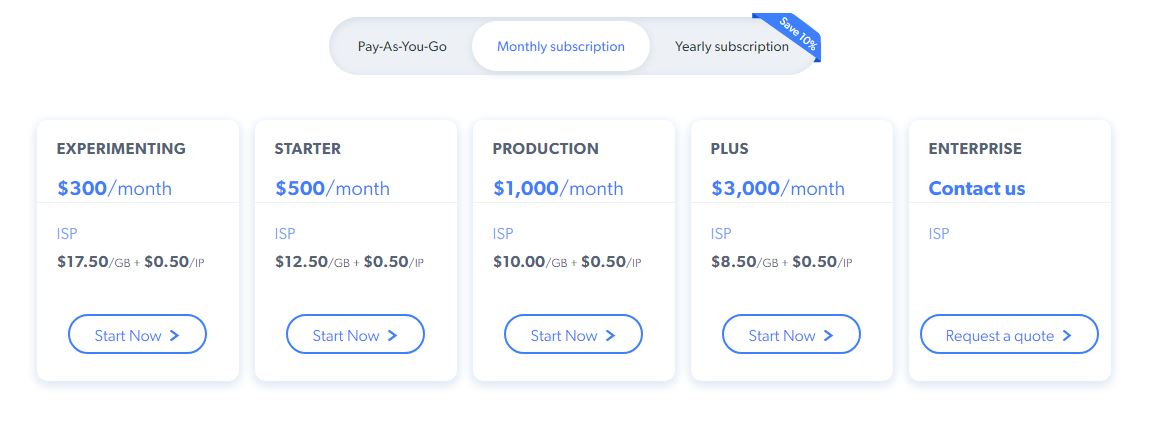
The table below compares all nine providers on ISP proxy pricing at the entry tier. Prices reflect confirmed data from brand knowledge files (scraped May 2026). All providers bill monthly unless noted.
| Provider | ISP Billing | Entry Price | ISP Pool | Locations | Trial/Guarantee |
|---|---|---|---|---|---|
| Bright Data | Per-IP/mo or Per-GB | $1.80/IP shared; $3.50/IP dedicated; $8/GB PAYG | 1.3M+ | ~50 countries | 7-day free (companies) |
| Decodo | Per-IP/mo or Per-GB | $0.27/IP shared; $2.10/IP dedicated; $1.30/GB Pay/GB | Premium ASNs | 16+ countries | 14-day money-back |
| Oxylabs | Per-IP/mo | $1.60/IP (10 IPs); $1.30/IP (100 IPs) | ~20 countries (self-service) | 20+ self-service; more via sales | 7-day free (companies) |
| NetNut | Per-GB/mo | $99/mo (7 GB, $14.40/GB) | 1M+ | 30+ countries | 7-day free (companies) |
| IPRoyal | Per-IP (24h/30d/60d/90d) | $1.80/proxy (24h); $2.70/proxy (30d) | 500K+ | 31+ countries | 24h refund option |
| SOAX | Unified plan credits or Per-IP (300+ min) | $90/mo (25 GB unified); Per-IP via sales (300 min) | 2.6M+ | Via unified plan | $1.99 paid trial (3d, 400MB) |
| Webshare | Per-IP/mo | $0.30/IP (20 IPs shared, $6/mo) | 100K+ | ~11 countries | Free datacenter plan |
| AstroProxy | Per-GB (residential only) | $7.30/GB prepaid; $0.10/port + per-10-MB PAYG | 50M+ residential (no ISP) | 100+ countries | Free test (contact support) |
| ProxyEmpire | Per-GB | $5.71/GB ($40/mo, 7 GB); $2.85/GB w/ PROMO50 | 30M+ residential + ISP | 195 countries | $1.97 trial (100 MB) |
Pricing note: ISP proxy rates improve significantly at scale. A $3.50/IP dedicated entry at Bright Data drops to $2.50/IP at 1,000 IPs. NetNut’s $14.40/GB entry drops to $4.50/GB at 1 TB. Always check the live pricing slider at the provider’s site before budgeting for ISP proxies. Promo codes listed (PROXYWAY60, PROXYWAY35%, PROMO50, proxyway35, PROXYWAY30) are subject to expiry — verify before purchasing.
ISP Proxy Pros & Cons: What to Expect from Static IP Proxies
ISP proxies solve a real problem — but they come with specific trade-offs worth understanding before you commit.
Pros ✓
- Residential-grade anonymity at datacenter speed: ISP ASN registration means platforms that block datacenter ranges let you through — while server-grade connectivity keeps response times under 0.3 seconds
- Static identity: The same IP for the life of your subscription — essential for account management, where IP rotation triggers suspension flags
- Unlimited bandwidth (most plans): Per-IP billing typically means no data caps — useful for high-volume, continuous tasks like price monitoring
- High uptime: Server-hosted IPs don’t go offline because a peer’s router rebooted — 99.9–99.99% uptime guarantees are realistic and verifiable
- Better performance on protected targets: Top ISP proxy providers achieve 85–100% success rates on Amazon, Google, and social platforms — well above what datacenter proxies manage on those targets
- Legitimate sourcing: Providers like NetNut (DiViNetworks) and Bright Data pay ISPs directly — no ethical ambiguity around consent
Cons ✗
- Higher price than datacenter: ISP proxies typically cost $1–3/IP/month versus $0.02–0.04/IP for datacenter shared proxies — 50–100x more expensive per IP
- Narrower location coverage: Even the largest ISP proxy networks cover 30–50 countries vs 195 for residential pools
- Not all IPs pass residential database checks: Webshare’s test showed only 36% of ISP IPs classified as residential by IP2Location; IPRoyal was 99% — your results depend on which provider’s ASNs you’re using
- Fewer subnets than residential: ISP proxy pools have far fewer /24 subnets than peer-to-peer residential networks, which matters for tasks that need high IP diversity
- Minimum commitments: Most providers require 30-day subscriptions; some require 300+ IP minimums (SOAX) for standalone ISP plans
Bottom Line: ISP proxies are worth the premium for any task that requires a stable, long-lived IP that passes residential trust checks. Account management, bot-protected scraping, and sneaker copping are the clearest use cases. For straightforward scraping of unprotected sites, datacenter proxies at $0.02–0.06/IP deliver the same results at a fraction of the cost.
Head-to-Head Comparisons
ISP proxy buyers typically come down to two decisions: enterprise scale vs performance value, and dedicated ISP vs budget shared. These two head-to-heads address both.
Bright Data vs Oxylabs — Enterprise ISP Proxies
| Feature | Bright Data | Oxylabs |
|---|---|---|
| ISP Pool Size | 1,300,000+ IPs | Not publicly quantified; 20+ self-service countries |
| ISP Countries | ~50 countries | ~20 (self-service); more via sales |
| Billing Options | Per-IP, Per-GB, PAYG (most flexible) | Per-IP only (no PAYG) |
| Dedicated ISP Self-Service | Yes — shared and dedicated | Yes — launched Feb 2026, 14 countries |
| Entry Price (Shared ISP) | $1.80/IP/month (10 IPs) | $1.60/IP/month (10 IPs) |
| Entry Price (Dedicated ISP) | $3.50/IP/month (10 IPs) | ~$2.10/IP/month |
| ISP Success Rate | 99.9% (advertised) | Not independently benchmarked for ISP |
| Trial | 7-day free (companies) | 7-day free (companies) |
| Compliance | ISO 27001, GDPR, TAG | EWDCI member, product insurance |
| Proxyway Rating | 9.3/10 | 9.3/10 |
Winner for ISP Pool Depth: Bright Data | Winner for Dedicated ISP Value: Oxylabs | Winner for Billing Flexibility: Bright Data | Winner for Compliance Documentation: Tie
Decodo vs IPRoyal — Performance vs Flexibility
| Feature | Decodo | IPRoyal |
|---|---|---|
| ISP Success Rate (Proxyway 2025) | 100% on 100 dedicated US IPs | 73.72% Amazon/Google combined |
| ISP Response Time | 0.22s avg (Proxyway 2025) | 3.14s avg (Proxyway 2025) |
| ISP Pool | Premium Verizon + AT&T ASNs | 500K+ IPs, AT&T, Verizon, Vodafone, Orange, etc. |
| ISP Locations | 16+ countries | 31+ countries (more coverage) |
| Minimum Commitment | 30 days | 24 hours |
| Entry Price | $0.27/IP/mo (shared); $3.33/IP (dedicated, 3 IPs) | $1.80/proxy (24h); $2.70/proxy (30d) |
| SOCKS5 with UDP | Yes | Yes |
| Billing Flexibility | 3 sub-types: Dedicated, Pay/GB, Shared | Duration-based: 24h, 30d, 60d, 90d |
| Guarantee | 14-day money-back | 24-hour refund option |
| Proxyway Rating | 9.3/10 | 8.5/10 |
Winner for ISP Performance: Decodo | Winner for Geographic Coverage: IPRoyal | Winner for Short-Term Commitments: IPRoyal | Winner for Value at Scale: Decodo
🏆 Choose Decodo or Bright Data When
- You need maximum ISP proxy performance on heavily protected targets (Nike, Amazon, social media)
- You’re running 30-day+ campaigns that justify monthly commitment
- You want PAYG or multiple billing options for ISP proxies
- You need enterprise compliance documentation and SLAs
🔍 Choose IPRoyal or Webshare When
- You need to test ISP proxies without a monthly commitment (IPRoyal 24h plans)
- You’re on a tight budget and want the lowest per-IP entry (Webshare from $0.30/IP)
- You need broader country coverage for ISP proxies (IPRoyal 31+ countries)
- You have moderate targets where top-tier performance isn’t critical
Best ISP Proxy Provider Ratings — Full Breakdown
We rated each provider on six criteria relevant to ISP proxy selection. Scores incorporate third-party benchmark data (Proxyway April 2025) where available, combined with ISP pool depth, pricing, feature set, and real-world success rate evidence.
| Provider | ISP Pool Quality | Performance | Price | Coverage | Ease of Use | Support & Docs | Overall |
|---|---|---|---|---|---|---|---|
| Bright Data | 4.9/5 | 4.7/5 | 3.2/5 | 4.9/5 | 3.8/5 | 4.7/5 | 4.6/5 |
| Decodo | 4.8/5 | 4.9/5 | 4.7/5 | 4.3/5 | 4.8/5 | 4.6/5 | 4.7/5 |
| Oxylabs | 4.6/5 | 4.6/5 | 3.5/5 | 4.2/5 | 4.0/5 | 4.6/5 | 4.4/5 |
| NetNut | 4.9/5 | 4.5/5 | 3.3/5 | 4.0/5 | 3.9/5 | 4.4/5 | 4.3/5 |
| IPRoyal | 4.0/5 | 3.6/5 | 4.3/5 | 4.5/5 | 4.3/5 | 4.3/5 | 4.1/5 |
| SOAX | 4.5/5 | 4.2/5 | 4.0/5 | 4.0/5 | 4.1/5 | 4.3/5 | 4.2/5 |
| Webshare | 3.6/5 | 4.5/5 | 4.9/5 | 3.0/5 | 4.5/5 | 3.5/5 | 4.0/5 |
| AstroProxy | 3.2/5 | 3.5/5 | 4.2/5 | 4.0/5 | 4.2/5 | 3.7/5 | 3.8/5 |
| ProxyEmpire | 3.5/5 | 3.5/5 | 4.3/5 | 4.8/5 | 4.0/5 | 3.6/5 | 3.9/5 |
Rating Summary: Decodo leads overall on performance and value — the only provider in this list to achieve a perfect ISP success rate in independent benchmarks. Bright Data leads on pool depth, location coverage, and enterprise compliance. NetNut holds a structural advantage through its DiViNetworks ISP backbone that no other provider replicates. Webshare wins on price-per-IP but loses ground on coverage and residential classification quality. IPRoyal and SOAX serve mid-market needs with useful flexibility features (24-hour commitments and unified plans respectively). AstroProxy and ProxyEmpire round out the list as alternatives for budget-conscious buyers, though AstroProxy’s lack of a true static ISP product is a notable gap.
Are ISP Proxies Legit, Safe & Worth the Cost?
Legitimacy & Safety
- ✓ Legal commercial product: ISP proxies are sold as legitimate commercial products by established companies. Using them for business data collection, account management, and web scraping is legal in most jurisdictions. The proxy itself is an intermediary tool — what you do with it determines legality.
- ✓ Ethical sourcing pathways exist: NetNut’s DiViNetworks pays ISPs directly for bandwidth. Bright Data operates with ISO 27001 certification and explicit KYC. Decodo and Oxylabs are EWDCI members. These providers can document their IP sourcing — important for enterprise procurement approval.
- ✓ Well-established providers: Bright Data (founded 2014), Oxylabs (2015), and Decodo/Smartproxy (2018) have decade-long operating histories. NetNut’s parent Alarum Technologies is publicly listed on NASDAQ (ALAR).
- ✓ Terms of Service compliance: Quality ISP proxy providers enforce acceptable use policies. Bright Data has notably strict KYC and will reject applications for questionable use cases — this actually benefits enterprise buyers who need compliance cover.
Long-Term Reliability
ISP proxy providers as a category have proven durable. The top six providers in this list have collectively served millions of business customers without notable outages or sudden shutdowns. NetNut’s public company structure (NASDAQ: ALAR) adds financial transparency. Bright Data’s 20,000+ business customers including Fortune 500 companies means the company has strong financial incentives to maintain service continuity.
Reality check: Not all ISP proxies are created equal. The “static residential” or “ISP proxy” label doesn’t guarantee that the IP will pass advanced anti-bot detection. Only ISP proxies registered under real consumer ISP ASNs (Verizon, AT&T, BT, Comcast) consistently fool sophisticated detection systems. Some lower-tier providers sell server IPs registered under regional or commercial ISPs that IP databases already classify as non-residential. Test your target-specific success rate before scaling a budget — don’t assume the label equals performance.
Worth It? Final Verdict
YES — ISP Proxies Are Worth It If:
- You manage multiple accounts on platforms that block datacenter IPs but require stable, consistent IP identity
- Your scraping targets (Amazon, Nike, Ticketmaster, LinkedIn) actively block datacenter ASN ranges
- You need unlimited bandwidth without paying per-GB residential rates
- Your use case requires long-lived IP sessions (sneaker copping, price monitoring, account warmup)
- You need compliance-grade proxy infrastructure for enterprise procurement
NO — Look Elsewhere If:
- Your targets are unprotected — datacenter proxies at $0.02/IP are 100x cheaper for the same result
- You need IP rotation across thousands of unique addresses daily — residential proxies provide far more IP variety
- Your budget is zero — there’s no legitimate free ISP proxy service
- You need 200+ countries — ISP networks simply don’t cover that
Our Recommendation: ISP proxies are worth the premium for any task that requires consistent, residential-trusted IP identity. Start with Decodo’s 14-day money-back guarantee or IPRoyal’s 24-hour plan to test ISP performance on your actual target before committing to a monthly plan. For enterprise-grade ISP proxies with the broadest coverage and strongest compliance credentials, Bright Data’s 7-day company trial gives you real data without immediate financial commitment.
Best ISP Proxy Providers — FAQs
What is an ISP proxy?
An ISP proxy is an IP address hosted on a data center server but registered under a consumer internet service provider (ISP) like AT&T, Verizon, or Comcast. This gives it the speed and reliability of a dedicated server combined with the residential-grade trust level of a home broadband connection. Websites see the ISP’s ASN instead of a cloud hosting company’s range, so anti-bot systems treat it as legitimate residential traffic. ISP proxies are also called “static residential proxies” — the two terms refer to the same product type.
How are ISP proxies different from residential proxies?
The key differences are stability, speed, and pricing model. Residential proxies rotate through real peer devices — home users who share their bandwidth. This gives you massive IP variety (millions of unique addresses) but makes long-term stability impossible, since a peer’s router can go offline anytime. ISP proxies are server-hosted, so they’re always online and you keep the same IP for your entire subscription. They’re also faster (server-grade connectivity) and typically priced per-IP with unlimited bandwidth, versus per-GB for residential. The trade-off: ISP proxy pools are smaller and cover fewer countries than residential networks.
How are ISP proxies different from datacenter proxies?
The ASN. Both datacenter and ISP proxies are server-hosted, giving them similar speed and uptime. The difference is how they’re registered. Datacenter IPs are owned by cloud hosting companies (AWS, Azure, OVH) whose ASNs are widely known and blocked by anti-bot systems on major sites. ISP proxies are registered under consumer ISPs (AT&T, Verizon), making them look like home broadband connections to those same anti-bot systems. On protected targets like Amazon, Nike, or LinkedIn, ISP proxies achieve 85–100% success rates; datacenter proxies on the same targets often achieve 5–30%.
What are ISP proxies best used for?
The clearest use cases are:
- Account management — managing multiple social media or e-commerce accounts that require a stable, consistent IP
- Sneaker copping — purchasing limited-release products on Nike, Adidas, or Footlocker where speed matters and datacenter IPs get blocked
- Scraping protected targets — Amazon, LinkedIn, Glassdoor, and other sites that aggressively block datacenter ranges
- Ad verification — checking ad placement from specific locations with stable, trusted IPs
- Price monitoring — continuous tracking on retail sites where unlimited bandwidth makes per-IP billing cost-effective
Which ISP proxy provider has the best performance?
Based on Proxyway’s April 2025 independent benchmark, Decodo achieved 100% success rate and 0.22-second response time on 100 dedicated US ISP IPs — both from Verizon and AT&T ASNs. Webshare showed 85.97% success on Amazon and Google combined with an impressive 23.77 MB/s download speed. Bright Data advertises a 99.9% ISP success rate. IPRoyal’s ISP proxies underperformed in Proxyway testing at 73.72% on Amazon/Google combined — fine for mid-tier targets but not for the most protected domains.
Are ISP proxies worth the extra cost vs datacenter proxies?
It depends on your target. For unprotected sites that don’t actively block datacenter IPs, ISP proxies are unnecessary — you’re paying 50–100x more per IP for the same result. For sites that specifically check ASN reputation (Amazon, Nike, most social platforms), datacenter proxies fail and ISP proxies succeed. A simple test: try your datacenter proxies on your actual target first. If you’re getting blocked, ISP proxies are worth the upgrade. If not, save the money.
How much do ISP proxies cost?
Entry-level pricing varies significantly by model:
- Per-IP (shared): From $0.27/IP/month (Decodo) to $1.80/IP/month (Bright Data Starter)
- Per-IP (dedicated): From ~$2.10/IP/month (Oxylabs) to $3.50/IP/month (Bright Data 10-IP tier)
- Per-GB: From $1.30/GB (Decodo Pay/GB 2,000 GB tier) to $14.40/GB (NetNut Starter)
- Short-term: IPRoyal offers 24-hour access from $1.80/proxy
At scale (100–1,000 IPs), prices converge in the $1.30–2.50/IP/month range across most major providers.
Can I use ISP proxies for web scraping?
Yes — ISP proxies are well-suited for web scraping, especially on protected targets. They’re less commonly used for bulk scraping than residential proxies because the per-IP model makes them expensive when you need thousands of unique IPs for large-scale crawls. But for scraping a fixed set of well-protected targets (Amazon product pages, retail pricing, LinkedIn data) where you need reliable access over time, ISP proxies are the most cost-efficient option. Pair them with rotating residential proxies for URL discovery and use ISP proxies for the actual data extraction.
What countries are covered by ISP proxies?
Coverage varies by provider. Bright Data covers ~50 countries for ISP proxies — the widest in this list. NetNut covers 30+ countries (primarily US and Europe). IPRoyal covers 31+ countries and 33 locations, making it one of the more geographically diverse options. Decodo dedicated ISP covers 16+ countries including US, Canada, major EU markets, and select APAC. Webshare has the narrowest coverage at ~11 countries. For most ISP proxy use cases (account management on US/EU platforms, US retail scraping), these coverage levels are sufficient.
Do ISP proxies support SOCKS5?
Most do. Bright Data, Decodo, Oxylabs, NetNut, and IPRoyal all support HTTP, HTTPS, and SOCKS5 for their ISP proxies. IPRoyal and Decodo both explicitly support SOCKS5 with UDP — useful for tools that require non-HTTP traffic. SOAX supports SOCKS5 with UDP plus QUIC across its unified plan. Check the specific ISP proxy product page for your chosen provider, as protocol support can differ between shared and dedicated ISP tiers.
Is there a free trial for ISP proxies?
The best available options:
- Bright Data: 7-day free trial for verified companies
- Oxylabs: 7-day free trial for verified businesses
- NetNut: 7-day free trial for company customers
- Decodo: 14-day money-back guarantee on first purchase (conditions apply)
- IPRoyal: 24-hour refund option — you can test for one day
- Webshare: Permanent free datacenter plan (10 IPs) to test setup, then upgrade to ISP
- SOAX: $1.99 paid trial (3 days, 400 MB)
Should I choose per-IP or per-GB pricing for ISP proxies?
Use per-IP pricing if your task involves unlimited or high-volume data through a fixed set of IPs. Account management, continuous price monitoring, and sneaker copping are all high-bandwidth tasks where per-IP unlimited pricing is dramatically cheaper than paying per GB. Use per-GB pricing if you need ISP-quality IPs but don’t know your exact traffic volume in advance, or if you only need ISP proxies occasionally and want to avoid committing to multiple IP slots. Decodo’s Pay/GB ISP option starts at $1.30/GB (2 TB tier) — competitive with residential proxies at scale.
Final Verdict
ISP proxies are the right tool when you need a stable, residential-trusted IP that doesn’t go offline — and you need it to perform on targets that actively block datacenter ranges. The nine providers in this list cover every budget and use case, but they’re not interchangeable. Decodo delivers the strongest benchmark performance. Bright Data offers the largest ISP pool with the most billing flexibility. NetNut’s DiViNetworks backbone is structurally unique. Webshare is the most affordable entry. IPRoyal is the only provider offering 24-hour commitments. Your best pick depends on your target, your volume, and how long you need to hold each IP.
✓ Top Picks
- Bright Data — Best overall: largest ISP pool, most locations, full billing flexibility, enterprise compliance
- Decodo — Best performance: 100% success rate, 0.22s response time, AT&T + Verizon ASNs confirmed
- NetNut — Best ISP backbone: DiViNetworks direct one-hop, 1M+ always-online IPs, NASDAQ-listed parent
- Oxylabs — Best for enterprise: dedicated ISP self-service (Feb 2026), product insurance, account managers
- Webshare — Best budget: from $0.30/IP/month, fastest download speed tested (23.77 MB/s)
- IPRoyal — Best flexibility: 24-hour ISP plans, 31+ countries, no monthly commitment required
✗ When to Look Elsewhere
- Your targets are open to datacenter IPs — ISP proxies are overkill at 50–100x the cost
- You need millions of rotating unique IPs — residential networks have far more pool diversity
- Budget is zero — there’s no legitimate free ISP proxy service (free datacenter proxies exist but fail on protected targets)
- You need 100+ countries — ISP networks max out at 30–50 locations even from the largest providers
Ready to Get Started with ISP Proxies?
Bright Data offers the largest ISP proxy pool in the market — 1.3M+ static IPs across 50+ countries with shared, dedicated, and PAYG billing. Use code PROXYWAY60 for 60% off your first order.
Try Bright Data ISP Proxies — Best ISP Pool in 2026 →