
Kameleo Review:
The Best Antidetect Browser for Multi-Accounting?
This Kameleo review covers its custom browser engines, fingerprint spoofing, mobile emulation, and local API — is it worth €59–€1,499/mo in 2026?
⚡ Quick Verdict
Kameleo is a technically serious antidetect browser built around two custom browser engines, real-world fingerprint data, and a local API that works with Selenium, Puppeteer, and Playwright. It runs entirely on your own hardware — no cloud dependency, no profile data leaving your machine — and offers a free tier with no credit card required. Mobile emulation (Android and iOS from a desktop PC) sets it apart from most competitors. The main tradeoff is cost: the Business plan at €299/month (or €225/month annual) unlocks the full mobile feature set, which is a meaningful jump from the €59/month Startup plan.
Web scrapers, multi-account managers, affiliate marketers, automation developers
You have ten accounts on the same platform and every time you log into more than two of them on a single device, the platform starts banning them. Or you’re running web scraping jobs and Cloudflare blocks you after the first hundred requests. Or you need to test your ad creative from a mobile device in a different country — without owning a phone from that country. This Kameleo review answers whether this antidetect browser solves all three problems.
Standard browsers weren’t built for any of this. Incognito mode doesn’t help. VPNs change your IP address but do nothing about the unique browser fingerprint that sites use to recognize you across sessions and devices.
This is the problem antidetect browsers solve. They let you create isolated browser profiles, each with a distinct, realistic fingerprint, so sites see them as completely different users on completely different devices.
Kameleo is one of the more technically credible options in this space. It doesn’t patch an existing browser — it runs two custom-built engines. It draws fingerprints from real-world devices rather than generating synthetic ones. And it lets you automate everything through a documented local API without your session data ever touching a third-party cloud.
That combination is rare. But it also costs money. This review breaks down exactly what you get at each price point and whether the technical depth justifies the premium over cheaper alternatives.
What Is Kameleo?
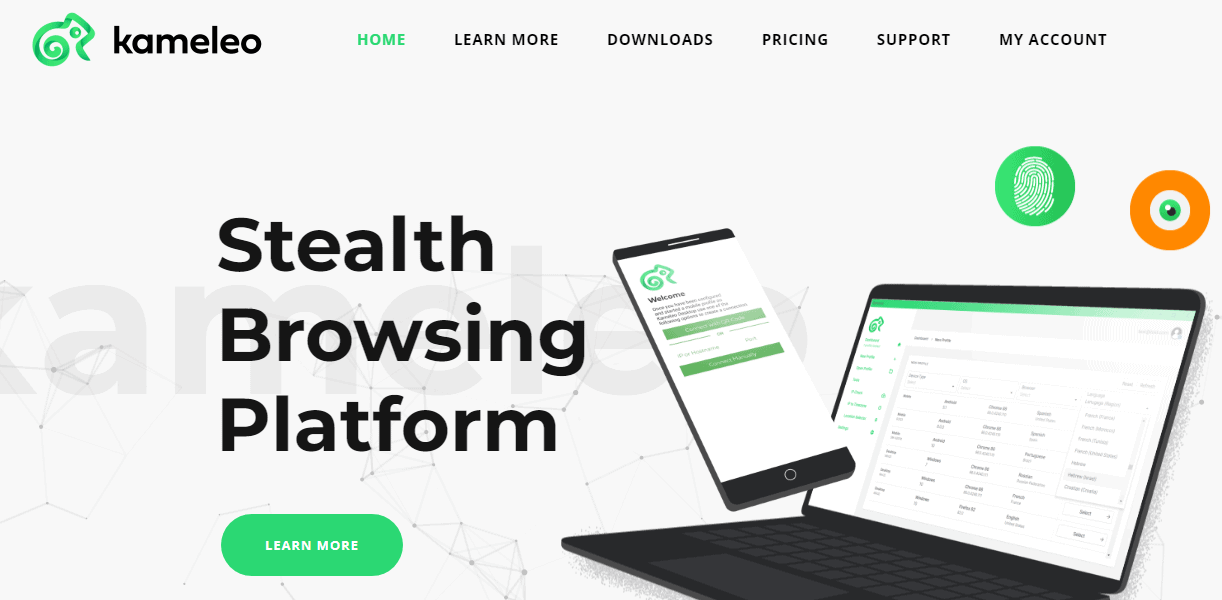
Kameleo is an antidetect browser — a desktop application that lets you create and manage multiple browser profiles, each with an independent, spoofed browser fingerprint. It is built by Outis Nemo Ltd., a company founded by software engineers with over a decade of IT security experience. The software is designed to defeat anti-bot detection systems including Cloudflare, DataDome, Human Security (PerimeterX), and Akamai.
Where most antidetect browsers modify the fingerprint parameters of an existing browser like Chrome, Kameleo takes a different approach. Its core capabilities include:
- Two custom-built browser engines: Chroma (Chromium-based, emulates Chrome, Edge, Safari, and mobile profiles) and Junglefox (Firefox-based, supports Playwright)
- Fingerprints drawn from millions of real-world user devices — not synthetically generated
- Per-profile proxy assignment (HTTP, HTTPS, SOCKS5, SSH)
- Mobile device emulation — simulate Android and iOS devices from a desktop PC, no physical hardware required
- A local REST API for programmatic profile control, compatible with Selenium, Puppeteer, and Playwright
- Team collaboration with role-based access (Admin, Analyst, Member) and session locking
- Docker support for containerized, scalable automation deployments
- Daily automated end-to-end stealth tests on 100+ protected websites, with results published in a public Masking Status Report
Company Background & Development Focus
Kameleo’s GitHub organization has accumulated 1,500+ stars across its open repositories, reflecting a developer-leaning user base. The team ships new Chroma kernel versions within 5 days of each official Chrome Stable release — a deliberate commitment to keeping fingerprints matched to the real-world distribution of browser versions that sites see. Junglefox releases follow roughly every 8 weeks, aligned with Firefox’s release cadence.
The platform runs entirely on-premise. Your profiles, cookies, and browsing history live on your own device or server — none of it transits through Kameleo’s infrastructure. For teams with data sensitivity requirements, that architecture is a meaningful differentiator from cloud-based antidetect browsers.
Who Is Kameleo For?
✓ Ideal Users
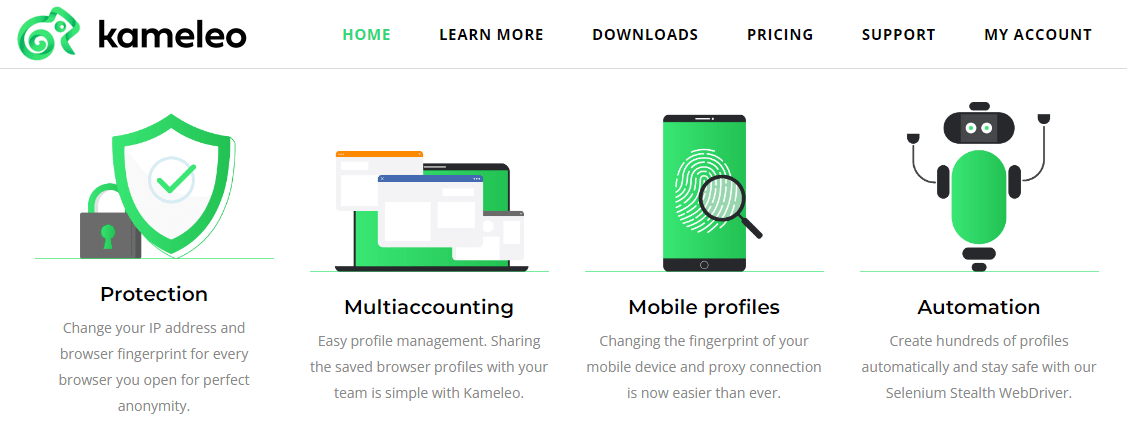
Kameleo is purpose-built for professionals who need persistent multi-profile isolation and either API-level automation or mobile fingerprinting. The users who get the most from it:
- Web scrapers and data engineers — Need to run high-volume scraping jobs against Cloudflare- or DataDome-protected sites without getting blocked. Kameleo’s daily-tested stealth mode and Selenium/Puppeteer/Playwright compatibility make it a natural fit. Some customers run up to 1.2 million browser instances per day on the platform.
- Multi-account managers — E-commerce sellers managing multiple Amazon or eBay stores, social media managers running dozens of accounts, and agencies managing client accounts across platforms. Each Kameleo profile isolates cookies, localStorage, and fingerprints completely.
- Affiliate marketers and ad buyers — Run ad verification tasks, test creative from different geo/device combos, or operate multiple affiliate accounts without cross-contamination. Mobile profile emulation is especially valuable for platforms like TikTok and Instagram that skew mobile.
- Automation and DevOps teams — The local REST API (OpenAPI-documented) and Docker support make Kameleo deployable as part of a containerized automation stack. SDKs exist for Python (PyPI), JavaScript/Node.js (NPM), and C# (NuGet).
- Security researchers — Test how detection systems respond to different fingerprint configurations using the live Masking Status Report and real browser engine diversity.
✗ Not Ideal For
Skip Kameleo if you:
- Only need basic privacy browsing — a regular VPN is simpler and cheaper
- Need cloud-synced profiles accessible from multiple machines simultaneously (Kameleo is local-first)
- Want built-in proxy bandwidth included in your subscription price (Kameleo requires your own proxy provider)
- Have a hard budget under €59/month and need features beyond the Free plan’s 2 concurrent browsers and 300-minute time limit
- Primarily use Linux as your desktop OS (Windows is the primary supported desktop platform)
Kameleo Antidetect Browser: Features & What You Get
Kameleo’s feature set divides into five main areas: the browser engines themselves, fingerprint masking, profile management, automation, and team tools. Here’s what each one delivers in practice.
Two Custom Browser Engines
Most antidetect browsers ship a patched version of Chrome. Kameleo built two separate engines from scratch:
- Chroma — Chromium-based. Emulates Chrome, Microsoft Edge, Safari, and both Android and iOS mobile profiles. New kernel versions are released within 5 days of each Chrome Stable update, so your profiles always match the version distribution that real users generate.
- Junglefox — Firefox-based. Supports Playwright in addition to Selenium and Puppeteer — a distinction that matters for teams already using Playwright in their CI pipelines. New releases follow Firefox’s approximately 8-week cadence.
Both engines support multikernel: Kameleo automatically fetches the specific kernel version that matches each profile’s fingerprint, so a profile configured as “Chrome 118 on Windows 10” actually runs on the corresponding kernel.
Fingerprint Masking
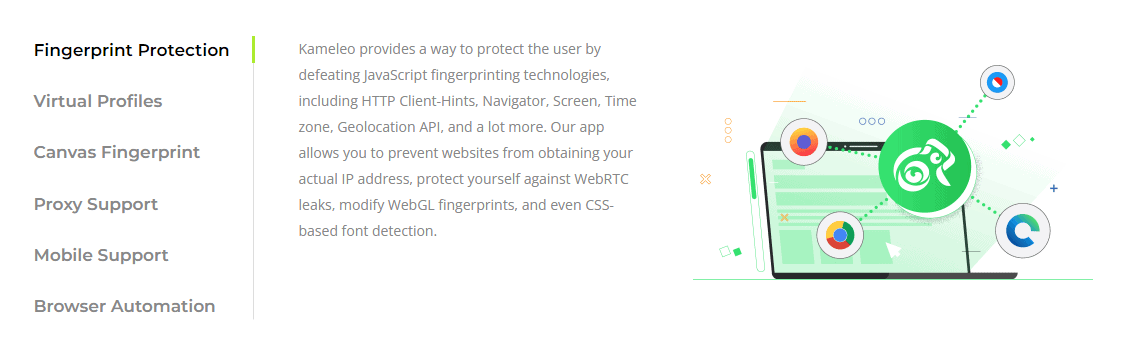
Kameleo masks the full set of parameters that modern detection systems check:
- Canvas and WebGL rendering (using proprietary Intelligent Canvas Spoofing technology)
- AudioContext, screen size and DPI, hardware concurrency, memory, and device pixel ratio
- User-agent, operating system, browser version, platform
- Locale, language, and timezone
- WebRTC IP handling and TCP/IP fingerprint
- Installed fonts, browser plugin list, and media device enumeration
What is Intelligent Canvas Spoofing? Canvas fingerprinting works by drawing an invisible image in your browser and reading the pixel data — variations in GPU rendering make each device produce a slightly different result. Traditional antidetect browsers block this entirely (which itself looks suspicious) or inject random noise. Kameleo’s approach mimics the way real browser/GPU combinations actually render canvas operations, making the output look indistinguishable from a genuine device.
Fingerprints are drawn from a database of millions of real-world devices rather than constructed synthetically. A profile that looks like “Chrome 124 on a MacBook Pro (macOS Ventura)” actually uses canvas, WebGL, and AudioContext data sampled from real machines running that configuration.
Mobile Device Emulation (Business & Enterprise)
This is Kameleo’s most distinctive feature relative to competitors at similar price points. On Business and Enterprise plans, you can simulate thousands of distinct Android and iOS device configurations from a desktop PC:
- Full fingerprint masking for mobile parameters: screen size, DPI, user-agent, hardware specs, locale
- Persistent session storage — cookies, history, and logins survive profile restarts
- Mobile profiles can be automated via Puppeteer, Playwright, or the Local API
- No physical Android or iOS device required
Free and Startup plans can run 1 mobile profile at a time (useful for testing). Full unlock requires Business (€299/month or €225/month annual).
Local API and Automation
When you launch Kameleo on your machine, a local REST API starts alongside it. You can create profiles, start and stop browsers, manage cookies, and read status — all programmatically. The API is documented with OpenAPI standards and available at developer.kameleo.io.
- SDKs: Python (PyPI:
kameleo.local-api-client), JavaScript/Node.js (NPM:@kameleo/local-api-client), C# (NuGet:Kameleo.LocalApiClient) - Framework support: Selenium, Puppeteer, Playwright (including Playwright on Junglefox)
- Headless mode available on Business and Enterprise plans
- Docker-ready for containerized deployments
- API rate limits: 60 req/min (Free), 120 (Startup), 600 (Business), 1,200 (Enterprise)
Team Collaboration and Profile Management
- Unlimited local profile storage on all plans (storage only limited by your device disk space)
- Cloud profiles: 100 (Free), 5,000 (Startup, Business, Enterprise)
- Import and export profiles and cookies
- Organize cloud profiles into named groups
- Role-based access: Admin, Analyst, Member
- Session lock — prevents two users from opening the same profile simultaneously
- Team size: up to 3 members (Free), unlimited (paid plans)
How Kameleo Works (Step-by-Step)
Getting from signup to a running stealth browser profile takes under 15 minutes. Here’s the full workflow:
Step 1: Register and Choose a Plan
Go to kameleo.io and click the pricing page. The Free plan requires no credit card — register with an email address and you’re in. Paid plans can be purchased with Visa, Mastercard, Bitcoin, Ethereum, USDC, Alipay, or bank transfer. Once your subscription is active, download the Kameleo desktop installer from the account dashboard.
Step 2: Install and Log In
Run the installer on your Windows PC. Launch the application and log in with your account credentials. On first run, Windows will prompt for a firewall exception — approve it, since Kameleo’s local API needs to bind to a port on your machine. The application launches in seconds.
Step 3: Create a New Browser Profile
Click “New Profile” in the dashboard. Select the device type (desktop or mobile), operating system (Windows, macOS, Linux, Android, iOS), browser (Chrome, Firefox, Edge, Safari), and language. Kameleo presents matching real-world fingerprint options from its database. Select one that fits your target audience and confirm.
Step 4: Assign a Proxy (Optional but Recommended)
Open the profile’s proxy settings. Enter your proxy credentials — HTTP, HTTPS, SOCKS5, or SSH are all supported. Kameleo does not supply proxy bandwidth, so you’ll need your own proxy provider. Matching your proxy’s geo-location to the profile’s locale (language, timezone) makes the combination significantly more convincing to detection systems.
Step 5: Launch and Browse (or Automate)
Click Start on the profile. A new browser window opens — it looks and behaves like a standard Chrome or Firefox window, but the fingerprint it presents to websites matches the profile you configured. For automation, connect your Selenium/Puppeteer/Playwright script to the local API endpoint that Kameleo exposes for that profile. Your script controls the browser while fingerprint integrity is maintained throughout the session.
Bottom line: The process requires no coding knowledge for manual use. For developers, the local API means you can start a profile and attach an automation framework in under 10 lines of code, according to Kameleo’s own docs — and the SDK packages handle the boilerplate for you.
Kameleo Pricing & Plans
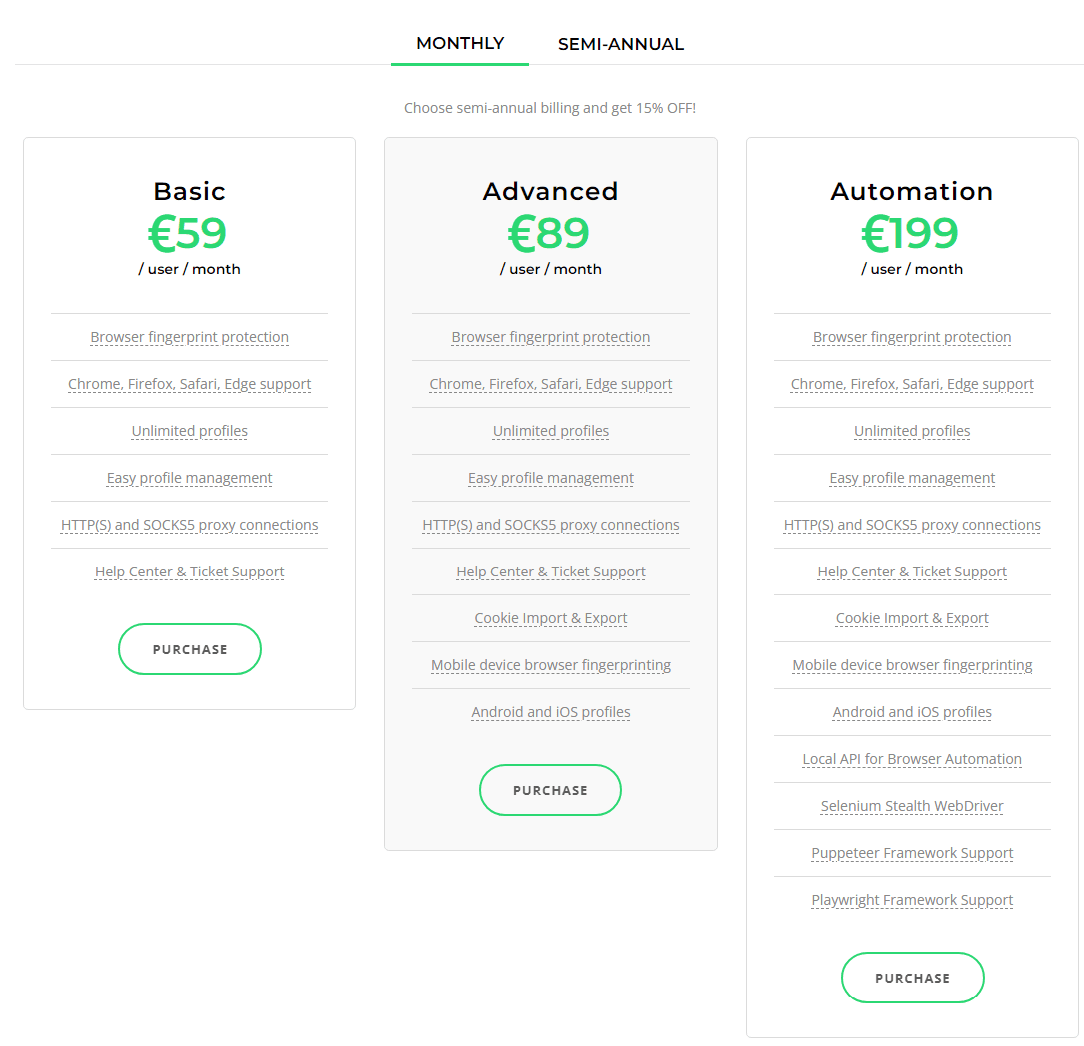
Kameleo offers four plans. Annual billing saves approximately 25% compared to monthly. All prices are in euros.
| Feature | Free | Startup | Business | Enterprise |
|---|---|---|---|---|
| Monthly price | €0 | €59/mo | €299/mo | €1,499/mo |
| Annual price | €0 | €45/mo | €225/mo | €1,125/mo |
| Concurrent browsers (default) | 2 | 10 | 100 | 1,000 |
| Browser usage time | 300 min/mo | Unlimited | Unlimited | Unlimited |
| Cloud profiles | 100 | 5,000 | 5,000 | 5,000+ |
| Team members | 3 | Unlimited | Unlimited | Unlimited |
| Mobile emulation | 1 at a time | 1 at a time | Full unlock | Full unlock |
| Headless browser mode | No | No | Yes | Yes |
| API rate limit (req/min) | 60 | 120 | 600 | 1,200 |
| CTO strategy call | No | No | No | 60 min |
Important pricing notes:
- The concurrent browser count is adjustable via a slider on the pricing page — the numbers above are defaults. More concurrent browsers costs more; verify the current per-seat pricing at kameleo.io/pricing.
- Kameleo does not include proxy bandwidth. You need your own proxy provider and pay for that separately.
- Headless mode and full mobile emulation require Business (€299/mo or €225/mo annual) — this is the biggest feature gate in the pricing structure.
- The Free plan’s 300-minute monthly browser usage cap effectively limits it to testing and evaluation, not production use.
Payment methods accepted: Visa, Mastercard, Bitcoin (BTC), Ethereum (ETH), USDC, Alipay, and bank transfer (minimum €1,000 for wire; activation takes up to 2 business days).
Refund and trial policy: The Free plan (€0) serves as the permanent free tier — no credit card required, no trial period that expires. No explicit refund policy details were captured from the site; check help.kameleo.io or the terms at kameleo.io/terms-conditions before purchasing a paid plan.
Kameleo Review: Pros & Cons
Pros ✓
- Two genuinely custom browser engines — not patched Chrome, but modified at the kernel level. Multikernel support keeps fingerprints accurate to real version distribution.
- Real-world fingerprint database — fingerprints drawn from actual devices, not synthetically generated. Intelligent Canvas Spoofing mimics real GPU rendering behavior.
- Free plan with no credit card — 2 concurrent browsers and 100 cloud profiles at €0 makes it easy to evaluate before committing.
- Full local API with SDKs — Python, Node.js, and C# packages. Playwright support including on the Firefox-based Junglefox engine, which is uncommon among competitors.
- Mobile emulation from desktop — simulate thousands of Android and iOS device configurations without physical hardware (Business+ only).
- On-premise architecture — all profile data stays on your own hardware. No dependency on Kameleo’s servers for day-to-day operation.
- Docker support — deploy containerized headless automation at scale.
- Transparent Masking Status Report — daily automated test results against Cloudflare, DataDome, Human Security, and Akamai, published publicly.
- No device limit — run on as many machines and servers as you need at no extra cost.
- Active development cadence — Chroma kernel updates within 5 days of Chrome Stable; 1,500+ GitHub stars.
Cons ✗
- Steep jump from Startup to Business — full mobile emulation and headless mode cost €299/month (or €225/month annual), a 5x increase over the Startup plan.
- No built-in proxy bandwidth — GoLogin includes 2 GB residential proxy traffic on paid plans; Multilogin includes bonus GB with every tier. With Kameleo, you pay separately for proxies.
- Free plan is capped at 300 minutes/month — practical only for evaluation, not real work.
- No cross-device cloud sync — profiles live locally. Sharing requires manual export/import unless you use cloud profiles, which are capped at 5,000.
- No phone support — support is via email, tickets, and Discord. Knowledge base is extensive but response time isn’t guaranteed except at higher tiers.
- Windows primary; macOS secondary — Linux desktop is not a supported OS for the main application (Docker-based deployment is an option for Linux servers).
Bottom Line: Kameleo earns its premium price through genuine technical differentiation — custom engines, real fingerprint data, and local architecture. The main friction is that its most valuable features (mobile emulation, headless mode) are locked behind a tier that costs €299/month. Teams that can justify that spend will find it hard to find a more technically serious option. Developers on a budget should evaluate whether GoLogin or Multilogin’s lower entry points make more sense for their specific workload.
Kameleo vs GoLogin vs Multilogin: Head-to-Head
GoLogin and Multilogin are the two most direct competitors in terms of positioning and use cases. Here’s how the three tools stack up on the dimensions that matter most.
Kameleo vs GoLogin
For a deeper look at GoLogin on its own merits, see our full GoLogin review.
| Feature | Kameleo | GoLogin |
|---|---|---|
| Free plan | Yes — 2 concurrent browsers, 100 cloud profiles | Yes — 3 browser profiles, no time limit |
| Starting paid price | €59/mo (Startup monthly) / €45/mo (annual) | $49/mo (Professional monthly) / $24/mo (annual) |
| Browser engines | 2 custom (Chroma + Junglefox) | Orbita (patched Chromium) |
| Firefox / Playwright support | Yes (Junglefox) | No native Firefox engine |
| Mobile emulation | Full (Business+); limited testing on Free/Startup | Android profiles available; iOS limited |
| Built-in proxy bandwidth | None — bring your own | 2 GB residential included on paid plans |
| Cloud profile sync | Up to 5,000 cloud profiles | Cloud-first; up to 10–10,000 profiles by plan |
| Headless mode | Business+ only | Available across plans |
| On-premise architecture | Yes — all data stays local | Cloud-based infrastructure |
| API rate limit (top plan) | 1,200 req/min (Enterprise) | 1,200 req/min (Custom) |
| Trial | Free plan (permanent, no card) | 7-day free trial (no card required) |
| Overall rating | 4.3/5 | 4.8/5 (G2, 70 reviews) |
Winner for Firefox/Playwright: Kameleo | Winner for Entry Price: GoLogin ($24/mo annual vs €45/mo) | Winner for Built-in Proxies: GoLogin | Winner for Local Architecture: Kameleo | Winner for Ease of Start: Tie (both have free plans, no card)
Kameleo vs Multilogin
Read our standalone Multilogin review for a detailed breakdown of its pricing, engines, and mobile features.
| Feature | Kameleo | Multilogin |
|---|---|---|
| Free plan | Yes (permanent, no card) | No — $2 paid trial (3 days) |
| Starting paid price | €59/mo (Startup monthly) / €45/mo (annual) | $11/mo (Pro 10 monthly) / ~$7.08/mo (annual) |
| Browser engines | Chroma (Chromium) + Junglefox (Firefox) | Mimic (Chromium) + Stealthfox (Firefox) |
| Fingerprint parameters | Full suite incl. Intelligent Canvas Spoofing | 55+ customizable parameters |
| Mobile emulation | Business+ (Android + iOS) | Cloud Phones + Virtual Phones (real Android) |
| Built-in proxy bandwidth | None | 1–5 GB bonus/month by plan; 150+ countries |
| Headless mode | Business+ only | Available |
| On-premise architecture | Yes | Cloud-based; local profiles available |
| 9+ years in market | No (founded by 10+ yr IT security veterans) | Yes (9 years explicitly stated) |
| G2 rating | Not captured | 4.8/5 |
| Entry profiles | Unlimited local + 100 cloud (Free) | 10 profiles ($11/mo) |
Winner for Price: Multilogin ($11/mo vs €59/mo at entry paid tier) | Winner for Free Access: Kameleo (permanent free plan vs $2 trial) | Winner for Local Architecture: Kameleo | Winner for Built-in Proxies: Multilogin | Winner for Real Mobile Devices: Multilogin (Cloud Phones with real Android hardware)
🏆 Choose Kameleo When:
- You need Firefox/Playwright support (Junglefox engine is a genuine differentiator)
- Data privacy is paramount and you cannot have profiles transiting third-party cloud infrastructure
- You’re running Docker-based headless automation at scale (Business+)
- You want a permanent free tier to evaluate before committing any budget
- You need mobile Android and iOS emulation from a single desktop machine at scale
- You value the Masking Status Report as a transparency/verification tool
🔍 Choose Competitors When:
- Your budget is under €45/month — GoLogin’s $24/month annual plan covers solid functionality
- You want built-in proxy bandwidth included in the subscription price (GoLogin, Multilogin)
- You need genuine cloud-synced profiles accessible from multiple machines without manual export
- You want real physical Android devices for mobile testing (Multilogin Cloud Phones)
- You need headless mode at the entry paid tier without jumping to €299/month
Ratings Breakdown
Here’s our category-by-category evaluation based on feature depth, real-world use feedback, and comparison against competing tools at similar price points:
| Category | Score | Notes |
|---|---|---|
| Fingerprint Quality | 4.7/5 | Real-world fingerprint database + Intelligent Canvas Spoofing. Daily automated tests on 100+ protected sites with public results. Multikernel support is technically strong. |
| Ease of Use | 4.0/5 | Clean UI for manual profile management. Steeper learning curve than cloud-based tools for automation setup. Extensive knowledge base and video docs help. |
| Pricing & Value | 3.8/5 | Free plan is generous for evaluation. Startup (€59/mo) covers most manual use cases well. Business (€299/mo) is a steep jump and excludes built-in proxies — competitors include proxy bandwidth at lower prices. |
| Automation & API | 4.6/5 | Local REST API with SDKs in three languages. Selenium, Puppeteer, and Playwright all supported, including Playwright on Firefox. Docker support. Best API among tools reviewed. |
| Mobile Emulation | 4.4/5 | Thousands of real Android and iOS configurations. No physical device required. Locked to Business+ which is the main friction — but the feature itself is technically solid. |
| Support & Documentation | 3.9/5 | Detailed knowledge base, developer.kameleo.io, Discord community. No phone support. Tech-savvy support team. 60-min CTO call only on Enterprise. |
| Overall Rating | 4.3/5 | Technically the strongest antidetect browser for API-driven automation and privacy-sensitive deployments. Pricing structure limits accessibility for solo users and small teams. |
Rating Summary: Kameleo scores highest on fingerprint quality and automation capabilities — the two dimensions where its custom browser engines and local API architecture create genuine distance from competitors. The value score drags the overall down because the most compelling features (full mobile emulation, headless mode) require the €299/month Business plan, and no proxy bandwidth is included at any tier. For teams that need what Kameleo specifically offers, the technical quality justifies the cost. For simpler use cases, cheaper alternatives cover the basics adequately.
Is Kameleo Legit, Safe & Worth It?
Legitimacy & Safety
- ✓ Established company — Kameleo is built by Outis Nemo Ltd., a company founded by IT security engineers with 10+ years of experience. The GitHub organization has 1,500+ stars, indicating an active, developer-facing product with real community engagement.
- ✓ Local data architecture — Your profile data, cookies, and browsing history never leave your machine. This is architecturally safer than cloud-based antidetect browsers from a data privacy standpoint.
- ✓ Transparent stealth testing — The public Masking Status Report shows real-time bypass results against Cloudflare, DataDome, Human Security (PerimeterX), and Akamai. Competitors don’t publish this kind of transparency.
- ✓ Accepts legitimate payment methods — Visa, Mastercard, bank transfer, and crypto (BTC, ETH, USDC) are all supported. Payments are processed through Stripe-protected infrastructure.
- ✓ Active development and community — Discord community, YouTube channel (1.37K subscribers), regular release notes, and a developer documentation portal at developer.kameleo.io all indicate a live, maintained product.
- ✓ Customer testimonials from verifiable companies — Named testimonials from co-founders and heads of partnerships at Databoutique, Massive, and Bitmaker appear on the homepage with LinkedIn-verifiable identities.
Long-Term Reliability
Kameleo has maintained compatibility across major Chrome and Firefox releases by building its own kernel update pipeline. The 5-day Chroma update commitment is a meaningful indicator that the team treats browser version staleness as a core risk to their product. Tools that ship infrequent updates tend to fall behind as detection systems look for older, atypical browser versions. Kameleo’s published update cadence and GitHub activity suggest this is a concern they actively manage.
Reality check: Kameleo manages your browser fingerprint — it does not manage your IP address. Running Kameleo without a proxy still exposes your real IP to the sites you visit. Fingerprint spoofing and IP masking work together. If you’re doing high-volume multi-accounting or scraping without a quality proxy paired to each profile, you will still get detected and blocked. Kameleo’s pricing does not include proxy bandwidth, so that’s a separate cost you need to factor in when comparing total cost of ownership.
Worth It? Final Verdict
✓ YES, Kameleo Is Worth It If:
- You need Firefox/Playwright compatibility in your automation stack (Junglefox is rare among antidetect browsers)
- Your team handles sensitive data and on-premise profile storage is a requirement
- You’re running large-scale automation with headless browsers and Docker deployments (Business+)
- Mobile emulation at scale (Android + iOS, thousands of device configs) is core to your workflow
- You want to verify stealth quality before committing — the Free plan and public Masking Status Report let you do this without spending money
- You can justify €225/month (annual Business) for a technically robust, actively maintained tool
✗ NO, Look Elsewhere If:
- You’re a solo operator on a tight budget — GoLogin at $24/month or Multilogin at ~$7/month deliver solid basic functionality for less
- You need built-in proxy bandwidth bundled into your plan
- Your workflow is primarily desktop Chrome profiles with no need for Firefox, mobile emulation, or API automation
- You need cloud-synced profiles instantly accessible from multiple physical machines
- You need headless mode but can’t justify the jump to €299/month
Our Recommendation: Kameleo is the best antidetect browser for automation engineers, data teams, and professional multi-account operators who need technical depth — specifically custom browser engines, local architecture, Playwright/Firefox support, and credible mobile emulation. The Free plan makes it easy to evaluate without risk. If you need full mobile or headless mode in production, budget €225/month (annual Business). If you need solid antidetect functionality without those specific features at a lower price, GoLogin ($24/mo annual) or Multilogin ($7/mo annual) are the logical alternatives to compare.
Kameleo Review: Frequently Asked Questions
What is Kameleo and how does it work?
Kameleo is an antidetect browser — a desktop application that lets you create multiple isolated browser profiles, each presenting a different, realistic browser fingerprint to websites. It runs two custom-built browser engines (Chroma, Chromium-based; Junglefox, Firefox-based) that are modified at the kernel level to spoof fingerprint parameters including Canvas, WebGL, AudioContext, user-agent, and hardware details. When you launch a profile, websites see it as a completely different user on a different device. If you’re still comparing options, our guide to the best antidetect browsers covers Kameleo alongside all major alternatives.
Is Kameleo free?
Yes — Kameleo has a permanent Free plan at €0/month with no credit card required. It includes 2 concurrent browser slots, 100 cloud profiles, 3 team members, and 300 minutes of browser usage time per month. The usage cap makes it impractical for production work but fully adequate for evaluation. Paid plans start at €59/month (Startup, monthly billing) or €45/month (Startup, annual billing).
Does Kameleo support Selenium, Puppeteer, and Playwright?
Yes, all three. Kameleo exposes a local REST API when you run the desktop app. You connect your automation framework to that API endpoint to control a running browser profile. Playwright is supported on both the Chroma (Chromium) and Junglefox (Firefox) engines — Playwright on Firefox is uncommon among antidetect browsers and is one of Kameleo’s distinguishing technical features. SDKs are available for Python, JavaScript/Node.js, and C#.
What is the difference between Chroma and Junglefox?
Chroma is Kameleo’s Chromium-based custom engine. It emulates Chrome, Microsoft Edge, Safari, and mobile profiles (Android and iOS). New Chroma kernels are released within 5 days of each official Chrome Stable update. Junglefox is Kameleo’s Firefox-based engine — it supports Playwright in addition to Selenium and Puppeteer, and is updated approximately every 8 weeks in line with Firefox’s release cadence. Both engines support multikernel operation, meaning Kameleo fetches the specific kernel version matching each profile’s fingerprint.
Does Kameleo include proxy bandwidth?
No. Kameleo does not supply proxies or include proxy bandwidth in any plan. You need your own proxy provider — Kameleo supports HTTP, HTTPS, SOCKS5, and SSH proxy types, assigned per profile. Kameleo’s website lists partner proxy providers on their partners page. Competitors like GoLogin (2 GB/month residential included on paid plans) and Multilogin (1–5 GB/month bonus) do bundle some proxy bandwidth, which affects the true cost comparison.
What plan do I need for mobile emulation?
Full mobile emulation requires Business (€299/month or €225/month annual) or Enterprise. Free and Startup plans allow you to run 1 mobile profile at a time, which is useful for testing but not production use. The Business plan unlocks thousands of Android and iOS device configurations simultaneously, with full fingerprint masking for mobile-specific parameters and automation support via the Local API.
Does Kameleo work with Docker and headless browsers?
Docker support is available on all plans. Headless browser mode (running profiles without a visible UI, essential for server-side automation) requires Business or Enterprise. The combination of Docker + headless mode + the Local API is what makes Kameleo suitable for large-scale containerized automation deployments. Some customers run up to 1.2 million browser instances per day using this setup.
How does Kameleo compare to GoLogin?
The main differences:
- Price: GoLogin’s Professional plan starts at $24/month (annual), cheaper than Kameleo’s Startup at €45/month annual.
- Browser engines: GoLogin uses Orbita (a patched Chromium). Kameleo has two custom engines including a Firefox-based one supporting Playwright.
- Built-in proxies: GoLogin includes 2 GB residential proxy bandwidth on paid plans. Kameleo does not.
- Architecture: Kameleo is local-first (all data on your hardware). GoLogin is cloud-based.
- Headless mode: GoLogin makes headless available across plans; Kameleo gates it at Business (€299/mo).
Choose GoLogin for lower price and built-in proxies. Choose Kameleo for Firefox/Playwright support and local data privacy.
How does Kameleo compare to Multilogin?
Kameleo and Multilogin are the two most technically sophisticated antidetect browsers on the market. Key differences:
- Price: Multilogin’s Pro 10 plan starts at ~$7/month (annual), far cheaper than Kameleo’s €45/month Startup. However, Multilogin’s higher tiers scale up quickly.
- Free plan: Kameleo offers a permanent free tier (no card). Multilogin charges $2 for a 3-day trial.
- Browser engines: Both have custom Chromium + Firefox engines (Kameleo: Chroma + Junglefox; Multilogin: Mimic + Stealthfox).
- Built-in proxies: Multilogin includes 1–5 GB proxy bandwidth per month. Kameleo includes none.
- Mobile: Multilogin offers Cloud Phones with real Android hardware. Kameleo’s mobile is desktop emulation only.
- Data privacy: Kameleo is fully local. Multilogin is cloud-based with optional local profiles.
Read our full Multilogin review for a complete breakdown. Choose Kameleo for local architecture and free evaluation. Choose Multilogin for bundled proxies and real mobile device support.
Is Kameleo safe to use?
Kameleo is a legitimate commercial software product built by an established company (Outis Nemo Ltd.) with 1,500+ GitHub stars and named customer testimonials from verifiable companies. The local architecture means your profile data never leaves your machine. The tool itself is designed for legal use cases — multi-account management, web scraping, ad verification, and privacy testing. As with any tool, legality depends on how you use it: check the terms of service of any platform you access with Kameleo before use.
Does Kameleo offer a refund?
Kameleo’s refund policy is not prominently detailed on the public-facing website. The Free plan exists as a no-risk evaluation option. Before purchasing a paid plan, review the terms at kameleo.io/terms-conditions or contact support via help.kameleo.io to confirm the current refund policy. Bank transfer orders (minimum €1,000) take up to 2 business days to activate.
What operating systems does Kameleo support?
The Kameleo desktop application runs primarily on Windows. macOS is also supported. Linux is not a supported desktop OS for the main application; however, Docker-based deployment works on Linux servers, which is how most Linux-environment automation users run it. The mobile emulation features simulate Android and iOS devices from within the desktop application — you don’t need an actual Android or iOS device.
How many browser profiles can I create?
Local profile storage is unlimited on all plans — you’re only constrained by your device’s disk space. Cloud profiles are capped at 100 (Free) or 5,000 (all paid plans). The constraint that actually limits concurrent production use is not the profile count but the concurrent browser limit: 2 (Free), 10 (Startup), 100 (Business), 1,000 (Enterprise). This slider is adjustable on the pricing page, with pricing changing as you increase the concurrent browser count.
Final Verdict
Kameleo is the antidetect browser you choose when technical correctness matters more than getting the lowest monthly bill. Two custom browser engines built from the kernel up, fingerprints drawn from real devices, Playwright support on Firefox, Docker-ready headless deployment, and a local architecture that keeps your data off third-party servers — these are genuine differentiators, not marketing claims. The Masking Status Report that publishes daily bypass results is a level of transparency no competitor currently matches.
The friction is real, too. Getting full value requires Business at €299/month (or €225/month annual), because mobile emulation and headless mode are both gated there. No proxy bandwidth is included at any tier. And the Free plan’s 300-minute monthly cap means evaluation is easy but production use isn’t. If your use case is primarily desktop Chrome profiles without complex automation requirements, GoLogin and Multilogin will serve you for less money.
✓ What We Love
- Two genuinely custom browser engines — not patched Chrome
- Real-world fingerprint database with Intelligent Canvas Spoofing
- Playwright on Firefox (Junglefox) — rare and genuinely useful
- Full local architecture — no profile data in third-party cloud
- Free plan, no credit card, no time limit
- Public Masking Status Report with daily anti-bot test results
- Docker + headless mode for containerized automation at scale
- Chroma kernel updated within 5 days of Chrome Stable release
✗ What Could Be Better
- Mobile emulation and headless mode gated at €299/mo (Business)
- No built-in proxy bandwidth — separate cost vs GoLogin/Multilogin
- Free plan capped at 300 min/month — not usable for production
- No cross-device cloud profile sync without manual export
- No phone support at any tier
- Windows-primary; Linux desktop not supported natively
Ready to Try Kameleo?
Start with the Free plan — no credit card, no time limit — and see whether Kameleo’s custom browser engines and fingerprint quality hold up for your specific use case before committing to a paid plan.
Try Kameleo Free Today →