
6 Best SERP API Providers in 2026: Accurate, Fast & Scalable
The best SERP API providers of 2026, ranked by accuracy, speed, Google SERP API coverage, and real per-1,000-result pricing — so you pick the right one fast.
⚡ Quick Verdict
Picking the wrong SERP API costs you more than money. You end up with stale data, failed requests at scale, or inaccurate geo-targeted results that make your rank tracking useless. After reviewing six leading providers on response time, parser quality, supported engines, and actual per-result pricing — Bright Data leads on enterprise raw power, Decodo wins on value and ease of use, DataForSEO dominates for SEO toolmakers who need every data type, and Oxylabs delivers the most feature-complete multi-engine solution. Your best pick depends on whether you need sheer speed, the cheapest per-result cost at scale, or a managed API that handles retries and CAPTCHAs for you.
Decodo — from $0.50 CPM, Google + Bing, free trial, AI Overview support
From $19/mo (Decodo) · $1/1K results PAYG (Bright Data) · $0.002/task (DataForSEO)
Oxylabs — 100% success on Google (Proxyway 2025), Fast API under 1.11s, 7-day trial
You set up keyword rank tracking across 500 target pages and your API returns outdated data — or worse, it starts failing silently once you scale past a few hundred daily requests. Choosing from the best SERP API providers isn’t just a technical decision; it’s a business one. The market is crowded, and providers differ enormously on what actually matters: data accuracy, response speed, search engine breadth, and what you pay per 1,000 results at production volume.
A SERP API (Search Engine Results Page API) automates the retrieval of structured data from Google, Bing, Yandex, Baidu, and other search engines. Instead of dealing with CAPTCHAs, IP bans, and JavaScript rendering yourself, you send a request and receive parsed JSON (or raw HTML) back — with the provider handling all the infrastructure complexity. The result is clean, reliable search data without the maintenance overhead of running your own scraper.
SEO professionals use SERP APIs for rank tracking and competitive intelligence. Marketers use them to monitor search trends and ad placements. Developers and data scientists pipe them into AI agents, RAG workflows, and content pipelines. The use cases are broad — but the technical requirements differ. A rank tracker needs consistent geo-accuracy. An AI agent needs sub-second response time. A large SEO platform needs the lowest possible per-result cost at 100 million requests per month.
This guide covers six proven SERP API providers evaluated on real data: response times from independent benchmarks (Proxyway 2025, Scrapingdog 2026), pricing at multiple volume tiers, supported engines, parser quality, and trial options. Whether you need a Google SERP API for rank tracking or a full SERP data API for an SEO platform, one of these six will fit. All pricing is sourced from provider knowledge files and competitor research gathered in May 2026.
What Is a SERP API?
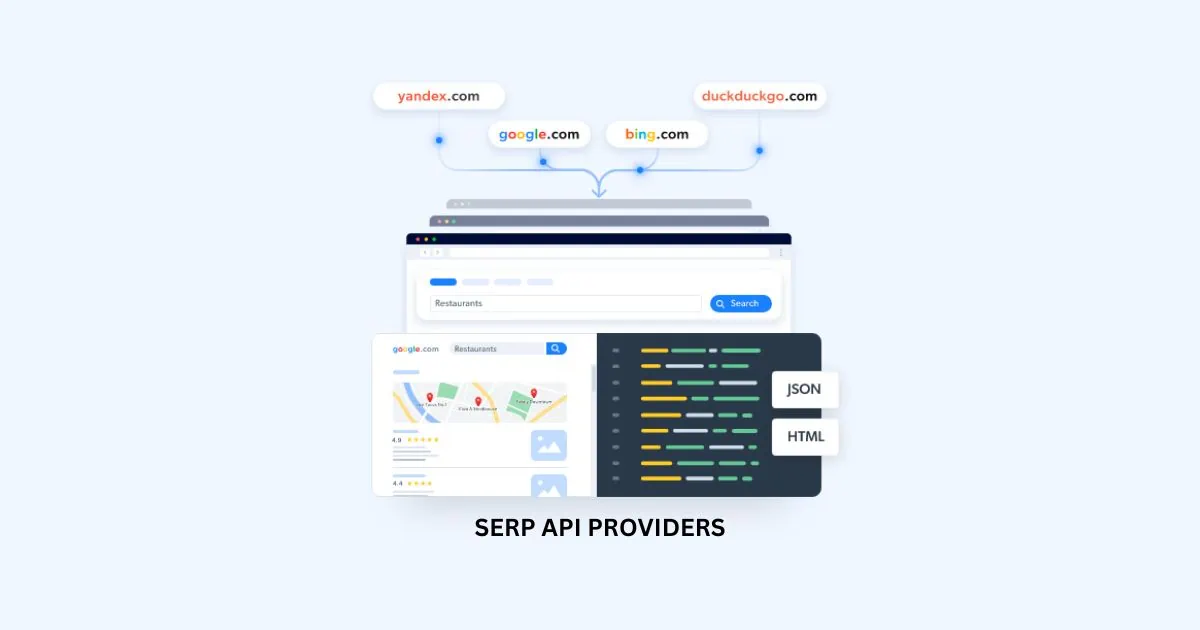
A SERP API is a managed web service that retrieves search engine results pages on your behalf. You send it a query (keyword, location, device, language) and it returns the results as structured data — typically JSON — covering organic listings, paid ads, featured snippets, local packs, AI overviews, and other SERP features.
What distinguishes a SERP API from a generic web scraping tool is specialization. SERP APIs are built specifically to navigate search engine anti-bot measures, parse the ever-changing layout of Google and other engines, and deliver consistent data at scale. Key capabilities include:
- Multi-engine support — Covering Google, Bing, Yandex, Baidu, DuckDuckGo, and others from a single API
- Geo-targeting — Returning results as seen from a specific country, city, zip code, or GPS coordinate
- Parser breadth — Extracting not just organic results but ads, shopping listings, AI overviews, news, images, and local packs
- Output format options — Raw HTML for maximum flexibility, or parsed JSON/Markdown for direct pipeline ingestion
- Async / webhook delivery — For high-volume batch jobs that don’t need real-time responses
- LLM integration — Connecting to AI agents via MCP server, LangChain, or direct tool calling
SERP API vs Building Your Own Google Scraper
Google blocks scrapers after roughly 100 requests from the same IP. Scaling your own scraper means managing residential proxy rotation, CAPTCHA solving, rendering JavaScript, parsing a layout that changes without notice, and handling failures. A SERP API shifts all of that to a specialist provider — so your engineering time goes into what the data does, not how to get it. The economics favor APIs at anything beyond early-stage testing volumes.
Who Needs a SERP API?
✓ Ideal Users for a SERP API
- SEO Professionals and Agencies — Tracking keyword rankings across dozens of clients, monitoring featured snippets, and auditing competitor visibility in Google requires accurate, geo-targeted SERP data at scale. Manual rank checking doesn’t cut it past a few hundred keywords.
- SaaS Developers Building SEO Tools — Rank trackers, keyword research platforms, and content gap tools all need a reliable SERP data feed. DataForSEO, Bright Data, and Decodo are built with this use case in mind — they support async batch requests and webhook delivery so your tool isn’t waiting on synchronous API calls.
- AI Agents and RAG Pipelines — LLMs need fresh, real-time web data to avoid hallucinating stale facts. SERP APIs connect AI agents to live search results via MCP servers and LangChain integrations. Bright Data’s MCP server and Apify’s Actor-based integrations are purpose-built for this workflow.
- Digital Marketers and PPC Teams — Monitoring competitor ad copy, tracking paid SERP features, and auditing local pack listings across regions requires systematic search data retrieval that manual checking cannot scale.
- Market Researchers and Intelligence Analysts — Tracking how search results change over time, analyzing trending topics, or monitoring brand visibility across multiple regions and engines is only feasible with a programmatic SERP API.
- E-Commerce Teams — Google Shopping and product SERP tracking — knowing where your products appear versus competitors in Google Shopping results — requires a SERP API that parses shopping-specific SERP features.
✗ Not Ideal For
A SERP API is NOT the right tool if you:
- Need to scrape non-search websites (product pages, social media, e-commerce listings) — use a general scraping API instead
- Only need a handful of keyword checks per day — Google Search Console’s free API covers basic rank data at low volume
- Are building something that needs real-time streaming of search results — SERP APIs are request-response, not event-stream
- Want zero-cost scraping — even the cheapest SERP APIs cost money at production volume
6 Best SERP API Providers — Reviewed & Ranked
Here are our top picks for the best SERP API providers in 2026. Each review covers supported search engines, parser quality, pricing per 1,000 results, real response time data from independent benchmarks, and the honest trade-offs. Provider order has been randomized — ranking reflects fit for different use cases, not a single winner.
1. DataForSEO
DataForSEO is not a proxy provider that happens to offer a SERP API — it’s a pure-play data API built specifically for SEO developers and platforms. Its API coverage is the widest in this list: SERP data, keyword data (volume, difficulty, CPC), backlink data, on-page data, and more. If you’re building an SEO tool from scratch or adding data feeds to an existing platform, DataForSEO is the most comprehensive data supplier here.
Supported Engines: Google, Yahoo, Bing, Yandex, Baidu, and more. Google coverage includes web search, Shopping, Maps, Images, News, Jobs, and Reviews.
Pricing: Pay-as-you-go. SERP data starts at $0.002 per task for high-speed delivery. Balance never expires. Minimum investment varies by speed tier — the high-speed pack is approximately $2,000/month minimum for large platforms. Smaller teams can start with lower-cost live or on-demand tasks. $1 free credit on signup for testing.
Response Time: Not independently benchmarked by Scrapingdog (confusing documentation prevented API testing). Internally, the speed tier selection determines latency — on-demand tasks can take longer than pre-cached “live” tasks.
Pros ✓
- Widest data type coverage in this list — SERP, keywords, backlinks, on-page, domains, merchants
- PAYG pricing with non-expiring balance — pay for exactly what you use
- Supports Google, Bing, Yahoo, Yandex, Baidu from one API
- Long track record — trusted by major SEO platforms globally
- Optimized for scalability and high-volume SEO tooling use cases
Cons ✗
- Documentation described as “noisy” — integration takes longer than simpler competitors
- No clearly published pricing table — pricing changes based on speed tier and volume
- High-speed tier carries a significant minimum monthly commitment (~$2K)
- Not ideal for quick prototyping or teams without dedicated API integration time
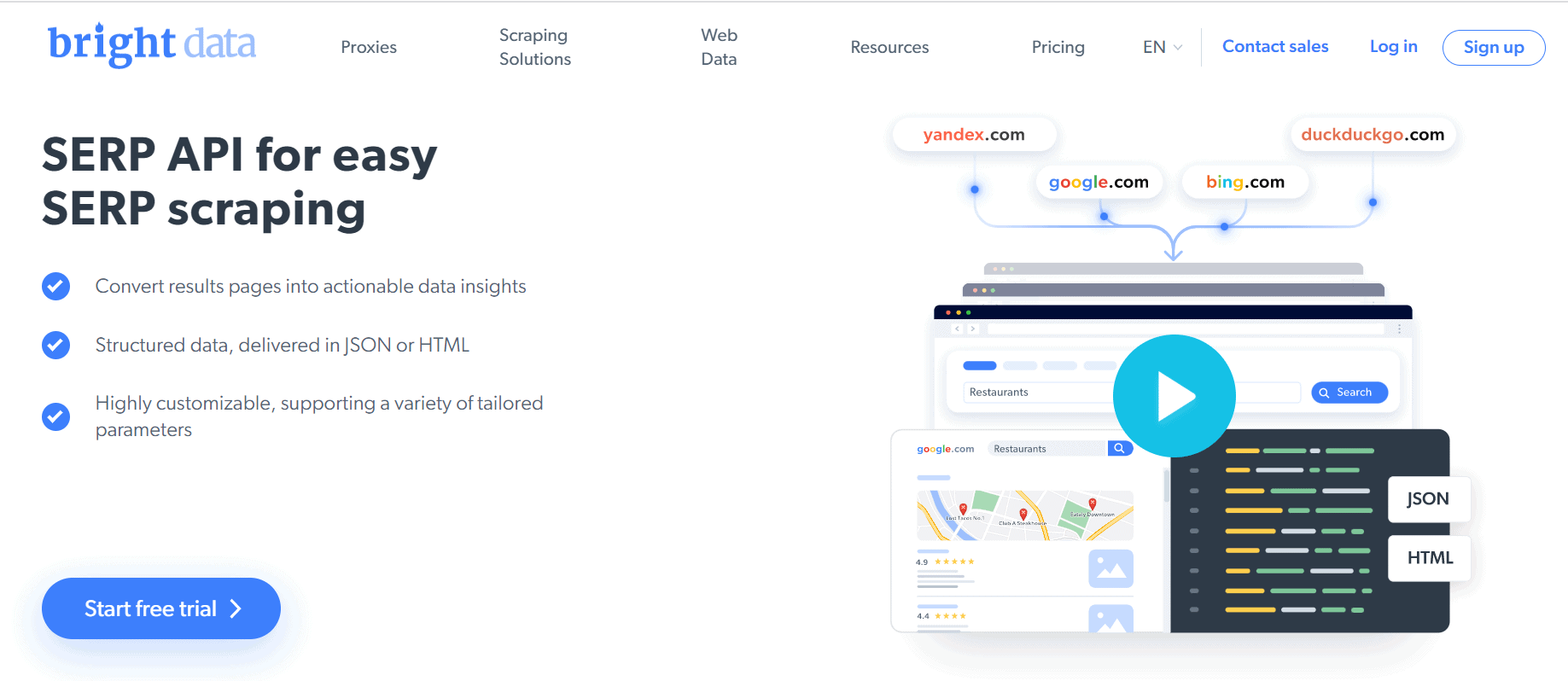
2. Bright Data SERP API

Bright Data is the largest web data infrastructure provider in the market, and its SERP API is backed by the same 400M+ IP network that powers its proxy services. The API covers Google, Bing, DuckDuckGo, Yandex, Yahoo, Naver, Baidu, and more from a single endpoint. It returns data in structured JSON, raw HTML, or AI-ready Markdown — making it one of the few SERP APIs that’s also purpose-built for LLM integration via its free MCP server. The average response time on SERP requests is under one second (sub-1s claimed; Proxyway independently confirmed ~4.79s on general scraping at 2 requests/second load). It runs on a pay-per-success model — you don’t pay for failed requests.
Supported Engines: Google (search, shopping, news, images, maps, AI overview), Bing, DuckDuckGo, Yandex, Yahoo, Naver, Baidu, and more.
Pricing: SERP API starts at $1/1K results (PAYG). Full subscription tiers drop the per-result cost with volume. The Unlocker API (general web access) starts at $1.50/1K results PAYG. New users get a 7-day free trial. Promo: first deposit matched up to $500.
Response Time: Sub-1 second claimed for SERP API specifically (dedicated infrastructure). Proxyway confirmed 4.79s avg on general scraping load test; Scrapingdog benchmarked 5.58s on standard Google requests — faster than SerpAPI (5.49s) but slower than Decodo or Serper at comparable loads.
Pros ✓
- 400M+ IP infrastructure — most reliable anti-block capability in the market
- Multi-engine: Google, Bing, DuckDuckGo, Yandex, Yahoo, Naver, Baidu from one API
- Pay-per-success model — no charge for failed requests
- AI-ready Markdown output + free MCP server for LLM agent integration
- 99.99% uptime across all products; ISO 27001 certified
- Proxyway Best Platform for Proxies 2024; Most Innovative Provider 2023
Cons ✗
- Most expensive at PAYG tier ($1/1K vs $0.50 CPM at Decodo)
- KYC verification required — can take up to 3 business days
- Full SERP pricing tiers require dashboard access to see
3. Apify
Apify is a full-stack web scraping and automation platform with over 19,000 pre-built “Actors” — serverless scraping scripts that cover virtually every scraping use case, including many dedicated to SERP data. Unlike the other providers here, Apify is more of a marketplace and platform than a single-product API. You find the Actor that matches your engine and use case, run it via API, and get your data. The platform’s MCP server, LangChain integration, and CrewAI compatibility make it the strongest choice for teams building AI agents that need flexible web search capabilities.
Supported Engines: Depends on the Actor — Google, Bing, Baidu, Yandex, DuckDuckGo, and others are covered by various Actors in the store.
Pricing: From $29/mo (includes $5 in platform credits). Free plan with $5 credits available. Per-search cost starts at approximately $0.003 and drops below $0.0019 at Business tier. Actor developers set their own pricing, so costs vary by Actor. No single fixed SERP pricing table.
Response Time: Scrapingdog benchmarked 8.2 seconds average — the slowest of tested providers, reflecting the overhead of running Actor infrastructure vs a dedicated SERP endpoint. Proxyway notes variable performance depending on the Actor used.
Pros ✓
- 19,000+ Actors — covers more SERP targets and engines than any single-product API
- Free $5 credit plan — lowest friction entry point for prototyping
- Native MCP server, LangChain, CrewAI, and Agno integrations for AI agents
- Runs entirely on Apify infrastructure — no server costs or maintenance
- Actors can be deployed, scheduled, or triggered by webhook
Cons ✗
- 8.2s average response time — slowest in this roundup for standard Google SERP
- Variable pricing and quality — Actor developers set their own prices and SLAs
- Not a dedicated SERP API — you need to find and evaluate the right Actor first
- Base $29/mo plan can be exhausted quickly at production volume
4. Decodo (formerly Smartproxy)

Decodo (rebranded from Smartproxy in April 2025) delivers the best balance of performance, ease of use, and price in this list. Its Web Scraping API includes a dedicated SERP Scraping API for Google and Bing, with templates for AI Overview, AI Mode, Travel Hotels, Lens, Ads with AI Overview, and standard search — covering the full modern Google SERP including the AI-powered features that others lag behind on. Proxyway confirmed 100% success rate and 3.76s average response time on Google scraping — the fastest in Proxyway’s 2025 scraping API test. Pricing starts at $19/mo for 38,000 requests, making it the most affordable entry point here for small teams.
Supported Engines: Google (web search, AI Overview, AI Mode, Shopping, Lens, Hotels, Ads) and Bing.
Pricing: From $19/mo for up to 38,000 requests ($0.50 CPM). Free trial: $1 credit with 14-day refund policy. No PAYG option — subscription only. JavaScript rendering is optionally available. Output: HTML, JSON, Markdown, XHR, PNG.
Response Time: Proxyway 2025 confirmed 3.76s average on Google scraping at 2 req/sec, 100% success rate. Scrapingdog benchmarked 4–5 seconds on their dashboard test. Fastest in Proxyway’s independent benchmark for this category.
Pros ✓
- 100% success rate on Google (Proxyway 2025) — best in class
- 3.76s avg response time — fastest in Proxyway’s SERP scraping API test
- Covers Google AI Overview and AI Mode — ahead of most competitors
- From $19/mo — most accessible entry price in this list
- Output in JSON, HTML, Markdown, XHR, PNG with optional JS rendering
- Proxyway Best Value Provider award — 5 consecutive years
Cons ✗
- No PAYG option — subscription required
- Only covers Google and Bing — narrower engine support than Bright Data or Oxylabs
- Full Web Scraping API pricing is slider-based — requires live site check
5. Nimble
Nimble is a fully managed API platform that handles data pipelines without requiring you to write scraping code. Its SERP API is part of a broader three-API stack — alongside an eCommerce API and a Web API — all running on Nimble’s own infrastructure. The “no code pipeline” pitch is genuine: you can build data collection workflows with one click and have results delivered to Amazon S3 or Google Cloud Storage directly. Nimble’s IP technology and browser emulation are designed to maximize delivery accuracy while minimizing detection. For teams that want data without engineering overhead, Nimble offers the most hands-off experience in this list.
Supported Engines: Google (via SERP API), with broader web access via the Web API. Supports country, city, and state targeting.
Key Features: Fully managed pipeline, no-code data collection, S3 and GCS delivery, AES-256 encryption, GDPR and CCPA compliant. Real-time data delivery or scheduled pipeline jobs. Unlimited access with no server charges — all compute runs on Nimble’s side.
Pricing: Not publicly listed — contact Nimble for a quote. Trial available on signup.
Pros ✓
- Fully managed no-code pipelines — no scraping infrastructure to maintain
- Direct delivery to S3 or Google Cloud Storage
- AES-256 encryption; GDPR and CCPA compliant
- Works across any country, city, or state targeting
- All three APIs (SERP, eCommerce, Web) available under one account
Cons ✗
- Pricing not publicly listed — requires contacting sales
- Less suited for developers who want direct API control and raw JSON
- Engine breadth not as wide as Bright Data or Oxylabs
6. Oxylabs SERP Scraper API
Oxylabs SERP Scraper API is the enterprise-grade solution built on top of its 175M+ IP residential network. Proxyway’s 2025 scraping API test confirmed 100% success rate on Google and a 4.79s average response time. Its Fast Search API takes performance further: 95% of requests returned in as fast as 1.11s (per Oxylabs) — the fastest response tier of any provider in this list for volume SERP use cases. The API includes a Web Unblocker for general scraping, an OxyCopilot AI assistant to help with query configuration, and coordinate-level geo-targeting for hyper-local SERP accuracy. It’s the only API here that also offers CSV output, which matters for non-developer teams who need to pipe results into spreadsheets or BI tools.
Supported Engines: Google, Bing, Baidu, Yandex (via Web Scraper API). Fast Search API covers Google and others with sub-second response.
Pricing: Web Scraper API at $49 for 49,000 results ($1/1K requests). Fast API: custom pricing. Web Unblocker: $45 for 8 GB ($5.64/GB). Micro plan at $49/mo includes Web, SERP, and E-Commerce Scraper APIs. 7-day free trial for companies. Promo code Discount30 for 30% off.
Response Time: 4.79s average on standard SERP load (Proxyway 2025); Fast API delivers 95% of requests in under 1.11 seconds.
Pros ✓
- 100% success rate on Google SERP (Proxyway 2025)
- Fast API: 95% of requests under 1.11s — fastest speed tier here
- Coordinate-level geo-targeting for hyper-local SERP accuracy
- CSV output option — unique in this list
- OxyCopilot AI assistant for query and configuration help
- Proxyway Best Enterprise Provider 2025
Cons ✗
- Standard SERP pricing ($1/1K) matches Bright Data — not the cheapest
- Fast API pricing is custom/enterprise — no public rate
- No PAYG option — subscription required
- KYC required before accessing services
How to Choose the Right SERP API
Every provider in this list can return Google search results. Comparing the best SERP API providers on surface specs alone misses the factors that actually matter at production scale — here are the five that separate a solid choice from a costly mistake.
1. SERP API Response Time: Why It Matters More Than You Think
If you’re running a real-time rank checker, 8 seconds per result (Apify’s benchmark) means your tool feels slow. If you’re doing nightly batch jobs for 100,000 keywords, 5 vs 8 seconds is the difference between a 10-minute and a 22-minute run window. Decodo’s 3.76s and Oxylabs’ Fast API at sub-1.11s are your options if speed is a requirement. For async batch processing, response time matters less — focus on success rate and pricing instead.
2. Google SERP API Parser Quality and Feature Coverage
Most SERP APIs return organic results and paid ads. Fewer parse Google’s AI Overview, People Also Ask, local packs, shopping panels, and knowledge graphs. If your SEO tool needs to track Google’s AI-powered SERP features — which now appear across many commercial search queries — only Decodo (AI Overview template, AI Mode) and Bright Data (AI Overview scraper) have built explicit support for these new SERP types.
3. Multi-Engine Requirements
If you only need Google and Bing, Decodo is the most cost-effective option. If you need Yandex for Russian market research, Baidu for Chinese SEO, or Naver for Korean search, you need Bright Data or Oxylabs — both cover these engines natively. DataForSEO also covers Yandex and Baidu. Apify covers virtually everything via Actors, but quality varies by Actor developer.
4. SERP Scraping API Pricing Models: Per-Result vs Credit vs Subscription
Per-result pricing (Bright Data, Oxylabs, DataForSEO) is predictable but can be expensive at low volume. Credit-based subscription pricing (Decodo) gives you a monthly budget that scales with your plan. PAYG without expiry (DataForSEO) is ideal if your volume is irregular — you buy credits and use them on your own schedule. There is no universally “cheapest” option; it depends entirely on your monthly request volume.
5. SERP Data API for LLM and AI Agent Integration
If you’re building AI workflows, not just collecting data, integration method matters. Bright Data and Apify both have official MCP servers. Bright Data integrates with LlamaIndex, CrewAI, Dify, and Agno. Apify integrates with LangChain and every major AI agent framework. Oxylabs has OxyCopilot. For AI-first workflows, Bright Data or Apify are the strongest choices.
Bottom line: For the best balance of performance and price, start with Decodo. For enterprise multi-engine requirements and AI integration, go Bright Data. For the highest volume SEO platform data needs, DataForSEO’s PAYG with non-expiring balance is hard to beat. If you need sub-second SERP delivery at scale, Oxylabs’ Fast API is in a class of its own.
SERP API Pricing: Side-by-Side Comparison
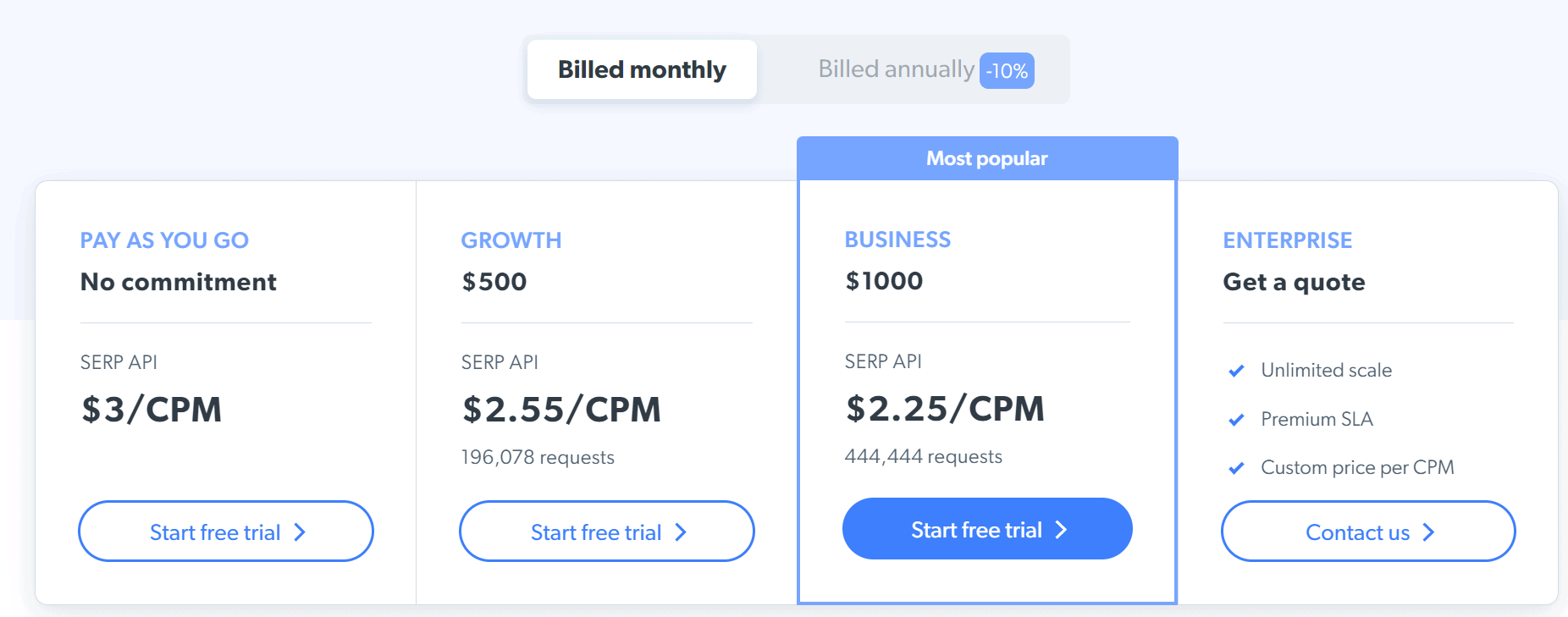
The table below compares all six providers on the metrics that matter most for SERP API selection: supported engines, response time, pricing entry point, and trial availability. All pricing data is sourced from provider knowledge files and competitor research gathered in May 2026.
| Provider | Supported Engines | Avg Response Time | Entry Price | Free Trial | Output Formats |
|---|---|---|---|---|---|
| DataForSEO | Google, Bing, Yahoo, Yandex, Baidu | Varies by tier | $0.002/task (PAYG, never expires) | $1 free credit | JSON, HTML |
| Bright Data | Google, Bing, DDG, Yandex, Yahoo, Naver, Baidu, more | ~5.58s (standard); <1s (dedicated SERP) | $1/1K results PAYG | 7-day free trial | JSON, HTML, Markdown |
| Apify | Google, Bing, Yandex, Baidu, DDG, others (Actor-dependent) | ~8.2s (benchmarked) | $29/mo (includes $5 credits); $0.003/search | Free $5 credit plan | JSON, HTML (Actor-dependent) |
| Decodo | Google (incl. AI Overview, AI Mode), Bing | 3.76s (Proxyway 2025) | $19/mo (38K requests, $0.50 CPM) | $1 credit + 14-day refund | JSON, HTML, Markdown, PNG |
| Nimble | Google (web, SERP); broader via Web API | Not publicly benchmarked | Contact for pricing | Trial on signup | JSON, direct cloud delivery |
| Oxylabs | Google, Bing, Baidu, Yandex | 4.79s std; <1.11s (Fast API, 95%ile) | $49 for 49K results ($1/1K); Fast API: custom | 7-day free trial (companies) | JSON, HTML, CSV |
Pricing note: Per-result costs drop significantly at scale. Bright Data at $1/1K for 50K results per month may drop to $0.20–$0.40/1K at 5 million results per month on enterprise contracts. DataForSEO’s high-speed tier requires ~$2K/mo minimum commitment but delivers enterprise-level throughput. Always request a volume quote from any provider before budgeting for production workloads above 500K results/month.
SERP API Pros & Cons: What to Expect
SERP APIs solve a real engineering problem. But they’re not a silver bullet, and there are legitimate trade-offs to understand before committing to a provider or pricing tier.
Pros ✓
- No infrastructure maintenance: You stop worrying about IP bans, CAPTCHA solvers, proxy pools, JavaScript rendering engines, and scraper upkeep. The provider handles all of it.
- Scales to millions of requests: Bright Data, Oxylabs, and DataForSEO are designed for enterprise-scale SERP data collection — tens of millions of results per month is routine.
- Geo-accurate results: City-level and coordinate-level targeting returns results as a user in that specific location would see them — essential for local SEO and multi-market rank tracking.
- Structured data, not raw HTML: Parsed JSON output means you’re working with clean data that plugs directly into your application, database, or AI pipeline.
- AI and LLM integration: Modern SERP APIs connect directly to AI agents via MCP servers and LangChain, enabling real-time search grounding for AI systems.
- Pay-per-success models: Providers like Bright Data only charge for successful results — failed requests don’t cost you anything.
Cons ✗
- Cost adds up at scale: Even $0.50 CPM becomes $50,000 at 100M requests/month. Volume pricing helps, but large-scale SEO platforms need to model cost carefully.
- Parser coverage gaps: Not every provider parses every SERP feature. If you need People Also Ask, featured snippets, and AI overviews all in one response, check each provider’s parser documentation before signing up.
- Engine limitations: Decodo only covers Google and Bing. Nimble’s engine breadth is limited. If you need Yandex or Baidu, your options narrow to Bright Data, Oxylabs, or DataForSEO.
- Latency for real-time use cases: Even the fastest standard SERP API returns results in 3–5 seconds. Real-time user-facing features require the Fast API tiers (Oxylabs, Bright Data) or a cached data approach.
- No Google official API replacement: Google’s Custom Search JSON API is being shut down in 2027; SERP APIs don’t carry the legal clarity of an official API — understand your ToS obligations before deploying.
Bottom Line: SERP APIs are the right tool for anyone doing programmatic search data collection at meaningful scale. The trade-offs — cost, latency, and occasional parser gaps — are manageable with the right provider choice. The alternative (maintaining your own Google scraper) is far more expensive in engineering time and far less reliable in practice.
SERP API Providers: Head-to-Head
How the leading SERP API providers compare on the metrics that matter most.
Bright Data vs DataForSEO — SERP APIs
| Feature | Bright Data | DataForSEO |
|---|---|---|
| Starting price | $0.001/request | Pay-as-you-go from $0.002/task |
| Search engines | Google, Bing, Yandex, DuckDuckGo, Yahoo, Naver, Baidu | Google, Bing, Yahoo, Yandex, Baidu |
| Real-time results | Yes | Yes (Live) + cached |
| Free trial | 7-day free trial | $1 credit on signup |
| Best for | Enterprise scraping at scale | Pay-per-use SEO research |
Winner for scale: Bright Data | Winner for flexible pricing: DataForSEO | Winner for search engine coverage: Bright Data
Apify vs Decodo — SERP APIs for Developers
| Feature | Apify | Decodo |
|---|---|---|
| Starting price | Free tier available; paid from $29/mo | From $19/mo (SERP plan) |
| Custom actors / templates | Yes — marketplace of 19,000+ scrapers | No — pre-built SERP templates |
| Async requests | Yes | No |
| JSON output | Yes | Yes |
| Best for | Developer workflows and AI agents | Budget-conscious Google/Bing scraping |
Winner for developers: Apify | Winner for budget: Decodo | Winner for simplicity: Decodo
🏆 Choose Bright Data When
- You need enterprise-scale SERP data across multiple engines
- You require Google, Bing, Yandex, and Naver in one API
- 99.99% uptime and pay-per-success billing are non-negotiable
🔍 Choose DataForSEO When
- You only pay for what you use — no monthly minimums at entry level
- You need SERP data plus keywords, backlinks, and on-page metrics from one API
- Your request volume is irregular and a non-expiring balance matters
SERP API Provider Ratings Breakdown
We rated each provider on six criteria relevant to SERP API selection: accuracy (success rate on Google), response speed, parser breadth (SERP feature coverage), engine support, pricing value, and ease of integration. Scores reflect independent benchmark data from Proxyway 2025 and Scrapingdog 2026 where available, combined with feature depth and pricing analysis.
| Category | Score | Notes |
|---|---|---|
| Accuracy / Success Rate | 4.8/5 | Bright Data and Oxylabs both hit 100% on Google (Proxyway); Decodo 100%; DataForSEO optimized for reliability at scale |
| Response Speed | 4.2/5 | Decodo fastest at 3.76s avg; Oxylabs Fast API <1.11s (95th %ile); Apify slowest at 8.2s |
| Parser & SERP Feature Coverage | 4.0/5 | Bright Data and DataForSEO widest; Decodo strong on Google AI features; Nimble and Apify variable |
| Engine Support | 4.3/5 | Bright Data leads (Google, Bing, DDG, Yandex, Yahoo, Naver, Baidu); Decodo and Nimble narrower |
| Pricing Value | 4.1/5 | Decodo most affordable ($0.50 CPM); DataForSEO best for irregular volume (PAYG, never expires); Bright Data and Oxylabs premium |
| Ease of Integration | 4.4/5 | Decodo and Apify simplest onboarding; DataForSEO docs complex; Nimble most hands-off (no-code) |
| Overall Rating | 4.3/5 | Strong market overall — Bright Data and Oxylabs lead on enterprise capability; Decodo leads on value; DataForSEO leads on SEO data breadth |
Rating Summary: The best SERP API providers in 2026 are reliably accurate (100% success rates are achievable) but differ sharply on speed, engine breadth, and pricing models. For most teams starting out, Decodo offers the best all-around entry point. For enterprise scale and multi-engine coverage, Bright Data or Oxylabs are the benchmarks. DataForSEO is the specialist choice when you need SEO data beyond just SERP results.
Are SERP APIs Legit, Safe & Worth It?
Legitimacy & Safety
- ✓ Legal commercial use: Using a commercial SERP API to collect publicly available search engine results is legal in most jurisdictions. You’re retrieving data that anyone with a browser can see — the API just automates the retrieval at scale.
- ✓ Enterprise-grade compliance: Bright Data (ISO 27001, SOC 2, GDPR), Oxylabs (EWDCI member, enterprise SLA), and Nimble (AES-256, GDPR, CCPA) all meet procurement standards for regulated industries.
- ✓ Google ToS awareness: Commercial SERP scraping APIs operate in a grey area with Google’s ToS — Google prohibits automated access to its search results without permission. Reputable providers manage this via their own IP infrastructure and accept liability for the scraping layer. Understand your use case and consult legal counsel for compliance-sensitive deployments.
- ✓ Data security: Enterprise providers encrypt data in transit and at rest. Nimble uses AES-256. Bright Data is ISO 27001 certified. For sensitive pipeline work, choose providers with documented security certifications.
Long-Term Reliability
All six providers in this list have been operating for multiple years. Bright Data (founded 2014), Oxylabs (2015), and Apify (2015) have decade-long track records and thousands of enterprise customers. DataForSEO has been the data supplier behind major SEO platforms for years. Decodo (founded 2018 as Smartproxy) holds five consecutive Proxyway Best Value awards. Nimble is newer but has grown rapidly with enterprise backing. None of these are fly-by-night services.
Reality check: Google actively works to block automated SERP access. Even the best SERP APIs occasionally experience periods of elevated failure rates or increased response times when Google deploys new anti-bot countermeasures. Monitor your success rate dashboards — the best providers (Bright Data, Oxylabs, Decodo) have proven track records of adapting quickly. Expect occasional brief degradations; sustained failures are rare with tier-1 providers. Budget 10–15% buffer traffic to account for retries.
Our Recommendation: Yes, SERP APIs are worth it — for any use case that requires more than a few hundred search results per day. The engineering cost of maintaining your own scraper outweighs the API cost almost immediately. Start with Decodo’s affordable entry plan or Bright Data’s 7-day trial, run your actual queries (your real keywords, your real target geos), and validate success rates before committing to a monthly plan. Don’t choose based on marketing claims — test with the actual queries you need to run at scale.
Best SERP API Providers — Frequently Asked Questions
What is a SERP API?
A SERP API (Search Engine Results Page API) is a managed service that retrieves data from search engines like Google, Bing, and Yandex programmatically. You send a request with parameters (keyword, location, language, device), and the API returns structured results — typically JSON — covering organic listings, paid ads, featured snippets, local packs, shopping results, and other SERP features. The provider handles IP rotation, CAPTCHA solving, and JavaScript rendering so you don’t have to.
What is the best SERP API provider in 2026?
The best SERP API depends on your use case. For most teams, Decodo offers the best balance of performance (100% success rate, 3.76s avg), price ($0.50 CPM), and ease of use. For enterprise multi-engine requirements and AI integration, Bright Data is the benchmark. For SEO platform builders who need keyword data, backlinks, and SERP data from one API, DataForSEO is the specialist choice. For the fastest raw response time at scale, Oxylabs’ Fast API is in a class of its own.
How much does a SERP API cost?
Pricing varies widely by provider and volume. At entry-level volumes:
- Decodo: from $19/mo for 38,000 requests ($0.50 CPM)
- Bright Data: $1/1K results PAYG
- Oxylabs: $49 for 49,000 results ($1/1K requests)
- Apify: $29/mo base; ~$0.003 per search
- DataForSEO: ~$0.002/task PAYG (high-speed tier requires larger commitment)
- Nimble: contact for pricing
At high volume (1M+ requests/month), enterprise contracts from Bright Data, Oxylabs, and DataForSEO can bring per-result costs well below $0.001.
Is it legal to use a SERP API to scrape Google?
Collecting publicly available search results via a commercial SERP API is legal in most jurisdictions — you’re accessing data anyone with a browser can see. However, Google’s Terms of Service prohibit automated access to its search results without express permission. Commercial SERP API providers accept the scraping liability on their end. For enterprise deployments or compliance-sensitive use cases, consult your legal team about your specific obligations. All six providers in this list are established commercial services used by major businesses worldwide.
Which SERP API is fastest?
Based on independent benchmarks: Decodo is fastest in Proxyway’s 2025 test at 3.76 seconds average on Google. Oxylabs’ Fast API delivers 95% of requests in under 1.11 seconds — the fastest tier available for high-volume use cases, though at custom/enterprise pricing. For standard SERP requests, Decodo is the fastest publicly benchmarked option. Apify was the slowest tested at 8.2 seconds average.
Can SERP APIs access Google AI Overviews and AI Mode results?
Yes, but coverage varies by provider. Decodo explicitly supports Google AI Overview and AI Mode as scraping templates in its SERP Scraping API — making it one of the first to offer structured access to Google’s AI-powered search features. Bright Data also supports AI Overview extraction. Most other providers in this list have not yet built dedicated parser support for AI Mode results as of May 2026 — check each provider’s documentation for current parser coverage.
Which SERP APIs support Yandex, Baidu, and other non-Google engines?
For multi-engine coverage: Bright Data supports Google, Bing, DuckDuckGo, Yandex, Yahoo, Naver, Baidu, and more. Oxylabs covers Google, Bing, Baidu, and Yandex. DataForSEO covers Google, Bing, Yahoo, Yandex, and Baidu. Decodo covers Google and Bing only. Apify covers virtually all engines via Actors (quality varies). Nimble focuses on Google via its SERP API with broader access via the Web API.
Do SERP APIs support geo-targeted results?
Yes — all six providers support country-level geo-targeting. City-level targeting is available with Bright Data, Oxylabs, Decodo, and DataForSEO. Oxylabs offers coordinate-level (GPS) targeting for hyper-local SERP accuracy — the most granular option in this list. Bright Data also supports state, ZIP, and ASN targeting. Geo-targeting accuracy matters significantly for local SEO rank tracking where national results differ from city-specific ones.
Can I use a SERP API for building an AI agent or RAG system?
Yes — this is one of the fastest-growing use cases for SERP APIs. Bright Data offers a free MCP server that connects AI agents to live search results, with integrations for LlamaIndex, CrewAI, Dify, and Agno. Apify has its own MCP server and integrates with LangChain, CrewAI, and more. Oxylabs has OxyCopilot for AI-assisted configuration. For AI agent workflows where you need real-time web search grounding, Bright Data and Apify are the strongest choices.
What is the difference between a SERP API and a web scraping API?
A SERP API is specialized for search engine results pages — it’s purpose-built to parse Google, Bing, and other search engines’ specific layouts and return structured data like organic results, ads, and snippets. A general web scraping API can scrape any website but requires you to define what data to extract. SERP APIs are faster and more reliable for search data specifically because they’re optimized for that one target. Providers like Bright Data and Oxylabs offer both — their SERP API and their general Web Scraper API are separate products.
Which SERP API has the best free trial?
Apify offers the most accessible free option: a free plan with $5 in platform credits — enough to run hundreds of SERP requests and test the platform. DataForSEO gives $1 free credit on signup. Bright Data and Oxylabs both offer 7-day free trials for verified companies (KYC required). Decodo offers $1 in credits with a 14-day money-back guarantee on first payment. For individual developers prototyping without commitment, Apify’s free plan is the lowest-friction starting point.
Is DataForSEO good for rank tracking and keyword research?
DataForSEO is the most complete data API for SEO platform builders. Beyond SERP data, it provides keyword data (volume, CPC, difficulty), backlink data, on-page metrics, and merchant data — all from one API. For teams building full SEO tools rather than just rank trackers, DataForSEO is the only provider in this list that covers the full data stack. The trade-off is documentation complexity and a minimum commitment for high-speed access. Pure SERP tracking at low volume is better served by Decodo or Bright Data.
Final Verdict
The best SERP API providers in 2026 are not interchangeable — they differ sharply on engine support, response time, parser quality, and pricing models. Decodo leads on overall value and Google performance for teams that only need Google and Bing. Bright Data leads for multi-engine enterprise requirements and AI agent integration. DataForSEO leads for SEO platform developers who need the full data stack beyond just SERP results. Oxylabs leads for enterprise speed with its Fast API delivering sub-1.11 second responses. And Apify is uniquely suited for teams building flexible AI workflows that need search as a modular component.
The right choice depends on your specific use case, volume, and technical requirements — not on any single ranking. Use the free trials and entry plans to test against your actual production queries before committing to a monthly plan.
✓ Top Picks by Use Case
- Decodo — Best value: 100% success, 3.76s avg, $0.50 CPM, Google AI Overview support
- Bright Data — Best overall: multi-engine, AI-ready, pay-per-success, 99.99% uptime
- DataForSEO — Best for SEO platforms: SERP + keywords + backlinks, PAYG, balance never expires
- Oxylabs — Best enterprise speed: Fast API <1.11s, 100% Google success, CSV output
- Apify — Best for AI agents: 19K+ Actors, MCP server, LangChain, free plan
- Nimble — Best for no-code pipelines: fully managed, S3/GCS delivery, GDPR/CCPA
✗ When to Look Elsewhere
- You only check a few hundred keywords per day — Google Search Console’s API is free
- You need non-search web scraping — use a general scraping API instead
- Your budget is truly zero — no production-quality SERP API is free at scale
- You need real-time streaming search results — SERP APIs are request-response, not event streams
Ready to Try the Best SERP API Providers?
Start with Bright Data’s 7-day free trial or Decodo’s $1 credit entry plan — test with your actual keywords and target geos before committing to a monthly plan.
Try Bright Data SERP API — Best Overall for 2026 →