
Blogging Statistics:
85 Powerful Data Points That Prove Blogging Still Works in 2026
85 verified blogging statistics for 2026: discover what separates high-traffic blogs from invisible ones — SEO, income, AI adoption, and content trends.
⚡ Key Blogging Stats at a Glance
Blogging is bigger than ever — and more competitive than ever. With 7.5 million new posts published every single day, standing out requires knowing what actually drives results. These statistics cut through the noise and show you where the real opportunities are in 2026: long-form content, AI-assisted workflows, email lists, and relentless SEO discipline.
31.6% of all websites on the internet
~5,750 posts per minute
Companies with blogs vs. without
Marketers now using AI tools in 2026
You started a blog, published a few posts, and then nothing happened. No traffic, no leads, no income. Sound familiar? You’re not alone — and the blogging statistics explain exactly why most blogs stay invisible.
The blog statistics for 2026 tell a tale of two extremes. On one end, you have the 90.63% of content that gets zero organic traffic from Google. On the other, you have companies generating 13x higher ROI from blogging and food bloggers pulling $9,169 in median monthly income. What separates these two groups is strategy, not luck.
This article compiles over 85 verified blogging statistics from multiple research sources including Orbit Media’s 2025 Annual Blogger Survey (808 marketers), Hostinger’s blogging research, and comprehensive industry data. These numbers will show you exactly what works, what doesn’t, and where to focus your energy.
Whether you’re just starting out or trying to grow an existing blog, these blogging trends and data points will change how you think about content creation, SEO, monetization, and the role AI now plays in every serious blogger’s toolkit.
Blogging Statistics: The Global Landscape in 2026

Blogging has grown from a personal hobby format into a cornerstone of digital marketing. The sheer scale of the industry in 2026 is staggering — and still expanding. Here’s the full picture.
Scale of the Blogging Industry
- 600 million+ active blogs exist among 1.9 billion websites globally — that’s roughly 31.6% of the entire web (Hostinger, 2026)
- 7.5 million new blog posts are published every single day — roughly 5,750 posts per minute (Hostinger, 2026)
- 3 billion posts are published per year, meaning the internet adds new content at a pace that makes discoverability harder each year
- 77% of internet users regularly read blogs — proving that demand for blog content remains high despite the competition (Elementor, 2025)
- 31.7 million bloggers were active in the United States as of the most recent count (Hostinger, 2026)
- The search query “how to start a blog” is searched 53,000 times per month globally — that’s over 1,700 people per day looking to enter the space
Platform Distribution
- WordPress.com users published 52.3 million blog posts in January 2024 alone — showing the platform’s dominance
- WordPress.com generated 18.41 billion page views by April 2024, reflecting massive reader engagement
- Tumblr hosts 518 million+ blogs, though engagement rates differ sharply from professional blogging platforms
- WordPress users collectively generate 70 million new posts per month
- The content marketing industry is valued at $417.85 billion and projected to reach $2 trillion by 2032 — a figure that shows just how central content has become to digital business
What this means for you: With 7.5 million posts published daily, you can’t just publish — you have to publish strategically. Topic selection, keyword targeting, and content depth are no longer optional; they’re the baseline for any blog that wants to be found.
Reader Behavior Basics
- 43% of blog readers skim posts rather than reading word for word — structure matters enormously (Hostinger, 2026)
- The average reader spends just 52 seconds per blog post — which means your intro, headings, and formatting do more work than your prose (Hostinger, 2026)
- 80% of readers read headlines, but only 20% click through to read the actual article — headline quality directly controls your traffic
- Average blogger age: 21–35 years old, reflecting the demographic most actively building content-based businesses online (Elementor, 2025)
Blog Post Length, Frequency & Format Statistics
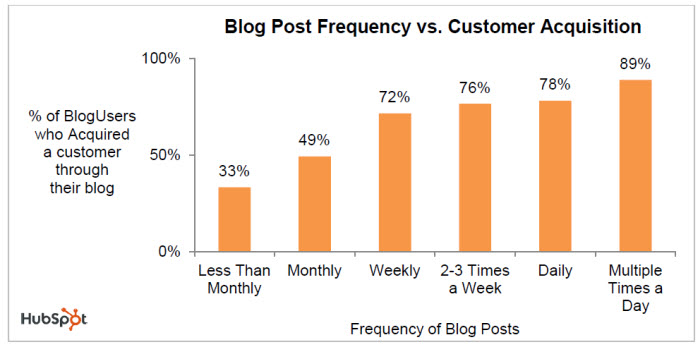
Content length, format, and publishing frequency all interact to determine how your blog performs. The data here is nuanced — more is not always better, but below a certain threshold, results drop off sharply.
Content Length Data
- The average blog post in 2026 is 1,416 words — up 42% from a few years ago, showing the industry-wide push toward more thorough content (AffMaven, 2026)
- Orbit Media’s 2025 survey puts the average at 1,333 words, slightly lower, with a note that the “skyscraper content” arms race may be plateauing
- Bloggers writing 2,000+ word posts report 39% “strong results” versus a 21% benchmark for all bloggers — this is one of the strongest correlations in the Orbit Media dataset (Orbit Media, 2025)
- For SEO specifically, the sweet spot is 1,760–2,400 words to maximize backlinks and social shares
- Posts over 3,000 words generate the most backlinks and social shares of any length category
- The #1 Google ranking for niche queries typically features content of 1,140–1,285 words — shorter than many assume for competitive SERPs
The length paradox: 75% of readers say they prefer posts under 1,000 words, yet posts over 2,000 words consistently outperform shorter ones for SEO and results. The solution: write long for algorithms, structure for human scanners. Use clear H2/H3 headings, short paragraphs, bullet lists, and summary boxes so skimmers still get value.
Publishing Frequency
- Companies publishing 16+ posts per month get 4.5x more leads than those publishing 0–4 posts/month — volume matters at scale (AffMaven, 2026)
- Marketers publishing multiple times per week report 37% strong results vs. the 21% benchmark (Orbit Media, 2025)
- About half of all marketers publish 2–4 times per month — the most common publishing cadence in professional content programs
- 57% of bloggers see better results posting daily, though daily publishing is unsustainable for most solo bloggers without AI assistance (Hostinger, 2026)
Time Investment
- The average time to write a blog post in 2025 was 3 hours 25 minutes — down from 4 hours 10 minutes in 2022, largely due to AI assistance (Orbit Media, 2025)
- AI tools cut production time by 30–50% specifically for headlines and outlines
Content Format Performance
| Content Format | Popularity | Performance Notes |
|---|---|---|
| How-to Articles | 76% | Most popular format; high search intent match |
| Listicles | 54% | Easy to skim; strong click-through on social |
| Guides & Ebooks | 43–53% | Best performing format at 27% strong results |
| News & Trends | 30% | Short shelf-life; good for social but weak for SEO |
| Original Research | 49% | Up from 25% in 2018; 25% strong results rate |
| Interviews/Roundups | Lower | Collaborative format; strong link-building value |
| Gated Content | 17% | Best for lead capture; requires strong offer |
Source: Orbit Media 2025 Annual Blogger Survey; AffMaven 2026 Blogging Statistics
Content Updating
- 61% of bloggers update old content as a deliberate strategy — not just fixing typos, but meaningful refreshes with new data and improved structure (AffMaven, 2026)
- Updating old posts can increase organic traffic by 106% — one of the highest ROI activities for any content team
- 46% say updating content produces “very strong results”, and 70% of bloggers report they regularly refurbish existing posts (Hostinger, 2026)
- Bloggers who update and republish are 2.5x more likely to report strong results than those who don’t (AffMaven, 2026)
SEO & Blog Traffic Statistics
Search engine optimization remains the most reliable driver of sustainable blog traffic. Social media delivers spikes; SEO delivers compounding returns. The data below makes that case definitively.
Search Engine Traffic Dominance
- Organic search drives 53.3% of all website traffic — more than any other channel combined (AffMaven, 2026)
- SEO drives over 1,000% more traffic than organic social media — not a typo; organic social has become increasingly pay-to-play (Elementor, 2025)
- 68% of all online experiences begin with a search engine — meaning most content discovery still starts at Google (AffMaven/Elementor, 2026)
- The #1 result on Google earns a 39.6% average click-through rate — position 2 falls to roughly 18%, and it drops sharply from there
- Websites with active blogs have 434% more indexed pages and 97% more inbound links than sites without blogs (Hostinger, 2026)
The hard truth about content: 90.63% of all content published on the internet gets zero organic traffic from Google. The reason isn’t always quality — it’s keyword selection and competitive positioning. Targeting long-tail keywords with clear search intent is the single most important SEO decision you can make.
Keyword Strategy
- Marketers who always do keyword research report 32% strong results versus the 21% average benchmark — a 50%+ improvement just from consistent keyword practice (Orbit Media, 2025)
- “Attracting visitors from search” spiked to the #1 challenge for 63% of marketers in 2025, up dramatically from previous years — AI Overviews are reducing clicks even when you rank (Orbit Media, 2025)
- Google is still 370x more popular than ChatGPT as a discovery channel, despite AI search growing rapidly
Analytics Correlation
- Only 1 in 3 marketers check performance of each published article — a massive gap where most blogs leave improvement on the table
- Bloggers who always use analytics report 32% strong results, while those who never check analytics report only 13% strong results (Orbit Media, 2025)
Voice Search
- 50% of searches are now voice-driven, requiring conversational, question-based content structures
- 58% of voice searches are looking for local business information
- 70% of voice requests use natural language — writing the way people speak is now a legitimate SEO tactic
Business Blogging Statistics: B2B Data & Lead Generation

For companies and marketers, blogging isn’t about self-expression — it’s about lead generation, trust building, and revenue. These content marketing statistics make the business case for blogging undeniable, and the numbers below prove it.
Lead Generation & Traffic
- Companies with blogs generate 67% more leads per month than those without — the single most-cited business blogging statistic for good reason (AffMaven/Hostinger, 2026)
- Consistent blogging produces 55% more website visitors than non-blogging competitors (Hostinger, 2026)
- Businesses that blog are 13x more likely to achieve positive ROI from their marketing investment (Hostinger, 2026)
- 76% of marketers rely on blog posts to distribute content — it remains the backbone of content marketing strategy
- 10% of marketers report blog content delivers the best ROI out of all content types, outperforming case studies, webinars, and infographics
Consumer Trust & Purchase Behavior
- 81% of online consumers trust advice from blogs — more than paid advertising, social media ads, or branded email (AffMaven, 2026)
- 61% of online users made a purchase based on a blog recommendation — making blogging directly attributable to sales conversions
- 70% of consumers prefer learning about companies through blogs rather than through traditional advertising (Hostinger, 2026)
- 70% of readers feel more connected to a brand after engaging with its blog content
- 82% feel more positive about a company that publishes custom content (Hostinger, 2026)
- 55% of users are influenced to purchase by consistently interesting blog content
- 33% of buyers research products on blogs before buying in-store — bridging digital content and offline purchase behavior
B2B Specific Data
- 91% of B2B marketers use content marketing — it’s essentially universal at this point
- 58% of B2B marketers cite lack of resources as their biggest content challenge
- 48% struggle aligning content with the buyer’s journey — creating content for the wrong stage of the funnel is one of the most common B2B blogging mistakes
- 45% struggle coordinating content across sales and marketing teams
- 39% of B2B blogs use related articles as CTAs to keep readers engaged and increase session duration
Bottom line on business blogging: If your company doesn’t have a blog, you are actively handing leads to competitors who do. The 67% more leads figure isn’t a vanity metric — it directly translates to pipeline and revenue when executed with keyword-focused, buyer-intent content.
AI & Content Marketing Statistics for Bloggers in 2026
No topic in 2026 content marketing generates more debate than AI. The data from Orbit Media’s 808-marketer survey cuts through the hype and gives a clear picture of what actually works.
Adoption Rates
- The share of marketers NOT using AI has fallen from 65% to just 5% in the last 24 months — AI adoption in content creation is now near-universal (Orbit Media, 2025)
- 80% of bloggers are already using AI tools in their content workflow (Elementor, 2025)
- 65% of bloggers use AI tools, with the most common uses being idea generation (43%), crafting headlines (29%), and outlining articles (28%) (Hostinger, 2026)
- 90% of content marketers plan to use AI tools through 2026 (AffMaven, 2026)
- 63% of companies report increased revenue after integrating AI into their content processes
How Bloggers Actually Use AI
- 75% of SEOs use AI for topic brainstorming, and 73% use it for content outlines — ideation and structure are where AI delivers best (AffMaven, 2026)
- Top uses by percentage: outlining (71.7%), content ideation (68%), drafting (57.4%), keyword research (54.5%) (Elementor, 2025)
- 71.7% of web content is now created with some AI assistance — purely human-written content is becoming the minority
What the Data Says About AI Effectiveness
| AI Usage Level | Strong Results Rate | vs. 21% Benchmark |
|---|---|---|
| AI holdouts (never use AI) | Lowest | Below benchmark |
| Use AI for complete articles (fully automated) | Lowest | Below benchmark |
| Use AI as editor/reviewer | 21–24% | At or above benchmark |
| Use AI for some tasks, not all | Highest | Above benchmark |
Source: Orbit Media 2025 Annual Blogger Survey (808 marketers)
Critical AI finding: Both extremes fail. Bloggers who refuse AI entirely AND those who publish AI-generated content without editing are the least likely to report strong results. The sweet spot is hybrid: use AI for research, outlines, and headline drafts, but add human expertise, personal stories, and original analysis. Google’s E-E-A-T guidelines increasingly reward first-hand experience — something AI cannot fake.
AI Limitations & Trust
- Only 8.5% of users “always trust” AI Overviews in Google Search — readers are skeptical of AI-generated answers
- Publishing AI content without human review is considered a failing strategy under E-E-A-T guidelines (Elementor, 2025)
- The “human-touch premium” — personal stories, unique insights, expert analysis — is becoming a competitive differentiator as AI content floods the web
Blogging Income Statistics: Monetization & Earnings Data
How much do bloggers actually make? The honest answer is: it varies wildly. These numbers reflect real income data across different blogger types and niches — including the less glamorous truth about timelines.
Blogger Income Reality
- The average U.S. blogger earns approximately $103,446/year — but this figure is heavily skewed by top earners and doesn’t reflect what most new bloggers experience (AffMaven, 2026)
- Blogging typically takes 1–2 years of consistent effort to generate meaningful income — it’s a long game, not a quick flip (Elementor, 2025)
- 60% of bloggers report at least “some financial results” from their blogging activities
- 15% of marketers report the highest ROI from websites and content marketing overall
Top Monetization Methods
- 70% of bloggers use affiliate marketing as their top revenue source — the most accessible monetization method for content creators (AffMaven, 2026). Tracking affiliate performance is a whole discipline in itself; tools like iAmAffiliate help bloggers manage and optimize their affiliate campaigns
- 57% accept sponsored posts — brand deals are common but require an established audience and credibility
- 25% of bloggers now sell online courses — the highest-margin monetization model for most niches
- Display advertising requires 50,000+ monthly sessions to generate meaningful revenue from premium ad networks
- The most profitable monetization model overall is selling your own products or services — every sale goes directly to you without a middleman
Niche Income Data
- Food bloggers earn the highest median monthly income at $9,169 — driven by high commercial intent traffic (AffMaven/Hostinger, 2026)
- Food blogs make up 42% of high-traffic blogs — it’s the most commercially successful niche by volume
- The top 4 niches by traffic are food, lifestyle, travel, and arts/crafts, making up 74% of all high-traffic blogs
Monetization bottom line: Affiliate marketing is the fastest path to initial revenue for new bloggers because it requires no product creation. But the highest long-term earners combine multiple streams: affiliate + digital products + email list monetization. The email list is the multiplier that makes all other channels more profitable.
Blogger Survey Data: Social Media & Email Promotion
Traffic doesn’t appear by magic after you hit publish. Where you distribute your content — and how you build owned audiences — shapes whether a blog lives or dies. Here’s what the latest blogger survey data says about promotion channels.
Social Media Promotion
- 90%+ of bloggers use social media to promote posts — it’s the most universally used promotion channel (Elementor, 2025)
- 93% of bloggers report social media as their top promotion channel (Orbit Media, 2025)
- 92% of bloggers drive traffic through social media, followed by email and SEO (Hostinger, 2026)
- LinkedIn is the most effective channel for B2B content distribution and lead generation
- Pinterest drives 33% more referral traffic to shopping and lifestyle blogs than Facebook
- 40% of bloggers use short-form video teasers (Reels, TikTok, Shorts) to link back to long-form articles
The social media trap: Social media gives you a borrowed audience — one that a platform can take away overnight through algorithm changes. Email gives you an owned audience that you control. The smartest bloggers treat social media as a lead funnel into their email list, not as their primary traffic source.
Email Marketing Statistics
- Email marketing delivers $36 ROI per $1 spent — the highest measurable return of any digital marketing channel (AffMaven, 2026)
- 77% of B2B marketers use email newsletters for content distribution
- There are 4 billion+ daily email users globally, making it the most universally accessible digital channel
- A content upgrade (lead magnet) increases email signups by 785% compared to a generic “subscribe” box — the offer matters enormously
- Email list growth is a top success metric for 42% of bloggers, ranking behind traffic but ahead of ad revenue
Guest Blogging & Link Building
- 64.9% of link builders use guest posting as their primary strategy for building backlinks
- Guest posters report 30% strong results vs. only 15% for non-guest posters — double the effectiveness (Orbit Media, 2025)
- Guest posts are shared 23% more frequently on social media than standard solo posts
- The average cost of a paid guest post placement is $77.80
- 62.96% of readers view multi-author blogs as more credible than single-author blogs — collaboration signals authority
- Only 37% of bloggers actively leverage external sources or guest posting — a significant opportunity for those who do
Paid Promotion
- Paid content promotion delivers 30% strong results — one of the highest performance rates in the Orbit Media study
- Influencer collaboration similarly correlates with 30%+ strong results
- 45% of content marketers never collaborate with influencers, leaving a major performance gap untapped
- Those who “usually or always” collaborate with influencers report 37% strong results vs. the 21% benchmark
Visual Content & Mobile Blogging Statistics
Text alone no longer cuts it. Visual content and mobile optimization have moved from “nice to have” to table stakes for any blog that wants to compete in 2026.
Visual Content Performance
- Articles with images receive 94% more total views than text-only posts — a near doubling of reach from adding visuals (AffMaven/Hostinger, 2026)
- Video can drive 53x more front-page Google results than text-only content (AffMaven, 2026) — and one independent data point puts this at 50x more organic search traffic (Elementor, 2025)
- 47% of bloggers include original infographics in their posts
- Posts with an image every 75–100 words get 2x the social shares of posts with fewer images
- Bloggers using 7+ visuals per post report 50% strong results — more than double the 21% benchmark (Orbit Media, 2025)
- Readers remember 10% of information without images but 65% with images after 3 days — visuals dramatically improve retention (Hostinger, 2026)
- Custom visual content delivers 7x higher conversion rates compared to stock photography or no visuals (Hostinger, 2026)
Video Statistics
- 26% of bloggers include video in their posts — still relatively low, meaning video is a competitive differentiator for those who use it (Orbit Media, 2025)
- Bloggers who use video report 28% strong results vs. the 21% benchmark
- Bloggers who use audio (podcast embeds) report an even higher 30% strong results
- 1 in 4 bloggers include videos in posts, with those who do reporting consistently better outcomes (Hostinger, 2026)
Mobile Traffic Statistics
- 63.3% of blog traffic now comes from mobile devices — desktop is the minority for most content sites (Elementor, 2025)
- 58.67% of global website traffic comes from mobile, making mobile-first design the default, not the exception
- 96% of bloggers optimize for mobile — those who don’t are actively hurting their rankings and user experience
- 74% of users are likely to return to a mobile-friendly website; slow or broken mobile experiences kill retention
- 61% of consumers are more likely to purchase from a mobile-friendly site (Elementor, 2025)
- Slow mobile load times cause a 53% increase in bounce rate — page speed is a direct traffic and revenue issue
- Google’s mobile-first indexing means your desktop site is effectively ignored for ranking if it isn’t mobile-optimized
Visual content summary: The data is consistent across every source — more visuals, better results. The specific types matter less than the volume: posts with 7+ images, embedded video, or original infographics consistently outperform text-heavy alternatives. If you’re writing 2,000+ word posts with one stock image, you’re leaving results on the table.
Blogging Trends & Key Challenges in 2026
Every blogger faces obstacles. But knowing which challenges are most common — and what the blog statistics for 2026 say about overcoming them — gives you a significant edge over those flying blind.
Top Blogging Challenges
- “Attracting visitors from search” is now the #1 challenge for 63% of content marketers in 2025 — a dramatic increase driven by Google’s AI Overviews reducing organic clicks (Orbit Media, 2025)
- 36.4% of content marketers reported a traffic decline year-over-year in 2025, attributed primarily to AI-generated search summaries eating into click-through rates
- “Creating engaging content” is cited as the #1 challenge by 22% of bloggers (AffMaven, 2026)
- 52% of bloggers struggle with consistency — publishing regularly over months and years is harder than starting
- 41% say link building is the most difficult SEO task they face
- 30% of internet users use ad blockers, reducing display ad revenue potential for publishers
- Google made 4,000+ algorithm changes last year — keeping up with SEO best practices is a near full-time job
The AI Search Disruption
The biggest challenge in 2026: Google’s AI Overviews now answer many queries directly in the search results, reducing the need for users to click through to the source article. CTR to content from Google is dropping even when rankings hold. Bloggers who depend entirely on informational SEO traffic need to diversify — email lists, YouTube, social communities, and direct audience relationships become more important as zero-click searches grow.
Future Trends to Watch
- Hyper-niche + personal branding: Readers increasingly follow people, not brands. Bloggers who show up as a real person with a distinct point of view outperform anonymous content sites
- “Mini-Media” model: The blog is becoming a hub that feeds video, podcast, newsletter, and social — not a standalone destination. Cross-channel presence compounds reach
- Authenticity as SEO: Google’s E-E-A-T guidelines treat first-hand experience as a ranking signal. Blogs that demonstrate actual expertise — product reviews you’ve bought, processes you’ve tested, results you’ve measured — gain ranking advantages over aggregated AI content
- Original research: The share of content programs publishing original data has grown from 25% to 49% since 2018 (Orbit Media, 2025). Original data earns links, press coverage, and ranking positions that commodity content cannot
- Interactive content: Quizzes, calculators, and polls dramatically increase “time on page” — a behavioral signal that Google weights in rankings
What Separates the Top 21% from Everyone Else
| Strategy | Strong Results Rate | vs. 21% Benchmark |
|---|---|---|
| Publishing 2,000+ word articles | 39% | +86% above benchmark |
| Collaborating with influencers | 37% | +76% above benchmark |
| Publishing 2–3x per week | 37% | +76% above benchmark |
| Using paid promotion | 30% | +43% above benchmark |
| Guest blogging | 30% | +43% above benchmark |
| Using video in posts | 28% | +33% above benchmark |
| Always doing keyword research | 32% | +52% above benchmark |
| Always using analytics | 32% | +52% above benchmark |
Source: Orbit Media Studios 2025 Annual Blogger Survey (808 content marketers)
The pattern is clear: The bloggers who get strong results aren’t doing one thing differently — they’re doing several things consistently: long-form content, frequent publishing, keyword research, analytics review, visual content, and outreach. None of these tactics are secret. The gap is execution consistency over time.
Blogging Statistics: Frequently Asked Questions
What do blogging statistics say about how many blogs exist in 2026?
There are over 600 million active blogs on the internet in 2026, representing approximately 31.6% of all 1.9 billion websites. WordPress alone accounts for tens of millions of those, with users generating over 70 million new posts per month. Despite the massive volume, only a small fraction of blogs generate significant traffic or income.
How many blog posts are published per day?
Approximately 7.5 million new blog posts are published every day — roughly 5,750 posts per minute or 3 billion per year. WordPress.com users alone published 52.3 million posts in January 2024. This volume is why keyword targeting and content differentiation matter so much: without a clear SEO strategy, new content is essentially invisible.
What percentage of blogs get no traffic, according to blogging statistics?
According to search visibility data, 90.63% of all published content gets zero organic traffic from Google. This doesn’t mean those blogs are “failures” in every sense — some are private, some rely on social traffic, some are brand-new — but it does mean that the majority of published content is functionally invisible to search engines. The main causes are targeting keywords that are too competitive, insufficient backlinks, and thin or unhelpful content.
What is the ideal blog post length for SEO in 2026?
The data points to a range rather than a single magic number:
- 1,760–2,400 words is the general SEO sweet spot for ranking and earning backlinks
- 2,000+ words delivers 39% strong results vs. the 21% average benchmark
- 3,000+ words generates the most backlinks and social shares
- For niche queries, even the #1 ranking page averages 1,140–1,285 words
The key insight from Orbit Media’s 2025 survey is that length alone isn’t the variable — it’s the correlation between length and depth of coverage. A 2,000-word post that thoroughly answers a question outperforms a 3,000-word post padded with filler.
How often should you publish blog posts?
Publishing frequency correlates with results, but the optimal cadence depends on your resources and content quality. Key data points:
- Companies publishing 16+ posts/month get 4.5x more leads than those publishing 0–4 posts
- Marketers publishing multiple times per week report 37% strong results vs. the 21% benchmark
- The most common cadence among professional content teams is 2–4 posts per month
The practical guidance: quality beats quantity at lower volumes, but high-volume publishing (with maintained quality) compounds results dramatically. If you can only publish twice per month, make both posts excellent rather than publishing mediocre content weekly.
What do blogging income statistics say about how much bloggers earn in 2026?
Income varies enormously. The “average” U.S. blogger earns approximately $103,446/year, but this is distorted by high earners. A more useful breakdown:
- Food bloggers earn a median monthly income of $9,169
- 60% of bloggers report at least “some financial results”
- Most bloggers take 1–2 years to generate meaningful income
- Top monetization methods: affiliate marketing (70%), sponsored posts (57%), online courses (25%)
The majority of people who start blogs don’t make significant income — primarily because they quit before the 12–24 month mark where results start to compound.
Is AI hurting or helping bloggers?
Both, depending on how it’s used. Orbit Media’s 2025 survey of 808 marketers found that:
- AI holdouts (those refusing to use AI) are among the least likely to report strong results
- Those who use AI to write complete articles without editing are also least likely to report strong results
- The sweet spot: using AI for outlines, research, headlines, and editing — then adding human expertise, examples, and original analysis
AI is also disrupting traffic through Google’s AI Overviews, which answer queries directly in search results and reduce click-through rates. Bloggers who rely solely on informational SEO traffic are most exposed to this shift.
Does blogging still generate leads for businesses?
Yes, and strongly so. Companies with active blogs generate 67% more monthly leads than those without. They also see 55% more website visitors, 434% more indexed pages, and 97% more inbound links. Businesses that blog are 13x more likely to achieve positive ROI from their marketing. The lead generation advantage of blogging has remained consistent across multiple years of data because the underlying mechanism — creating content that answers buyer questions — still works.
What are the best blogging niches for income?
Based on traffic and income data:
- Food: Highest median monthly income ($9,169), 42% of high-traffic blogs
- Lifestyle, Travel, Arts & Crafts: Together make up 74% of all high-traffic blogs
- Finance/Investing: High commercial intent, strong affiliate commissions
- Software/SaaS: Very high affiliate commissions for B2B tools
Niche selection matters, but execution matters more. A focused blog in a “small” niche with strong keyword targeting will outperform a broad blog in a popular niche with no strategy.
How important is email marketing for bloggers?
Email marketing delivers $36 ROI per $1 spent — the highest measurable return of any digital marketing channel. For bloggers specifically, building an email list creates an owned audience that isn’t subject to social media algorithm changes or Google ranking shifts. A content upgrade (targeted lead magnet matched to a specific post) can increase email signups by 785% compared to a generic subscribe button. The data is consistent: bloggers with email lists monetize more efficiently across every other channel.
Do images and videos make a measurable difference in blog performance?
Yes — the data is clear and consistent. Articles with images get 94% more views than text-only posts. Blogs using video in posts report 28% strong results vs. the 21% average. Posts with 7+ visuals per article report 50% strong results — more than double the benchmark. Video specifically can drive 53x more front-page Google results than text-only content. The practical implication: every post should have multiple relevant images at minimum, with embedded video or original infographics whenever the topic warrants it.
What percentage of blog traffic comes from mobile?
In 2026, 63.3% of blog traffic comes from mobile devices, with some sources citing overall global web traffic at 58.67% mobile. This makes mobile optimization non-negotiable. Google’s mobile-first indexing means your mobile experience is what determines your search rankings — not your desktop version. Slow mobile load times directly increase bounce rates (53% increase for slow pages), and 74% of users say they’re unlikely to return to a site that provided a poor mobile experience.
What These Blogging Statistics Tell Us: Final Verdict
After reviewing all 85+ data points across market size, content strategy, SEO, business impact, AI adoption, monetization, and promotion, the picture is consistent: blogging works — but only for those who treat it as a discipline, not a hobby.
The gap between the 90.63% of content that gets zero traffic and the top-performing 10% isn’t talent or luck. It’s strategy: long-form content written for specific keyword intent, published consistently, promoted through email and social, updated regularly, and enriched with original visuals and data. The Orbit Media benchmarks make this explicit — every tactic that correlates with strong results is learnable and repeatable.
AI has changed the production side of blogging, reducing time-to-publish while raising expectations for E-E-A-T signals like personal experience and expert analysis. The bloggers who will thrive through this shift are those who use AI to work faster while investing that saved time into what AI cannot replicate: genuine expertise, real-world testing, and authentic human voice.
✓ What the Stats Confirm Works
- Long-form content (2,000+ words) for SEO depth
- Consistent publishing cadence (2–3x per week)
- Keyword research before every post
- Regular content updates (doubles traffic potential)
- Email list building from day one
- Multiple visuals per post (7+ images = 50% strong results)
- Guest blogging and influencer collaboration
- Analytics review for every published article
- AI-assisted workflow (for outlines, research, editing)
✗ What the Stats Say Doesn’t Work
- Publishing AI-generated content without human editing
- Refusing to use AI tools at all (leaves efficiency gains on table)
- Short posts under 1,000 words for competitive keywords
- Infrequent publishing (0–4 posts/month = 4.5x fewer leads)
- Publishing without keyword research
- Ignoring analytics after publishing
- Text-only posts with no visual content
- Relying solely on social media for traffic (borrowed audience)
- Expecting income in the first 6 months
Ready to Put These Blogging Statistics to Work?
Hostinger gives you fast, affordable hosting built for bloggers — with one-click WordPress installation and 24/7 support to get you live today.
Start Your Blog with Hostinger →