
NetNut Review:
ISP-Backbone Proxies Worth the Premium?
Our NetNut proxies review tests residential, ISP, mobile, and datacenter products — is the DiViNetworks backbone worth the enterprise price in 2026?
⚡ Quick Verdict
NetNut is an enterprise-grade proxy network backed by Alarum Technologies (NASDAQ: ALAR), built around its DiViNetworks ISP backbone — a direct-ISP sourcing model that skips the end-user peer-to-peer layer entirely. Its static residential (ISP) pool is the largest independently verified ISP proxy pool on the market at 1M+ always-online IPs. The rotating residential pool hits 85M+ IPs across 195+ countries with a 96–99% success rate in independent tests. Plans are subscription-only (no PAYG), starting at $99/month, and target data teams, Fortune 500 enterprises, and high-volume scraping operations that need reliability over rock-bottom per-GB rates. If that sounds like you, NetNut is one of the best-sourced networks available. If you want flexible pay-as-you-go with lower entry costs, look at Bright Data or Oxylabs.
Enterprise scraping, ISP/static residential proxies, SERP monitoring, high-volume data teams
You’re spending $500 a month on residential proxies, and half your scraping jobs still fail because your IPs keep getting blocked. The provider swore it had 100 million IPs. What they didn’t tell you was how many of those IPs were burned by every scraper farm that touched them before you.
Standard residential proxies route your traffic through actual end-users’ devices — people who opted into peer-to-peer bandwidth-sharing programs for a few dollars a month. That’s fine until the platform on the other end notices the same “residential” IP has been used by 40 different scrapers in 24 hours. At that point, the IP is residential in name only.
This NetNut proxies review examines whether the company’s DiViNetworks ISP backbone approach actually solves that problem. Instead of buying bandwidth from peer networks, NetNut pays internet service providers directly for idle bandwidth — meaning its static residential IPs never route through end-user devices at all. Direct one-hop connectivity, real browsing history attached to the IP, always-online availability. That’s the claim.
We cross-referenced independent Proxyway performance benchmarks (April 2025), G2 reviews, and the publicly available technical data from NetNut’s NASDAQ-listed parent company Alarum Technologies to give you an honest look at what you’re actually paying for across all four core proxy products.
What Is NetNut?
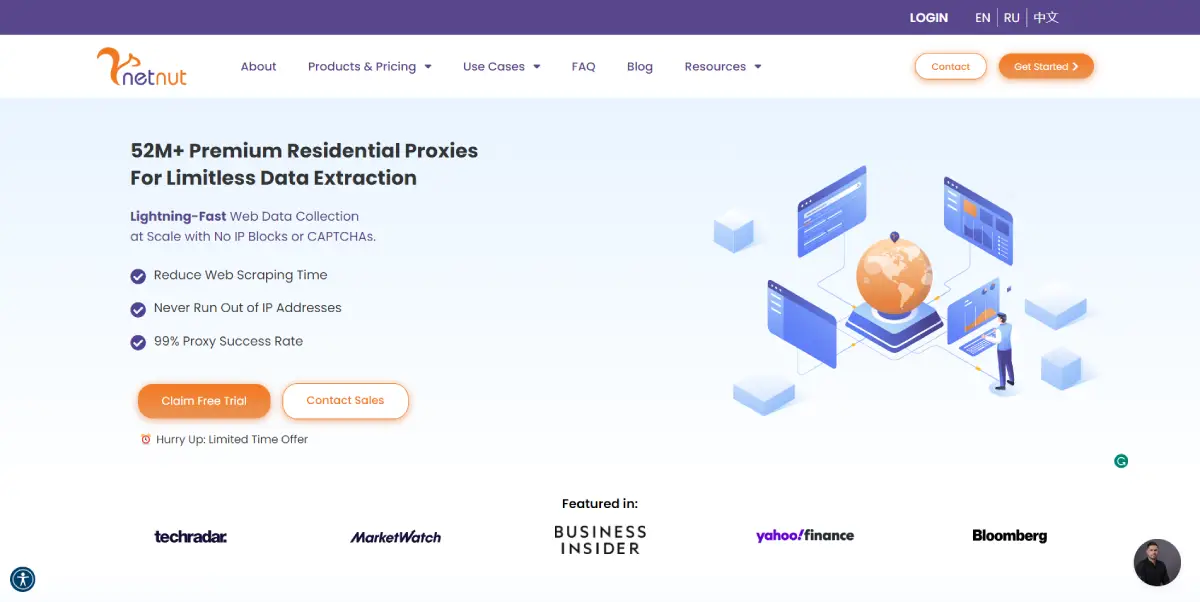
NetNut is an Israeli proxy network and web data infrastructure provider founded in 2017, now operating as a subsidiary of Alarum Technologies (NASDAQ: ALAR). Its flagship differentiator is the DiViNetworks ISP backbone — a direct commercial relationship with internet service providers that lets NetNut source IP addresses without routing through peer-to-peer residential networks.
The platform covers four core proxy products plus a suite of scraper APIs:
- Rotating Residential Proxies — 85M+ IPs across 195+ countries; targeting down to city, state, and ASN
- Static Residential (ISP) Proxies — 1M+ always-online ISP IPs across 30+ countries via DiViNetworks
- Mobile Proxies — 5M+ 3G/4G/5G/LTE IPs across 100+ countries
- Datacenter Proxies — 150K+ IPs across 200+ locations, starting at $1.00/GB
- Website Unblocker — CAPTCHA-solving, browser fingerprinting, 100% success rate claim
- SERP Scraper API and B2B Data Scraper API — contact sales for pricing
- Professional Profile Datasets (250M profiles) and Company Datasets (50M companies)
Company Background & DiViNetworks
NetNut was founded in 2017 and acquired by Alarum Technologies, which is listed on the NASDAQ under the ticker ALAR. That public listing is genuinely unusual in the proxy industry — most proxy providers are private with no audited financials. Alarum’s annual reports are publicly accessible, which means NetNut’s operational scale and revenue claims are verifiable in a way that competitors’ claims are not.
The DiViNetworks subsidiary is the technical core of NetNut’s ISP proxy advantage. DiViNetworks operates a network of agreements with internet service providers under which ISPs share idle, unused bandwidth. The resulting IPs have direct one-hop ISP connectivity — there is no end-user device sitting between your request and the internet. That architecture means the IPs are always online (no peer device going offline), have real browsing history attached to the address, and can theoretically run in parallel alongside actual residential users on the same ISP allocation.
As of 2026, NetNut serves 3,500+ customers worldwide, routes 500B+ monthly requests, and holds G2’s #1 Web Data Provider ranking with badges for Best Support, Best Relationship, Best Usability, Easiest Setup, and EMEA Leader — among others. Enterprise clients include Lenovo, RocketReach, Sterling Check, Apify, Import.io, and PriceLabs.
Who Is NetNut For?
✓ Ideal Users
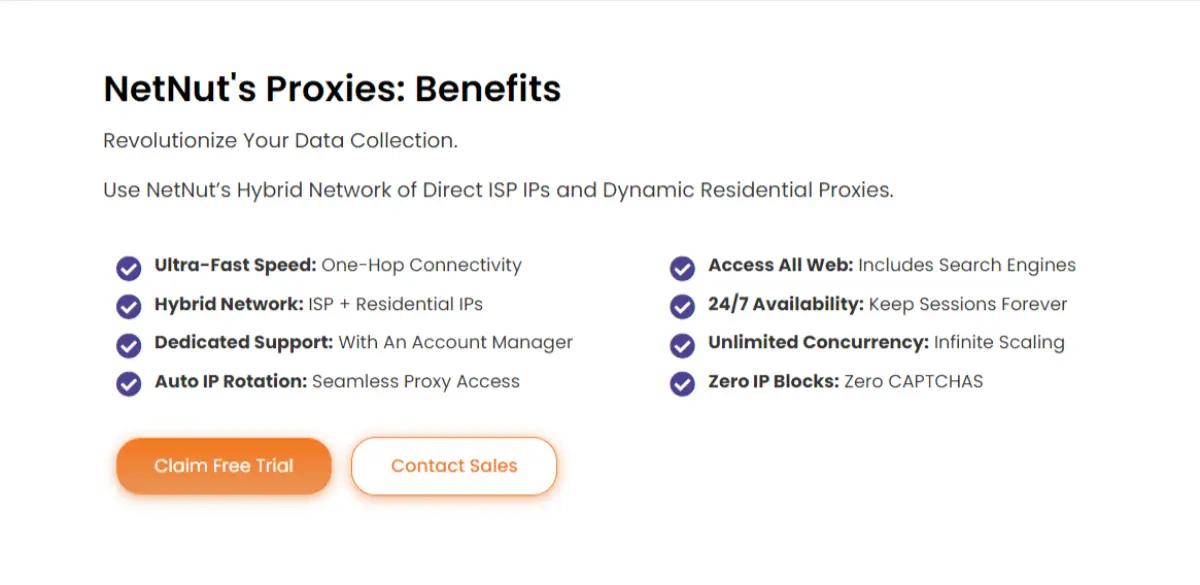
NetNut is built for organizations that treat proxy infrastructure as a production dependency, not a monthly experiment. Its pricing and feature set signal enterprise intent. If you’re on this list, you’ll likely get strong value:
- Enterprise Data Teams — Large-scale market research, alternative data collection, price intelligence, and travel aggregation pipelines that require consistent uptime and SLA guarantees. NetNut’s 99.99% uptime claim and NASDAQ-listed parent back up the reliability promise.
- SEO & SERP Monitoring Agencies — Tracking keyword rankings across locations at scale. NetNut’s SERP Scraper API and 195+ country residential coverage handle geo-targeted rank tracking from country down to city level.
- Ad Verification Specialists — Checking that ads display correctly in specific markets without triggering fraud detection. ISP proxies with direct connectivity are harder for ad platforms to fingerprint as proxy traffic.
- Account Management Operations — Businesses that need stable, persistent IP identities for account-based tasks. The static ISP pool’s always-online nature means an IP assigned to an account today will be available tomorrow — unlike peer-sourced IPs that go offline when the end-user’s device sleeps.
- Brand Protection & Threat Intelligence Teams — Monitoring for unauthorized product listings, phishing domains, or counterfeit goods across markets. NetNut’s broad residential and ISP coverage gives a realistic global view of what site visitors in different countries actually see.
- Proxy Resellers — NetNut has a dedicated reseller program and sub-user management in the dashboard with granular usage controls. The API-first design makes white-labeling and resale practical.
✗ Not Ideal For
Skip NetNut if you:
- Want pay-as-you-go flexibility — every NetNut product is subscription-only, with no PAYG option and no traffic top-up if you run out mid-month
- Have a budget under $99/month — that’s the universal entry price across all four core products (consider IPRoyal or NodeMaven for lower-cost entry points)
- Need ISP proxies outside the US and Europe — the static residential pool covers only 30+ countries
- Plan to scrape Amazon heavily on datacenter proxies — Proxyway’s April 2025 tests found only a 22.93% Amazon success rate on NetNut datacenter IPs
- Prefer to test before committing — the 7-day free trial requires KYC and is gated to business/company accounts only
NetNut Features & What You Get
NetNut’s feature architecture is designed for enterprise-grade data operations. Here’s what you actually get across the four core proxy products:
Core Proxy Networks
- Rotating Residential Proxies: 85M+ IPs, 195+ countries, targeting by country, state, city, and ASN. HTTP/HTTPS/SOCKS5 protocols. Unlimited concurrent connections. Sticky sessions up to 1 hour via
nnidtoken. - Static Residential (ISP) Proxies: 1M+ always-online ISP IPs sourced via DiViNetworks, 30+ countries, direct one-hop connectivity. No peer devices in the routing chain. 99.99% network uptime.
- Mobile Proxies: 5M+ 3G/4G/5G/LTE IPs across 100+ countries. Rotating or sticky sessions. Country and ASN targeting (no city-level targeting due to smaller pool size).
- Datacenter Proxies: 150K+ IPs across 200+ locations. Starting at $1.00/GB — NetNut’s lowest entry point per GB. Best for non-contested high-volume scraping.
NetNut’s DiViNetworks ISP Backbone — Core Differentiator
What makes DiViNetworks ISP proxies different:
- Direct ISP sourcing: NetNut pays ISPs directly for unused bandwidth — no end-user peer device sits between your request and the internet
- Always online: Unlike peer-sourced IPs, ISP addresses don’t go offline when a home user’s device sleeps or disconnects
- Real browsing history: IPs have genuine ISP-attached history, making them harder to fingerprint as proxy traffic
- One-hop latency: ISP proxies averaged 0.46s response time in Proxyway testing — faster than peer residential (0.68–1.49s by gateway)
- B2B compliance: Commercial ISP agreements avoid the peer-consent GDPR ambiguities that plague P2P residential networks. Apify COO Ondra Urban specifically cited this in a testimonial.
Session & Rotation Options
- Every-request rotation: New IP per request — maximum speed for high-volume scraping
- Sticky sessions (residential/ISP/mobile): Maintain the same IP for a session using a session ID; up to 1 hour max on residential via
nnidtoken - Datacenter sticky: Bind to same IP indefinitely within a session
- Important limitation: You cannot combine country + ASN targeting simultaneously on any product
Protocols & Authentication
- Protocols: HTTP, HTTPS, and SOCKS5 on all four core products
- Concurrency: Unlimited simultaneous connections on all plans
- Authentication: Username/password credentials or IP whitelisting (whitelist may require manual setup on ISP and datacenter plans)
- Single gateway endpoint: All products route through
gw.ntnt.io:5959, with proxy type selected via the username string prefix (-res,-stc,-mob,-dc)
Dashboard, Analytics & Management Tools
- Proxy Generator widget builds credential strings automatically based on your targeting selections
- Granular usage reports: filter by date range, country, domain, and connection error type
- API access for programmatic proxy management and real-time usage statistics
- Sub-account management with individual traffic limits — designed for reseller and team operations
- Network SLA page with uptime commitments
Scraper API Suite (Contact Sales for Pricing)
- Website Unblocker: 100% success rate claim, CAPTCHA solving, dynamic browser fingerprinting, automatic IP rotation and retry
- SERP Scraper API: Structured SERP data tailored by location, language, and device type
- B2B Data Scraper API: Real-time company and professional profile extraction; pay only for successful results
Compliance & Certifications
- ISO certified (certificate publicly available at netnut.io)
- GDPR compliant
- Patented proxy technology
- NASDAQ-listed parent Alarum Technologies (audited financials, publicly available)
How NetNut Works (Step-by-Step)
Getting a NetNut account live takes longer than budget providers — there’s KYC involved for residential plans. But once onboarded, the proxy setup itself is straightforward. Here’s the full flow:
Step 1: Apply for a Trial or Plan
Register at dashboard.netnut.io. For business and enterprise plans, you’ll complete a KYC form — company name, use case, and contact details. NetNut’s 7-day free trial is available to business customers who complete this process. If you just want to browse pricing first, the product pages list all plan tiers publicly. Contact sales via [email protected] or the on-site call scheduler for custom volume pricing or the 3/6/12-month long-term discount rates.
Step 2: Choose Your Product and Plan
Pick the product type that fits your use case. Rotating residential at $99/28 GB is the starting point for web scraping and market research. Static ISP at $99/7 GB is for tasks that need persistent IP identity. Mobile at $99/13 GB covers mobile-specific platforms. Datacenter at $100/100 GB is the cost-efficient choice for less contested targets. Annual billing saves approximately 15% across all products.
Step 3: Generate Your Proxy Credentials
In the dashboard, open the Proxy Generator widget. Select your proxy type, target location, and session preference. The widget assembles the full credential string for you. For example, a rotating US residential proxy looks like:
USERNAME-res-sc-us:[email protected]:5959
For a static ISP proxy with a sticky session ID:
USERNAME-stc-sid-12345:[email protected]:5959
Step 4: Integrate With Your Stack
Drop the credentials into your scraping framework (Scrapy, Playwright, Puppeteer, Selenium), your antidetect browser profile, or any HTTP client that supports proxy configuration. NetNut’s documentation at help.netnut.io includes integration examples for common programming languages and frameworks. The single gateway address (gw.ntnt.io:5959) keeps configuration simple across product types.
Step 5: Monitor Usage and Optimize
Track consumption via the dashboard’s analytics panel — filter by date, country, domain, and error type. Sub-users each get their own traffic allocation and reporting view, making team and reseller management clean. If you approach your plan limit mid-month, note that no top-up is available — you must wait for renewal or upgrade to the next plan tier. Plan your bandwidth allocation conservatively.
Bottom line: NetNut’s onboarding is heavier than PAYG providers because of KYC, but that friction also means you get a dedicated account manager, proper SLA documentation, and a support team that treats you as a business account rather than a self-service customer. For enterprise data operations, that trade-off makes sense.
NetNut Pricing & Plans
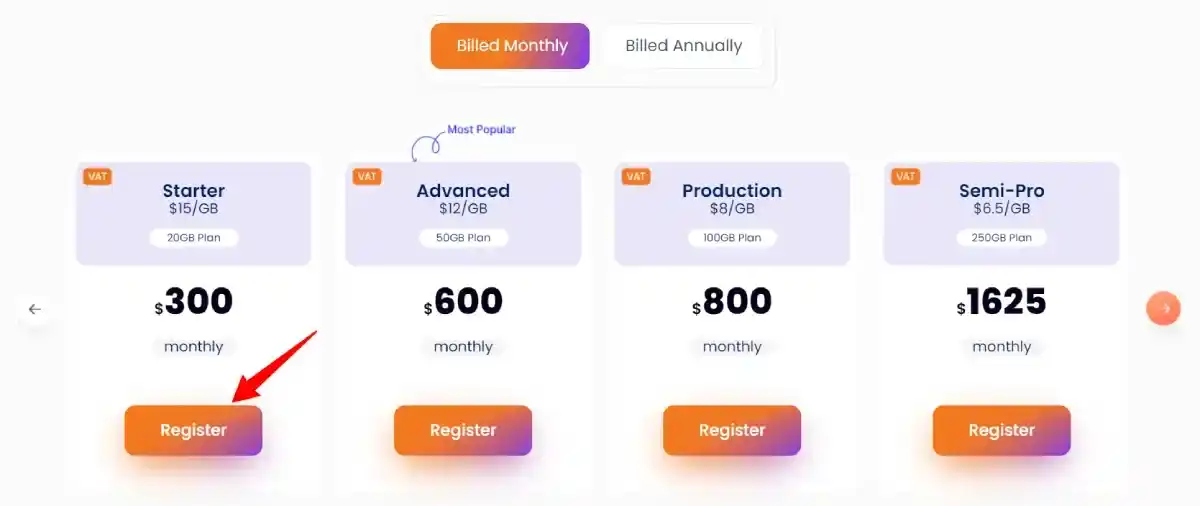
NetNut uses subscription-only pricing across all four core products — there is no pay-as-you-go option and no traffic top-up if you exhaust your allocation before renewal. Annual billing saves approximately 15% vs monthly. All prices are confirmed from live product pages scraped May 2026. VAT is additional where applicable.
Rotating Residential Proxy Pricing
| Plan | GB/Month | Monthly Billing | Annual Billing (per mo) | Effective $/GB (Annual) |
|---|---|---|---|---|
| Starter | 28 GB | $99 | $84 | $3.00/GB |
| Advanced | 72 GB | $249 | $210 | $2.93/GB |
| Production | 150 GB | $499 | $423 | $2.82/GB |
| Semi-Pro | 350 GB | $999 | $850 | $2.43/GB |
| Professional | 800 GB | $1,999 | $1,696 | $2.12/GB |
| Master | 2,000 GB | $3,750 | $3,180 | $1.59/GB |
Static Residential (ISP) Proxy Pricing
| Plan | GB/Month | Monthly Billing | Annual Billing (per mo) | Effective $/GB (Annual) |
|---|---|---|---|---|
| Starter | 7 GB | $99 | $84 | $12.00/GB |
| Advanced | 20 GB | $250 | $213 | $10.65/GB |
| Production | 50 GB | $499 | $424 | $8.48/GB |
| Semi-Pro | 125 GB | $999 | $849 | $6.79/GB |
| Professional | 350 GB | $1,999 | $1,699 | $4.85/GB |
| Master | 1,000 GB | $4,500 | $3,825 | $3.82/GB |
Mobile Proxy Pricing
| Plan | GB/Month | Monthly Billing | Annual Billing (per mo) | Effective $/GB (Annual) |
|---|---|---|---|---|
| Starter | 13 GB | $99 | $84 | $6.46/GB |
| Advanced | 34 GB | $250 | $213 | $6.24/GB |
| Production | 72 GB | $499 | $424 | $5.88/GB |
| Semi-Pro | 163 GB | $999 | $849 | $5.20/GB |
| Professional | 340 GB | $1,999 | $1,699 | $4.99/GB |
| Master | 1,000 GB | $4,500 | $3,825 | $3.82/GB |
Datacenter Proxy Pricing
| Plan | GB/Month | Monthly Billing | Annual Billing (per mo) | Effective $/GB (Annual) |
|---|---|---|---|---|
| Starter | 100 GB | $100 | $90 | $0.90/GB |
| Advanced | 250 GB | $185 | $166 | $0.66/GB |
| Production | 500 GB | $350 | $315 | $0.63/GB |
| Semi-Pro | 750 GB | $450 | $405 | $0.54/GB |
| Professional | 1,000 GB | $500 | $450 | $0.45/GB |
| Master | 2,000 GB | $1,000 | $900 | $0.45/GB |
Important pricing notes:
- No pay-as-you-go option on any product — you’re committing to a monthly or annual subscription
- No top-up available — if you run through your allocation mid-month, you must wait for renewal or upgrade your plan tier
- ISP proxies start at $99 for only 7 GB ($14.40/GB monthly) — steep entry price for low-volume use. Rates become more competitive above 100 GB
- Datacenter proxies at $0.45/GB annually (Professional and Master tiers, 1,000 GB+) are highly competitive but Amazon success rates were only 22.93% in Proxyway tests — not ideal for contested e-commerce targets
- 3/6/12-month long-term plans available at additional discount — contact [email protected]
- Proxyway discount code Proxyway reportedly provides 30% off — confirm with sales
- VAT is additional where applicable
- Scraper APIs (Website Unblocker, SERP Scraper API, B2B Data Scraper) are billed per request — pricing requires contacting sales or checking the dashboard
Trial: A 7-day free trial is available for verified business customers. You’ll need to complete a KYC form with company details and use case information. Contact sales to initiate the trial. This is one of the more generous free trials in the enterprise proxy space, but it is not available to individual or unverified accounts.
NetNut Proxies: Pros & Cons
Pros ✓
- Largest ISP proxy pool on the market: 1M+ always-online static ISP IPs, confirmed by Proxyway as the largest tested ISP pool in the industry
- DiViNetworks direct ISP sourcing: One-hop connectivity, no end-user devices in routing chain, always-available IPs with real browsing history attached
- 85M+ residential IPs, 195+ countries: Among the largest residential pools with particularly strong US (470K unique IPs) and UK (351K unique IPs) coverage
- Publicly traded parent company: Alarum Technologies (NASDAQ: ALAR) provides audited financial transparency rare in the proxy industry
- 7-day free trial for businesses: A real free trial, not a paid one — genuinely lets you validate the product before committing $99+/month
- G2 #1 Web Data Provider: Multiple G2 badges including Best Support, Best Relationship, Easiest Setup, and EMEA Leader
- Granular analytics: Dashboard filtering by date, country, domain, and error type — enterprise-grade usage visibility
- ISO certified & GDPR compliant: Patented technology with documented compliance posture
- Sub-account management with API: Designed for team and reseller operations
- Competitive datacenter rates: $0.45–$1.00/GB for high-speed datacenter proxies
- 500B+ monthly requests: Proven at enterprise scale
Cons ✗
- No PAYG option: Subscription-only on every product — no flexibility for irregular or one-off use
- No traffic top-up: Exhaust your plan mid-month and you wait or upgrade — there’s no adding extra GB
- $99/month entry price on all products: Individual developers and small teams are effectively priced out
- ISP pool limited to 30+ countries: Static residential coverage is strong in the US and Europe but limited beyond that
- Datacenter Amazon success rate of 22.93%: Proxyway’s April 2025 test found the datacenter pool struggles with contested e-commerce targets — pool likely overused
- Mobile pool quality caveat: Proxyway found that the default mobile pool included many non-mobile IPs; a cleaner pool required a separate request to support
- KYC required for trial: Free trial gated behind business verification — not self-serve
- Scraper API pricing opaque: Website Unblocker, SERP Scraper API, and B2B scraper pricing requires contacting sales or accessing the dashboard
- 1-hour max sticky sessions on residential: Less flexible than providers offering 24-hour sticky sessions for account management work
Bottom Line: NetNut’s strengths are concentrated in two areas: the DiViNetworks ISP backbone (uniquely strong for static residential use) and raw residential pool scale (85M+ IPs with verified geo coverage). Its weaknesses are structural — no PAYG, no top-up, $99/month minimum — making it an enterprise tool, not a general-purpose proxy service. If your budget and use case fit, it’s one of the best-sourced networks available. If you need flexibility over scale, look at Bright Data, Oxylabs, or our Decodo review for a PAYG-friendly alternative.
NetNut vs Bright Data & Oxylabs: Side-by-Side
NetNut competes directly with Bright Data and Oxylabs in the enterprise proxy space. Here’s how the numbers stack up — and where each provider wins:
NetNut vs Bright Data
| Feature | NetNut | Bright Data |
|---|---|---|
| Residential Pool | 85M+ IPs | 150M+ IPs |
| Countries (Residential) | 195+ | 195+ |
| ISP/Static Residential Pool | 1M+ (largest tested by Proxyway) | Separate ISP product, smaller pool |
| ISP Sourcing Model | DiViNetworks (direct ISP agreements) | Mixed sourcing |
| Starting Price (Residential) | $99/mo (28 GB) | $500/mo (69 GB); PAYG from $8.40/GB |
| Pay-As-You-Go | No | Yes |
| Free Trial | 7 days (business KYC required) | No free trial (pay-as-you-go available) |
| Residential Success Rate | 96–99% (Proxyway, April 2025) | ~99%+ (Proxyway tests) |
| Scraper API Suite | Website Unblocker, SERP, B2B APIs | Web Scraper IDE, SERP API, full no-code scrapers |
| Parent Company | Alarum Technologies (NASDAQ: ALAR) | Bright Data Ltd. (private) |
| Best For | ISP proxies, enterprise data, subscription teams | Maximum flexibility, largest pool, PAYG use |
Winner for ISP Pool: NetNut (1M+ direct-ISP IPs, largest verified pool) | Winner for Residential Pool Size: Bright Data (150M+ vs 85M+) | Winner for Flexibility: Bright Data (PAYG available; NetNut is subscription-only) | Winner for Entry Price: NetNut ($99/mo subscription vs Bright Data’s $500/mo subscription — though Bright Data has PAYG from $8.40/GB)
NetNut vs Oxylabs
| Feature | NetNut | Oxylabs |
|---|---|---|
| Residential Pool | 85M+ IPs | 100M+ IPs |
| Countries (Residential) | 195+ | 195+ |
| ISP/Static Residential | 1M+ always-online (DiViNetworks) | Separate ISP product |
| Starting Price (Residential) | $99/mo (28 GB) | $99/mo (9 GB); $8.00/GB PAYG |
| Pay-As-You-Go | No | Yes ($8.00/GB residential) |
| Residential Success Rate | 96–99% (Proxyway) | ~99%+ (Proxyway) |
| Datacenter Pricing | From $0.45/GB (annual) | From ~$0.30/GB at high volume |
| Scraper APIs | Website Unblocker, SERP, B2B | Web Scraper API (full structured output) |
| Free Trial | 7 days (business KYC) | 7-day trial (residential, $49 refundable deposit) |
| G2 Rating | #1 Web Data Provider (G2) | High ratings across G2 categories |
| Best For | ISP proxies, enterprise scraping, SERP monitoring | Broad proxy suite, structured scraper APIs, PAYG flexibility |
Winner for ISP Pool: NetNut (larger, direct-ISP sourced) | Winner for PAYG Flexibility: Oxylabs ($8.00/GB residential PAYG available; NetNut has none) | Winner for Datacenter Rates: Oxylabs at high volume | Winner for Residential Entry Value: NetNut ($99/28 GB vs Oxylabs $99/9 GB for subscription)
🏆 Choose NetNut When:
- You specifically need static ISP/residential proxies with always-online availability
- Your use case demands direct ISP connectivity and GDPR-compliant sourcing
- You’re running enterprise-scale scraping and want a NASDAQ-listed provider with audited financials
- You need strong US and UK residential coverage with high success rates
- You’re a reseller or team needing sub-user management with API access
- You want a 7-day free trial before committing to enterprise pricing
🔍 Choose Competitors When:
- You want pay-as-you-go flexibility — Bright Data, Oxylabs, and Decodo all offer PAYG
- Your budget is under $99/month — IPRoyal and NodeMaven have no sub-$99 barrier
- You need ISP proxies outside the US and Europe — NetNut’s static pool covers only 30+ countries
- You want a larger raw residential pool — Bright Data’s 150M+ beats NetNut’s 85M+
- You need to scrape Amazon at scale via datacenter — Oxylabs or Bright Data perform better on contested e-commerce targets
NetNut Ratings Breakdown
Here’s our category-by-category evaluation based on Proxyway performance benchmarks (April 2025), G2 reviews, and verified pricing data:
| Category | Score | Notes |
|---|---|---|
| Pool Size & Coverage | 4.5/5 | 85M+ residential IPs with 470K unique US IPs and 351K UK IPs confirmed by Proxyway. Largest ISP pool verified. Weaker ISP geographic spread (30+ countries vs 195+ for residential). |
| Performance & Reliability | 4.4/5 | 96–99% residential success rate by gateway (Proxyway). ISP proxies averaged 0.46s response time. Datacenter Amazon success only 22.93% — a notable weak spot for e-commerce. |
| Pricing & Value | 3.8/5 | Subscription-only with no PAYG or top-up. $99/month entry price across all products. Competitive at volume (residential Master: $1.59/GB annual). ISP entry pricing ($14.40/GB monthly) is steep for small volumes. |
| Dashboard & UX | 4.2/5 | Proxy Generator widget simplifies credential setup. Granular analytics with domain-level and error-type filtering. Sub-user management and API strong for enterprise use. KYC onboarding adds friction. |
| Customer Support | 4.5/5 | G2 “Best Support” badge. Dedicated account manager on enterprise plans. Contact via [email protected], Telegram (@netnut.sales), Discord, and call scheduler. Multiple language support (English, Russian, Chinese). |
| Trust & Compliance | 4.8/5 | NASDAQ-listed parent (Alarum Technologies) with audited financials. ISO certified. GDPR compliant. Patented technology. Featured in TechRadar, Bloomberg, Business Insider. Trusted by Fortune 500 clients. |
| Overall Rating | 4.4/5 | Top-tier for enterprise ISP and residential proxies. Subscription-only pricing limits accessibility for smaller teams. |
Rating Summary: NetNut scores highest on trust and compliance (4.8/5) and pool coverage/support (both 4.5/5) — exactly the metrics that matter to enterprise buyers. The weakest score is pricing flexibility (3.8/5) because subscription-only billing with no PAYG or top-up creates real constraints for teams with variable bandwidth needs. For organizations that can commit to monthly or annual plans at scale, the per-GB rates at 800 GB+ are genuinely competitive with the market.
Is NetNut Worth It? Legitimacy, Safety & Verdict
Legitimacy & Safety
- ✓ NASDAQ-listed parent company — Alarum Technologies (NASDAQ: ALAR) is publicly traded with audited annual reports. This level of financial transparency is essentially unique in the proxy industry. The company’s operational scale is verifiable, not just claimed.
- ✓ Founded 2017, 8+ years of operation — One of the older proxy providers in a market where new entrants appear and disappear frequently. Eight years of continuous operation with Fortune 500 clients speaks to operational stability.
- ✓ ISO certified & GDPR compliant — Certificate publicly available at netnut.io. Compliance documentation matters particularly for enterprise buyers with procurement requirements.
- ✓ Patented technology — DiViNetworks’ ISP sourcing model is a patented, documented technical approach — not just a marketing claim about “premium IPs.”
- ✓ G2 #1 Web Data Provider — Rated by verified business customers across multiple G2 categories including Best Support, Easiest Setup, and Best Relationship. 4.2/5 on Trustpilot from 187 reviews.
- ✓ KYC verification — Requiring business verification for the free trial and certain plans reduces the chance of sharing the pool with low-quality or abusive users.
Long-Term Reliability
NetNut’s backing by Alarum Technologies gives it financial runway that pure-play private proxy startups lack. The NASDAQ listing means quarterly reporting obligations and external audit scrutiny — a proxy provider can’t quietly fold without public disclosure. Its 3,500+ enterprise customer base and 500B+ monthly requests indicate production-scale infrastructure, not a small operation.
The DiViNetworks ISP model also has a structural advantage: ISP bandwidth agreements create stable, contractual infrastructure rather than relying on voluntary peer device participation. When an ISP agrees to share bandwidth, that arrangement is typically multi-year and doesn’t fluctuate based on whether end-users feel like keeping an app installed.
Reality check: NetNut’s mobile proxy pool had a documented quality issue in Proxyway’s April 2025 test — the default pool contained many non-mobile IPs, and a cleaner mobile-only pool required a separate request to the support team. This suggests the mobile product is less mature than the residential and ISP products. If mobile proxies are your primary need, verify pool composition with sales before committing to a subscription.
Worth It? Final Verdict
✓ YES, NetNut Is Worth It If:
- You need static residential (ISP) proxies with always-online availability — NetNut has the largest verified ISP pool
- GDPR compliance and ISO certification are procurement requirements for your organization
- You’re running enterprise-scale residential scraping in the US, UK, or EU where NetNut’s pool is thickest
- Financial transparency matters — working with a NASDAQ-listed provider removes vendor risk from your procurement conversation
- You consume 150 GB+ per month where subscription rates become genuinely competitive ($2.82/GB annually for residential)
- You have a team or reseller operation that needs sub-account management and API-based proxy control
✗ NO, Look Elsewhere If:
- You want flexibility — there is no PAYG option and no mid-month top-up on any product
- Your budget is under $99/month — the entry price is the same across all four products
- You need ISP proxies in Asia, Latin America, or Africa — coverage is limited to ~30 countries (US and Europe focus)
- Mobile proxies are your primary need — the default pool quality issue requires active verification with support (see our ProxyEmpire review for a mobile-first alternative)
- You plan to scrape Amazon or other protected e-commerce sites on datacenter proxies — 22.93% success rate is commercially unviable
Our Recommendation: NetNut earns its 4.4/5 rating through genuine technical differentiation — the DiViNetworks ISP backbone is the best-documented, independently verified ISP proxy architecture in the market. The 85M+ residential pool and strong G2 enterprise reputation back up the core promise. For enterprise data teams, SEO agencies, and ad verification specialists working at scale in the US and Europe, it’s a top-tier choice. If you’re a business customer, take the 7-day free trial before committing — it’s a real free trial, not a paid one, and it’s the best way to validate whether the network fits your specific targets.
If your team is smaller, your budget is tighter, or you need PAYG flexibility, Oxylabs (starting at $99/mo with PAYG available) or Bright Data (PAYG from $8.40/GB) will serve you better without the subscription commitment.
NetNut Proxies Review: Frequently Asked Questions
What is NetNut and what makes it different from other proxy providers?
NetNut is an Israeli proxy network founded in 2017, owned by Alarum Technologies (NASDAQ: ALAR). Its main differentiator is the DiViNetworks ISP backbone — a network of direct commercial agreements with internet service providers that provides always-online static residential (ISP) IPs without routing through end-user devices. This gives ISP proxies direct one-hop connectivity, real browsing history, and permanent availability compared to peer-sourced residential proxies that go offline when home users’ devices disconnect. NetNut also operates an 85M+ rotating residential pool, 5M+ mobile IPs, and 150K+ datacenter IPs, plus a scraper API suite.
How much does NetNut cost?
NetNut has a $99/month entry price across all four core products. Specifically:
- Rotating Residential: $99/mo for 28 GB ($3.53/GB monthly); $84/mo annually ($3.00/GB)
- Static Residential (ISP): $99/mo for 7 GB ($14.40/GB monthly); $84/mo annually ($12.00/GB)
- Mobile: $99/mo for 13 GB ($7.60/GB monthly); $84/mo annually ($6.46/GB)
- Datacenter: $100/mo for 100 GB ($1.00/GB monthly); $90/mo annually ($0.90/GB)
There is no pay-as-you-go option and no traffic top-up. Annual billing saves approximately 15%.
Does NetNut offer a free trial?
Yes — NetNut offers a genuine 7-day free trial, not a paid one. The trial requires KYC verification: you need to provide company details and use case information. Individual or unverified accounts cannot access the trial. Contact [email protected] or use the call scheduler on the site to initiate. This is one of the more generous free trials in enterprise proxy services, assuming you qualify as a business customer.
What is the DiViNetworks ISP backbone and why does it matter?
DiViNetworks is a NetNut subsidiary that has commercial agreements with internet service providers to access idle, unused ISP bandwidth. This means NetNut’s static residential (ISP) proxies don’t route through peer-to-peer networks of residential devices — they connect directly via ISP infrastructure. The practical benefits: IPs are always online (no device going to sleep), have real browsing history attached, have faster response times (0.46s average vs 0.68–1.49s for rotating residential), and are sourced in a way that avoids the GDPR consent ambiguities of P2P residential networks. Apify COO Ondra Urban specifically cited the compliance benefit in a testimonial.
How does NetNut perform in independent tests?
Based on Proxyway’s April 2025 benchmark:
- Rotating Residential: 96–99% success rate by gateway; 0.68–1.49s average response time; 470,287 unique US IPs and 351,592 unique UK IPs confirmed
- Static ISP: 93.63% average success rate (Proxyway Oct 2023); 0.46s response time — fastest of the four products
- Mobile: 97–99% success rate in most geos; default pool contained non-mobile IPs — request a dedicated mobile pool
- Datacenter: 96.54% average on US gateway but only 22.93% on Amazon specifically — the shared pool is burned on contested e-commerce targets
Is NetNut good for SERP monitoring and SEO work?
Yes — SERP monitoring is one of NetNut’s core stated use cases and it handles it well. The 85M+ residential pool with city-level targeting across 195+ countries lets you check rankings from specific geos accurately. NetNut also offers a dedicated SERP Scraper API that returns structured SERP data by location, language, and device type — contact sales for pricing. For SEO agencies tracking rankings across many markets, the residential pool’s breadth and consistency make it a strong choice.
Can I use NetNut for social media and account management?
Yes, but with one important limitation: rotating residential proxies have a maximum sticky session of 1 hour, which is shorter than providers like Bright Data or SOAX that offer up to 24-hour sticky sessions. For account management tasks that need persistent IP identity over hours or days, the static ISP proxies are the better fit — they’re always online and maintain the same IP address for as long as you need. The downside is the ISP pool only covers 30+ countries, so geographic flexibility is limited. If you specifically need ISP proxies for high-frequency bot tasks, compare with our HypeProxies review for a niche ISP proxy option aimed at that use case.
What happens if I run out of traffic before my renewal date?
NetNut does not offer a traffic top-up option on any product. If you exhaust your monthly allocation before renewal, your options are to wait for the next billing cycle or upgrade to a higher plan tier. There is no PAYG credit system and no way to add extra gigabytes without changing your plan. For this reason, teams with variable or unpredictable usage should budget conservatively — overestimate your needs or choose a plan tier with a buffer.
How does NetNut compare to Bright Data for enterprise use?
Bright Data has a larger residential pool (150M+ vs 85M+ IPs) and offers pay-as-you-go pricing from $8.40/GB alongside its subscription plans. NetNut’s key advantages over Bright Data are: the DiViNetworks ISP backbone (larger, always-online ISP pool), NASDAQ-listed financial transparency (Bright Data is private), lower subscription entry price ($99/mo vs Bright Data’s $500/mo subscription tier), and a genuine free trial. If you specifically need ISP proxies at scale or want audited financials, NetNut is the stronger choice. For maximum residential pool size and PAYG flexibility, Bright Data wins. For a mid-range alternative with PAYG and solid residential coverage, see our Infatica review.
What payment methods does NetNut accept?
NetNut accepts PayPal, Visa, Mastercard, American Express, bank wire transfer, and Bitcoin (cryptocurrency). This covers most enterprise procurement workflows. Note that VAT is additional where applicable, so European business customers should factor that into budget planning.
Is NetNut suitable for scraping Amazon and e-commerce sites?
For e-commerce scraping, the answer depends on which proxy product you’re using. Rotating residential proxies perform well at 96–99% success rates overall and handle most e-commerce targets effectively. Datacenter proxies, however, showed only a 22.93% Amazon success rate in Proxyway’s April 2025 tests — the shared datacenter pool is overused on contested targets. If Amazon scraping at scale is your primary need, use the residential plan, not the datacenter plan, and expect to pay the residential pricing ($3.00+/GB).
How do I cancel my NetNut subscription?
Contact NetNut’s support team via live chat, email ([email protected]), Telegram (@netnut.sales), or Discord to manage your subscription or cancellation. Since NetNut uses subscription billing without a self-serve cancel button confirmed in the public documentation, direct communication with the support team is the recommended path. Given the G2 “Best Support” rating and dedicated account manager model, response times should be prompt. Request cancellation before your next renewal date to avoid being charged for another cycle.
NetNut Review: Final Verdict
NetNut is a legitimate, enterprise-grade proxy network with a genuinely defensible technical advantage in the ISP proxy space. The DiViNetworks backbone is the best-documented direct-ISP sourcing model in the market, and Proxyway’s independent verification confirms that the 85M+ residential pool and 1M+ ISP pool deliver on their headline claims. NASDAQ-listed parent Alarum Technologies adds a layer of financial credibility that no private-company competitor can match. If you’re running production-scale data operations that depend on reliable, compliant proxy infrastructure, NetNut belongs on your shortlist.
The trade-off is structural. Subscription-only billing, no PAYG, no top-up, and a $99/month floor price make this a tool for organizations with predictable bandwidth needs and enterprise budgets. Individual developers, small teams testing proxy workflows, or anyone who needs billing flexibility will find better entry points with providers like NodeMaven, Decodo, or Infatica.
✓ What We Love
- DiViNetworks ISP backbone — largest verified always-online ISP pool (1M+)
- 85M+ residential IPs with confirmed strong US and UK coverage
- NASDAQ-listed parent (Alarum Technologies) with audited financials
- ISO certified, GDPR compliant, patented technology
- 7-day genuinely free trial for business customers
- G2 #1 Web Data Provider with multiple Best Support badges
- Granular analytics: domain-level and error-type filtering
- Sub-account management and API for enterprise/reseller operations
- Trusted by Fortune 500 clients (Lenovo, Apify, RocketReach)
✗ What Could Be Better
- No PAYG option on any product — subscription-only billing
- No traffic top-up — exhaust your plan and wait until renewal
- $99/month minimum across all products — no low-budget entry
- ISP pool limited to 30+ countries (US and Europe focus)
- Datacenter Amazon success rate only 22.93% on contested targets
- Mobile pool required manual support request for clean IP pool
- Scraper API pricing not public — requires sales contact
- 1-hour max sticky sessions on residential (vs 24h on some competitors)
Ready to Test NetNut’s ISP-Backbone Proxies?
Business customers get a 7-day free trial — validate the network against your actual targets before committing to a subscription.
Start Your NetNut Free Trial →