
Private Internet Access Review:
The Most Configurable VPN in 2026 (Proven No-Logs)
Our Private Internet Access (PIA VPN) review covers court-proven no-logs, open-source apps, 29,650+ servers in 91 countries, and pricing from just $1.33/month.
⚡ Quick Verdict
Private Internet Access (PIA) is the only major VPN whose no-logs policy has been proven in federal court — not once, but three times. Add 29,650+ servers across 91 countries, unlimited simultaneous connections, 100% open-source apps, and a price that bottoms out at $1.33/month, and you get one of the most credible privacy tools available in 2026. The power-user configuration options go deeper than any comparable VPN. The tradeoff is a US jurisdiction and an interface that can overwhelm beginners.
Privacy-focused users, torrent enthusiasts, power users wanting maximum control
Most VPN companies ask you to trust their no-logs claims. Private Internet Access doesn’t have to ask. In this Private Internet Access review, the evidence speaks for itself: in 2016, the FBI subpoenaed PIA for user records in a criminal investigation. PIA handed over nothing — because there was nothing to hand over. That happened again in 2016 during a Russian server seizure, and a third time in 2018 with another US government request. Three real-world tests. Zero user data produced.
That track record is PIA’s biggest selling point. It’s rare and it matters — especially when you’re trusting a VPN with everything you do online.
Beyond privacy, PIA gives you 29,650+ servers across 91 countries, unlimited simultaneous device connections, WireGuard and OpenVPN support with user-selectable encryption strength, a built-in ad and tracker blocker, port forwarding, and apps that are 100% open source. The starting price is $1.33/month on the three-year plan. There’s not much on the market that competes with that combination.
There are genuine trade-offs to discuss too: PIA is based in the United States (a 5 Eyes country), the app can feel dense for VPN newcomers, streaming on non-dedicated servers is inconsistent, and its parent company, Kape Technologies, has a complicated history. This review covers all of it honestly.
What Is Private Internet Access?
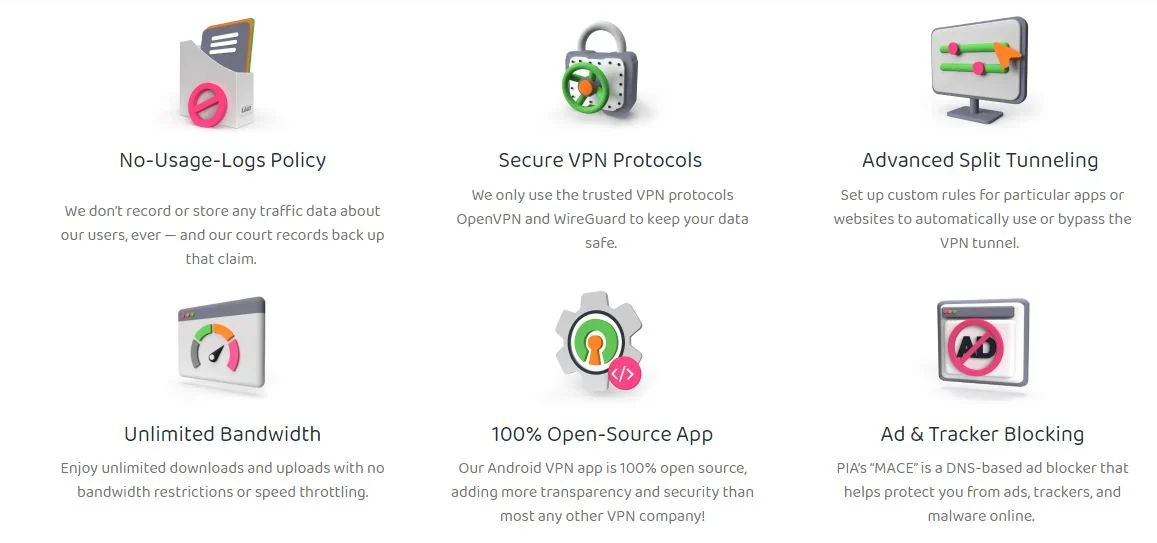
Private Internet Access (PIA) is a consumer and business VPN service headquartered in Denver, Colorado. It has been operating for over 15 years and currently runs 29,650+ servers across 91 countries. PIA is best known for its no-logs policy, its deep security configurability, and being one of a small number of VPNs whose privacy promises have held up in actual court proceedings.
At its core, PIA:
- Encrypts your internet connection and hides your IP address from websites, advertisers, and your ISP
- Routes your traffic through servers in 91 countries so you can access geo-restricted content
- Supports WireGuard, OpenVPN (with user-selectable 128-bit or 256-bit AES encryption), and IKEv2/IPSec on iOS
- Blocks ads, trackers, and malware through its built-in MACE feature
- Allows unlimited simultaneous connections — every device you own on a single subscription
- Publishes all app source code publicly so anyone can audit the code for security issues
Company Background & Ownership
PIA was founded around 2010 and built a strong reputation among privacy advocates over the following decade. In 2019, the company was acquired by Kape Technologies PLC, a London-listed firm that also owns ExpressVPN, CyberGhost, and ZenMate. Kape was formerly known as Crossrider, a company that faced criticism for adware-related issues before rebranding entirely around privacy products.
That ownership history deserves a mention. In practice, PIA has continued to operate independently with the same privacy policies and the same court-proven track record since the acquisition. The Deloitte audit in June 2022 — a Big Four accounting firm — independently confirmed no data is logged. But if you prefer a VPN outside the Kape umbrella, that is a fair consideration.
What no other VPN can match is PIA’s real-world courtroom record. Audits are valuable. Having a federal subpoena return zero results is something else entirely.
Who Is PIA VPN For?
✓ Ideal Users
PIA is a strong fit for a specific type of user. If you match one of these profiles, it is likely the right choice:
- Privacy-focused users — You take your digital privacy seriously and want more than a company’s word. The court record and open-source codebase give you actual evidence to evaluate, not marketing claims.
- Torrenters and P2P users — Every one of PIA’s 29,650+ servers supports P2P. You don’t need to hunt for “P2P-optimized” servers. Port forwarding (available on non-US servers) improves download speeds by an additional 10–15%.
- Power users and tech-savvy subscribers — You want control. PIA is the only major VPN that lets you select between 128-bit and 256-bit AES encryption, choose protocols, configure custom DNS, set port forwarding, and granularly define split tunneling rules by app, IP address, or domain.
- Multi-device households — Unlimited simultaneous connections means your laptop, phone, tablet, partner’s devices, and smart TV router setup all run on one subscription with no extra cost.
- Linux users — PIA offers a full graphical Linux app. Most VPNs only provide a command-line interface for Linux users; PIA’s GUI is a genuine differentiator.
- Budget-conscious buyers — At $1.33/month on the three-year plan, PIA is one of the cheapest premium VPNs available. The price doesn’t increase at renewal.
✗ Not Ideal For
PIA may not be the right fit if you:
- Are a VPN beginner who wants a dead-simple app with minimal settings (Surfshark or NordVPN are friendlier)
- Need a VPN that reliably works in China — PIA’s obfuscation helps but is not guaranteed
- Stream primarily on Disney+, Amazon Prime, or Paramount+ (hit-or-miss on standard servers; dedicated streaming servers help)
- Specifically want a VPN outside US jurisdiction for political or legal reasons
- Need port forwarding on US servers (it is blocked on all US server locations)
Features & What You Get
PIA packs more configurable features into a single subscription than almost any comparable VPN. Here is a breakdown of what matters most:
Privacy & Security Core
- No-Logs Policy — PIA never records browsing activity, connection timestamps, traffic data, or DNS queries. Proven in federal court three times; independently audited by Deloitte in June 2022.
- RAM-Only Servers — Every server runs on RAM instead of hard drives. When a server is rebooted, all session data is wiped automatically. There is nothing to seize.
- Open-Source Apps — All PIA client applications (Windows, macOS, Linux, Android, iOS) are published publicly. Security researchers, journalists, and individual users can read and audit the code at any time.
- Kill Switch — Two modes: standard (kills your internet if the VPN drops) and advanced (blocks traffic even when the VPN is manually off, ensuring you never accidentally browse unprotected).
- DNS Leak Protection — PIA routes DNS queries through its own private DNS servers, preventing your ISP from seeing what sites you visit even if the VPN connection falters.
- Multi-Hop (Double VPN) — Routes your traffic through two separate VPN servers back-to-back, adding a second layer of encryption. Available bundled with obfuscation.
Protocols & Encryption
What makes PIA’s encryption unique: It is the only major VPN that lets you choose between AES-128-bit and AES-256-bit encryption with OpenVPN. Most VPNs lock you into one setting. AES-128 is faster with nearly equivalent real-world security; AES-256 is the gold standard for maximum assurance. PIA lets you decide.
- WireGuard — The fastest modern protocol; always uses 256-bit encryption. Available on Windows, macOS, Linux, Android, and iOS. Recommended for everyday use.
- OpenVPN — Battle-tested protocol available on Windows, macOS, Linux, and Android. User-selectable 128-bit or 256-bit AES. Supports multiple TCP and UDP ports for bypassing firewalls.
- IKEv2/IPSec — Available on iOS alongside WireGuard. Good for mobile use given its fast reconnection when switching networks.
Performance & Connectivity
- 29,650+ Servers in 91 Countries — One of the largest server networks of any VPN. Covers all 50 US states — useful for accessing state-specific content.
- 10 Gbps Network Cards — PIA’s NextGen servers use 10 Gbps connections. Speed tests confirm minimal overhead: approximately 4% speed loss on nearby servers, with downloads staying above 100 Mbps even on long-distance international connections.
- Unlimited Simultaneous Connections — One subscription covers every device you own, all connected at the same time.
- Split Tunneling — Route specific apps, websites, or IP addresses outside the VPN tunnel while everything else stays protected. Granular control by app, IP, or domain (Windows, macOS, Android).
- Port Forwarding — Available on non-US servers. Improves torrent download speeds by approximately 10–15% and is useful for hosting services.
- SOCKS5 Proxy — Included in all plans. Useful for torrenting or as an additional routing layer alongside the VPN. (Note: if you are researching SOCKS5 residential proxies for business scraping, see our PIA S5 Proxy review — it is a separate product entirely.)
- Automation Rules — Set PIA to auto-connect on public Wi-Fi networks, stay disconnected on trusted home networks, or apply custom behavior per network type.
Built-In Tools
- MACE Ad Blocker — DNS-level blocker for ads, trackers, and malicious websites. Included in all plans at no extra cost. On iOS, it operates as a Safari content blocker.
- Obfuscation / Shadowsocks — Disguises VPN traffic as regular HTTPS traffic to bypass deep packet inspection. Available in the US, UK, Switzerland, Netherlands, Canada, and Japan.
- Smart DNS — Change your virtual location on Smart TVs and gaming consoles without installing a full VPN app.
- VPN Snooze — Temporarily suspend the VPN connection for a set time and have it reconnect automatically.
- Linux GUI App — A full graphical interface for Linux, not just a command-line tool. Supports Ubuntu 18.04+, Mint, Debian, Fedora, and Arch.
Add-Ons (Optional Extras)
- Dedicated IP — A static IP address used exclusively by you. Reduces CAPTCHAs, lowers blocklist risk, and works well for online banking or accessing work systems. Available in Australia, Germany, Canada, Japan, Singapore, Switzerland, Belgium, Sweden, the US, and the UK. Pricing shown at checkout.
- PIA Antivirus — Windows-only malware scanner built with the same privacy-first approach as the VPN. No tracking, no data logging. Pricing shown at checkout (approximately $5 per month based on third-party review data).
How PIA VPN Works (Step-by-Step)
Getting set up with Private Internet Access takes under five minutes. Here is the full process:
Step 1: Choose Your Plan
Visit the PIA pricing page and select one of the three subscription options — monthly, annual, or the three-year plan. If you want to test before committing, iOS and Android users get a 7-day free trial. Everyone gets a 30-day money-back guarantee regardless of plan.
Step 2: Create an Account and Pay
PIA accepts credit cards, PayPal, Bitcoin, Ethereum, Litecoin, retail gift cards (Starbucks, Walmart), Amazon Payments, and Google/Apple Pay. Cryptocurrency and gift card payments are the most anonymous options if privacy at the account level matters to you.
Step 3: Download and Install the App
Download the app for your platform from PIA’s website or your device’s app store. Native apps are available for Windows, macOS, Linux (with a full GUI), Android, and iOS. Browser extensions for Chrome, Firefox, and Opera function as proxies rather than full VPN clients. Router installation is also supported on DD-WRT, Tomato, Pfsense, OpenWRT, AsusWRT, and more.
Step 4: Connect to a Server
Log in, pick a server location, and click Connect. For speed, use WireGuard and pick the nearest server. For streaming, use a dedicated streaming server (available in 11 countries including the US, UK, Germany, Japan, and Australia). For torrenting, any server works — enable port forwarding on a non-US server for better download speeds.
Step 5: Configure Settings to Your Preference
This is where PIA separates itself from most VPNs. In the settings panel you can: select encryption level (128-bit vs 256-bit), switch protocols, enable the Kill Switch, activate MACE, set up split tunneling by app or domain, configure automation rules per network, enable multi-hop, or set a custom DNS server. Most users will leave defaults in place; power users will appreciate having every option accessible.
Bottom line: PIA’s default settings are secure out of the box. You do not need to touch the advanced options to be protected. But when you want to go deeper, every control is there.
PIA VPN Pricing & Plans
PIA offers three straightforward plans. No complicated tiers, no feature differences between plans — you get exactly the same features on all three. The only variable is how long you commit upfront.
| Plan | Monthly | Annual | 3 Years + 3 Months Free |
|---|---|---|---|
| Monthly Rate | $11.95/mo | $3.33/mo | $1.33/mo |
| Total Billed | $11.95/mo | $39.95 first year | $79 upfront |
| Renewal Price | $11.95/mo | $39.95/year | $79 every 3 years |
| Savings vs Monthly | — | ~72% off | ~89% off |
| Simultaneous Devices | Unlimited | Unlimited | Unlimited |
| Features | Full feature set | Full feature set | Full feature set |
Note on add-ons: Dedicated IP and PIA Antivirus pricing is shown only at checkout and is not displayed publicly. Add-on pricing is in addition to the base subscription cost. The 3-year plan is the one PIA markets as “Best Deal” and is the one most long-term users choose.
Payment methods accepted:
- Credit and debit cards (Visa, Mastercard, American Express, Discover)
- PayPal
- Cryptocurrency (Bitcoin, Ethereum, Litecoin, Dogecoin)
- Retail gift cards (Starbucks, Walmart, and other major brands)
- Amazon Payments, Google Pay, Apple Pay
Money-back guarantee: 30 days for new subscribers. If you purchase through the Apple App Store or Google Play, those platforms’ own refund policies apply instead. To request a refund, contact PIA’s 24/7 live chat — the process typically takes about 3 days. A 7-day free trial is available on iOS and Android without a credit card.
Pros & Cons
Pros ✓
- Court-proven no-logs: FBI and US government subpoenas in 2016 and 2018 returned zero user data — real proof, not just a policy statement
- Deloitte audit (2022): A Big Four accounting firm independently confirmed the no-logs policy holds up
- 100% open-source apps: All client code is publicly available and auditable on every platform
- Unlimited simultaneous connections: Every device you own, connected at once, on one plan
- Largest US server network: All 50 states covered — rare among VPNs
- Selectable encryption: AES-128 or AES-256 with OpenVPN — the only major VPN offering this choice
- Excellent for torrenting: P2P on all 29,650+ servers, port forwarding available (non-US), SOCKS5 proxy included
- MACE included free: DNS-level ad, tracker, and malware blocker on all plans
- Native Linux GUI: Full graphical app, not just a CLI tool
- Affordable long-term pricing: $1.33/month on 3-year plan, with no price increase at renewal
- RAM-only servers: Session data wiped automatically on every reboot
- 30-day money-back guarantee + 7-day free trial on mobile
Cons ✗
- US jurisdiction (5 Eyes): Based in Denver, Colorado — a member of the 5 Eyes and 14 Eyes surveillance alliances
- Kape Technologies ownership: Parent company formerly operated under the Crossrider name before rebranding around privacy products
- Inconsistent streaming: Disney+, Amazon Prime, and Paramount+ can be hit-or-miss on standard servers; dedicated streaming servers are required for reliable access
- Not reliable in China: Obfuscation helps but PIA acknowledges it does not work consistently
- ~80 virtual server locations: Roughly half the 91-country network uses virtual server IPs — physical server location may differ
- Port forwarding blocked on US servers: Legal restrictions mean US server users cannot use this feature
- Interface complexity: Advanced settings panel can overwhelm VPN first-timers
- No proprietary protocol: Relies on WireGuard, OpenVPN, and IKEv2 (all established open-source protocols)
Bottom Line: PIA’s privacy credentials are objectively stronger than almost any VPN on the market. The US jurisdiction is a real concern on paper, but three court-proven no-logs outcomes and a Deloitte audit make it hard to dismiss the service on that basis alone. The trade-offs — streaming inconsistencies, complexity, China performance — are real but situational.
PIA VPN vs NordVPN and Surfshark: 2026 Comparison
PIA competes directly with NordVPN and Surfshark in the premium VPN market. Here is how the three stack up side-by-side on the metrics that matter most.
PIA vs NordVPN
| Feature | Private Internet Access | NordVPN |
|---|---|---|
| No-Logs Proof | Court-proven x3 + Deloitte audit | Independently audited (no court cases) |
| Open-Source Apps | Yes — all platforms | No (proprietary) |
| Server Count | 29,650+ servers, 91 countries | 6,800+ servers, 111 countries |
| Simultaneous Connections | Unlimited | 10 devices |
| Jurisdiction | USA (5 Eyes) | Panama (outside 14 Eyes) |
| Protocol | WireGuard, OpenVPN, IKEv2 | NordLynx (WireGuard-based), OpenVPN, IKEv2 |
| Streaming | Good (dedicated servers in 11 countries) | Excellent (consistent across platforms) |
| Torrenting | P2P on all servers + port forwarding | P2P servers only; no port forwarding |
| Price (2-yr plan) | $1.33/mo (3yr plan) | $3.49/mo (2yr plan) |
| Ad Blocker | MACE (all plans, free) | Threat Protection (included) |
| China Performance | Inconsistent | Inconsistent |
Winner for Privacy Proof: PIA (court-proven) | Winner for Streaming: NordVPN | Winner for Torrenting: PIA | Winner for Price: PIA | Winner for Jurisdiction: NordVPN (Panama) | Winner for Unlimited Devices: PIA
You can read our full NordVPN review for a deeper breakdown of its features and performance.
PIA vs Surfshark
| Feature | Private Internet Access | Surfshark |
|---|---|---|
| No-Logs Proof | Court-proven x3 + Deloitte audit | Independently audited; no court cases |
| Open-Source Apps | Yes — all platforms | No |
| Server Count | 29,650+ servers, 91 countries | 3,200+ servers, 100 countries |
| Simultaneous Connections | Unlimited | Unlimited |
| Jurisdiction | USA (5 Eyes) | Netherlands (EU, 9 Eyes) |
| Beginner-Friendly Interface | Moderate (can feel complex) | Very easy — clean and minimal |
| Streaming | Good (dedicated servers) | Very good (consistent) |
| Encryption Choice | 128-bit or 256-bit (user-selectable) | 256-bit only (no user choice) |
| Price (2-yr plan) | $1.33/mo (3yr plan) | $1.99/mo (2yr plan) |
| Built-In Ad Blocker | MACE (DNS-level, all plans) | CleanWeb (DNS-level, all plans) |
| Port Forwarding | Yes (non-US servers) | No |
Winner for Privacy Proof: PIA | Winner for Ease of Use: Surfshark | Winner for Server Network: PIA | Winner for Price: PIA | Winner for Streaming: Surfshark | Winner for Torrenting: PIA (port forwarding)
See our full Surfshark review if you want to dig deeper into how it performs.
🏆 Choose PIA When:
- Proven privacy protection is your primary requirement
- You torrent frequently and want P2P on every server
- You need unlimited device connections
- You want open-source, auditable VPN apps
- You use Linux and need a proper GUI app
- Long-term price is your deciding factor ($1.33/mo)
🔍 Choose NordVPN or Surfshark When:
- You stream heavily and need consistent access to Netflix, Disney+, or Amazon Prime
- You prefer a VPN outside US or EU jurisdiction
- You are a VPN beginner and want the simplest possible interface
- You need reliable access in China
- You want a proprietary protocol (NordLynx)
Ratings Breakdown
Here is our category-by-category scoring based on hands-on evaluation, documented speed tests, and user feedback across verified review platforms:
| Category | Score | Notes |
|---|---|---|
| Privacy & Security | 4.9 / 5 | Court-proven no-logs (x3), Deloitte audit, RAM-only servers, open-source apps, kill switch. Strongest privacy track record in this category. |
| Speed & Performance | 4.3 / 5 | ~4% overhead on nearby servers with WireGuard; downloads stay above 100 Mbps on long-distance connections. Some slow outlier servers exist. |
| Features & Configuration | 4.8 / 5 | Most configurable VPN available — selectable encryption, multi-hop, split tunneling, port forwarding, automation rules, MACE, SOCKS5, Smart DNS. |
| Pricing & Value | 4.7 / 5 | $1.33/month on 3-year plan; no price increase at renewal; all features included in every plan. Among the best value propositions in the category. |
| Streaming & Torrenting | 3.8 / 5 | Excellent for torrenting (P2P everywhere, port forwarding); streaming is good on dedicated servers but inconsistent on standard ones for Disney+/Amazon. |
| Ease of Use | 3.6 / 5 | Clean main interface but deep settings panel requires some learning. Full Linux GUI is a genuine plus. Less beginner-friendly than Surfshark or NordVPN. |
| Overall Rating | 4.4 / 5 | Outstanding for privacy-focused and power users. Minor deductions for US jurisdiction and streaming consistency. |
Rating Summary: PIA scores near the top in privacy, features, and value — three areas where it genuinely leads the market. Speed is strong. The areas that pull the overall score back are streaming consistency on standard servers and the interface complexity for new users. For anyone who takes privacy seriously, 4.4/5 reflects a service that backs up its claims with documented courtroom results.
Is PIA VPN Legit, Safe & Worth It?
Legitimacy & Safety
- ✓ Court-proven no-logs policy — In 2016, the FBI requested PIA’s user records as part of a criminal case. PIA had no data to hand over. A Russian government server seizure the same year produced the same result. A third US government request in 2018 again turned up nothing. This is the strongest real-world evidence any VPN can provide.
- ✓ Deloitte independent audit (June 2022) — A Big Four accounting firm audited PIA’s infrastructure and confirmed the no-logs policy. This is a more credible audit than those performed by smaller boutique firms.
- ✓ 100% open-source apps — Every line of code in PIA’s client applications is publicly available. Security researchers and individual users can inspect it. No hidden backdoors can survive public scrutiny of the source code.
- ✓ RAM-only servers — All servers run on volatile memory. Shut down a server and all session data disappears. Physical seizure of hardware yields nothing useful.
- ✓ Established operation — PIA has been running for over 15 years. It holds a 4.3/5 rating on Trustpilot from nearly 11,000 verified reviews.
- ✓ Transparent about virtual servers — PIA openly discloses which of its server locations are virtual (IP matches the country, physical hardware is elsewhere). That transparency is rare.
Long-Term Reliability
PIA has been a top-ten VPN for years across independent review platforms. Its privacy architecture has not been compromised in any documented case. The service offers 24/7 live chat support in English, French, German, and Romanian. Renewal pricing does not increase — the $39.95/year and $79/three-years rates hold at renewal. The 30-day money-back guarantee gives you a real exit window if the service doesn’t work as expected.
The one thing to understand clearly: PIA is based in the United States, which is a 5 Eyes and 14 Eyes member country. Under US law, PIA could theoretically be compelled to log data going forward by a court order. The existing no-logs record proves they have not done so historically — but it does not guarantee future immunity from legal pressure. If jurisdiction matters to you more than proven track record, look at VPNs headquartered in Panama (NordVPN) or outside the 14 Eyes alliance.
Worth It? Final Verdict
✓ YES, PIA Is Worth It If:
- You want the most evidence-backed privacy of any VPN
- You need unlimited simultaneous device connections
- You torrent regularly and want maximum flexibility (port forwarding, P2P everywhere)
- You value open-source transparency and want to verify what the app is doing
- Long-term value is important — $1.33/month with no price increase is hard to beat
- You use Linux and need a real graphical app, not just a CLI
✗ NO, Consider Alternatives If:
- US jurisdiction is a hard blocker for you regardless of no-logs history
- You primarily stream and need Disney+/Amazon Prime to work every time
- You are a VPN newcomer who wants one-click simplicity without any settings to navigate
- You need a VPN that works reliably in China
- You specifically want a VPN not owned by Kape Technologies
Our Recommendation: Private Internet Access is one of the most credible privacy tools available in 2026. Three federal-level no-logs tests, a Deloitte audit, fully open-source apps, RAM-only servers, and the most configurable feature set of any major VPN — all at $1.33/month long-term. If privacy is your main reason for using a VPN, PIA’s track record is unmatched. If streaming is your primary use case and you want the easiest experience, NordVPN or Surfshark may serve you better.
Private Internet Access Review 2026: Frequently Asked Questions
What is Private Internet Access VPN?
Private Internet Access (PIA) is a consumer VPN service that encrypts your internet connection and masks your IP address. It operates 29,650+ servers across 91 countries and is best known for its court-proven no-logs policy — confirmed three times by actual federal subpoenas returning zero user data — and for being the only major VPN with 100% open-source client applications.
Is PIA VPN safe to use?
Yes. PIA uses AES-256-bit encryption (or AES-128-bit — your choice with OpenVPN), WireGuard, a verified kill switch, DNS leak protection, and RAM-only servers that wipe data on reboot. Its no-logs policy has been tested by the FBI and US government on three separate occasions — each time, no user data was available to hand over. A Deloitte audit in 2022 independently confirmed the policy. All app code is open source and publicly auditable.
Does PIA VPN keep logs?
No. PIA maintains a strict no-logs policy and has demonstrated it under real legal pressure. In 2016, two separate government requests (an FBI subpoena and a Russian server seizure) produced zero user data. A third US government request in 2018 had the same result. Deloitte independently audited the policy in 2022 and confirmed it. This combination of court proof and third-party audit is the strongest evidence base any VPN currently offers.
How much does Private Internet Access cost?
PIA offers three plans:
- Monthly: $11.95/month
- Annual: $3.33/month (billed $39.95 upfront; renews at $39.95/year)
- 3 Years + 3 Months Free: $1.33/month (billed $79 upfront; renews at $79 every 3 years)
The price does not increase at renewal. Every plan includes the full feature set — there are no feature-locked tiers.
How many devices can I use with one PIA subscription?
Unlimited. One PIA subscription covers all your devices simultaneously — laptop, phone, tablet, smart TV via router, partner’s devices, everything — with no extra cost. Most competing VPNs cap simultaneous connections at 5–10 devices.
Does PIA VPN work for streaming Netflix?
Yes, PIA works with Netflix and has confirmed access to 17+ Netflix libraries including the US, UK, Germany, Japan, and Canada. It also works with BBC iPlayer, HBO Max, and Hulu. However, Disney+, Amazon Prime Video, and Paramount+ can be inconsistent on standard servers. PIA’s dedicated streaming servers (available in 11 countries) provide more reliable access to those platforms. Use a dedicated streaming server if you are having trouble.
Is PIA good for torrenting?
PIA is one of the best VPNs for torrenting. P2P is allowed on every one of its 29,650+ servers — no need to find special P2P servers. Port forwarding is available on non-US servers and improves download speeds by approximately 10–15%. A SOCKS5 proxy is included in all plans for additional routing flexibility. The kill switch ensures your real IP is never exposed if the VPN drops during a download.
Does PIA VPN work in China?
PIA claims it is possible but does not guarantee it. PIA’s obfuscation (Shadowsocks) disguises VPN traffic as regular HTTPS to bypass deep packet inspection. However, PIA’s own support team has confirmed it does not work reliably in China. If China compatibility is your primary requirement, NordVPN or ExpressVPN have more consistent records in that environment. You must also download the app before arriving in China, as the PIA website may be blocked.
What is PIA’s jurisdiction and why does it matter?
PIA is headquartered in Denver, Colorado, USA. The US is a founding member of the 5 Eyes intelligence alliance and is part of the broader 14 Eyes network. In theory, US law could compel PIA to log user data under a court order going forward. In practice, three separate court-level requests have already tested this — and PIA produced zero data each time. The architecture (RAM-only servers, no logging) means there is nothing to compel even if a legal order were issued.
Who owns Private Internet Access?
PIA is owned by Kape Technologies PLC, a London-listed company that also owns ExpressVPN, CyberGhost, and ZenMate. Kape was formerly named Crossrider, which faced criticism related to adware before rebranding in 2018 to focus exclusively on privacy software. Since the rebrand, Kape has not had documented privacy incidents. PIA continues to operate with its original privacy policies and court-proven no-logs record under Kape’s ownership.
Does PIA VPN have a free trial?
Yes, but only on mobile. iOS and Android users can start a 7-day free trial without a credit card. All other platforms start with the paid plan, but every subscription comes with a 30-day money-back guarantee. To claim a refund, contact PIA’s 24/7 live chat support — the process typically completes within about 3 business days.
What is the difference between PIA VPN and PIA S5 Proxy?
These are two completely separate products. Private Internet Access (PIA VPN) at privateinternetaccess.com is the consumer VPN reviewed here — it encrypts your connection and routes traffic through its server network for privacy. PIA S5 Proxy is a different company entirely, offering residential SOCKS5 proxy services for business use cases like web scraping and multi-account management. They share similar names but are unrelated.
Final Verdict
Private Internet Access is the most credible privacy VPN available in 2026. It is the only VPN in this category whose no-logs policy has been stress-tested by actual law enforcement — three times — and held up each time. The open-source apps, RAM-only servers, Deloitte audit, and deepest security configuration options of any major VPN make it the right choice for users who want evidence, not promises.
The price is compelling: $1.33/month on the three-year plan, with the price locked in at renewal. Unlimited device connections, P2P on all servers, and built-in MACE ad blocking make the overall package hard to match at this price point. The limitations — US jurisdiction, inconsistent streaming on some platforms, a denser interface — are real but manageable for most users.
✓ What We Love
- Court-proven no-logs — tested by the FBI, not just audited
- 100% open-source apps on every platform
- Unlimited simultaneous device connections
- 29,650+ servers in 91 countries, all 50 US states
- Selectable AES-128 or AES-256 encryption (OpenVPN)
- MACE ad/tracker blocker included for free
- Port forwarding + P2P on all servers
- $1.33/month with no renewal price hike
- Native Linux GUI app
✗ What Could Be Better
- US jurisdiction (5 Eyes) is a structural concern
- Streaming on Disney+ and Amazon Prime inconsistent on standard servers
- Settings panel can overwhelm VPN beginners
- No reliable China performance
- Port forwarding unavailable on US servers
- Kape Technologies ownership history
Ready to Try Private Internet Access?
Get PIA’s court-proven privacy, unlimited connections, and 29,650+ servers starting at just $1.33/month — backed by a 30-day money-back guarantee.
Get Private Internet Access Now →