
9 Best Mobile Proxy Providers in 2026
Compare the best mobile proxy providers of 2026 — tested on real 4G/LTE networks, mobile IP pool depth, carrier targeting, and actual pricing for social media, sneaker copping, and mobile scraping.
⚡ Quick Verdict
Mobile proxies are the hardest-to-block proxy type available — and also the most misunderstood. A genuine mobile proxy routes your traffic through a real SIM card assigned by a mobile carrier. Websites see a T-Mobile, Vodafone, or AT&T IP address that millions of real phones share. That’s why ban rates are near zero and why mobile proxies are the go-to for social media automation, sneaker bots, ad verification, and mobile app testing. The problem is that “mobile proxy” has become a marketing label — some providers sell datacenter IPs with a mobile label. After reviewing nine providers on pool authenticity, carrier depth, geographic coverage, and actual pricing, here’s the short version: Bright Data leads on enterprise scale, Smartproxy wins on price-performance and trial access, The Social Proxy stands out for real SIM card infrastructure, and Oxylabs delivers the best third-party-verified mobile performance stats.
Bright Data — 7M+ mobile IPs, 99.99% uptime, no concurrent connection limit
Smartproxy — from $2.25/GB, 100% scraping API success rate, free 100 MB trial
The Social Proxy — 130+ real mobile carriers, 45+ countries, true SIM hardware
Oxylabs — 99.94% success rate (Proxyway 2025), 20M mobile IPs
You set up a social media automation tool, run it through a residential proxy, and within 48 hours the account gets flagged. You switch to a different residential provider. Same result. The problem isn’t your tool — it’s the proxy type. Residential IPs look great on paper, but mobile carrier IPs have something residential can’t fully replicate: the fingerprint of a real smartphone on a real 4G network.
When a website or app sees an IP assigned by T-Mobile, Verizon, or Vodafone to a handset, it treats that traffic like any other mobile user. The same IP block is shared by thousands of real phones. Flagging one IP flags real customers — so platforms are far more cautious about blocking them. That’s the core advantage of a genuine mobile proxy.
The problem is that the label “mobile proxy” gets applied to very different things. Some providers use real SIM cards in physical hardware. Others route through real mobile devices via peer networks. A few just relabel datacenter IPs. The difference in ban rates and trust scores between these approaches is enormous.
This guide covers nine providers we’ve evaluated specifically for mobile IP authenticity, carrier and geographic depth, rotation controls, and real pricing. We’ve used third-party benchmark data from Proxyway (April–June 2025) where available, and brand knowledge files for pricing accuracy.
What Are Mobile Proxies?
A mobile proxy is a proxy server that routes your traffic through an IP address assigned by a mobile carrier — think T-Mobile, AT&T, Vodafone, or any of hundreds of regional carriers worldwide. The IP comes from a real 3G, 4G, or LTE SIM card, not a server. Because mobile carriers use CGNAT (Carrier-Grade Network Address Translation), thousands of real mobile users share the same public IP address at any moment. Blocking that IP would mean blocking thousands of legitimate smartphone users, so platforms are extremely reluctant to do it.
Three infrastructure approaches produce mobile proxies, and they have meaningfully different characteristics:
- Real SIM Card Hardware — Physical SIM cards installed in hardware (modems, phones, or dedicated devices). The IP comes from a real active SIM assigned to that device by a carrier. The Social Proxy uses this model. Provides the most authentic carrier fingerprint, but pools are smaller.
- Peer Network (Real Devices) — Software installed on real mobile devices (Android phones, iPhones) that opts in to share their carrier connection. Providers like Oxylabs, Smartproxy, Bright Data, SOAX, and ProxyEmpire use this model. Larger pools, carrier diversity, but dependent on device online status.
- Mobile Gateway / Dongle Farms — USB modems or hotspot devices aggregated in a data center. Lower cost but less authentic than either of the above — some operators cut corners here. Buyer beware of unusually cheap “mobile” pricing using this model.
Why Mobile IP Authenticity Matters
Websites and apps fingerprint incoming connections on multiple signals: IP classification (datacenter vs. residential vs. mobile), ASN (which carrier owns the IP), device headers, TLS fingerprints, and behavioral patterns. A mobile carrier IP passes all of these checks by default — because it IS a mobile carrier IP. Residential proxies pass most of these but occasionally fail on ASN-level checks. Datacenter IPs fail the basic classification check almost immediately on well-defended platforms. If your target is Instagram, TikTok, Twitter/X, or a sneaker site with a Kasada or PerimeterX anti-bot system, mobile is the only proxy type that consistently works long-term.
Who Needs Mobile Proxies?
✓ Ideal Users for Mobile Proxies
- Social Media Managers & Automation Teams — Running multiple Instagram, TikTok, Twitter/X, or Facebook accounts from automation tools requires mobile IPs to avoid detection and bans. These platforms actively distinguish mobile carrier traffic from residential and datacenter traffic. A mobile IP is the closest thing to an organic smartphone session.
- Sneaker Bot Operators — Sneaker sites (Nike SNKRS, Adidas Confirmed, Footlocker) run sophisticated anti-bot systems that specifically look for non-mobile IP fingerprints. Running your bot through a genuine 4G mobile IP dramatically reduces detection rates and increases cop success during high-demand drops.
- Ad Verification Teams — Verifying that mobile ad campaigns display correctly across different carriers, devices, and geos requires a genuine mobile IP fingerprint. An ad fraud detection or brand safety tool running through mobile proxies gets the same view as a real mobile user — without the carrier IP mismatch that flags a datacenter source.
- Mobile App Testers — Testing geo-restricted app content, carrier-specific features, or regional pricing inside mobile apps requires traffic to actually originate from a mobile carrier IP. VPNs often fail this check; dedicated mobile proxies don’t.
- Mobile-Specific Web Scrapers — Some websites and APIs serve entirely different content or apply different rate limits to mobile versus desktop traffic. Scraping the mobile version of a site (Amazon mobile, booking platforms, local delivery apps) with a genuine mobile carrier IP returns the same response a real smartphone would get.
- Ticket Buyers & Resellers — Concert and event ticketing platforms (Ticketmaster, Live Nation, StubHub) apply aggressive per-IP rate limits. Mobile carrier IPs — shared across thousands of real phone users — are far harder to block without collateral damage to legitimate buyers.
✗ Not Ideal For
Mobile proxies are NOT the right tool if you:
- Need high-bandwidth, high-volume data scraping at the lowest possible cost — datacenter proxies are 10–20x cheaper per GB
- Are doing simple public web scraping on sites without anti-bot protection — overkill and expensive
- Need unlimited bandwidth for long continuous sessions — mobile pools are smaller and per-GB costs add up fast
- Want to access geo-restricted video streaming — mobile proxies work but are expensive for streaming bandwidth
- Are using free “mobile proxy” lists — they are either fake (datacenter IPs with a label) or compromised devices that leak your traffic
9 Best Mobile Proxy Providers — Tested & Ranked
Here are our top picks for the best mobile proxy providers in 2026, evaluated on IP authenticity, carrier coverage, pool depth, pricing, and third-party performance data. Each section covers what makes the provider stand out and where it falls short.
1. Bright Data

Bright Data invented the residential proxy market in 2014 (then Luminati Networks) and has been first-to-scale on mobile proxies as well. Its 7M+ mobile IP pool spans 3G, 4G, and 5G networks globally, with no concurrent connection limit — meaning large teams can run thousands of parallel mobile sessions without throttling. The platform offers an API specifically for 3G/4G/LTE targeting, OS-level filtering (iOS vs. Android), and carrier/ASN targeting. Proxyway’s research confirms Bright Data equalized residential and mobile pricing in early 2025, making mobile access more cost-effective than it used to be at the same subscription tier.
Mobile Pool: 7M+ mobile IPs globally, 3G/4G/5G coverage, 195 countries. Single endpoint integration — no need to manage multiple gateways. No concurrent connection cap. 99.99% uptime SLA on enterprise plans. API targeting by country, city, ASN (carrier), OS type.
Pricing: Mobile proxies accessed at the same rates as residential (equalized in Jan 2025). PAYG at $8/GB. Subscription plans from $499/mo. Promo code RESIGB50 gives 50% off for 3 months on residential/mobile. New signup deposit match up to $500.
Pros ✓
- First mover in mobile proxies — longest track record
- No concurrent connection limit — scales to enterprise workflows
- API for 3G/4G/LTE targeting with OS-level filter (iOS/Android)
- 99.99% uptime SLA — highest in the market
- ISO 27001 certified, SOC compliant, GDPR ready
- Proxyway Best Platform for Proxies 2024
Cons ✗
- Most expensive at PAYG — $8/GB before discounts
- KYC required — up to 3 business days for verification
- Subscription starts at $499/mo minimum commitment
- Mobile product visibility reduced in recent navigation restructure
2. Smartproxy (now Decodo)

Smartproxy (rebranded as Decodo in April 2025) consistently wins Proxyway’s Best Value award — and its mobile proxy offering is where that value shows most clearly. At $2.25/GB for the 500 GB plan (currently 50% discounted), mobile proxies are priced the same as residential, which is unusually generous. The 10M+ mobile IP pool covers 160+ locations from 700+ carriers, with iOS and Android OS targeting, city-level geo-filters, and sticky sessions up to 24 hours. A free 3-day / 100 MB trial makes it the easiest no-risk entry point in this list. Proxyway’s April 2025 benchmark confirmed Decodo as the fastest residential proxy globally at 99.86% success rate — and mobile performance tracks similarly.
Mobile Pool: 10M+ real mobile IPs from 700+ carriers, 160+ locations. 3G/4G/5G. City-level targeting. OS filter: iOS or Android. Rotating per-request or sticky up to 24 hours. 99.76% success rate; <0.5s avg. response time. 99.99% uptime.
Pricing: From $3.75/GB (2 GB plan, $7.50/mo). Current 50% discount shows $2.25/GB at 500 GB ($1,125/mo). PAYG at $4/GB. Free 3-day / 100 MB trial. 14-day money-back on first purchase.
Pros ✓
- Free 100 MB trial — lowest friction entry in this list
- Mobile priced same as residential — exceptional value
- 700+ carrier coverage across 160+ locations
- iOS and Android OS-level targeting
- 99.76% success rate; <0.5s response time
- Proxyway Best Value — 5 consecutive years (2020–2025)
Cons ✗
- 10M pool smaller than Oxylabs (20M) or Bright Data (7M+ confirmed mobile)
- ASN and city filters cannot be used simultaneously
- Cryptocurrency not accepted for mobile proxy plans
3. Oxylabs

Oxylabs earns the highest third-party verified mobile proxy performance of any provider in this list. Proxyway’s April 2025 benchmark recorded a 99.94% average success rate globally on mobile proxies — with 199,708 unique mobile IPs observed over 280,000 requests worldwide. The 20M+ mobile IP pool is the largest among all providers tested by Proxyway. Carrier and ASN targeting is available, though country and ASN filters cannot be combined simultaneously. If you need measurably reliable mobile proxies with an enterprise-grade SLA and a dedicated account manager, Oxylabs is the benchmark.
Mobile Pool: 20M+ mobile IPs, 195 countries. Proxyway verified: 99.94% success rate globally, 0.57s avg. response time. 98.94% mobile IP purity globally. Peer-to-peer real cellular devices. Targeting: country, state, city, coordinates, ASN (carrier). Cannot combine country + ASN simultaneously. HTTP, HTTPS, SOCKS5.
Pricing: From $30/mo (4 GB, $7.50/GB). Most popular: $100/mo (15 GB, $6.67/GB). Higher tiers via JS slider — verify at oxylabs.io/products/mobile-proxies/pricing. 7-day free trial for companies. Promo code proxyway35 gives 35% off first purchase.
Pros ✓
- 99.94% global success rate — highest independently verified mobile performance
- 20M+ mobile IP pool — largest Proxyway-tested mobile pool
- 98.94% mobile IP purity globally (Proxyway 2025)
- Coordinate-level geo-targeting (not just city)
- Dedicated account manager for enterprise clients
- EWDCI certified, 7-day company trial
Cons ✗
- Starting at $7.50/GB — above average for mobile proxies
- KYC required before access
- Cannot combine country + ASN targeting in the same request
- Full pricing tier above $100/mo requires checking JS-rendered page
4. The Social Proxy

The Social Proxy takes a fundamentally different approach from every other provider in this list. Instead of routing through peer devices or software-based networks, it uses real physical SIM cards from 130+ actual mobile carriers across 45+ countries. You get a genuine 4G or 3G connection from a SIM card that a real carrier has provisioned — not a software-layer approximation. This infrastructure choice means the IP fingerprint is indistinguishable from a physical smartphone on that network. No advance SIM card reservation is needed; you select carrier and country, and the platform connects you to an available SIM. This makes it the specialist pick for high-stakes social media automation, where IP authenticity is the difference between a surviving account and a banned one.
Mobile Pool: 130+ real mobile carriers, 45+ countries, 4G and 3G networks. Real SIM card hardware — not peer software. No advance SIM reservation required. Connection rotates between available SIMs on your selected carrier and country. Excellent for sticky long-duration sessions on a single carrier identity.
Pricing: Priced per dedicated SIM or session plan — pricing varies by carrier and country. Verify current plans at thesocialproxy.com. Generally positioned at a premium given the real SIM infrastructure cost.
Pros ✓
- Real SIM cards from real carriers — most authentic mobile fingerprint available
- 130+ mobile carriers across 45+ countries
- 4G and 3G coverage — matches what real mobile users see
- No advance SIM reservation — select carrier and connect instantly
- Ideal for high-stakes social media account survival
Cons ✗
- Smaller total pool than peer-network providers (Oxylabs, Bright Data)
- Premium pricing relative to GB-based providers
- Fewer targeting granularity options (carrier-based, not city/ZIP level)
- Less suitable for high-volume scraping at scale
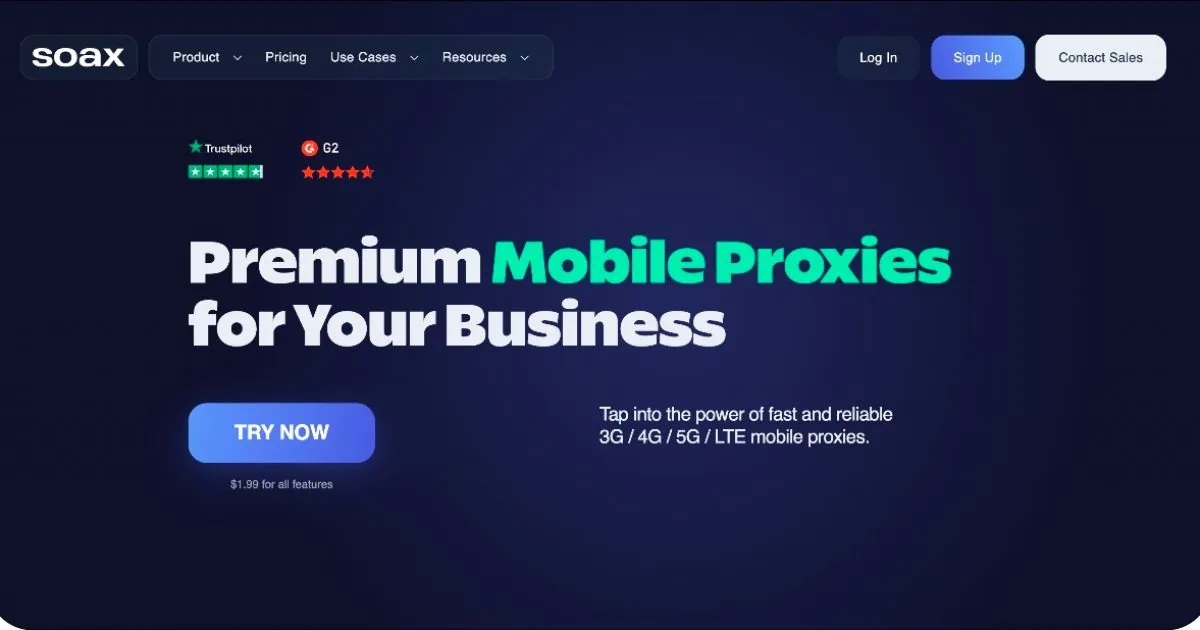
5. SOAX

SOAX’s most compelling feature for mobile proxy buyers is its unified plan model: one subscription gives you access to residential, mobile, ISP, and datacenter proxies with interchangeable credits. You don’t pay a separate mobile premium — mobile traffic draws from the same credit pool as everything else. Its 33M+ mobile IP pool covers 195+ countries across 3G, 4G, 5G, and LTE networks. Proxyway’s April 2025 benchmark confirmed 165,038 unique mobile IPs globally from 280,000 test requests, with a 99.61% global success rate. SOAX also offers SOCKS5 with full UDP support — one of few providers to do so on mobile.
Mobile Pool: 33M+ mobile IPs, 195+ countries, 3G/4G/5G/LTE. Proxyway verified: 165,038 unique IPs, 99.61% global success rate, 1.39s avg. response time. Carrier/ASN targeting, city and region filters. Top mobile countries: USA, UK, Germany, Brazil, Canada, Indonesia, Russia, India, Ukraine, Australia. SOCKS5 with UDP. Rotating per-request or sticky sessions.
Pricing: Unified plan from $90/mo (25 GB, $3.60/GB) — covers all proxy types including mobile. No mobile premium. Code PROXYWAY35% gives 35% off. Paid trial: $1.99 for 3 days and 400 MB.
Pros ✓
- 33M+ mobile IPs — one of the largest mobile pools available
- Unified plan: mobile + residential + ISP + datacenter on one credit pool
- SOCKS5 with UDP — rare for mobile proxies
- 99.61% global success rate (Proxyway 2025)
- Web Optimizer, MaxIP, Lookalike Rotation — advanced session controls
- Proxyway Contender of the Year 2025
Cons ✗
- No free trial — only paid trial at $1.99
- Dashboard still transitioning to new beta — some features missing
- Annual discount not captured on pricing page — requires live verification
6. Nimble
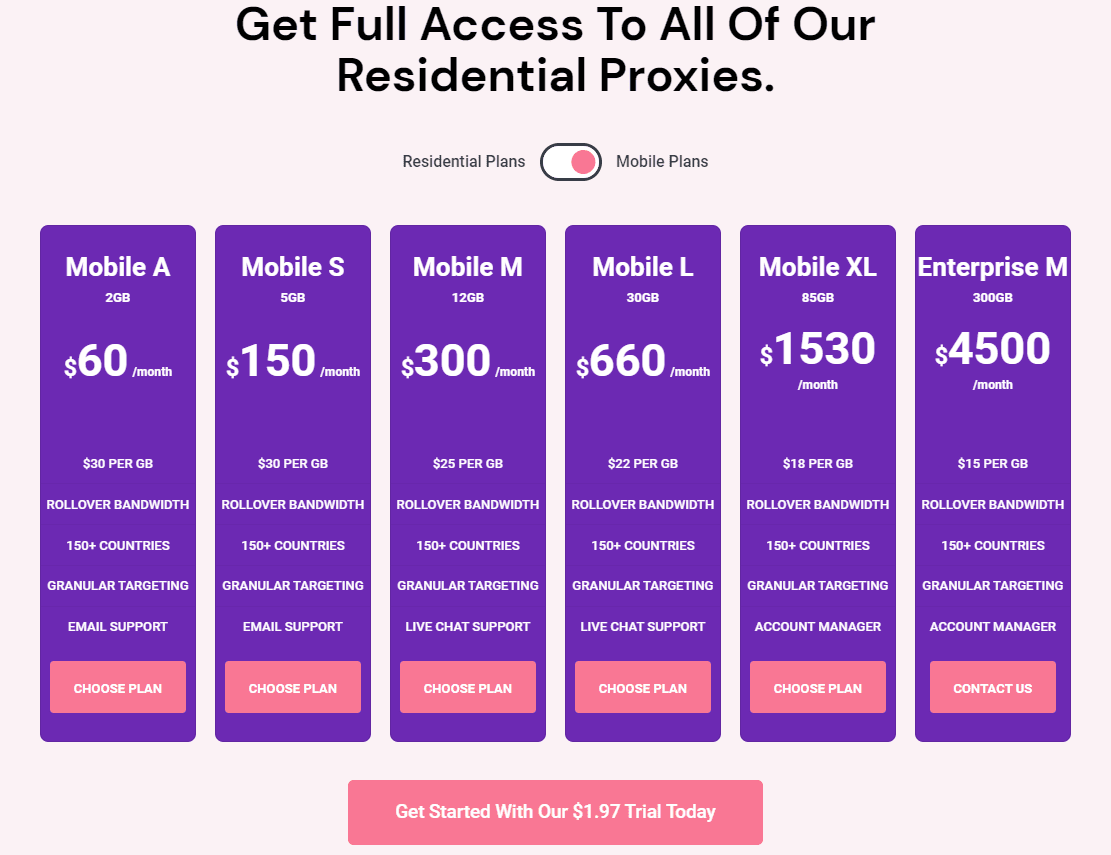
Nimble differentiates itself with dual IPv4 and IPv6 mobile proxy support — a distinction that matters if your scraping target is modernizing its infrastructure. It offers both rotating and sticky sessions, with state and city-level targeting that lets you pin traffic to specific metros. Latency is advertised as minimal, which holds up for most use cases. One important pricing note: the Essential plan does not carry over unused credits to the next billing cycle, so budget carefully. If you regularly hit the ceiling, upgrading is more cost-effective than letting credits expire.
Mobile Pool: IPv4 and IPv6 mobile proxies. Rotating and sticky sessions. State and city-level geo-targeting. Minimal latency architecture. HTTP and HTTPS protocols.
Pricing: Plan-based pricing with monthly credit allocation. Essential plan has no credit rollover — credits expire at end of billing cycle. Verify current plans and tiers at nimbleway.com.
Pros ✓
- IPv4 + IPv6 mobile proxies — both protocols supported
- State and city-level geo-targeting
- Rotating and sticky session modes
- Minimal latency — well-optimized network architecture
- Clean dashboard with straightforward setup
Cons ✗
- Essential plan has no credit rollover — unused traffic expires
- No independent Proxyway benchmark data for mobile specifically
- Less carrier diversity than The Social Proxy or Bright Data
7. Rayobyte

Rayobyte takes a US-focused approach to mobile proxies, building its 4G mobile network through direct ISP partnerships — not just peer software. Alongside its 4G mobile offering, Rayobyte provides DSL and cable residential IPs that help verify that its infrastructure genuinely connects through ISP-provisioned hardware rather than generic datacenter sourcing. Unlimited data on mobile plans is the headline feature: no per-GB billing, just a flat monthly fee. Military-grade encryption is advertised across all connections. If your work is US-centric and bandwidth consumption is unpredictable, flat-rate unlimited mobile is a strong fit.
Mobile Pool: US-based 4G mobile proxies. ISP partnerships for authentic carrier IPs. Unlimited data — flat monthly rate, no GB cap. Also offers DSL/cable residential IPs alongside mobile. Military-grade encryption. 99% uptime.
Pricing: Flat monthly rate for unlimited data — pricing depends on location count and plan type. Verify current plans at rayobyte.com. No per-GB billing on mobile plans.
Pros ✓
- Unlimited data — no GB caps, flat monthly pricing
- US 4G mobile via direct ISP partnerships
- Military-grade encryption on all connections
- DSL and cable options alongside mobile — diverse US IP types
- Predictable cost for high-bandwidth US mobile use cases
Cons ✗
- US-focused — limited international mobile coverage
- Flat fee may be expensive for low-usage use cases
- No independent Proxyway mobile benchmark available
8. ProxyEmpire

ProxyEmpire’s standout feature applies to its mobile proxies just as strongly as its residential ones: non-expiring rollover traffic. When you buy a mobile GB plan, unused bandwidth carries over indefinitely — even after a subscription lapses. For teams with sporadic or seasonal mobile proxy usage, this eliminates the pressure to use up credits before month-end. Proxyway’s June 2025 benchmark measured 151,261 unique mobile IPs globally, confirming real pool depth. The active PROMO50 code halves pricing to as low as $3.75/GB for the 45 GB plan. Carrier-level targeting, country/region/city filters, and support for iPhone, iPad, Android, and Windows Phone devices round out a solid mid-market offering.
Mobile Pool: 4M+ mobile IPs (advertised), 151,261 unique IPs verified by Proxyway (June 2025). 170+ countries. Carriers: Verizon, T-Mobile, AT&T, Vodafone, and others. 3G/4G/5G/LTE. Country, region, city, carrier/ASN targeting. Sticky sessions 30 seconds to 30 minutes. HTTP, HTTPS, SOCKS5 with UDP. Compatible with iPhone, iPad, Android, Windows Phones.
Pricing: From $50/mo (6 GB, $8.34/GB standard). With PROMO50: from $25/mo (6 GB, $4.17/GB). 45 GB plan at $3.34/GB with promo. 300 GB plan at $2.50/GB with promo. $1.97 trial (50 MB mobile). Non-expiring rollover traffic on all plans.
Pros ✓
- Non-expiring mobile traffic — unused GB rolls over indefinitely
- PROMO50 cuts prices in half (verify live status)
- Carrier/ASN targeting for major US and international carriers
- Supports iPhone, iPad, Android, Windows Phone targeting
- SOCKS5 with UDP on mobile
- EWDCI certified ethical sourcing
Cons ✗
- Standard (non-promo) pricing is above average at $8.34–9/GB
- Proxyway-confirmed pool (151K unique IPs) smaller than top-tier providers
- Slower response times than US leaders (1.25–3.21s on mobile, Proxyway 2025)
- No IP whitelisting — credential auth only
9. Proxy-Cheap

Proxy-Cheap earns its name in the mobile proxy segment with a focused EU and US coverage model and unlimited bandwidth on its mobile plans. Rather than competing on global pool depth, it targets buyers who need reliable 4G connectivity in Europe and the United States without paying per-GB. The 99% uptime commitment is solid for a budget-tier provider, and the competitive pricing makes it accessible for smaller teams or developers testing mobile proxy integration. It’s not the right choice for global carrier targeting or enterprise SLAs, but for EU/US mobile use cases on a tight budget, it is one of the few providers offering genuinely unlimited mobile bandwidth at this price point.
Mobile Pool: EU and US coverage. 4G/LTE mobile networks. Unlimited bandwidth — no per-GB billing. 99% uptime. Competitive pricing for EU/US mobile use cases.
Pricing: Flat monthly fee per plan — no bandwidth caps. Pricing varies by location and plan tier. Verify current plans at proxy-cheap.com. Generally among the lowest-cost mobile proxy options for EU/US.
Pros ✓
- Unlimited bandwidth — no per-GB billing on mobile
- Competitive pricing for EU and US mobile coverage
- 99% uptime commitment
- Simple plan structure — easy to budget
Cons ✗
- EU and US only — no global mobile carrier coverage
- Smaller provider — fewer enterprise features
- No independent Proxyway benchmark data
- Limited carrier targeting granularity vs. larger providers
How to Choose the Right Mobile Proxy Provider
Every provider in this list calls their product a mobile proxy. The question is whether the underlying infrastructure matches what your use case actually requires. Here are the five factors that separate genuine mobile proxies from imitations.
IP Authenticity — SIM Card vs. Peer Network vs. Dongle Farm
The gold standard is a real SIM card in real hardware (The Social Proxy). The practical standard for most use cases is a real mobile device running opt-in peer software (Oxylabs, Bright Data, Smartproxy, SOAX, ProxyEmpire). Dongle farms in data centers are a lower-quality option that some providers use to cut costs. When evaluating a new provider, ask explicitly: “How do you source your mobile IPs?” and look for third-party benchmarks that verify mobile IP purity (Proxyway’s mobile IP purity scores are the most reliable available).
Carrier and Geographic Depth
A provider with 10M mobile IPs concentrated in the US is very different from one with 10M spread across 170 countries. For social media automation, you need carrier depth in the country your accounts are targeting. For global mobile scraping, you need coverage across multiple carriers and regions. Check which specific carriers a provider offers for your target countries — not just country-level coverage claims.
Session Control — Rotation vs. Sticky
Rotating mobile proxies (new IP per request) work for scraping tasks. Sticky sessions (same IP held for a set duration) are essential for social media account management, login sessions, and any workflow where session continuity matters. For account warming, you want the same mobile IP for hours or days — check whether the provider offers sticky sessions of 1 hour, 24 hours, or longer before committing.
Pricing Model — Per-GB vs. Flat Rate vs. Per-SIM
Per-GB pricing (Oxylabs from $6.67/GB, Smartproxy from $2.25/GB, SOAX from $3.60/GB) suits scraping where data volume is predictable. Flat-rate unlimited (Rayobyte, Proxy-Cheap) suits high-bandwidth use cases where you can’t predict consumption. Per-SIM pricing (The Social Proxy) suits dedicated carrier session work. Don’t pay for unlimited when you use 10 GB/month — and don’t buy per-GB when you need 500 GB/month.
Protocol Support
HTTP/HTTPS proxies work for browser automation and most scraping tools. SOCKS5 is required for non-HTTP protocols and UDP-dependent applications. SOAX and ProxyEmpire both offer SOCKS5 with full UDP on mobile. Smartproxy and Oxylabs offer SOCKS5 but check current UDP availability on mobile specifically at the time of purchase.
Bottom line: For social media automation, start with Smartproxy’s free trial to test carrier authenticity on your target platform. For the highest-verified performance at enterprise scale, Oxylabs’ 99.94% success rate is the benchmark. For genuine SIM card infrastructure, The Social Proxy is the specialist. For budget EU/US unlimited mobile, Proxy-Cheap is the most accessible option.
Mobile Proxy Pricing: Side-by-Side Comparison
The table below compares all nine mobile proxy providers on entry price, pool depth, and key features. All pricing from provider knowledge files or direct pricing pages (scraped May 2026). Promo pricing noted where applicable.
| Provider | Mobile Pool | Countries | Entry Price | Pricing Model | Trial |
|---|---|---|---|---|---|
| Bright Data | 7M+ mobile IPs | 195 | $8/GB PAYG ($4/GB w/ RESIGB50) | Per-GB / Subscription | 7-day (companies) |
| Smartproxy | 10M+ from 700+ carriers | 160+ | $3.75/GB (2 GB plan, $7.50/mo) | Per-GB / Subscription | Free 100 MB / 3 days |
| Oxylabs | 20M+ mobile IPs | 195 | $7.50/GB ($30/mo, 4 GB) | Per-GB / Subscription | 7-day (companies) |
| The Social Proxy | 130+ real carriers | 45+ | Per-SIM / session plan | Per-SIM | Contact sales |
| SOAX | 33M+ mobile IPs | 195+ | $3.60/GB ($90/mo unified plan) | Unified credits | $1.99 / 400 MB / 3 days |
| Nimble | IPv4 + IPv6 | Global | Verify at nimbleway.com | Credit plan | Verify at nimbleway.com |
| Rayobyte | US 4G via ISP partners | US | Flat monthly (unlimited) | Flat rate / unlimited | Verify at rayobyte.com |
| ProxyEmpire | 4M+ (151K verified) | 170+ | $8.34/GB ($50/mo); $4.17/GB w/ PROMO50 | Per-GB, rollover | $1.97 / 50 MB mobile |
| Proxy-Cheap | EU + US 4G | EU/US | Flat monthly (unlimited) | Flat rate / unlimited | Verify at proxy-cheap.com |
Pricing note: Mobile proxy pricing drops significantly at higher volumes. An $8/GB entry rate often falls to $3–4/GB at 100+ GB tiers. Promo codes (RESIGB50 for Bright Data, proxyway35 for Oxylabs, PROXYWAY35% for SOAX, PROMO50 for ProxyEmpire) are subject to expiry — verify live at each provider’s pricing page before purchasing. Unlimited flat-rate plans (Rayobyte, Proxy-Cheap) are most cost-effective when monthly usage exceeds 50–100 GB.
Mobile Proxy Pros & Cons: What to Expect
Mobile proxies solve specific, high-stakes problems — but they come with real trade-offs in cost and pool size that you need to weigh before committing to a provider.
Pros ✓
- Highest trust level of any proxy type: Mobile carrier IPs share blocks with thousands of real phones. Blocking one IP risks blocking legitimate users — so platforms avoid it. This is the core mobile proxy advantage.
- Near-zero ban rates on social media: Instagram, TikTok, Twitter/X, and Facebook have trained their detection on datacenter and residential fingerprints. Mobile carrier IPs pass most checks by default.
- Sneaker site success: Nike SNKRS, Adidas, Footlocker, and StockX all use Kasada, PerimeterX, or Akamai — bot detection that specifically targets non-mobile sources. Mobile proxies are the go-to for sneaker botting for exactly this reason.
- Mobile-specific content access: Some platforms serve entirely different responses to mobile carrier IPs — different prices, content, or API rate limits. Mobile proxies are the only way to get the same view as a real smartphone.
- Global carrier coverage: Providers like SOAX (33M+ IPs, 195 countries), Oxylabs (20M IPs), and Bright Data (7M+) give you genuine carrier-grade traffic in most major markets.
- 100% success rate claims on scraping APIs: Smartproxy’s Site Unblocker claims 100% success on protected targets when paired with mobile traffic.
Cons ✗
- Most expensive proxy type: Mobile proxies typically cost $3–9/GB versus $2–6/GB for residential and $0.40–1/GB for datacenter. For high-volume scraping, this adds up fast.
- Smaller pools than residential: Even the largest mobile providers (SOAX at 33M, Oxylabs at 20M) have smaller pools than residential networks (Oxylabs has 175M residential). Pool exhaustion is a real risk on narrow geo-targets.
- Device dependency: Peer-network mobile proxies depend on real devices being online. If the device goes offline, the session drops. This is less of an issue with large pools but matters for sticky session continuity.
- Slower than datacenter: Mobile networks introduce real-world latency — 0.57s (Oxylabs) to 1.39s (SOAX) average response times, versus 0.25–0.30s for datacenter proxies.
- “Mobile” label abuse: Some providers call datacenter IPs “mobile” to justify higher pricing. Always look for independent benchmark data or ask explicitly about IP sourcing before purchasing.
Bottom Line: Mobile proxies are not a replacement for residential proxies — they’re a specialist tool for use cases where IP authenticity at the carrier level is the deciding factor. If your accounts keep getting banned despite residential proxies, or your sneaker bot success rate is under 30%, switching to genuine mobile proxies from a provider with independent benchmark data is the most likely fix. Don’t pay the mobile premium for general-purpose scraping that residential handles just as well.
Mobile Proxy Provider Ratings Breakdown
We rated each mobile proxy provider on four criteria specific to mobile proxy use cases. Scores draw on third-party Proxyway benchmark data (April–June 2025) where available, combined with pool depth, pricing competitiveness, and feature depth.
| Provider | IP Authenticity | Performance | Price/Value | Ease of Use | Overall |
|---|---|---|---|---|---|
| Bright Data | 4.8/5 | 4.7/5 | 3.2/5 | 3.8/5 | 4.4/5 |
| Smartproxy | 4.5/5 | 4.7/5 | 4.8/5 | 4.9/5 | 4.7/5 |
| Oxylabs | 4.8/5 | 4.9/5 | 3.5/5 | 4.0/5 | 4.6/5 |
| The Social Proxy | 5.0/5 | 4.5/5 | 3.3/5 | 4.0/5 | 4.3/5 |
| SOAX | 4.5/5 | 4.4/5 | 4.3/5 | 4.2/5 | 4.4/5 |
| Nimble | 4.2/5 | 4.3/5 | 4.0/5 | 4.3/5 | 4.2/5 |
| Rayobyte | 4.3/5 | 4.1/5 | 4.2/5 | 4.2/5 | 4.2/5 |
| ProxyEmpire | 4.3/5 | 3.8/5 | 4.3/5 | 4.0/5 | 4.1/5 |
| Proxy-Cheap | 3.8/5 | 3.7/5 | 4.5/5 | 4.3/5 | 4.0/5 |
Rating Summary: Smartproxy leads overall on the combination of performance, price, and accessibility — with the added advantage of a free trial that lets you test mobile coverage before spending anything. Oxylabs leads on raw performance metrics thanks to Proxyway’s third-party verified 99.94% success rate. The Social Proxy earns the highest IP authenticity score for its real SIM card infrastructure. Bright Data and SOAX are strong enterprise picks. ProxyEmpire and Proxy-Cheap serve budget and occasional-use scenarios well.
Are Mobile Proxies Legit, Safe & Worth It?
Legitimacy & Safety
- ✓ Legal to use commercially: Purchasing mobile proxy services from reputable commercial providers is legal in most jurisdictions. The proxy is infrastructure — the legality of what you do with it depends on your specific use case and target platform’s terms of service.
- ✓ Ethically sourced options available: Providers in this list (Bright Data, Smartproxy/Decodo, Oxylabs, ProxyEmpire) are EWDCI members, meaning their peer-network mobile IPs come from opt-in device users who have explicitly agreed to share bandwidth. SOAX is pursuing SOC 2 and ISO 27001 certifications and partners with The World Ethical Data Forum.
- ✓ Enterprise-grade compliance: Bright Data holds ISO 27001 certification. Oxylabs is an EWDCI member with published ethical sourcing documentation. For procurement in regulated industries, these certifications matter.
- ✓ Real SIM card hardware is the most transparent: The Social Proxy’s model using physical SIM cards is arguably the most straightforward — there’s no ambiguity about whether the device owner has opted in, because the SIM belongs to the provider directly.
Long-Term Reliability
The established providers in this list have multi-year operating histories. Bright Data has operated since 2014. Oxylabs since 2015. Smartproxy/Decodo since 2018. SOAX since 2020. ProxyEmpire since 2020. Proxyway independently benchmarks most of these providers every quarter — which means you have objective, repeatable performance data rather than just marketing claims. The Social Proxy, Nimble, Rayobyte, and Proxy-Cheap are smaller but focused providers with real customer bases.
Reality check: Mobile proxies are not magic. Instagram, TikTok, and other platforms continuously improve their detection methods. Even with genuine mobile carrier IPs, accounts that exhibit non-human behavioral patterns (too many actions per minute, no organic pauses, no device fingerprint consistency) will get flagged eventually. Mobile proxies buy you more time and better odds — they don’t make an account invincible. Pair mobile proxies with a proper anti-detect browser, realistic posting schedules, and gradual account warming for best results.
Worth It? Final Verdict
YES — Mobile Proxies Are Worth It If:
- You manage multiple social media accounts and residential proxies keep getting flagged
- You run sneaker bots on Nike SNKRS, Adidas, or similar platforms using Kasada/PerimeterX
- Your use case involves ad verification on mobile-specific campaigns
- You need the mobile-version content or pricing from a platform (delivery apps, local pricing)
- You test mobile app features that check the underlying IP type
NO — Stick with Residential or Datacenter If:
- You’re scraping public data on sites without anti-bot protection
- Your budget is tight and you need hundreds of GB per month
- Your target doesn’t distinguish mobile from residential IPs
- You want to stream video at scale — bandwidth cost is prohibitive
- You just want to test a geo-restriction check once — a residential proxy works fine
Our Recommendation: If you’re unsure whether mobile proxies will solve your specific problem, start with Smartproxy’s free 100 MB / 3-day trial. Test your actual target platform. If ban rates drop and sessions hold, upgrade. If results are similar to what you got with residential, save the money. Don’t pay the mobile premium until you’ve verified it makes a measurable difference for your specific use case. For social media automation teams that have confirmed the benefit, Oxylabs (best raw performance) or Smartproxy (best value) are the two providers with independent benchmark data to back their mobile claims.
Mobile Proxy FAQs: Your Questions Answered
What is a mobile proxy?
A mobile proxy is a proxy server that routes your traffic through an IP address assigned by a mobile carrier (such as T-Mobile, AT&T, or Vodafone) to a real SIM card or mobile device. Because mobile carriers use CGNAT (Carrier-Grade NAT), thousands of real phones share the same public IP address simultaneously — making it extremely difficult for websites to block mobile IPs without affecting legitimate users. Mobile proxies carry the highest trust score of any proxy type.
What’s the difference between mobile proxies and residential proxies?
Both use real-world, non-datacenter IPs, but the source differs. Residential proxies use IPs assigned by ISPs to home broadband connections. Mobile proxies use IPs assigned by cellular carriers to SIM cards and handsets. Mobile IPs sit on carrier networks (3G/4G/LTE) and use Carrier-Grade NAT, making them harder to detect and block than residential IPs. Mobile proxies are more expensive per GB but deliver lower ban rates on the most sensitive targets — social media, sneaker sites, and mobile-native apps.
Which is the best mobile proxy provider overall?
For most users, Smartproxy (Decodo) is the best all-around mobile proxy provider: a free 100 MB trial, competitive pricing from $2.25/GB, 700+ carrier coverage, and Proxyway’s Best Value award five consecutive years. For independently verified performance, Oxylabs leads with a 99.94% global success rate (Proxyway 2025) and a 20M+ IP pool. For genuine SIM card infrastructure, The Social Proxy is the specialist. For the largest mobile IP pool overall, SOAX at 33M+ is the top pick.
Are mobile proxies good for Instagram and social media automation?
Yes — mobile proxies are the recommended proxy type for Instagram, TikTok, Twitter/X, and Facebook automation. These platforms actively distinguish between datacenter IPs, residential IPs, and mobile carrier IPs. A genuine 4G carrier IP is the most indistinguishable from a real smartphone session. Pair mobile proxies with an anti-detect browser (Multilogin, GoLogin) and realistic posting intervals for best account survival rates. Sticky sessions lasting 12–24 hours on the same IP are important for account continuity.
How much do mobile proxies cost?
Mobile proxy pricing varies by provider and model:
- Per-GB subscription: From $2.25/GB (Smartproxy 500 GB plan) to $8/GB (Bright Data PAYG)
- Flat-rate unlimited: Rayobyte and Proxy-Cheap offer unlimited data plans — verify current monthly fees at their sites
- Per-SIM: The Social Proxy charges per dedicated SIM session
- With promo codes: ProxyEmpire with PROMO50 brings 6 GB to $25/mo ($4.17/GB). Oxylabs with proxyway35 gives 35% off first purchase.
For context: residential proxies typically cost $2–6/GB, datacenter $0.40–1/GB. Mobile is the premium tier — budget accordingly.
Are mobile proxies good for sneaker bots?
Yes — mobile proxies are the preferred proxy type for sneaker copping bots. Nike SNKRS, Adidas Confirmed, Footlocker, and similar platforms use advanced anti-bot systems (Kasada, PerimeterX, Akamai Bot Manager) that specifically flag non-mobile fingerprints. A genuine 4G mobile IP from a carrier like Verizon or T-Mobile passes these checks far more reliably than residential or datacenter IPs. Mobile proxy pools are smaller though — you may need to time your bot run carefully to avoid IP exhaustion during high-demand drops.
Can I use mobile proxies for ad verification?
Yes, and it’s one of the best use cases for mobile proxies. Mobile ad verification requires your verification tool to appear as a genuine mobile user — because many mobile ads only display to mobile carrier traffic. Using a mobile proxy ensures your ad checker sees exactly what a real smartphone user would see, including carrier-specific ad targeting, geo-targeting accuracy, and mobile-specific creative formats. Providers like Bright Data and Oxylabs specifically list ad verification as a use case for their mobile proxy products.
What’s the difference between rotating and sticky mobile proxies?
Rotating proxies assign a new mobile IP with every request — ideal for scraping tasks where you want to distribute requests across many IPs and avoid rate limits. Sticky (session) proxies hold the same mobile IP for a defined duration (typically 1 minute to 24 hours) — essential for social media account management, login sessions, checkout flows, and any workflow where maintaining the same IP identity matters. Most providers in this list offer both modes; check the maximum sticky session duration before purchasing if long sessions are critical.
Is there a free mobile proxy option?
The only genuine free mobile proxy trial from a reputable provider is Smartproxy’s 3-day / 100 MB trial (no credit card required on some plans). This is enough to test mobile IPs on your actual target platform. Bright Data and Oxylabs offer 7-day free trials for verified companies. ProxyEmpire offers a $1.97 / 50 MB mobile trial. “Free mobile proxy” lists online are not genuine mobile proxies — they’re either datacenter IPs mislabeled as mobile, or compromised devices that expose your traffic. Avoid them.
What are the best mobile proxies for scraping?
For scraping use cases, the best mobile proxy providers are:
- Oxylabs — 99.94% success rate (Proxyway verified), 20M+ pool, best for high-volume scraping requiring mobile IP fingerprints
- Smartproxy — 99.76% success rate, best price/performance, free trial to test your specific target
- SOAX — 33M+ mobile IPs, 99.61% global success rate, unified plan covering mobile + residential
- Bright Data — 7M+ mobile IPs, no concurrent connection limit, best for enterprise-scale parallel scraping
For most scraping use cases, residential proxies are more cost-effective. Use mobile proxies specifically when your target is a mobile app or mobile-specific API that distinguishes carrier traffic.
How do I know if a “mobile proxy” is genuinely mobile?
Three ways to verify: (1) Ask the provider about their IP sourcing model — real SIM cards (The Social Proxy), peer-network mobile devices (Oxylabs, Smartproxy, SOAX), or dongle farms. (2) Check third-party benchmark data — Proxyway tests mobile IP purity (percentage of IPs classified as genuinely mobile). Oxylabs showed 98.94% mobile purity; SOAX showed 94.14% globally. (3) Run a fresh IP through an IP classification API (like MaxMind or IPQualityScore) — genuine mobile carrier IPs will show the ASN of a cellular carrier, not a residential ISP or datacenter provider.
Can I cancel a mobile proxy subscription easily?
Yes — all major providers in this list offer self-service subscription management. Smartproxy and Oxylabs have straightforward dashboard cancellation. Bright Data allows cancellation with a 3-day refund window. SOAX offers self-service cancellation through the dashboard. ProxyEmpire’s rollover model makes cancellation low-risk since unused traffic doesn’t expire. Always check the provider’s specific refund and cancellation policy before purchasing, as conditions vary — especially for annual plans.
Final Verdict
Mobile proxies are not a marketing buzzword — they are a distinct and genuinely superior proxy type for specific high-stakes use cases. The nine providers in this list all offer mobile proxies, but they differ sharply on IP authenticity, pool depth, carrier coverage, and pricing models. Smartproxy leads on overall value and accessibility, Oxylabs leads on verified performance data, The Social Proxy leads on infrastructure authenticity, and SOAX leads on raw pool size. For most buyers, the starting move is Smartproxy’s free trial — test your actual target, confirm the mobile IP advantage is real for your use case, then choose the plan that fits your scale and budget.
✓ Top Picks
- Smartproxy — Best overall: free trial, value pricing, 700+ carriers, 99.76% success rate
- Oxylabs — Best verified performance: 99.94% success rate (Proxyway), 20M+ pool
- The Social Proxy — Best IP authenticity: real SIM cards, 130+ carriers, 45+ countries
- Bright Data — Best enterprise: 7M+ mobile IPs, no concurrency limit, 99.99% uptime SLA
- SOAX — Best pool size: 33M+ mobile IPs, unified plan covers all proxy types
- ProxyEmpire — Best for occasional use: non-expiring traffic rollover, PROMO50 halves costs
✗ When to Skip Mobile Proxies
- You’re scraping public data sites that don’t fingerprint mobile vs. residential
- Your budget is under $50/month and you need more than 15 GB
- You need global coverage including countries with thin mobile pools
- Your use case is bandwidth-intensive (video, large file downloads)
- You haven’t verified that residential proxies actually fail for your target
Ready to Try Genuine Mobile Proxies?
Start with Smartproxy’s free 100 MB trial — test real 4G carrier IPs on your actual target before committing to a plan.
Try Smartproxy Mobile Free — Best Value Mobile Proxies →