
7 Best Backconnect Proxy Providers in 2026
Compare the top backconnect proxy providers of 2026 — tested on rotating IP pool size, sticky session support, per-GB pricing, and real-world success rates for scraping and automation.
⚡ Quick Verdict
Backconnect proxies solve the single biggest problem in web scraping: IP bans. By routing your traffic through a rotating pool of residential, mobile, or datacenter IPs via a single gateway, they let you scrape at scale without managing lists, dealing with dead IPs, or getting rate-limited into oblivion. After reviewing all seven providers below on pool size, rotation flexibility, sticky session depth, and real per-GB pricing, Bright Data leads on raw network scale, Smartproxy (now Decodo) wins for value and speed, and SOAX stands out for its unified pricing model. Your best pick depends on budget, session length needs, and whether you need residential or datacenter rotation.
Bright Data — 72M+ residential IPs, 195+ countries, free trial available
Smartproxy — $8.5/GB, 40M+ IPs, sticky sessions up to 30 min
Nimble — 96%+ success rate on Amazon/Google, AI optimization engine
IPRoyal — sticky sessions up to 24h, auto-rotate per request or interval
Your scraper hits a site 50 times and gets blocked on the 51st. You buy a fresh list of IPs, burn through half of them in a day, and repeat the cycle every week. If you’ve been managing proxy lists manually, you know exactly how much overhead this creates — and how quickly it breaks down at scale.
Backconnect proxies fix this at the architecture level. Instead of connecting directly to a list of IP addresses, you connect to a single gateway — and the provider handles everything on the backend: rotating IPs, replacing dead ones, distributing load, and letting you control session length through simple parameters. It’s the difference between managing a fleet of individual servers and calling an API.
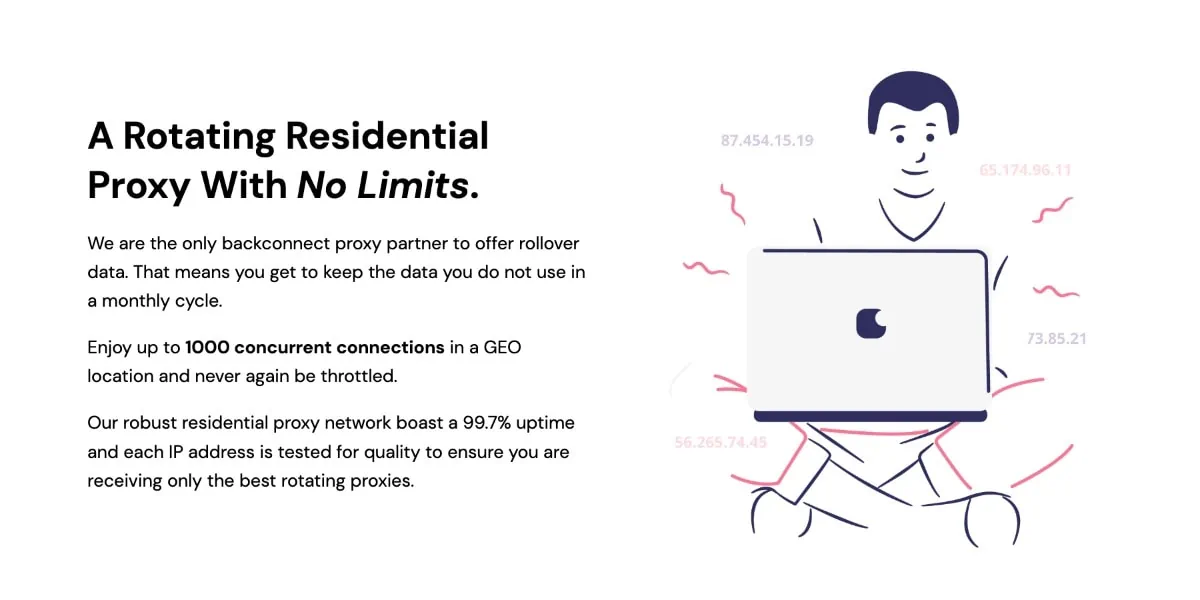
Also called rotating proxies, backconnect proxies are the standard choice for any project that involves large-scale scraping, price monitoring, SERP tracking, or ad verification. The gateway never changes. The IPs behind it rotate on every request, on error, or at a fixed interval — your choice. You pay for bandwidth consumed, not IPs acquired.
The challenge is that not every backconnect proxy provider is built the same. Pool size matters. Rotation logic matters. Sticky session length matters enormously for account management use cases. And pricing models vary from simple per-GB billing to thread-based and port-based approaches that can catch you off-guard. This guide cuts through all seven major providers with real benchmarks and concrete pricing figures — no marketing fluff.
What Are Backconnect Proxies?

A backconnect proxy is a gateway server that connects you to a provider’s pool of IP addresses. You send your requests to a single endpoint — a hostname and port — and the gateway automatically picks an IP from the pool, routes your request through it, and returns the response. The IP behind the gateway can change with every request, after an error, or on a timer.
The backconnect format is how virtually all modern residential proxy networks work. Because residential IPs belong to real users’ devices, you can’t connect to them directly or in advance — they come and go as devices go online and offline. The backconnect gateway abstracts all of that complexity away.
Three types of proxies commonly run in backconnect format:
- Residential backconnect proxies — IPs assigned by ISPs to real home users, rotated automatically. Highest trust level with anti-bot systems. Best for scraping protected sites like Amazon, Google, and social media platforms.
- Mobile backconnect proxies — IPs from real mobile devices on 3G/4G/5G networks. Even harder to detect and block than residential. Used for mobile-specific scraping and app testing.
- Datacenter backconnect proxies — Server IPs in rotating pools. Much faster and cheaper, but easier for sites to detect. Effective when the target doesn’t have aggressive bot detection.
How the Gateway Works
You connect using a format like gate.provider.com:10000:username:password. Many providers let you append parameters directly to the username — for example, adding -country-US-city-chicago to target a specific location, or -session-abc123 to keep the same IP across multiple requests. The gateway handles the IP selection; you just control what you need through those parameters.
Because the gateway address never changes, backconnect proxies are easy to integrate into any tool that accepts a proxy string. No list management. No cron jobs to check for dead IPs. The provider’s infrastructure handles all of that automatically.
Who Needs Backconnect Proxies?
✓ Ideal Users for Backconnect Proxies
- Web Scrapers — Any project that hits the same domain more than a few hundred times a day will trigger rate limiting or IP bans without rotation. Backconnect residential proxies are the standard solution — they spread requests across thousands of IPs so no single one gets flagged.
- Price Intelligence Teams — E-commerce platforms like Amazon, Walmart, and Alibaba serve different prices and availability data to frequent visitors. A backconnect proxy pool lets you check prices at scale without triggering bot detection.
- SEO & SERP Researchers — Tracking keyword rankings across multiple locations requires local IPs that rotate frequently. Backconnect proxies with geo-targeting let you see what Google, Bing, or Baidu actually shows to users in a specific city.
- Ad Verification Teams — Agencies verifying that ads display correctly across geographies use backconnect proxies to simulate local users in dozens of markets simultaneously.
- Social Media Managers — Running multiple accounts on Instagram, Twitter/X, TikTok, or LinkedIn from one IP gets those accounts flagged fast. Sticky-session backconnect proxies assign a stable IP to each account, mimicking natural user behavior.
- Sneaker & Ticket Buyers — Limited-drop purchasing requires hitting a site from many unique IPs simultaneously. Backconnect pools with per-request rotation are built exactly for this use case.
✗ Not Ideal For
Backconnect proxies are NOT the right tool if you:
- Need the same fixed IP address every session — use ISP static proxies or dedicated datacenter IPs instead
- Are streaming high-bandwidth video — residential proxies are not optimized for throughput; bandwidth costs add up fast
- Have a budget of zero — free backconnect proxies expose your traffic to unknown parties and get banned within hours
- Need guaranteed session lengths beyond 24 hours — most providers cap sticky sessions at 10–30 minutes (IPRoyal extends to 24h, Proxyrack to 300 minutes)
7 Best Backconnect Proxy Providers — Tested & Ranked
Here are the top backconnect proxy providers we’ve evaluated for rotating IP pool size, session flexibility, geo-targeting options, and real pricing. Each section covers what makes them worth considering — or skipping.
1. Bright Data

Bright Data is the largest proxy provider in the world by any measure that matters: pool size, number of products, number of enterprise customers (20,000+), and independent benchmark scores. Its residential backconnect network spans 72M+ IPs across 195 countries, with city, state, ZIP, and ASN targeting all available at no extra cost. If your backconnect proxy use case is serious — high-volume scraping, enterprise procurement requirements, or anything that demands proven reliability — Bright Data is the benchmark everyone else is measured against.
Pool & Coverage: 72M+ residential IPs, 195 countries. Proxyway-tested at 885,512 unique IPs globally with 98.59% residential purity. City, ZIP, and ASN targeting included. Dedicated residential pools available for exclusive per-domain use. Also offers mobile (7M+ IPs), ISP (1.3M+), and datacenter (1.3M+) backconnect pools.
Rotation & Sessions: Rotating per request by default. Sticky sessions available. Supports SOCKS5, HTTP, and HTTPS. Intelligent request routing via Scraping Browser and Web Unlocker products.
Pricing: Residential PAYG at $8/GB. Starter plan $499/mo (71 GB, $7/GB). Active promo RESIGB50 gives 50% off for 3 months. Free trial available for companies (7 days). First deposit matched up to $500.
Pros ✓
- Largest residential backconnect pool: 72M+ IPs across 195 countries
- 98.96% global residential success rate (Proxyway-tested)
- City, ZIP, ASN targeting at no extra cost
- Full product stack: residential, mobile, ISP, datacenter, Scraping Browser, SERP API
- ISO 27001 certified; GDPR-ready; ethically sourced
- Proxyway Best Platform for Proxies 2024
Cons ✗
- Most expensive in this list — PAYG $8/GB before promos
- KYC verification required — up to 3 business days
- Subscription plans start at $499/mo minimum
2. Smartproxy (now Decodo)

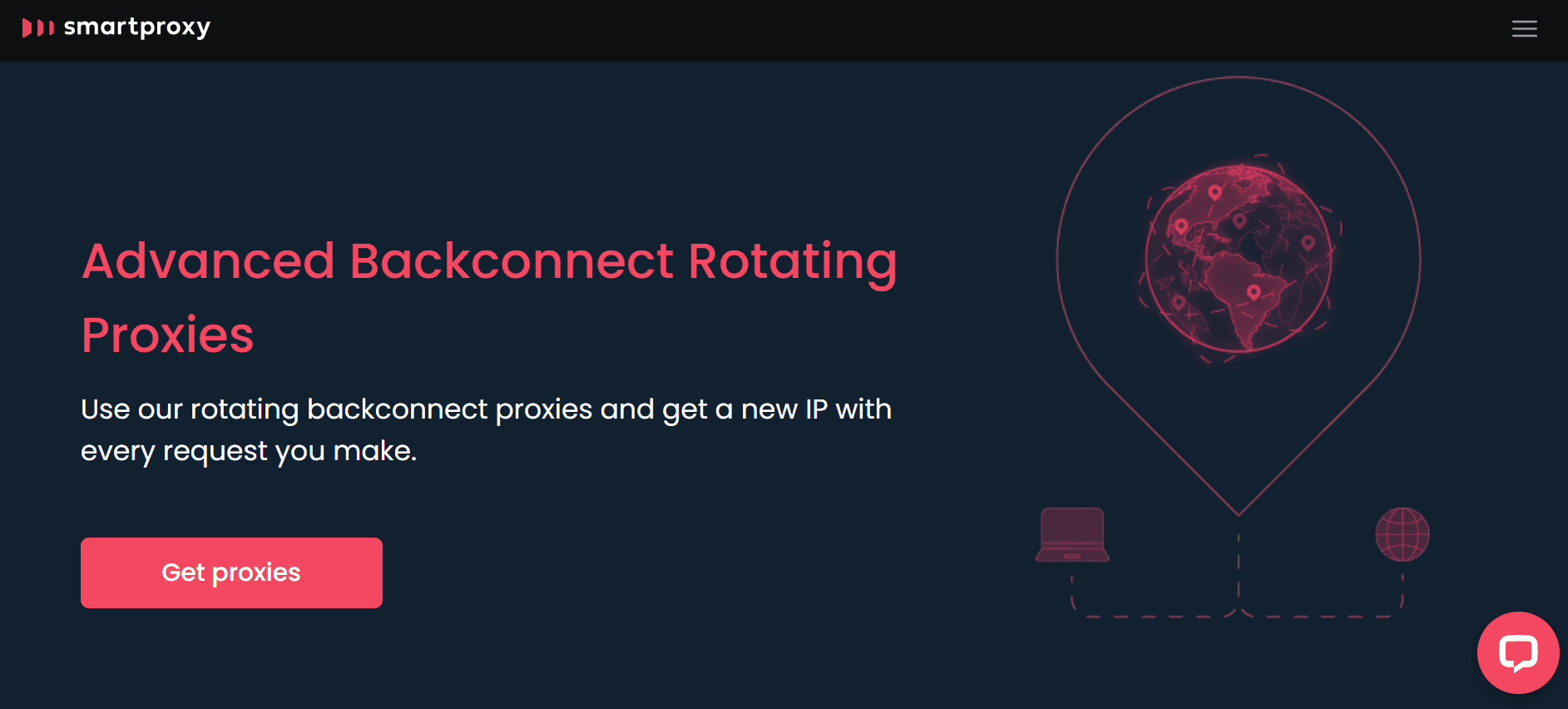
Smartproxy — which rebranded to Decodo in April 2025 — has held Proxyway’s Best Value Provider award for five consecutive years, and the April 2025 benchmark confirmed why: it’s the fastest residential proxy network ever tested, hitting 99.86% global success rate at a sub-0.63-second response time globally. Its 40M+ residential IP pool across 195 countries comes with sticky sessions up to 30 minutes (or up to 24 hours with configuration), and the 3-day free trial gives you 100 MB to test your actual scraping targets before committing.
Pool & Coverage: 40M+ residential IPs (115M+ per the Decodo rebrand), 195+ countries. Proxyway April 2025 benchmark found 1,155,602 unique IPs globally — one of the largest active pools tested. City, state, ZIP (US), and ASN targeting available.
Rotation & Sessions: Per-request rotation by default. Sticky sessions configurable from 1 minute up to 24 hours. Unlimited concurrent connections. HTTP, HTTPS, SOCKS5 (with UDP available on request).
Pricing: PAYG at $4/GB. Subscription plans from $3/GB (50 GB, $150/mo). 3-day free trial (100 MB). 14-day limited money-back guarantee on first purchase. Code DECODO5 gives 5% off all self-service products.
Pros ✓
- Fastest residential proxies globally — Proxyway April 2025
- 99.86% success rate, 0.63 s response time
- Sticky sessions up to 24 hours
- No concurrency limits — unlimited parallel connections
- Best Value award from Proxyway 5 consecutive years
- Free 3-day / 100 MB trial to test your targets
Cons ✗
- PAYG and subscription cannot run simultaneously
- Top-up capped at 80% of plan value per cycle
3. Nimble
Nimble launched in 2022 and has been scaling hard ever since — 80+ employees, venture capital backing, and a product philosophy built around AI-driven optimization rather than raw pool size. Its residential backconnect proxies come with an IP optimization engine that you configure per use case (SERP, social media, e-commerce), and the results show: in Proxyway’s March 2024 benchmarks, Nimble achieved 96.03% success rate on Amazon, Google, and social media targets — among the best scores tested. The 7-day free trial (20 MB) is a real test window for premium use cases.
Pool & Coverage: Pool size not publicly advertised. Benchmark found 290,890 unique global IPs — smaller than enterprise providers but the focus is IP quality and optimization, not raw numbers. Global coverage with country, state, city targeting. Geo-sessions available for extended stable sessions.
Rotation & Sessions: Per-request rotation or sticky sessions up to 30 minutes. Geo-sessions (AI-selected stable IPs) can last days or weeks. Unlimited concurrency. HTTP only (SOCKS5 in progress).
Pricing: PAYG or subscription. Starting at $8/GB. 7-day free trial (20 MB, company email required). Platform-based pricing covers all Nimble products (proxies, SERP API, e-commerce API) under one plan. Essential plan starts at ~$300/mo.
Pros ✓
- 96.03% success rate on premium targets (Amazon, Google, social) — Proxyway 2024
- AI optimization engine per use case (SERP, e-commerce, social)
- Geo-sessions for extended stable-IP workflows
- Platform-based pricing: one plan covers proxies + all scraping APIs
- 7-day free trial available
- Real-time performance alerts in dashboard
Cons ✗
- No SOCKS5 support yet
- Company email required to register — no personal Gmail
- Pool size smaller than enterprise competitors
- Premium pricing — not competitive for high-volume budget use cases
4. IPRoyal

IPRoyal sits in the mid-market with a distinctive offer: its PAYG residential traffic never expires, so unused GB stays in your account indefinitely. That makes it an unusually good fit for teams with sporadic scraping needs — you can buy 10 GB, run your project, and come back six months later without losing what you paid for. Its residential backconnect pool hits 32M+ IPs across 195 countries, with sticky sessions configurable from 1 second all the way to 7 days — one of the longest in this list. The Pawns.app sourcing model means IPs are genuinely opted-in residential.
Pool & Coverage: 32M+ residential IPs across 195+ countries. Proxyway April 2025 benchmark: ~535,859 unique IPs, 99.56% global success rate. City and state targeting available. ISP targeting requires $2,000 spend threshold.
Rotation & Sessions: Automatic rotation per request. Sticky sessions from 1 second to 7 days. Auto-rotate at 1, 10, or 30-minute intervals. Manual rotation via dashboard or API. HTTP, HTTPS, SOCKS5 (TCP only).
Pricing: PAYG residential from $7.35/GB (non-expiring). Subscription from $7/GB (1 GB, 5% discount). High-volume pricing goes down to ~$1.75/GB. Code PROXYWAY30 gives 30% off. ISP proxies available from $1.80/proxy for 24 hours.
Pros ✓
- Non-expiring PAYG traffic — buy once, use anytime
- Sticky sessions up to 7 days — longest in this list
- 99.56% global residential success rate (Proxyway 2025)
- No monthly minimum commitment
- Accepts 25+ cryptocurrencies
- ISP proxies available for just 24 hours ($1.80/proxy)
Cons ✗
- 32M IP pool smaller than enterprise options
- SOCKS5 TCP-only — no UDP support
- Sub-users and ISP targeting require minimum spend thresholds
5. SOAX

SOAX’s defining differentiator is its unified plan model: one subscription covers residential, mobile, ISP, and datacenter backconnect proxies simultaneously, with credits interchangeable across all types. If your projects mix residential and mobile backconnect needs, SOAX is the only provider in this list where you don’t have to pay separately for each. Its 155M+ residential pool includes 2,074,320 Russian IPs listed on the homepage — an unusual level of transparency about country-level density. Proxyway’s April 2025 benchmark clocked 99.73% global success rate at 0.90 s response time.
Pool & Coverage: 155M+ residential IPs, 33M+ mobile IPs, 2.6M+ ISP IPs, 300K+ datacenter IPs. 195+ countries. Country, state, city, and ASN targeting combinable.
Rotation & Sessions: Per-request rotation. Sticky sessions available with configurable duration. Special pool filters: Web Optimizer, MaxIP (for larger unique IP count), Lookalike Rotation. Protocols: HTTP, HTTPS, SOCKS5 (with UDP), QUIC.
Pricing: Starter plan $90/mo (25 GB, $3.60/GB). Advanced $170/mo (50 GB, $3.40/GB). Professional $740/mo (300 GB, $2.46/GB). Paid trial: $1.99 for 3 days + 400 MB. Code PROXYWAY35% gives 35% off.
Pros ✓
- Unified plan: one subscription covers all proxy types (residential, mobile, ISP, DC)
- 155M+ residential + 33M+ mobile IPs — massive combined pool
- 99.73% global success rate (Proxyway April 2025)
- SOCKS5 with UDP — full protocol support including QUIC
- Advanced pool filters (MaxIP, Web Optimizer, Lookalike Rotation)
- Proxyway Contender of the Year 2025
Cons ✗
- No free trial — only $1.99 paid trial
- ISP/datacenter per-IP pricing not shown publicly — requires contacting sales
- Annual pricing not transparently displayed on pricing page
6. GeoSurf (Historical — Shut Down December 2023)

GeoSurf was one of the original premium backconnect residential proxy providers, founded in Israel in 2009. For over a decade it served enterprise clients who needed localization testing across 1,700+ city-level locations worldwide — a feature set that was genuinely ahead of its time. Its residential backconnect pool peaked at around 3.5 million IPs across 150+ countries. Unfortunately, GeoSurf’s parent company BiScience lost a legal dispute to Bright Data in late 2023 and shut down all proxy services on December 20, 2023.
Important: GeoSurf is no longer operational. If you were a GeoSurf customer, you need to migrate to an active provider. The closest modern alternatives with equivalent enterprise-grade, city-level residential backconnect proxies are Bright Data, Oxylabs, and SOAX — all of which have significantly larger pools and more features at comparable or lower pricing.
Historical highlights (for reference): 3.5M+ residential IPs, 150+ countries, 1,700+ city-level locations. Rotation every request, 1, 10, or 30 minutes. Plans started at $300 for 25 GB. No SOCKS5 support. No free trial — demo on request only. Proxyway Benchmark (March 2023): 372,877 unique IPs, 93.24% residential purity.
What Made GeoSurf Strong ✓
- 1,700+ city-level targeting locations — market-leading at launch
- Specialized ad verification and Instagram proxy products
- Unlimited concurrent connections and threads
- 14 years of enterprise proxy experience (2009–2023)
Why Customers Switched ✗
- No longer available — shut down December 20, 2023
- $300 minimum was the highest entry point in the market
- No SOCKS5 protocol support
- Mediocre performance benchmarks vs premium competitors
7. ProxyRack
ProxyRack has been running backconnect proxy infrastructure since 2014 — one of the older operators in this space — and its main differentiator is an unmetered residential proxy product that charges by threads (concurrent connections) rather than bandwidth. If your use case involves consistent long-term scraping where you can predict thread count better than data volume, ProxyRack’s model makes budgeting much more predictable. It’s also one of the very few providers that supports SOCKS5 with full UDP — and even SOCKS4 — making it usable for non-HTTP traffic that most competitors can’t handle.
Pool & Coverage: Premium residential: 5M+ unique monthly IPs. Unmetered: 4.4M+ IPs. 140+ countries. Country, city, ISP targeting, plus OS filtering and IP uptime filtering. Proxyway August 2025 benchmark: 670,925 unique IPs (Premium), 95.83% success rate globally.
Rotation & Sessions: Per-request rotation or sticky sessions up to 300 minutes (5 hours). Four rotation policies: Loose, Strict, Any, None. Configure via port numbers in dashboard or username parameters. HTTP, HTTPS, SOCKS4, SOCKS4a, SOCKS5 (with UDP).
Pricing: Premium residential from $15/mo (10 GB, $1.50/GB). Unmetered from $1,000/mo (1,000 threads). Private Unmetered from $131.90/mo (5 ports). $13.95 all-access 7-day trial. Annual plans save 15%.
Pros ✓
- Unmetered residential option — no bandwidth tracking or surprises
- SOCKS4, SOCKS4a, SOCKS5 with UDP — broadest protocol support in this list
- Sticky sessions up to 300 minutes (5 hours)
- ISP and OS-level targeting (Windows, Mac, Linux, FreeBSD)
- $13.95 all-access 7-day trial to test all products
- EWDCI member — ethically sourced IPs
Cons ✗
- Premium pool success rate lags behind top providers (95.83% vs 99%+)
- Very small team (1–5 employees on LinkedIn) — support depth concerns
- Unmetered plans expensive at entry ($1,000/mo for 1,000 threads)
- Marketing and website content outdated since 2022
How to Choose the Right Backconnect Proxy Provider
Every provider in this list offers backconnect rotating proxies. The question is which one fits your actual use case. These five factors separate a provider that works for you from one that costs you time and money to replace.
Pool Size and Active IP Depth
Advertised pool sizes and real active pools are often very different. Bright Data advertises 72M+ but Proxyway found 885,512 unique IPs in testing. Smartproxy (Decodo) advertises 40M+ but actually returned 1,155,602 unique IPs — more than what’s claimed. What matters is how many IPs the provider actually cycles through during your scraping run. Providers with thin active pools repeat IPs quickly, which raises your detection risk on sensitive targets.
Sticky Session Length
Per-request rotation is ideal for basic scraping. But the moment you need to log into an account, complete a multi-step checkout, or handle a session-aware form, you need sticky sessions — and the maximum length varies dramatically. IPRoyal offers up to 7 days. ProxyRack goes up to 300 minutes. Smartproxy goes to 24 hours. Nimble’s geo-sessions can last days or weeks. Know your workflow requirements before picking a provider.
Protocol Support
Most providers support HTTP, HTTPS, and SOCKS5 TCP. If you need SOCKS5 with UDP (for gaming, real-time data feeds, or non-HTTP traffic), only SOAX and ProxyRack in this list offer full UDP support. If you need SOCKS5 at all, avoid Nimble for now — it’s still HTTP-only.
Pricing Model: Per-GB vs Unmetered
Per-GB billing is predictable for scraping projects where you know your data volume. Unmetered billing (ProxyRack) is better when you’re making many small requests and thread count is easier to predict than bandwidth. At very high volumes, per-GB rates from providers like Smartproxy ($3/GB) or SOAX ($2.46/GB at 300 GB) become more economical than unmetered plans. Run the math for your actual monthly volume before committing.
Trial and Refund Policy
Never buy a six-month plan with a new provider before testing on your actual targets. Smartproxy offers a free 100 MB 3-day trial. ProxyRack gives a $13.95 all-access 7-day trial. Nimble provides a 7-day free trial (20 MB). SOAX’s $1.99 paid trial gives 400 MB. Always test against your real targets — not just an IP check tool — before committing to a subscription.
Bottom line: For most teams starting with backconnect proxies, Smartproxy (Decodo) is the easiest starting point — free trial, competitive pricing, fastest speeds, and broad compatibility. If you need the most IPs and enterprise-grade compliance, Bright Data. For unified residential + mobile on one plan, SOAX. For unmetered residential backconnect, ProxyRack is the only real option in this list.
Backconnect Proxy Pricing: Side-by-Side Comparison
The table below compares all active providers on the metrics that matter for backconnect proxy selection. Prices reflect the most common entry-level residential plan. GeoSurf is excluded as it is no longer operational.
| Provider | Pool Size | Entry Price | Max Sticky Session | Protocol | Trial |
|---|---|---|---|---|---|
| Bright Data | 72M+ residential | $8/GB PAYG (50% off promo available) | Flexible | HTTP, HTTPS, SOCKS5 | 7-day (companies) |
| Smartproxy (Decodo) | 40M+ / 115M+ residential | $4/GB PAYG; $3/GB (50 GB plan) | 24 hours | HTTP, HTTPS, SOCKS5 (UDP available) | Free 3-day / 100 MB |
| Nimble | Not disclosed | $8/GB PAYG; ~$300/mo Essential | 30 min (geo-sessions: days/weeks) | HTTP only | 7-day free (20 MB) |
| IPRoyal | 32M+ residential | $7.35/GB PAYG (non-expiring) | 7 days | HTTP, HTTPS, SOCKS5 | No free trial |
| SOAX | 155M+ resi + 33M+ mobile | $3.60/GB ($90/mo Starter) | Configurable | HTTP, HTTPS, SOCKS5 (UDP), QUIC | $1.99 / 3-day / 400 MB |
| ProxyRack | 5M+ premium; 4.4M+ unmetered | $1.50/GB (Premium, 10 GB); $1,000/mo unmetered | 300 min (5 hours) | HTTP, HTTPS, SOCKS4, SOCKS5 (UDP) | $13.95 / 7-day all-access |
Pricing note: Per-GB rates drop significantly at scale. Bright Data’s $8/GB PAYG becomes $2.50/GB at $1,999/mo. Smartproxy’s $4/GB PAYG competes with enterprise pricing at higher volumes. Always check the provider’s live pricing slider for your actual volume tier. Promo codes (RESIGB50, PROXYWAY35%, PROXYWAY30, DECODO5) are subject to expiry — verify before purchasing.
Backconnect Proxy Pros & Cons: What to Expect
Backconnect proxies are the right solution for most large-scale automated browsing tasks — but they come with real trade-offs worth understanding before you invest.
Pros ✓
- Zero IP list management: No dead IPs, no manual rotation scripts, no cron jobs. The gateway handles everything automatically.
- Massive scale without friction: Go from 10 requests to 10,000 concurrent ones without reconfiguring your infrastructure — just add more bandwidth or threads.
- High success rates on protected targets: Residential backconnect pools achieve 96–99%+ success rates on Amazon, Google, and social platforms — far beyond what static IP lists deliver.
- Location flexibility: Switch target countries with a parameter change — no need to buy a new set of IPs for each geography.
- Sticky sessions for multi-step workflows: Add session IDs to maintain the same IP across a login, cart add, checkout flow, or account management sequence.
- Ethical sourcing options: Top providers (Bright Data, Smartproxy, SOAX, ProxyRack) source IPs from opt-in users, reducing legal and reputational risk.
Cons ✗
- Per-GB costs add up: At $3–8/GB, a 500 GB/mo scraping operation costs $1,500–4,000/mo just in proxy fees. Budget carefully before scaling.
- Shared pool reputation risk: You don’t control which IPs you get. If previous users abused a particular IP, it may arrive in your session already flagged on your target site.
- Session length limits: Most providers cap sticky sessions at 30 minutes. For workflows requiring days-long persistent sessions, options are limited (IPRoyal’s 7-day max, Nimble’s geo-sessions).
- Speed trade-off: Residential backconnect proxies route through real user devices — response times of 0.6–2 s are typical, versus 0.1–0.3 s for datacenter IPs.
Bottom Line: Backconnect proxies are essential infrastructure for any project that scrapes at scale. The costs are real but predictable — and the alternative (manually managing proxy lists at scale) wastes engineering time worth far more than the subscription cost. The key is choosing a provider whose pool depth and session model match your actual use case.
Backconnect Proxy Provider Ratings Breakdown
We rated each active backconnect proxy provider on six criteria relevant to rotating proxy use cases. Scores draw from third-party benchmark data (Proxyway 2024–2025) where available, combined with pricing competitiveness, session flexibility, and protocol depth.
| Category | Score | Notes |
|---|---|---|
| Pool Size & IP Depth | 4.5/5 | Bright Data leads (885K unique IPs tested); Smartproxy also top-tier (1.15M unique); IPRoyal smaller but sufficient for most |
| Rotation & Session Flexibility | 4.4/5 | IPRoyal’s 7-day sticky sessions are unmatched; Nimble’s geo-sessions are innovative; all support per-request rotation |
| Success Rate on Real Targets | 4.5/5 | Nimble 96.03% on Amazon/Google; SOAX 90.27%; Smartproxy 99.86% (infrastructure test); ProxyRack lags at 95.83% |
| Pricing & Value | 4.2/5 | Smartproxy $3/GB at scale is market-leading value; ProxyRack’s $1.50/GB premium is excellent; Bright Data expensive without promos |
| Protocol & Integration Support | 4.3/5 | ProxyRack leads with SOCKS4/5 + UDP; SOAX adds QUIC; Nimble is HTTP-only — a limitation for non-browser use cases |
| Ease of Use & Documentation | 4.4/5 | Smartproxy and Bright Data have best-in-class documentation; ProxyRack’s port-based system has a learning curve |
| Overall Rating | 4.4/5 | Backconnect proxies from top providers deliver excellent performance — the market has matured significantly since 2022 |
Rating Summary: Smartproxy (Decodo) leads overall on the combination of speed, pool depth, value, and ease of use. Bright Data leads on raw scale and enterprise features. SOAX wins for teams that need residential and mobile backconnect under one plan. IPRoyal is the best option for teams with sporadic usage and non-expiring traffic needs. ProxyRack is the right call when SOCKS5 with UDP or unmetered bandwidth is a firm requirement.
Are Backconnect Proxies Legit, Safe & Worth It?
Legitimacy & Safety
- ✓ Legal to use commercially: Purchasing and using backconnect proxies from a reputable provider is legal in most jurisdictions. The proxy is an intermediary — the legality of what you do with it depends on your specific use case and the target site’s terms of service.
- ✓ Ethically sourced options widely available: Bright Data, Smartproxy, SOAX, and ProxyRack are all members of the Ethical Web Data Collection Initiative (EWDCI) or carry ISO certification. Their residential IPs come from opted-in users — not compromised devices.
- ✓ Enterprise compliance available: Bright Data (ISO 27001, SOC, GDPR-ready) and SOAX (G2 Leader, Easiest to Do Business With) meet enterprise procurement standards. Nimble is venture-backed and US-registered with a track record of institutional clients.
- ✓ Independent benchmarks verify claims: Proxyway’s regular proxy market research independently tests success rates, pool sizes, and speed — so you’re not just relying on marketing copy. All providers in this list except GeoSurf (now defunct) have been independently benchmarked.
Long-Term Reliability
Bright Data (founded 2014), Smartproxy/Decodo (founded 2018), and IPRoyal (founded 2020) all have multi-year track records with millions of active customers. SOAX (founded 2020) and ProxyRack (founded 2014) have demonstrated consistent operation. Nimble (founded 2022) is newer but has institutional investment and is scaling fast. GeoSurf’s closure in December 2023 after losing a legal dispute is a reminder that even established providers can exit — always keep export options in mind and avoid locking critical workflows into a single provider with no exit plan.
Reality check: Backconnect proxies are not magic. Even with residential IPs, some targets will still detect automation through browser fingerprinting, behavioral analysis, or TLS fingerprinting — none of which the proxy itself affects. If you’re hitting 90%+ success rates and still getting blocked on the remaining 10%, the problem is likely not the proxy — it’s your scraping logic, headers, or request timing. Pair backconnect proxies with proper browser emulation and realistic request patterns for the best results.
Worth It If:
- You’re scraping more than a few hundred pages per day on any single domain
- Your targets include Amazon, Google, or major social platforms
- You manage multiple accounts that must appear as different users
- You need geo-specific data from multiple countries or cities simultaneously
Not Worth It If:
- Your scraping volume is under 1 GB/month — a free or cheap static proxy will do
- You need a fixed IP every session — use dedicated/static proxies instead
- Your target has no bot protection and rarely blocks IPs
- Your budget is zero — free backconnect proxies are a security risk
Our Recommendation: Yes, backconnect proxies from established providers are absolutely worth using for any project that requires scale. Start with Smartproxy’s free 100 MB trial or SOAX’s $1.99 paid trial to validate performance on your actual targets before committing. Test against your specific domain — not just a generic IP-check tool — to get meaningful data before buying a subscription. If you’re an enterprise user, Bright Data’s 7-day company trial gives you the most complete evaluation environment.
Backconnect Proxy FAQs: Your Questions Answered
What is a backconnect proxy?
A backconnect proxy is a gateway server that connects your traffic to a pool of IP addresses managed by a proxy provider. Instead of connecting directly to a specific IP, you connect to one endpoint (hostname and port), and the gateway automatically selects an IP from the pool for each request. The IP can change on every request, on error, or at set intervals — making backconnect proxies effectively the same as rotating proxies. The terms are used interchangeably in the industry.
What is the difference between backconnect proxies and regular proxies?
With regular (static) proxies, you get a list of IP addresses and connect to each one directly. You’re responsible for managing that list — checking for dead IPs, rotating them, handling failures. With backconnect proxies, you connect to one gateway and the provider handles everything behind the scenes: IP selection, rotation, replacement. Backconnect proxies are “managed” — the provider does the work. Static proxy lists are “unmanaged” — you do the work.
Which is the best backconnect proxy provider overall?
For most users, Smartproxy (now Decodo) is the best all-around backconnect proxy provider: fastest residential speeds globally (Proxyway April 2025), 99.86% success rate, pricing from $3/GB, free 100 MB trial. For maximum pool size and enterprise features, Bright Data. For unified residential + mobile on one plan, SOAX. For the longest sticky sessions (7 days), IPRoyal. For unmetered residential bandwidth, ProxyRack. For AI-optimized premium scraping, Nimble.
Can I use backconnect proxies for any proxy type (residential, datacenter, mobile)?
Yes. The backconnect format is a server architecture, not a proxy type. Residential, mobile, datacenter, and ISP proxies can all be delivered through a backconnect gateway. Residential and mobile proxies almost always use the backconnect format because their IPs come from real devices that rotate in and out of availability. Datacenter proxies can be either a backconnect pool or a static list — it depends on the provider’s configuration.
How long can I hold the same IP with a backconnect proxy (sticky sessions)?
It depends heavily on the provider. Here are the maximums from providers in this list:
- IPRoyal: up to 7 days
- ProxyRack: up to 300 minutes (5 hours)
- Smartproxy (Decodo): up to 24 hours
- Nimble geo-sessions: days to weeks (AI-stabilized)
- SOAX: configurable duration
- Bright Data: flexible by product
If your workflow requires very long stable sessions, IPRoyal’s 7-day sticky session is the most permissive standard offering in the market.
Are backconnect proxies good for web scraping?
Yes — backconnect residential proxies are the standard tool for web scraping at scale. Their auto-rotating IP pool means you’re never hitting the same domain from the same IP consecutively, which is the primary cause of scraping bans. Top providers achieve 96–99%+ success rates on protected targets like Amazon, Google, and social media. For sites without aggressive bot detection, datacenter backconnect proxies are faster and significantly cheaper.
How do I set up a backconnect proxy?
Setup is usually straightforward. You receive a gateway address, port, username, and password from your provider. Enter these in your scraping tool, browser, or code just as you would any proxy. To add location targeting or session control, most providers let you append parameters to the username — for example, appending -country-US-city-NewYork-session-abc123. Many providers also offer endpoint-based setup where you change the port number to change location, which works better for tools that don’t support credential-based authentication.
Are backconnect proxies legal?
Yes, purchasing and using backconnect proxies from a commercial provider is legal in most countries. What matters is how you use them. Scraping publicly available pricing data, tracking SERP rankings, or running ad verification are standard commercial practices. Scraping personal data, bypassing paywalls, or violating a site’s Terms of Service may raise legal issues depending on your jurisdiction. Use ethically sourced providers (EWDCI members like Bright Data, Smartproxy, SOAX, ProxyRack) to minimize compliance risk.
What happened to GeoSurf?
GeoSurf, one of the original premium backconnect proxy providers (founded 2009), shut down on December 20, 2023. Its parent company BiScience lost a legal dispute to Bright Data and was required to close the proxy business. If you were a GeoSurf customer, the closest alternatives with equivalent enterprise-grade city-level residential backconnect proxies are Bright Data, SOAX, and Smartproxy — all of which offer larger pools, better performance benchmarks, and more competitive pricing than GeoSurf had at closure.
Do backconnect proxies support SOCKS5?
Most providers support SOCKS5, but the details matter. SOAX and ProxyRack support SOCKS5 with full UDP — essential for non-HTTP traffic like gaming, real-time data, or certain APIs. Smartproxy supports SOCKS5 with UDP available on request. IPRoyal and Bright Data support SOCKS5 TCP-only on most products. Nimble is currently HTTP-only with SOCKS5 listed as in progress. If SOCKS5 with UDP is a requirement, SOAX or ProxyRack are your best options.
How much do backconnect proxies cost?
Pricing varies significantly by provider and volume:
- Smartproxy (Decodo): $4/GB PAYG; $3/GB (50 GB/mo plan)
- Bright Data: $8/GB PAYG; $7/GB Starter ($499/mo)
- SOAX: $3.60/GB Starter ($90/mo, 25 GB)
- IPRoyal: $7.35/GB PAYG (non-expiring); ~$1.75/GB at high volume
- Nimble: ~$8/GB entry; ~$300/mo Essential plan
- ProxyRack: $1.50/GB Premium residential; $1,000/mo unmetered
Prices drop significantly at scale. A provider charging $8/GB at entry may charge $2.50/GB at 500+ GB. Always check the live pricing slider for your actual volume tier.
Can I try backconnect proxies before buying a subscription?
Yes — most providers offer trials. Smartproxy gives a free 3-day / 100 MB trial with no credit card required on many plans. Nimble provides a 7-day free trial (20 MB) with a company email. ProxyRack offers a $13.95 all-access 7-day trial covering all products. SOAX runs a $1.99 paid trial for 3 days and 400 MB. Bright Data offers a 7-day free trial for verified company accounts. Always run your trial against your actual target URLs to get meaningful performance data before committing to a plan.
Final Verdict
Backconnect proxies are not a luxury — for any project that scrapes at meaningful scale, they’re the only practical solution. The seven providers in this list cover the full range from budget to enterprise, unmetered to per-GB, and HTTP-only to full SOCKS5 with UDP. GeoSurf no longer operates. The six active providers each have a clear use case they excel at: Smartproxy for value and speed, Bright Data for enterprise scale, Nimble for AI-optimized scraping, IPRoyal for session persistence, SOAX for unified plan flexibility, and ProxyRack for unmetered or UDP-heavy use cases.
✓ Top Picks
- Smartproxy (Decodo) — Best overall: fastest speeds, 99.86% success rate, free trial, $3/GB at scale
- Bright Data — Best enterprise: 72M+ IPs, full compliance stack, complete product suite
- SOAX — Best unified plan: residential + mobile + ISP + DC under one subscription
- IPRoyal — Best sticky sessions: up to 7 days, non-expiring PAYG traffic
- Nimble — Best AI-optimized scraping: 96%+ on Amazon/Google, geo-sessions
- ProxyRack — Best unmetered: thread-based pricing, SOCKS5 with UDP
✗ When to Look Elsewhere
- You need a static, fixed IP every session — use dedicated proxies instead
- Your budget is zero — free backconnect proxies expose your traffic
- You need SOCKS5 with UDP and don’t want to use SOAX or ProxyRack
- Your target has no bot protection and rarely bans IPs — a static IP list will cost less
Ready to Start Using Backconnect Proxies?
Start with Smartproxy’s free 100 MB trial — test your actual scraping targets before spending a dollar on a subscription.
Try Smartproxy Free — Best Backconnect Proxy Value →