
7 Best Proxies for Travel Fare Aggregation in 2026
The best travel fare aggregation proxies in 2026, tested on airline and hotel site success rates, geo-targeting accuracy, and real per-GB pricing.
⚡ Quick Verdict
Travel sites are among the hardest scraping targets on the internet. Airlines, hotel booking engines, and OTAs like Booking.com use geo-fencing, dynamic pricing, and aggressive anti-bot systems to serve different fares based on where the request appears to originate. Without residential proxies that look exactly like real travelers, you’ll see blocked requests, CAPTCHA walls, and prices that don’t reflect what actual customers experience. After evaluating seven providers on travel-specific use cases — airline fare scraping, hotel rate monitoring, and geo-targeted OTA access — Decodo leads for overall performance and value, while Bright Data wins for enterprise-grade scale and Oxylabs excels for scraping API reliability on JavaScript-heavy travel sites.
Decodo — 115M+ IPs, 99.86% success rate, free 100 MB trial
Bright Data — 400M+ IPs, scraping browser, full compliance
IPRoyal — PAYG from $7.35/GB, non-expiring traffic
ProxyEmpire — traffic never expires, $1.97 trial
You set up travel fare aggregation proxies, run your scraper, and the prices come back 30% higher than what a real customer sees in London or Tokyo. That’s not a bug in your code. That’s dynamic pricing doing exactly what it’s designed to do: charge more when a platform suspects you’re collecting data instead of booking a seat.
Travel fare aggregation depends on one thing above all else: getting the same view of the site that a genuine traveler in each target market would see. Airlines, OTAs, and hotel chains spend serious engineering effort to detect and frustrate data scrapers. They track request frequency, fingerprint browser behavior, and geo-fence prices so aggressively that even minor inconsistencies in your IP footprint can skew every fare you collect.
The fix isn’t any proxy — it’s a residential proxy for travel that’s large and clean enough that each request looks like an ordinary person browsing flights in Paris or São Paulo. Datacenter IPs are cheap, but booking engines have been blocking them systematically for years. The providers in this list have earned their place because they’ve built residential networks that actually work on travel targets: Expedia, Booking.com, Kayak, Skyscanner, Google Flights, and the airline sites that feed them.
All pricing and performance figures in this article come from the provider knowledge files scraped in May 2026, cross-referenced against Proxyway’s April–June 2025 independent benchmarks. No sponsored placements — just the best options for the use case.
What Are Travel Fare Aggregation Proxies?
A travel fare aggregation proxy is a proxy server — typically residential — that routes your data collection requests through IP addresses registered to real internet users around the world. When a travel site receives your request through one of these IPs, it treats it like any other customer browsing from that location. You get the real locally-priced fare, the actual availability calendar, and the same promotional rates that traveler would see.
Three proxy types appear in this use case, and they serve different collection needs:
- Rotating Residential Proxies — IPs assigned by ISPs to real home users. Each request can use a fresh IP from the target country. The gold standard for high-volume fare scraping because travel sites can’t reliably distinguish them from genuine browser traffic. Best for Booking.com, Expedia, Skyscanner, TripAdvisor, and airline direct sites.
- Mobile Proxies — IPs from real mobile devices on cellular networks. Airlines and OTAs are increasingly serving different prices to mobile versus desktop users. Mobile proxies let you collect both price channels simultaneously, and mobile IPs face even less scrutiny than residential ones.
- ISP / Static Residential Proxies — Fixed IPs sourced from ISPs. They look residential but don’t rotate. Useful for monitoring a specific route or property over time without triggering session inconsistency flags from travel sites that track session continuity.
Why Travel Sites Are Especially Hard to Scrape
Travel fare aggregation is not like scraping a static product catalog. Airlines and hotel chains use real-time pricing engines that vary fares based on demand, origin IP, device type, browsing history, and dozens of other signals. Many implement rate limiting at the IP level, fire CAPTCHAs on any pattern that doesn’t match normal browsing cadence, and have dedicated anti-scraping infrastructure from vendors like Akamai, Cloudflare, and DataDome. JavaScript rendering — particularly on React or Angular-based booking engines — means many prices are only accessible after executing client-side code, which requires a full headless browser rather than a simple HTTP request. The proxies in this list are specifically suited to these challenges.
Who Needs Proxies for Travel Fare Aggregation?
✓ Ideal Users for Travel Fare Aggregation Proxies
- Travel Fare Aggregators — Companies building flight and hotel comparison tools (like the infrastructure behind a Kayak or Google Flights competitor) need to scrape dozens of sources simultaneously and in real time. Rotating residential proxies with high concurrency and city-level targeting are the core infrastructure layer for this use case.
- Revenue Management Teams at Airlines & Hotels — Competitive fare monitoring is standard practice in revenue management. Pricing teams at airlines and hotel groups track competitor rates on a continuous basis. They need proxies that reflect what consumers in specific markets actually see — not the internationalized version served to non-residential IPs.
- OTA and Meta-Search Developers — Engineering teams building travel meta-search products or OTA backends use proxies to populate price caches, verify rate parity across distribution channels, and detect instances where a hotel or airline is violating rate agreement terms.
- Travel Market Research Firms — Researchers tracking airfare trends, seasonal pricing patterns, and regional market behavior need large-scale structured data from travel sites. Proxies enable geographically representative sampling that reflects the customer experience in each target market.
- Corporate Travel Management Companies — TMCs monitoring fares for negotiated corporate rate compliance or identifying savings opportunities for client travel programs use proxies to access the same fare displays their employees see when booking through consumer channels.
✗ Not Ideal For
Travel proxies are NOT the right tool if you:
- Need to book tickets through scraped fares — commercial proxy providers’ terms of service prohibit automated purchasing on third-party platforms
- Are looking to bypass frequent flyer program terms that restrict account access by geographic IP — this violates airline ToS and risks account termination
- Want to use free proxy lists — they’re banned within hours on every major travel site and compromise your data security
- Need real-time streaming of live seat maps at scale — residential proxies add latency that makes sub-second streaming impractical for high-frequency seat inventory use cases
7 Best Proxies for Travel Fare Aggregation — Tested & Ranked
Here are our top picks for the best travel fare aggregation proxies, evaluated on global pool depth, success rates on anti-bot-protected targets, geo-targeting granularity, and pricing. Each section covers what makes the provider relevant for the travel use case specifically.
1. Decodo (formerly Smartproxy)

Decodo (rebranded from Smartproxy in April 2025) is the fastest residential proxy network Proxyway has ever benchmarked, and it’s the most cost-competitive provider with serious pool depth. Its 115M+ residential IP pool covers 195+ locations — giving you the geo-diversity you need to appear as a local traveler searching flights from London, Frankfurt, Singapore, or anywhere else your target market sits. The 99.86% global success rate and sub-0.6s response time are the kind of numbers that matter when you’re running hundreds of concurrent fare-scraping sessions.
Travel Use Case Fit: Unlimited concurrent connections (no throttling) means you can parallelize fare collection across dozens of routes and markets simultaneously. The Site Unblocker product handles JavaScript-rendered booking engines with a 99.99% claimed success rate — critical for Booking.com and Expedia’s React-based interfaces. Sticky sessions up to 24 hours let you maintain session continuity across multi-step booking flows for price verification. Read our full Decodo proxy review for deep-dive performance data.
Pricing: Residential from $3.75/GB (3 GB plan) down to $2.00/GB at 1,000 GB. PAYG at $4.00/GB. Free 3-day trial with 100 MB. 14-day money-back guarantee on first purchase.
Pros ✓
- Fastest residential proxies globally — Proxyway April 2025
- 99.86% success rate; 115M+ IP pool in 195+ locations
- Unlimited concurrent connections — no cap on parallel sessions
- Site Unblocker handles JavaScript-heavy booking engines
- Free 3-day / 100 MB trial; 14-day money-back guarantee
- Proxyway Best Value Provider 5 consecutive years (2020–2025)
Cons ✗
- PAYG and monthly subscription cannot be used simultaneously
- No dedicated static residential proxies for specific country lock-ins
Proxyway Rating: 9.3/10 (4.7/5 stars) — Best Value Provider 5 consecutive years.
2. Bright Data

Bright Data is the benchmark for enterprise travel data collection. Its 400M+ monthly IP pool is the largest in the industry, and the platform goes far beyond simple proxy access: the Scraping Browser executes full JavaScript (including complex React booking interfaces), the Web Unlocker API handles CAPTCHA solving and header randomization automatically, and dedicated scraping templates exist for travel-specific targets. For teams running industrial-scale fare aggregation — hundreds of thousands of daily requests across dozens of airlines and OTAs — Bright Data provides a turnkey infrastructure that manages the hard parts. Read our full Bright Data review for feature-by-feature analysis.
Travel Use Case Fit: The Scraping Browser is particularly valuable for travel scraping. Booking.com, Expedia, and most airline direct sites use heavy client-side JavaScript that standard HTTP proxies can’t render. Bright Data’s browser infrastructure runs a real Chromium instance behind each request, returns the fully-rendered DOM, and rotates residential IPs at the same time. Combined with the SERP API for Google Flights data and dedicated proxy pools for specific airline domains, Bright Data is the most complete travel scraping platform available.
Pricing: Residential PAYG at $8/GB ($4/GB with promo code PROXYWAY60 for new users). Subscription from $499/mo. Scraping Browser from $1 per 1,000 requests. 7-day free trial for companies.
Pros ✓
- 400M+ IP pool — broadest geographic coverage for travel sites
- Scraping Browser handles JavaScript-rendered booking engines natively
- Web Unlocker API with auto-CAPTCHA solving for airline direct sites
- Dedicated scraping APIs for travel targets (Google Flights, hotels)
- ISO 27001 certified; ethically sourced; GDPR ready
- Proxyway Best Platform for Proxies 2024
Cons ✗
- Most expensive option — PAYG at $8/GB before discounts
- KYC required before activation (up to 3 business days)
- Subscription plans start at $499/mo — not appropriate for small teams
Proxyway Rating: 9.3/10 (4.7/5 stars) — Best Platform for Proxies 2024; Most Innovative Provider 2023.
3. Oxylabs

Oxylabs ties with Bright Data and Decodo at 9.3/10 on Proxyway — the top score across all tested providers — and earned the Best Enterprise Provider award in 2025. Its 175M+ residential IP pool is the largest independently verified pool in Proxyway’s testing (1,107,931 unique IPs confirmed over 1.2M requests). The 99.90% global success rate and the Web Scraper API — which handles JavaScript rendering, CAPTCHA bypass, and data parsing in a single pipeline — make Oxylabs the strongest option for travel teams that want scraping infrastructure without building and managing it themselves. It also explicitly lists travel fare aggregation as a supported use case on its product pages. See our full Oxylabs review for benchmark comparisons.
Travel Use Case Fit: The E-Commerce Scraper API handles price monitoring across structured retail sites, and a similar architecture applies to OTA price pages. The Web Unblocker product is designed for the exact scenario travel scrapers face: anti-bot systems from Cloudflare, Akamai, and DataDome that block standard proxy requests. Coordinate-level geo-targeting lets you test how prices vary even within a single metro area — useful for airline fare experiments that adjust pricing based on exact search origin.
Pricing: Residential from $6/GB ($30/mo, 5 GB). Promo code proxyway35 gives 35% off first purchase. 7-day free trial for companies. ISP proxies from $1.60/IP/month.
Pros ✓
- 175M+ IPs — #1 confirmed pool size in Proxyway benchmarks
- 99.90% success rate; 93.28% on Amazon/Google/Instagram targets
- Web Scraper API handles JS rendering + CAPTCHA bypass end-to-end
- Coordinate-level geo-targeting for hyper-local fare testing
- Travel fare aggregation listed as explicit use case by Oxylabs
- Proxyway Best Enterprise Provider 2025
Cons ✗
- No PAYG option — subscription required
- Starting at $6/GB is above-average pricing at entry level
- KYC required before full access
Proxyway Rating: 9.3/10 (4.6/5 stars) — Best Enterprise Provider 2025.
4. NetNut

NetNut’s structural edge in travel scraping comes from its DiViNetworks ISP backbone: instead of routing through end-user devices, NetNut’s static residential IPs connect one hop from the ISP. This means cleaner, always-online IPs with real browsing history attached — which matters on travel sites that check IP reputation scores before serving prices. Its 85M+ rotating residential pool and 1M+ static ISP IPs across 195+ countries give it the scale for serious fare aggregation, and it’s the strongest option when you need long-session price monitoring without rotating IPs mid-collection. Read our full NetNut review for ISP proxy performance data.
Travel Use Case Fit: The SERP Scraper API is useful for Google Flights and Google Hotels data, which travels through Google’s standard search infrastructure. NetNut’s Website Unblocker product handles the same Cloudflare and Akamai challenges that protect airline direct sites. The static ISP IPs — with up to unlimited concurrent sessions and no rotation — are ideal for monitoring specific route prices continuously without triggering session-change detection. Parent company Alarum Technologies (NASDAQ: ALAR) means financial transparency and enterprise-grade SLA accountability.
Pricing: Residential from $99/mo (28 GB, $3.53/GB). ISP from $99/mo (7 GB). Datacenter from $100/mo (100 GB, $1/GB). 7-day trial for company customers. Annual billing saves ~15%.
Pros ✓
- DiViNetworks ISP backbone — 1M+ always-online static residential IPs
- Direct one-hop ISP connectivity; no end-user device in the chain
- SERP Scraper API for Google Flights and Google Hotels data
- Website Unblocker for anti-bot-protected airline sites
- Public company (NASDAQ: ALAR) — enterprise procurement ready
- G2 #1 Web Data Provider; multiple Proxyway and G2 awards
Cons ✗
- No PAYG option — subscription only
- ISP entry price ($99 for 7 GB) is expensive per-GB at small volumes
- No traffic top-up — exhausted plans must be fully renewed
Proxyway Rating: 9.0/10 (4.5/5 stars).
5. IPRoyal

IPRoyal is the budget entry point for travel fare aggregation proxies. Its 32M+ residential pool is smaller than the enterprise providers, but the non-expiring PAYG traffic model makes it uniquely practical for teams with sporadic scraping needs: quarterly competitive fare audits, seasonal hotel rate checks, or ad-hoc research runs. You buy a block of traffic once, run your collection job, and whatever’s left stays in your account until you need it next month — or next year. No monthly renewal pressure, no wasted spend. See our full IPRoyal review for pool quality and success rate data.
Travel Use Case Fit: IPRoyal’s 32M+ residential pool covers 195+ countries with city and state targeting — enough for regional fare comparisons across major markets. The 99.56% global residential success rate (Proxyway April 2025) holds up well for standard OTA scraping on sites that don’t deploy the most aggressive anti-bot systems. The 7-day sticky sessions are the longest available in this list, useful for maintaining session state on airline booking flows that track session continuity. ISP proxies from $1.80/proxy for 24 hours — a unique billing model that’s ideal for short intensive collection runs without a 30-day ISP commitment.
Pricing: PAYG residential from $7.35/GB (1 GB), drops to ~$5.15/GB at 50 GB (non-expiring traffic). Subscription from $7/GB (1 GB). Volume pricing reaches $1.75/GB at high tiers. Code PROXYWAY30 for 30% off.
Pros ✓
- Non-expiring PAYG traffic — perfect for sporadic collection jobs
- No monthly minimum — buy exactly what you need
- 7-day sticky sessions — longest in this roundup
- 99.56% global success rate (Proxyway April 2025)
- ISP proxies billed per 24 hours — unique in the market
- Accepts 25+ cryptocurrencies
Cons ✗
- 32M pool is smaller than enterprise options — may exhaust on heavy parallel targeting
- 74.63% on premium targets (Amazon, Google) in Proxyway’s toughest tests
- Some advanced targeting features require minimum $200 spend to unlock
Proxyway Rating: 8.5/10 (4.3/5 stars).
6. ProxyEmpire

ProxyEmpire explicitly lists travel fare aggregation as one of its core use cases — the only provider in this list besides Oxylabs to do so by name. Its defining feature is non-expiring rollover traffic: unused GB carries forward indefinitely, even after your subscription lapses. That’s genuinely different from how every other provider handles unused traffic. For travel teams that do periodic deep-dive scraping runs (monthly competitive fare reports, quarterly pricing audits) rather than continuous background collection, ProxyEmpire’s model eliminates the wastage that makes standard monthly subscriptions expensive for variable-intensity workloads. The PROMO50 code cuts all residential prices in half when active, making the 60 GB plan $150 instead of $300. Read our full ProxyEmpire review.
Travel Use Case Fit: 30M+ residential IPs across 195+ countries with city, region, and ASN targeting. The $1.97 trial (100 MB) lets you test against your actual travel targets before committing. SOCKS5 with UDP support — useful for tools that need lower-level protocol access. Dashboard available in Russian, Bulgarian, and English for international teams. EWDCI certified for ethical sourcing compliance.
Pricing: Residential from $40/mo (7 GB, $5.71/GB). With code PROMO50: $20/mo (7 GB, $2.85/GB). 1 TB plan at $3.00/GB standard, $1.50/GB with promo. Non-expiring rollover on all plans. $1.97 trial (100 MB residential).
Pros ✓
- Non-expiring rollover traffic — eliminates waste on periodic-use workloads
- Travel fare aggregation listed as an explicit, supported use case
- PROMO50 code halves all residential and mobile prices
- City, region, and ASN targeting across 195+ countries
- EWDCI certified ethical sourcing; SOCKS5 with UDP
- $1.97 trial — lowest-risk entry point in this list
Cons ✗
- Active pool smaller than advertised (~9.3M confirmed by Proxyway vs 30M claimed)
- Slower response times than top-tier providers (2–3x behind on some gateways)
- No IP whitelisting — credential auth only
Proxyway Rating: 8.2/10 (4.1/5 stars).
7. Infatica

Infatica rounds out the list as a well-certified mid-market option with one technical strength that’s particularly relevant for travel scraping: Proxyway benchmarked it as the fastest UK residential proxy tested across all providers. The UK is a major origin point for European fare research (easyJet, Ryanair, British Airways), and fast UK residential IPs make a material difference when you’re running concurrent collections against multiple carriers. The 95.12% target success rate on Amazon, Google, and Instagram — platforms with comparable anti-bot protection to booking engines — indicates strong performance on protected targets. Read our full Infatica review.
Travel Use Case Fit: 35M+ residential IPs across 195 countries with city, ZIP, ISP, and ASN targeting. Four ISO certifications (27001, 22301, 27701, 20000-1) — the strongest compliance profile in this list, which matters for travel data businesses operating under GDPR. The 7-day trial for $4 is a low-risk way to verify travel site coverage before committing to a subscription. Mobile proxies from $8/GB PAYG (5M+ IPs) for teams that need to collect mobile-specific fares alongside desktop pricing.
Pricing: PAYG at $4/GB. 25 GB plan at $3.84/GB ($96/mo). Annual billing saves 20%. 7-day trial for $4 (residential). ISP proxies from $1.95–$3.00/IP/month with unlimited traffic.
Pros ✓
- Fastest UK residential proxies tested (Proxyway) — critical for European fare monitoring
- 95.12% success rate on protected targets (Amazon, Google, Instagram)
- ISO 27001, 22301, 27701, 20000-1 — strongest compliance stack in this list
- Full feature access (city/ZIP/ASN/ISP targeting) on all tiers
- 7-day trial for $4 — fair risk-free entry for travel use case testing
Cons ✗
- Active pool (~15M confirmed by Proxyway) smaller than enterprise providers
- Cannot top up traffic mid-cycle — requires full plan upgrade
- KYC required to view ISP and dedicated DC plans
Proxyway Rating: 8.7/10 — G2: 4.8/5.
How to Choose the Best Travel Proxy for Fare Aggregation
Every provider in this list claims global coverage and high success rates. The real test is whether those success rates hold up specifically on travel targets — booking engines, airline sites, and OTAs that have invested heavily in anti-bot systems. Here are the five factors that actually determine fit for travel fare aggregation.
Success Rate on Protected Targets, Not Just Infrastructure Tests
A 99.9% uptime claim measures server availability, not whether your requests get through to Booking.com. What you need is the success rate on real targets with anti-bot protection. Proxyway’s benchmark methodology tests against Amazon, Google, and Instagram — all of which use comparable detection infrastructure to major OTAs. Providers that score 95%+ on those targets (Oxylabs at 93.28%, Infatica at 95.12%, Decodo at 99.86% infrastructure-level) are your strongest performers for travel. Providers with lower scores on protected targets will let you down on Skyscanner or Expedia.
JavaScript Rendering Capability
Most airline direct sites and OTAs render their prices entirely in JavaScript. A basic HTTP proxy returning a raw HTML response will give you an empty price field or a loading state — not the fare. If your collection pipeline doesn’t already include a headless browser layer, choose a provider that includes one. Bright Data’s Scraping Browser, Oxylabs’ Web Scraper API, and Decodo’s Site Unblocker all handle this at the product level — you don’t need to build and maintain your own headless browser infrastructure.
Geographic Targeting Granularity
Airlines price by origin market. A London user and a Frankfurt user searching the same route on the same day may see fares that differ by 15–40% — even on the same airline’s website. Country-level targeting is the minimum; city-level targeting is the standard you should require. All seven providers in this list offer city-level targeting. Oxylabs adds coordinate-level geo-targeting for hyper-local fare experiments. Decodo and Bright Data include city targeting at no extra cost across all plans.
Session Duration and Sticky IPs
Travel booking engines track session continuity. A multi-step fare search that rotates IPs mid-session triggers bot detection on most platforms — each step looks like it came from a different location. You need sticky sessions long enough to complete a full search-and-verify cycle. IPRoyal offers the longest sticky sessions (7 days); Decodo offers up to 24-hour stickiness; most others support 10–30 minutes per session, which is adequate for single fare lookups but may not cover complex multi-segment search flows.
Concurrency and Scale
Real-time fare aggregation requires hitting dozens of routes on dozens of platforms simultaneously. Providers that impose concurrency limits — or throttle above a certain number of parallel requests — will bottleneck your pipeline. Decodo explicitly offers unlimited concurrent connections with no cap. Oxylabs and Bright Data handle enterprise-scale concurrency at the subscription tier. Check concurrency limits carefully before signing up if you’re running more than 50 simultaneous sessions.
Bottom line: For high-volume continuous fare aggregation, Decodo or Oxylabs. For enterprise teams that need JavaScript rendering built in, Bright Data or Oxylabs. For periodic audit-style collection with no monthly waste, ProxyEmpire or IPRoyal. For UK-origin fare monitoring with ISO compliance, Infatica.
Travel Proxy Pricing: Side-by-Side Comparison
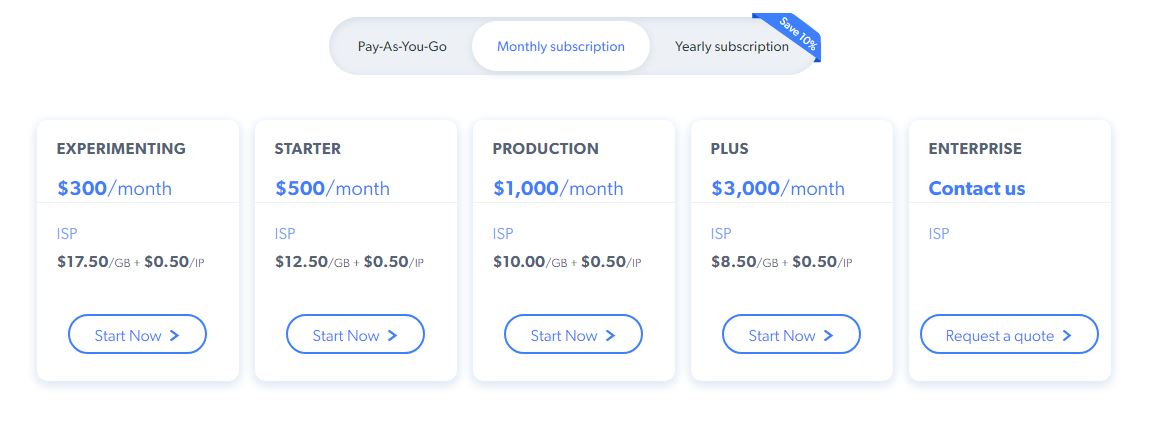
The table below compares all seven providers on the metrics that matter most for travel fare aggregation. Entry prices reflect standard residential proxy plans at common tier points. All data sourced from provider knowledge files scraped May 2026.
| Provider | Residential Pool | Entry Price (Residential) | City Targeting | JS Rendering | Trial |
|---|---|---|---|---|---|
| Decodo | 115M+ (195+ locations) | $3.75/GB (3 GB plan); $4/GB PAYG | Yes | Site Unblocker | Free 100 MB / 3 days |
| Bright Data | 400M+ (195 countries) | $8/GB PAYG ($4/GB w/ PROXYWAY60) | Yes | Scraping Browser + Web Unlocker | 7-day (companies) |
| Oxylabs | 175M+ (195 countries) | $6/GB ($30/mo, 5 GB) | Yes (+ coordinates) | Web Scraper API + Web Unblocker | 7-day (companies) |
| NetNut | 85M+ residential; 1M+ ISP | $3.53/GB ($99/mo, 28 GB) | Yes | Website Unblocker | 7-day (companies) |
| IPRoyal | 32M+ (195+ countries) | $7.35/GB PAYG (non-expiring) | Yes | No (proxy only) | 24-hr refund (select products) |
| ProxyEmpire | 30M+ (195+ countries) | $5.71/GB ($40/mo); $2.85/GB w/ PROMO50 | Yes | No (proxy only) | $1.97 / 100 MB |
| Infatica | 35M+ (195 countries) | $4/GB PAYG; $3.84/GB (25 GB) | Yes | No (proxy only) | 7 days for $4 |
Pricing note: Entry-level rates drop significantly at volume. A $6/GB residential proxy at the 5 GB tier can reach $2–3/GB at 500 GB+. If you’re price-sensitive, see our guide to cheap residential proxies for volume-tier analysis. Always check the live pricing slider on the provider’s site before budgeting. Promo codes (PROXYWAY60, proxyway35, PROMO50, PROXYWAY30) are subject to expiry — verify at checkout. JS rendering products (Scraping Browser, Web Scraper API, Site Unblocker) are billed separately from raw proxy bandwidth.
Pros & Cons of Travel Fare Aggregation Proxies
Proxies are the enabling infrastructure for travel data collection — but they come with real trade-offs that affect project design, cost, and legal exposure.
Pros ✓
- Access geo-accurate fares: Airlines and OTAs serve different prices based on search origin. Residential proxies in target markets reveal what consumers in those markets actually pay.
- Scale data collection: Hundreds of concurrent sessions across dozens of travel sites simultaneously — at a cost per request that’s a fraction of building and maintaining equivalent server infrastructure.
- Bypass anti-bot protection: Quality residential IPs from providers with large pools avoid the IP reputation blacklists that block datacenter ranges on Cloudflare and Akamai-protected booking engines.
- Real-time monitoring: Airline fares change by the minute. Residential proxies with low latency (<0.6s on Decodo, Oxylabs) enable near-real-time rate collection that keeps pace with dynamic pricing engines.
- Mobile fare channels: Mobile proxies reveal pricing discrepancies between the mobile app and desktop web — a revenue management intelligence layer not accessible without mobile IPs.
- Competitive intelligence at scale: A six-figure investment in building equivalent data collection infrastructure in-house versus ~$3–8/GB for managed residential proxy infrastructure with anti-bot handling included.
Cons ✗
- Cost at scale: High-volume continuous fare aggregation at $3–8/GB adds up quickly. Budget $2,000–10,000/month for a production-scale residential proxy setup covering major OTAs and airline sites.
- Terms of service risk: Most airline and OTA ToS prohibit automated data collection. Commercial use of scraped fare data without a data licensing agreement creates legal exposure depending on jurisdiction.
- Response time variability: Residential IPs route through real consumer connections, which vary in speed. Expect 0.5–2s response times depending on provider and gateway — significantly slower than datacenter proxies.
- JavaScript rendering overhead: Adding a headless browser layer (Scraping Browser, Web Scraper API) on top of residential proxies increases per-request cost and latency. Not all simple fare pages need it, but most modern booking engines do.
- IP pool depletion on high-value targets: Providers with smaller active pools (IPRoyal, ProxyEmpire) may exhaust clean IPs on heavily targeted airlines that maintain aggressive IP blocklists.
Bottom Line: For serious travel fare aggregation, the ROI on quality residential proxies is clear — the alternative is either licensing data from GDS providers at exponentially higher cost, or attempting collection with datacenter IPs that get blocked within hours. The risks (cost, ToS exposure) are manageable with proper provider selection and responsible usage practices.
Best Travel Proxy Providers Compared: Decodo vs Bright Data vs Oxylabs
These are the three providers most commonly evaluated against each other by travel data teams. Here’s how they compare head-to-head on the metrics that matter for fare aggregation specifically.
| Feature | Decodo | Bright Data |
|---|---|---|
| Residential Pool | 115M+ IPs | 400M+ IPs |
| Global Success Rate | 99.86% | 98.96% |
| Avg. Response Time | 0.63s (Proxyway 2025) | 1.12s (Proxyway 2024) |
| JS Rendering Product | Site Unblocker ($) | Scraping Browser + Web Unlocker ($$) |
| Entry Price | $3.75/GB (3 GB plan) | $8/GB PAYG ($4/GB w/ promo) |
| Concurrent Sessions | Unlimited | Unlimited |
| Free Trial | Free 100 MB / 3 days | 7-day (companies only) |
| Best For | Speed + Value | Scale + JS scraping |
Winner for Speed & Value: Decodo | Winner for Maximum Scale & JS Rendering: Bright Data | Winner for Trial Accessibility: Decodo
| Feature | Oxylabs | Decodo |
|---|---|---|
| Residential Pool | 175M+ IPs (#1 in Proxyway test) | 115M+ IPs |
| Target Success Rate (Amazon/Google/Instagram) | 93.28% | 99.86% (infrastructure-level) |
| Geo-Targeting | Country, State, City, ASN, ZIP, Coordinates | Country, State, City, ASN, ZIP |
| Scraping API for Travel | Web Scraper API + E-Commerce API | Site Unblocker |
| Entry Price | $6/GB ($30/mo, 5 GB) | $3.75/GB (3 GB plan) |
| PAYG Option | No (subscription only) | Yes ($4/GB) |
| Travel Use Case Listed | Yes — explicit on product pages | General use / scraping |
| Best For | Enterprise fare pipelines | Mid-market / fast scraping |
Winner for Pool Depth & Scraping API: Oxylabs | Winner for Price & Flexibility: Decodo | Winner for Coordinate-Level Targeting: Oxylabs
🏆 Choose Decodo When
- You need the fastest residential proxy speeds globally
- You want to start with a free trial before committing
- Your budget is tight but your concurrency needs are high
- You’re running a mid-market travel monitoring tool
🔍 Choose Bright Data or Oxylabs When
- You need full JavaScript rendering built into the proxy product
- Your pipeline processes 100,000+ daily requests across multiple OTAs
- You need enterprise SLAs, dedicated account management, or KYC compliance
- You’re building a commercial travel data product for resale
Travel Proxy Provider Ratings Breakdown
We rated each provider on four criteria directly relevant to travel fare aggregation. Scores reflect Proxyway’s independent benchmark data (April–June 2025) where available, combined with pricing competitiveness, JavaScript rendering capability, and travel-specific feature depth.
| Provider | Pool & Coverage | Speed & Success Rate | Travel Features | Value for Money | Geo-Targeting | Support Quality | Overall |
|---|---|---|---|---|---|---|---|
| Decodo | 4.5/5 | 4.9/5 | 4.3/5 | 4.8/5 | 4.6/5 | 4.4/5 | 4.7/5 |
| Bright Data | 4.9/5 | 4.7/5 | 4.9/5 | 3.2/5 | 4.8/5 | 4.7/5 | 4.6/5 |
| Oxylabs | 4.8/5 | 4.8/5 | 4.7/5 | 3.5/5 | 4.9/5 | 4.6/5 | 4.5/5 |
| NetNut | 4.4/5 | 4.4/5 | 4.2/5 | 3.8/5 | 4.3/5 | 4.2/5 | 4.2/5 |
| Infatica | 3.8/5 | 4.4/5 | 3.7/5 | 4.3/5 | 4.1/5 | 4.0/5 | 4.1/5 |
| IPRoyal | 3.7/5 | 3.9/5 | 3.5/5 | 4.5/5 | 3.8/5 | 3.7/5 | 3.9/5 |
| ProxyEmpire | 3.6/5 | 3.5/5 | 3.8/5 | 4.4/5 | 3.7/5 | 3.6/5 | 3.8/5 |
| Overall Rating | 4.2/5 | 4.4/5 | 4.2/5 | 4.0/5 | 4.3/5 | 4.2/5 | 4.3/5 |
Rating Summary: Decodo leads overall on the combination of speed, value, and pool depth for practical travel scraping workloads. Bright Data leads on feature completeness for enterprise-scale JS-heavy collection. Oxylabs is the strongest enterprise alternative with a verified larger pool and explicit travel use case support. Infatica is the best mid-market choice for UK-origin fare monitoring with compliance requirements. IPRoyal and ProxyEmpire serve teams with variable-intensity collection needs where non-expiring traffic eliminates monthly wastage.
Are Travel Fare Aggregation Proxies Safe, Legit & Worth It?
Legitimacy & Safety
- ✓ Commercial proxy use is legal in most jurisdictions: Purchasing and using residential proxies from a licensed commercial provider is legal. The proxy is an intermediary — your use case determines legal exposure, not the proxy itself.
- ✓ Ethically sourced options are the standard among top providers: Bright Data, Decodo, Oxylabs, ProxyEmpire (EWDCI certified), and Infatica (ISO 27701) all operate with opt-in peer networks or ISP-sourced IPs, not compromised devices.
- ✓ Enterprise compliance credentials available: Bright Data (ISO 27001, SOC), Infatica (ISO 27001, 22301, 27701, 20000-1), and NetNut (NASDAQ-listed parent) meet procurement requirements for regulated industries including financial services and insurance.
- ✓ Travel scraping is standard industry practice: Revenue management at airlines and hotel chains, OTA meta-search platforms, and travel market intelligence firms all use proxy-backed data collection as a core business function. The technology is legitimate; compliance with target site ToS is the operator’s responsibility.
Long-Term Reliability
All seven providers in this list have multi-year operating histories. Bright Data (founded 2014), Decodo (founded 2018 as Smartproxy), and Oxylabs (2015) have a decade-long track record in the proxy industry. Proxyway’s independent benchmarks — which test real success rates on real targets rather than relying on provider marketing claims — give you an objective reliability measure that’s harder to fake than a 5-star review.
Reality check: No proxy provider guarantees 100% success on every travel site. Major OTAs and airlines continuously update their anti-bot infrastructure. Even the top providers see occasional blocking on the most aggressively protected targets (direct airline sites with Akamai or DataDome integration). Build your pipeline with retry logic and CAPTCHA solving as standard, not optional. Budget 15–25% more bandwidth than your calculated need to account for failed requests and retries on demanding travel targets.
Our Recommendation: Yes, travel proxies are worth using for legitimate fare aggregation and competitive monitoring work. Start with Decodo’s free 100 MB trial or ProxyEmpire’s $1.97 trial — run your actual target URLs against them before committing to a plan. Test on the specific airline sites and OTAs you need to monitor: success rates vary by target, and the only reliable way to know your actual performance is to measure it against your real collection targets before you scale.
Travel Fare Aggregation Proxy FAQs
What are travel fare aggregation proxies?
Travel fare aggregation proxies are residential or mobile proxy servers that route your data collection requests through IP addresses registered in specific geographic locations. When you query an airline, hotel booking engine, or OTA like Expedia or Booking.com through one of these IPs, the site sees a request from a real user in that location — giving you access to the locally-priced fare that consumer would see rather than a generic or inflated international rate.
Why can’t I just use datacenter proxies for travel scraping?
Datacenter IPs are hosted on commercial server infrastructure — and travel sites know this. Airlines and OTAs maintain blocklists of known datacenter IP ranges from AWS, Google Cloud, Azure, and similar hosting providers. Requests from these IPs are either blocked outright, served a CAPTCHA, or shown inflated “rack rate” fares designed to discourage automated comparison. Residential proxies, sourced from real ISP-assigned consumer IPs, avoid this problem because they’re indistinguishable from genuine traveler searches.
Which proxy is best for scraping Booking.com and Expedia?
Decodo and Oxylabs are the strongest performers for Booking.com and Expedia specifically. Both platforms use heavy JavaScript rendering and Cloudflare protection. Decodo’s Site Unblocker and Oxylabs’ Web Scraper API both handle JavaScript execution and CAPTCHA bypass at the product level. For Booking.com’s multi-step booking flows that require session continuity, Decodo’s sticky sessions up to 24 hours are particularly useful. For Expedia’s more complex JavaScript rendering, Oxylabs’ Web Scraper API or Bright Data’s Scraping Browser provide the most reliable rendering pipeline.
Do I need mobile proxies for travel fare aggregation?
Not always — but mobile proxies add an important data dimension. Airlines and hotel chains increasingly offer app-exclusive fares or show different prices to mobile versus desktop users. If you’re building a comprehensive fare dataset that needs to reflect the full consumer experience across channels, mobile proxies let you collect both price layers simultaneously. Mobile IPs also face less scrutiny from anti-bot systems than even residential desktop IPs in many cases, since mobile traffic patterns are harder to distinguish from genuine user behavior.
Is it legal to scrape travel fare data?
The legal picture is complex and jurisdiction-dependent. In general: collecting publicly available fare data (prices displayed to any anonymous visitor without a login) is treated as permissible in most jurisdictions under data protection frameworks like GDPR. However, most airline and OTA terms of service explicitly prohibit automated data collection without a commercial data licensing agreement. Using scraped fare data in a commercial product without authorization creates contractual risk, though not necessarily criminal liability. If you’re building a commercial fare aggregation product, consult legal counsel and consider licensed data feeds from GDS providers or direct airline data partnerships alongside proxy-based collection.
How many proxies do I need for fare aggregation?
It depends on your collection frequency and the number of routes and markets you’re monitoring. A single residential proxy session can complete a fare query in 0.5–2 seconds. If you need to monitor 1,000 route-market combinations every 15 minutes, you need roughly 70–140 concurrent sessions running continuously. The key metric isn’t “how many proxies” but how many concurrent sessions your provider supports without throttling. Decodo offers unlimited concurrent connections; Oxylabs and Bright Data handle enterprise-scale concurrency at subscription tiers. Start with a 25–50 GB/month plan, measure your actual bandwidth consumption per query, and scale from there.
What is sticky session proxying and why does it matter for travel sites?
A sticky session means that multiple sequential requests go through the same IP address rather than rotating to a new IP after each one. Travel booking engines track session state — if your IP changes between the flight search page and the pricing detail page, the site detects an inconsistency that flags bot behavior. Sticky sessions allow you to maintain the same IP for a complete search-and-verify cycle, which prevents this detection. IPRoyal offers up to 7-day sticky sessions (the longest available); Decodo offers up to 24 hours; most providers offer 10–30 minutes per sticky session.
How do I test if a travel proxy actually works on my target sites?
The only reliable test is to run your actual target URLs through the proxy before committing to a subscription. Use your fare aggregation scraper (or a simple headless browser like Playwright or Puppeteer) against the specific airline sites or OTAs you need — not just a generic IP check. Look for: (1) Does the site serve the correct currency and pricing for the target country? (2) What’s the success rate over 50–100 requests? (3) What’s the CAPTCHA rate? Decodo’s free 100 MB trial, ProxyEmpire’s $1.97/100 MB trial, and Infatica’s 7-day/$4 trial all give you enough bandwidth to run meaningful tests before spending on a full subscription.
Can I use proxies to monitor hotel rates on Booking.com continuously?
Yes — continuous hotel rate monitoring is one of the most common proxy use cases in the travel industry. Revenue management teams at hotel chains and travel management companies use this to verify rate parity across OTAs, track competitor pricing, and identify distribution anomalies. For continuous 24/7 monitoring, you’ll want a subscription plan (rather than PAYG) from a provider with proven success rates on Booking.com specifically. Decodo and Oxylabs are the recommended choices for this use case — both handle Booking.com’s JavaScript rendering and session management reliably at scale.
What’s the difference between ProxyEmpire and Decodo for travel scraping?
Decodo is faster (0.63s vs ProxyEmpire’s 0.91–2.50s depending on gateway) and has a significantly larger confirmed active pool (1.15M unique IPs in Proxyway testing vs 843K for ProxyEmpire). Decodo wins for continuous high-frequency fare collection where speed and pool depth determine how many routes you can monitor per minute. ProxyEmpire wins for periodic collection: its non-expiring rollover traffic is ideal if you’re running monthly competitive audits rather than continuous background monitoring. With PROMO50, ProxyEmpire’s pricing drops to $2.85/GB for the 7 GB plan — competitive with Decodo for low-volume use cases.
Which providers offer the best free trials for travel proxy testing?
Decodo offers the best free trial: 3 days and 100 MB at no cost, no credit card required on some plans. This is enough bandwidth for 50–100 fare queries to validate performance on your targets. ProxyEmpire’s $1.97 / 100 MB trial is the lowest-cost paid entry. Infatica’s 7-day / $4 trial gives more time for extended testing across multiple markets. Bright Data and Oxylabs offer 7-day free trials for verified company accounts — not accessible to individuals but useful for B2B teams going through a procurement evaluation.
Do I need a scraping API or just a proxy for airline sites?
It depends on the airline’s tech stack. Most major airline direct booking sites (BA, Lufthansa, Delta, Emirates) use JavaScript-heavy React or Angular frameworks where fares are only populated after client-side execution. A standard HTTP proxy returning raw HTML will give you an empty price field on these sites. You need either a headless browser layer in your own pipeline (Playwright, Puppeteer, Selenium) or a provider that includes JavaScript rendering in their product (Bright Data’s Scraping Browser, Oxylabs’ Web Scraper API, Decodo’s Site Unblocker). OTA aggregators like Kayak and Skyscanner expose some pricing via structured API endpoints — check whether a partner API is available before building a scraper.
Final Verdict
Travel fare aggregation is one of the most technically demanding proxy use cases available. Airline and OTA anti-bot systems are sophisticated, dynamic pricing detection is always-on, and the data you need only exists behind JavaScript execution in most modern booking engines. The seven providers in this list all have the residential pool depth to handle travel targets — but they differ significantly on speed, JavaScript rendering capability, geographic granularity, and pricing model. Decodo leads for practical mid-market workloads. Bright Data and Oxylabs lead for enterprise-scale pipelines that need JS rendering built into the product. IPRoyal and ProxyEmpire serve teams with variable-intensity collection needs where non-expiring traffic eliminates monthly waste.
✓ Top Picks
- Decodo — Best overall: fastest speeds, 99.86% success rate, free trial, no concurrency limits
- Bright Data — Best for enterprise: 400M+ pool, Scraping Browser, Web Unlocker, travel scraping APIs
- Oxylabs — Best for scraping API reliability: largest confirmed pool, Web Scraper API, explicit travel use case support
- NetNut — Best for ISP-backbone stability: 1M+ static IPs, always-online, SERP Scraper for Google Flights
- Infatica — Best for UK fare monitoring with compliance: fastest UK residential, ISO certifications
- ProxyEmpire — Best for periodic collection: non-expiring rollover traffic, PROMO50 for cost-effective campaigns
- IPRoyal — Best for pay-as-you-go flexibility: non-expiring PAYG, 7-day sticky sessions, no monthly minimum
✗ When to Look Elsewhere
- You need sub-50ms latency for seat inventory streaming — residential proxies aren’t built for real-time inventory feeds
- Your budget is zero — free proxy lists are blocked on every major travel site within hours and expose your scraper traffic
- You need licensed GDS access for guaranteed uptime SLAs on fare data — that requires a commercial data partnership, not a proxy
- You want to automate bookings — proxy ToS and target site ToS both prohibit this use case explicitly
Ready to Start Collecting Travel Fare Data?
Start with Decodo’s free 100 MB trial — test against your actual airline and OTA targets before spending a dollar on a subscription.
Try Decodo Free — Best Travel Proxy Value →