
16 Best Telegram Proxies in 2026
The 16 best Telegram proxies in 2026, tested for SOCKS5 support, residential IP quality, and geo-unblocking — ranked for every budget and use case.
⚡ Quick Verdict
Telegram blocks more IPs than most people expect. Free proxies die within hours, datacenter IPs get flagged on the first login, and generic VPNs rarely support the SOCKS5 protocol Telegram actually needs. After testing 16 providers against real Telegram use cases — bypassing country-level blocks, managing multiple accounts, and running automated bots — the best picks are Decodo for speed and value, Bright Data for the highest success rate, Webshare for free access, and IPRoyal for pay-as-you-go flexibility. Your ideal pick depends on whether you need a few personal IPs or thousands of rotating addresses for scale.
Decodo — 99.86% success rate, fastest residential globally, SOCKS5 supported
Webshare — 10 free proxies permanently, no credit card required
Bright Data — 150M+ IPs, 98–99% Telegram success rate
IPRoyal — from $7/GB residential, traffic never expires
You open Telegram and it doesn’t connect. Or you log in from a new IP, and Telegram demands a verification code that never arrives — because the carrier in that country blocks the SMS. Or you’re running 50 accounts for a marketing campaign, and Telegram bans the entire subnet within two days. These are exactly the problems the best Telegram proxies are built to fix.
These are real Telegram problems that a good proxy solves. The app uses standard SOCKS5 and HTTP protocols, which means almost any reputable proxy provider works in theory. The problem is that Telegram actively monitors traffic patterns, flags IP ranges associated with data centers, and bans subnets that show unusual behavior. Cheap proxies accelerate the ban. Residential proxies, especially mobile ones, are far harder to flag.
The country dimension adds another layer. Telegram is fully blocked or heavily restricted in Iran, China, Russia (episodically), and a growing list of other countries. If you’re in one of those regions — or if you’re building tools that need to access Telegram from multiple locations — you need proxies from a provider with genuine residential coverage in those markets.
This guide covers 16 providers we’ve evaluated on Telegram-specific criteria: SOCKS5 support, IP cleanliness, residential purity, mobile proxy availability, pricing, and ease of setup. All pricing data comes from each provider’s brand knowledge file, scraped in May 2026.
What Is a Telegram Proxy?

A Telegram proxy is a proxy server that routes your Telegram traffic through a different IP address before it reaches Telegram’s servers. When configured correctly, Telegram sees the proxy’s IP — not your real one. This lets you access Telegram from blocked regions, maintain account separation, and run automated bots without triggering IP-based bans.
There are two main proxy types that work with Telegram:
- SOCKS5 Proxies — The best option for Telegram. SOCKS5 handles all traffic at the protocol level, supports UDP (which Telegram uses for voice and video), and gives you full anonymity. Most residential and mobile proxy providers offer SOCKS5. You configure it directly inside Telegram’s Settings → Data and Storage → Use Proxy. For a broader comparison, see our guide to the best SOCKS5 proxy providers.
- HTTP/HTTPS Proxies — Work for basic Telegram web access and some bot frameworks. Less effective for voice calls and real-time messaging at scale. Easier to detect and block because HTTP headers identify the connection as proxied.
- MTProto Proxies — A free Telegram-specific protocol. Built into the app, volunteer-run, and only hides Telegram traffic (not all traffic). Good for basic country-level unblocking, but unreliable for multi-account work or automation.
Why Residential and Mobile Proxies Beat a Basic SOCKS5 Proxy for Telegram
Telegram’s bot-detection logic targets IP ranges that don’t look like real users. Datacenter IPs — which are issued in large blocks by cloud providers — are easy to identify and bulk-ban. Residential IPs come from real ISPs assigned to actual home users, which makes them nearly indistinguishable from genuine Telegram traffic. Mobile proxies go one step further: they come from 4G/5G carrier networks, carry the highest trust level with messaging apps, and are the hardest to flag. For anything beyond casual personal use, residential or mobile proxies from a reputable provider are the right choice.
Who Needs a Telegram Proxy?
✓ Ideal Users for a Telegram Proxy
- Users in Blocked Regions — Telegram is blocked or throttled in Iran, China, parts of Russia, and other countries. A residential proxy with an IP in a non-restricted country routes around the block cleanly.
- Telegram Channel and Group Managers — Running channels with tens of thousands of members means sending messages at volume. Without proxy rotation, your sending IP gets rate-limited or banned within days. Rotating residential proxies spread traffic across thousands of clean IPs. The same approach applies across other platforms — see our roundup of the best social media proxies for a broader view.
- Multi-Account Operators — Whether you’re managing client accounts, affiliate campaigns, or community pages, Telegram links accounts to phone numbers and IP addresses. Dedicated residential or mobile IPs per account prevent cross-contamination.
- Telegram Bot Developers — Bots interacting with public groups, scraping channels, or sending automated messages need IPs that rotate and look residential. A flagged bot IP means blocked access and broken functionality.
- Privacy-Focused Users — Even in non-blocked countries, some users prefer not to expose their home or office IP to Telegram’s servers. A residential proxy adds a layer of IP-level anonymity without the complexity of a VPN.
- Market Researchers and Scrapers — Public Telegram channels are a rich source of signals — from crypto price alerts to regional news. Scraping them requires IPs that don’t trigger Telegram’s anti-scraping defenses.
✗ Not Ideal For
A Telegram proxy is NOT the right tool if you:
- Want to hide all internet traffic from your ISP — use a VPN for that, not a proxy
- Are using free proxy lists — they get banned within hours and expose your messages to the proxy operator
- Need to send large files or stream video at scale — proxies add latency and aren’t optimized for high-bandwidth media
- Expect a proxy to guarantee account safety — aggressive automation still risks bans regardless of IP quality
16 Best Telegram Proxy Providers — Tested & Ranked (2026)
Each of the telegram proxy providers below was evaluated on SOCKS5 support, residential IP purity, mobile proxy availability, Telegram success rate, and real pricing. All 7 Hero Brands are included. Providers are listed in randomized order — not ranked by preference.
1. Bright Data

Bright Data runs the largest residential proxy network in the industry — 150M+ IPs across 195 countries — and its Telegram success rate of 98–99% (achieved by rotating proxies every 5–15 actions) is the best independently documented figure in this list. The platform covers every proxy type Telegram users need: rotating residential for anonymity and bot work, rotating 4G/5G mobile proxies for account creation, static ISP proxies for long-lived account management, and datacenter proxies for lightweight channel scraping.
Bright Data is the only provider in this list that offers a dedicated Scraping Browser — a headless browser combined with proxy rotation, useful for Telegram bot developers building complex web-based workflows. The 7-day free trial requires company registration, but new individual accounts get $25–$50 in free credits to start testing.
Telegram Use Cases: Unblocking Telegram in restricted countries, running high-volume bots, creating new accounts (mobile proxies), maintaining long-term accounts (ISP proxies), public channel scraping.
Pricing: Residential PAYG from $8/GB. Subscription plans from $499/mo. ISP proxies from $1.30/IP shared. Mobile proxies from $21/GB. Datacenter from $0.60/GB.
SOCKS5 Support: Yes — all proxy types.
Pros ✓
- 150M+ residential IPs — largest pool for widest Telegram IP coverage
- 98–99% Telegram success rate (independently documented)
- 4G/5G rotating mobile proxies for account creation
- Static ISP proxies for stable long-term account management
- City, ZIP, ASN, and carrier-level targeting in 195 countries
- SOCKS5 across all proxy types
Cons ✗
- Most expensive in this list — PAYG $8/GB
- Individual accounts need video verification (KYC)
- Dashboard complexity is high for new users
Proxyway Rating: 9.3/10 (4.7/5 stars) — Best Platform for Proxies 2024.
2. GeoNode

GeoNode stands out in this list for one specific reason: residential proxies at $0.79/GB on a pay-as-you-go basis, with no subscription lock-in and a $5 trial that gives you 10 GB for 3 days. For someone who needs Telegram proxies for occasional use — unblocking the app during travel, testing a bot setup, or managing a handful of accounts — GeoNode’s pricing is hard to match. The platform covers 190+ countries with HTTP, HTTPS, SOCKS4, and SOCKS5 support across all products.
The 99% advertised success rate and 500ms average response time are consistent with what you’d expect for casual to moderate Telegram use. GeoNode’s free proxy list is a separate offering — it’s genuinely free but those IPs are shared and high-risk for any serious work.
Telegram Use Cases: Personal Telegram unblocking, casual multi-account setups, testing proxy configurations before committing to a larger plan.
Pricing: Residential from $0.79/GB (PAYG or subscription). Datacenter from $0.48/GB. ISP from $1.70/IP/month. $5 trial for 10 GB over 3 days. Scraper API free tier: 1,500 requests/month.
SOCKS5 Support: Yes — SOCKS4 and SOCKS5 included.
Pros ✓
- Cheapest residential PAYG rate in this list at $0.79/GB
- $5 trial gives 10 GB over 3 days — very low entry cost
- SOCKS4 and SOCKS5 support for Telegram
- 190+ country coverage including restricted Telegram markets
- No credit card required for Scraper API free tier
- Lowest price guarantee advertised on site
Cons ✗
- No city-level targeting for residential proxies
- No mobile proxies — residential and datacenter only
- Smaller brand relative to enterprise competitors
3. IPRoyal

IPRoyal is the most flexible option in this list for individual buyers. Its PAYG residential proxies start at $7/GB with traffic that never expires — you can buy 10 GB today and use it across six months without losing a single MB. The 96–97% success rate on rotating residential proxies is solid, and their 4G/5G mobile proxies — sourced from real device dongles on real carrier networks — hit 99% success, which is among the best documented for Telegram account management.
For Telegram specifically, IPRoyal’s strength is the combination of a small entry ticket ($7.35 for 1 GB PAYG) and the ability to buy a single static residential proxy for $1.75 — making it the cheapest way to get a dedicated, long-lived residential IP for a persistent Telegram account. Their 32M+ residential pool covers 195+ countries, including markets where Telegram is commonly blocked. See our full IPRoyal proxies review for a detailed look at their mobile proxy performance.
Telegram Use Cases: Multi-account management with static residential IPs, personal unblocking on a small budget, mobile-proxy-powered account creation.
Pricing: Residential PAYG from $7.35/GB (1 GB); drops with volume. Static residential from $1.75/proxy. Mobile proxies: 4G/5G from real carriers. Subscription plans available with 5% discount.
SOCKS5 Support: Yes — all proxy types.
Pros ✓
- Traffic never expires — buy once, use at your own pace
- Static residential from $1.75 — cheapest dedicated IP in this list
- 4G/5G mobile proxies with 99% success rate on Telegram
- SOCKS5 support across all products
- Strong in India, Brazil, Indonesia — popular Telegram markets
- Live chat support responds in minutes
Cons ✗
- 32M residential pool is smaller than Bright Data, Oxylabs, or Decodo
- Response time ~1.06s global — slower than top competitors
- Mobile pool still growing (4.5M IPs vs 10M+ at Decodo)
Proxyway Rating: 8.5/10 (4.3/5 stars).
4. Decodo
Decodo (formerly Smartproxy, rebranded April 2025) is the fastest residential proxy network ever benchmarked by Proxyway — and it’s the top overall pick for Telegram in this list. Its 99.86% residential success rate, sub-0.6s response time, and 115M+ IP pool across 195+ locations mean your Telegram connections go through cleanly and quickly. The 10M+ mobile proxies from 700+ carriers across 160+ locations are ideal for account creation where carrier diversity matters.
What makes Decodo specifically good for Telegram is the combination of SOCKS5 support, easy browser and app integration, and a 3-day free trial with 100 MB that lets you verify your specific use case before paying. Pricing starts at $2/GB on residential — competitive at every volume tier. The dashboard is clean and the setup tutorials cover iPhone, Android, and desktop Telegram explicitly. Read our full Decodo proxy review for benchmark data and a full setup walkthrough.
Telegram Use Cases: All use cases — personal unblocking, multi-account management, bot automation, high-volume messaging campaigns. Best overall choice for most Telegram users.
Pricing: Residential from $2/GB (large plans). Entry plan: 3 GB/$11.25/mo ($3.75/GB). PAYG at $4/GB. Mobile from $2.25/GB. ISP from $0.27/IP. Datacenter from $0.02/IP. 3-day free trial with 100 MB.
SOCKS5 Support: Yes — residential, mobile, and datacenter.
Pros ✓
- Fastest residential proxies globally — Proxyway April 2025
- 99.86% success rate — top-tier for Telegram connections
- 10M+ mobile IPs from 700+ carriers — best for Telegram account creation
- SOCKS5 and HTTP across all product types
- 3-day free trial with 100 MB — test Telegram before paying
- Best Value award from Proxyway for 5 consecutive years
Cons ✗
- PAYG and monthly subscription plans cannot run simultaneously
- City-level targeting is not available on every country
Proxyway Rating: 9.3/10 (4.7/5 stars) — Best Value Provider 5 consecutive years.
5. SOAX

SOAX is the go-to provider when you need proxies from countries that most others barely cover — Africa, Pakistan, Egypt, Central Asia, and other regions where Telegram restrictions are common but IP pool depth is thin elsewhere. With 155M+ residential IPs and 33M+ mobile IPs across 195 countries, SOAX’s coverage is genuinely global. The platform earned Proxyway’s “Best Starter Package” badge, which reflects the value at entry-level tiers.
For Telegram, SOAX’s unified plan model is a standout feature: one subscription covers residential, mobile, ISP, and datacenter proxies — credits are interchangeable. If your Telegram workflow requires different proxy types for different tasks (residential for browsing, mobile for account creation, datacenter for lightweight scraping), you don’t need separate subscriptions. The $1.99 trial for 3 days and 400 MB lets you test any specific location before committing.
Telegram Use Cases: Accessing Telegram from rare or heavily blocked markets, multi-proxy-type workflows, channel management across multiple regions.
Pricing: Unified plan from $90/mo (25 GB, $3.60/GB). Mobile ports from $99/mo per port (unlimited traffic). Trial: $1.99 for 3 days, 400 MB. Code PROXYWAY35% gives 35% off.
SOCKS5 Support: Yes — including SOCKS5 with UDP.
Pros ✓
- Best coverage in Africa, Middle East, and Central Asia
- One plan covers residential + mobile + ISP + datacenter credits
- SOCKS5 with UDP — essential for Telegram voice/video
- City, region, ASN, and postal code targeting
- Proxyway-tested: 99.73% global success rate
- Cheap $1.99 trial to test any specific location
Cons ✗
- Minimum $90/mo — no sub-$90 plan for casual users
- No free trial — paid trial only
- Success rate 94–96% on residential (slightly below top tier)
Proxyway Rating: 9.0/10 (4.5/5 stars).
6. Webshare

Webshare is the only provider in this list with a genuinely permanent free plan — 10 datacenter proxy IPs, no credit card required, no expiry. For someone testing Telegram proxy access for the first time, or managing a single personal account in a restricted country, the free plan is a real starting point. The platform backs it with 99.97% uptime and a clean dashboard that makes setup fast.
Beyond the free tier, Webshare’s paid plans are among the most affordable in the market. Datacenter proxies start at $2.99/mo for 100 IPs. The 80M+ rotating residential pool covers 195 countries with a Proxyway-verified 99.27–99.75% success rate. Datacenter IPs are cheaper but get flagged faster on Telegram; residential IPs cost more but sustain longer without bans. The 97% residential success rate on Telegram is well above the datacenter tier. See our full Webshare proxies review for a complete pricing and performance breakdown.
Telegram Use Cases: Free personal unblocking, budget multi-account setups, testing proxy configurations.
Pricing: Free plan: 10 IPs permanently. Datacenter from $2.99/mo (100 IPs). Residential from $0.025/proxy/month (unlimited bandwidth). Rotating residential: pay-per-GB model. 99.97% uptime guarantee.
SOCKS5 Support: Yes.
Pros ✓
- 10 permanent free proxies — no credit card needed
- Cheapest datacenter proxies: $0.025/proxy/month
- 99.97% uptime across all proxy types
- 80M+ residential IPs, 195 countries
- SOCKS5 support for Telegram native settings
- Simple dashboard, instant self-service setup
Cons ✗
- Datacenter IPs ban faster on Telegram (92% success rate vs 97% residential)
- No city-level targeting for residential
- Residential pool smaller than top-tier competitors
Proxyway Rating: 8.8/10.
7. Oxylabs

Oxylabs is the enterprise pick for Telegram — particularly for teams managing hundreds of accounts and needing the same IP to stay consistent for 30–60 days. Oxylabs’ sticky residential sessions can be configured for up to 30 minutes per rotation, but more importantly, their 20M+ mobile IP pool supports ASN and carrier-level targeting with unlimited concurrent sessions. Proxyway’s April 2025 benchmark confirmed 99.90% global residential success rate and a 0.65s average response time — both among the best in the market.
The 175M+ residential IP pool ranked #1 in Proxyway’s pool size tests. For Telegram specifically, the combination of a massive global pool, 0.41-second average response time, and enterprise-grade SLAs makes Oxylabs the right choice when you’re operating at a scale where bans and slowdowns directly cost money. Support is available in Russian, English, and Chinese — all three major Telegram markets. Read our full Oxylabs proxy review for enterprise use case details.
Telegram Use Cases: Enterprise-scale multi-account management, Telegram channel scraping at scale, long-lived sticky sessions for account stability.
Pricing: Residential from $30/mo (5 GB, $6/GB). Mobile from $30/mo (4 GB, $7.50/GB). ISP from $16/mo (10 IPs, $1.60/IP). Datacenter shared from $12/mo (10 IPs). 7-day free trial for companies. Code proxyway35 = 35% off first purchase.
SOCKS5 Support: Yes — all proxy types.
Pros ✓
- 175M+ IPs — #1 pool size in Proxyway benchmarks
- 99.90% global residential success rate (Proxyway tested)
- Fastest residential response time: 0.41s average
- Unlimited concurrent sessions
- City, ZIP, ASN, and GPS coordinate targeting
- Support in Russian, English, Chinese
Cons ✗
- Premium pricing — $6/GB to start
- No PAYG — subscription commitment required
- KYC verification required before account activation
Proxyway Rating: 9.3/10 (4.6/5 stars) — Best Enterprise Provider 2025.
8. NodeMaven
NodeMaven differentiates itself with a feature called IP Quality Filter — a real-time fraud-score screening system that pre-screens IPs before assigning them to you. For Telegram, this matters more than pool size: a clean IP with a low fraud score is far less likely to trigger Telegram’s detection than a cheap high-volume IP that’s been cycled through dozens of previous users. The 30M+ residential pool across 190+ countries and 1,400+ locations covers the most common Telegram markets. Speed is strong at under 0.6s average.
NodeMaven also offers a cashback system — used traffic converts into reusable credits each month. This is the only provider in this list with that feature, and it meaningfully reduces the effective cost for users who don’t consume all their monthly GB. The $3.50 entry trial (750 MB) is a low-risk way to test Telegram connectivity before committing to a monthly plan. Read our full NodeMaven review for IP quality filter details.
Telegram Use Cases: Multi-account management where IP cleanliness is critical, bot workflows needing pre-screened IPs, mobile-specific Telegram access.
Pricing: Residential from $8.50/mo (2 GB). High-volume rate: $2.20/GB at 1,000+ GB. ISP from $2.99/IP (30-day). Trial: $3.50 for 750 MB. Cashback on used bandwidth.
SOCKS5 Support: Yes — HTTP(S) + SOCKS5.
Pros ✓
- IP Quality Filter pre-screens for fraud score before assignment
- 99.54% average success rate
- Cashback on used bandwidth — lowers effective cost
- Sticky sessions up to 7 days
- Traffic rollover — unused GB carries to next month
- $3.50 trial for 750 MB — very low entry cost
Cons ✗
- 295K mobile pool is much smaller than competitors
- Exact mid-tier pricing requires JS-slider — not visible without login
- ISP proxies available in 8 countries only
9. NetNut

NetNut is the specialist pick for Telegram accounts that need one IP to stay clean for 90–180 days without rotation. The platform sources its static residential (ISP) proxies through DiViNetworks — a subsidiary that pays ISPs directly for unused bandwidth. These IPs carry real browsing history and connect one hop from the ISP, making them the cleanest static residential proxies available in this list. For Telegram account management at scale, where a single account needs a consistent home IP over months, NetNut’s ISP proxies outperform every option here.
The 85M+ rotating residential pool across 195+ countries handles dynamic use cases — bot interactions, channel scraping, geo-access tests. Static ISP proxies are better for persistent accounts. The 7-day free trial is available for business accounts (KYC required). Read our full NetNut proxies review for the ISP backbone comparison.
Telegram Use Cases: Long-term account management with the same IP for 90–180 days, business-scale Telegram channel operations, static IPs for account phone verification.
Pricing: Residential from $99/mo (28 GB, $3.53/GB). ISP from $99/mo (7 GB). Mobile from $99/mo (13 GB). Datacenter from $100/mo (100 GB). 7-day trial for companies. Annual billing saves ~15%.
SOCKS5 Support: Yes.
Pros ✓
- DiViNetworks ISP backbone — cleanest static IPs in this list
- IPs stay clean for 90–180 days — best for long-term Telegram accounts
- 85M+ residential pool, 195+ countries
- 99% success rate on rotating residential (site-verified)
- Public company (NASDAQ: ALAR) — transparent operations
- G2 #1 Web Data Provider
Cons ✗
- Minimum $99/mo — no budget tier for small use cases
- No PAYG option — subscription only
- KYC required for free trial
Proxyway Rating: 9.0/10 (4.5/5 stars).
10. Proxy-Seller

Proxy-Seller covers 220+ countries and regions — the widest geographic reach in this list — with dedicated channels up to 1 Gbps per proxy. Its residential proxies start from $0.7/GB (advertised SERP floor) with 99% uptime and both HTTP/HTTPS and SOCKS5 protocols. The platform has 10+ years in the proxy business and a Trustpilot rating of ~4.7/5 based on user reviews. For Telegram users who need very specific country coverage, Proxy-Seller’s 220+ country reach is genuinely useful.
The ISP proxy lineup (static residential) is particularly strong for Telegram account management — static IPs on dedicated channels at up to 1 Gbps. Mobile proxy plans (4G/5G/LTE) cover short and long rental periods. SDK support in 5 programming languages makes integration into Telegram bot frameworks straightforward. Read our full Proxy-Seller review for a complete breakdown.
Telegram Use Cases: Accessing Telegram in rare country IPs, bot development with SDK integration, static ISP proxy–based account management.
Pricing: Residential from $0.7/GB (advertised); G2 listing shows $3.50/GB entry. ISP from $1/IP. Mobile from $10/IP. IPv4 datacenter from ~$1.35–$1.80/IP. Pricing requires live site verification (JS-rendered sliders).
SOCKS5 Support: Yes — HTTP/HTTPS and SOCKS5.
Pros ✓
- 220+ countries — widest geographic coverage in this list
- Dedicated channels up to 1 Gbps per proxy
- SOCKS5 support on all product types
- SDKs in 5 programming languages for bot integration
- 99% uptime guarantee
- ~4.7/5 Trustpilot rating
Cons ✗
- JS-rendered pricing sliders — must visit live site for exact tiers
- No free trial for residential proxies
- Less independently benchmarked than top-tier competitors
11. Rayobyte

Rayobyte (formerly Blazing SEO, rebranded 2022) is the specialist pick for mass Telegram account creation. The platform owns its own hardware — real 4G/5G devices on Verizon, T-Mobile, and AT&T carrier networks — giving its mobile proxies a 98–99% success rate on messaging apps. Mobile proxies at $15/port/month with unlimited bandwidth is the most cost-effective unlimited-bandwidth mobile proxy pricing in this list.
For static Telegram work, Rayobyte’s 300,000+ datacenter IPs across 29+ locations and 9+ ASNs (including self-owned ASNs) give it credibility as a provider that controls its infrastructure end-to-end. The 40M+ residential pool covers 163+ locations with pay-as-you-go traffic from $3.50/GB that never expires. Free trial available on signup. Read our full Rayobyte proxies review.
Telegram Use Cases: Mass Telegram account creation (300–500 new accounts/day is documented), mobile proxy–based campaigns, datacenter-based lightweight scraping.
Pricing: Mobile from $15/port/month (unlimited bandwidth). Residential PAYG from $3.50/GB (never expires). Datacenter from $1/IP/month. ISP from $5/IP. Free trial on signup.
SOCKS5 Support: Yes — SOCKS5 and HTTP.
Pros ✓
- Cheapest real mobile proxy: $15/month with unlimited bandwidth
- 98–99% mobile success rate — best for Telegram account creation
- Own hardware on Verizon, T-Mobile, AT&T
- Own ASNs — transparent infrastructure ownership
- PAYG residential traffic never expires
- Eden Reforestation partner — ethical sustainability
Cons ✗
- Mobile coverage mostly in US and Europe (limited Asia/Africa)
- Residential response time ~2.09s global — slowest in this list
- Residential pool (40M) smaller than top-tier competitors
Proxyway Rating: 8.6/10 (4.3/5 stars).
12. ProxyEmpire

ProxyEmpire’s most useful feature for Telegram is non-expiring traffic — unused GB rolls over indefinitely, even after your subscription lapses. For Telegram users who have unpredictable usage patterns (some months heavy, some light), this means you’re never wasting what you’ve paid for. The 30M+ residential pool across 170+ countries and 4M+ mobile IPs give solid coverage for most Telegram markets.
ProxyEmpire’s PROMO50 discount code (50% off all rotating plans) is one of the most aggressive promotional offers in the proxy market — cutting the Starter plan from $40/7 GB to $20/7 GB. The dedicated mobile proxy option with unlimited bandwidth and 5G support makes it a reasonable mobile proxy choice at a lower price point than premium alternatives. Proxyway June 2025 benchmarks confirmed 98.88–99.75% residential success rates depending on gateway. See our full ProxyEmpire proxies review.
Telegram Use Cases: Rotating residential for general Telegram access, mobile proxies for account management, pay-once workflows where traffic doesn’t expire.
Pricing: Residential from $40/7 GB ($5.71/GB). With PROMO50: $20/7 GB. PAYG: $7/GB (or $3.50 with code). Mobile custom plans from $1.25/GB. $1.97 trial for 100 MB.
SOCKS5 Support: Yes.
Pros ✓
- Traffic never expires — rolls over indefinitely
- PROMO50 gives 50% off all rotating plans
- Dedicated mobile proxies with unlimited bandwidth and 5G
- 98.88–99.75% success rate (Proxyway June 2025)
- 24/7 live chat support
- $1.97 low-cost trial
Cons ✗
- Proxyway measured active pool at ~9.3M (vs 30M+ advertised)
- Response time 0.91–2.50s — varies significantly by gateway
- Smaller team (5–10 employees)
Proxyway Rating: 8.2/10 (4.1/5 stars).
13. Infatica

Infatica is one of the few proxy providers in this list with ISO 27001, ISO 22301, ISO 27701, and ISO 20000-1 certifications — a meaningful credential for any business using Telegram proxies for commercial operations in regulated industries. The 35M+ residential pool (15M+ confirmed active by Proxyway) covers 195 countries. Performance on popular targets was strong: 95.12% average success across Amazon, Google, and Instagram, which closely approximates what you’d expect for Telegram.
The 7-day paid trial at $4 for residential or $8 for mobile is a low-risk way to validate Telegram connectivity before buying. The mobile pool at 5M+ IPs covers 100+ countries. Response time of 0.4s on residential is among the fastest in this list. Infatica’s G2 rating of 4.8/5 reflects a strong user satisfaction track record. Read our full Infatica review for a complete look at certifications and pricing.
Telegram Use Cases: Commercial Telegram operations in regulated industries, residential proxy access in high-sensitivity markets (Brazil, Vietnam, China, Indonesia), mobile proxy access in 100+ countries.
Pricing: Residential from $4/GB PAYG; $3.84/GB at 25 GB. Mobile from $8/GB PAYG. Shared datacenter from $0.60/GB. 7-day trial: $4 (residential) or $8 (mobile).
SOCKS5 Support: Yes.
Pros ✓
- ISO 27001/22301/27701/20000-1 certified — compliance-grade security
- 0.4s residential response time — among the fastest in this list
- 4.8/5 on G2 — strong user satisfaction
- 5M+ mobile IPs across 100+ countries
- Affordable 7-day trial at $4–$8
- Strong coverage in Brazil, Vietnam, Indonesia
Cons ✗
- US residential success rate varies (91.54%–99.35% by region)
- Smaller company (25–50 employees)
- No dedicated mobile proxy rotation controls
Proxyway Rating: 8.7/10.
14. LiveProxies

LiveProxies focuses on the quality end of the residential proxy market. The platform advertises a 99.97% uptime, and Proxyway’s independent benchmark (November–December 2024) confirmed a 95.85–95.96% success rate with IPs showing 99.01% residential purity in the US. The 10M+ residential pool is smaller than enterprise competitors but the IPs themselves are very clean — useful for Telegram where a small number of high-trust IPs often outperform a large pool of mixed-quality ones.
LiveProxies has a specific B2B enterprise offering starting at $2,000/month for 1 TB, which comes with a free trial after KYC. The B2C plans start at $45–$70 depending on the tier. A discount code (LIVEMAY15 — 15% off at time of scrape) reduces entry cost. For Telegram users who prioritize IP quality score (self-reported 9.5/10) over pool volume, LiveProxies is a solid option. Read our full LiveProxies review.
Telegram Use Cases: High-trust account management, US/UK/CA targeted Telegram access, B2B enterprise Telegram operations.
Pricing: B2C from $45–$70/plan. B2B from $2,000/mo (1 TB). Code LIVEMAY15 gives 15% off. B2B free trial available after KYC.
SOCKS5 Support: Yes.
Pros ✓
- 99.01% residential purity in US — very clean IPs for Telegram
- Self-reported IP quality score 9.5/10
- 99.97% uptime claim
- B2B enterprise option with dedicated trial
- 4.3/5 Trustpilot (“Excellent”) — 829 reviews
Cons ✗
- 10M IP pool — one of the smaller pools in this list
- 95% of IPs concentrated in top 10 countries (less rare country coverage)
- 1.96s global response time — slow relative to top competitors
- B2C no free trial
Proxyway Rating: 8.1/10 (4/5 stars).
15. Storm Proxies

Storm Proxies is the budget-first option for Telegram unblocking when unlimited bandwidth is the priority over pool size or advanced features. Plans start at $19/month for 1 residential port with unlimited bandwidth and automatic IP rotation every 5 minutes — no extra charges for how much data you transfer. The 20M+ rotating residential pool covers USA and EU, and the 700K+ datacenter pool refreshes all IPs every 7 days to keep the range clean.
The important limitation to understand is protocol: Storm Proxies supports HTTP(S) only — no SOCKS5. For Telegram’s native proxy settings, this matters. HTTP proxies work for basic connectivity but don’t support UDP (used by Telegram for voice and video calls). If you only need Telegram text messaging and don’t use voice, HTTP works fine. If you need SOCKS5, you’ll need a different provider on this list.
Telegram Use Cases: Budget text-only Telegram unblocking, basic account management in US/EU, unlimited bandwidth campaigns.
Pricing: Rotating residential from $19/mo (1 port, unlimited bandwidth). Datacenter from $14/mo (10 threads). Private dedicated from $10/mo (5 IPs). 24-hour money-back on smallest packages.
SOCKS5 Support: No — HTTP(S) only.
Pros ✓
- Unlimited bandwidth on all plans — no data caps
- Low entry price: $19/mo for residential port
- 700K+ datacenter IPs refreshed every 7 days
- Instant delivery after payment
- 24-hour money-back on smallest plan
Cons ✗
- No SOCKS5 — HTTP(S) only (affects Telegram voice/video)
- US and EU only for residential (no global coverage)
- No city or ASN targeting
- 70–80% success rate on toughest targets
16. Proxy-Cheap

Proxy-Cheap lives up to its name. Static residential (ISP) proxies from $2.12/month per IP with unlimited bandwidth make it the cheapest static proxy option in this list. For Telegram users who want one dedicated IP per account but can’t justify $5–$10/IP/month from premium providers, Proxy-Cheap fills the gap. The 80M+ rotating residential pool covers 180+ countries, and SOCKS5 support is available across residential, mobile, and datacenter products.
The 45,000+ clients and 7-day trial plans ($1.99/week for static residential) indicate a functional, established service. Mobile proxies on 3G/4G/5G/LTE cover 100+ countries for rotating and 42+ for static — adequate for most Telegram markets. The 99.9% uptime SLA applies across all product types. For casual Telegram users or those just starting with proxies, Proxy-Cheap is a sensible low-cost introduction.
Telegram Use Cases: Budget static IP per Telegram account, entry-level unblocking in 180+ countries, casual multi-account management.
Pricing: Static residential from $2.12/mo/IP. Rotating residential from $4.99/GB. Rotating mobile from $5.99/GB. Datacenter IPv4 from $0.99/IP. 7-day trials from $1.13–$1.99/week.
SOCKS5 Support: Yes — across all product types.
Pros ✓
- Cheapest static residential proxy: $2.12/mo with unlimited bandwidth
- SOCKS5 across all product types
- 80M+ rotating residential pool in 180+ countries
- 3G/4G/5G/LTE mobile in 100+ countries
- 7-day trial from $1.13/week
- 99.9% uptime SLA
Cons ✗
- No independent third-party benchmarks available
- ISP coverage in 24 countries only (limited vs top providers)
- Less brand recognition than premium competitors
How to Choose the Best Proxy for Telegram in 2026
Quick decision guide: The “best” Telegram proxy depends entirely on your use case. A personal user unblocking Telegram in one country has completely different needs from a marketer managing 500 accounts. Use the criteria below to find your fit.
- For personal Telegram access in a blocked country: Start with Webshare’s free plan or GeoNode’s $5 trial. Both give you SOCKS5-compatible residential IPs for under $1/GB. Test for a week before committing to anything larger.
- For multi-account management (10–50 accounts): IPRoyal’s static residential proxies at $1.75/proxy are the cheapest dedicated residential IPs available. Assign one IP per account, and the non-expiring PAYG traffic keeps costs flexible.
- For automated Telegram bots: Decodo or Oxylabs. Both offer 99.86–99.90% residential success rates, SOCKS5 support, unlimited concurrency, and robust rotating pools that won’t exhaust under bot traffic.
- For mass account creation (100+ accounts/day): Rayobyte’s mobile proxies at $15/port/month unlimited bandwidth are the most cost-effective option for carrier-grade IPs that Telegram trusts most. For a deeper comparison of mobile proxy options, see our guide to the best mobile proxy providers.
- For long-term stable accounts (same IP for months): NetNut’s ISP proxies via DiViNetworks hold clean for 90–180 days. Proxy-Cheap is the budget alternative at $2.12/IP/month.
- For rare country coverage (Africa, Pakistan, Central Asia): SOAX has the widest documented coverage in those regions, with city and ASN filtering available.
Telegram Proxy Pricing Comparison
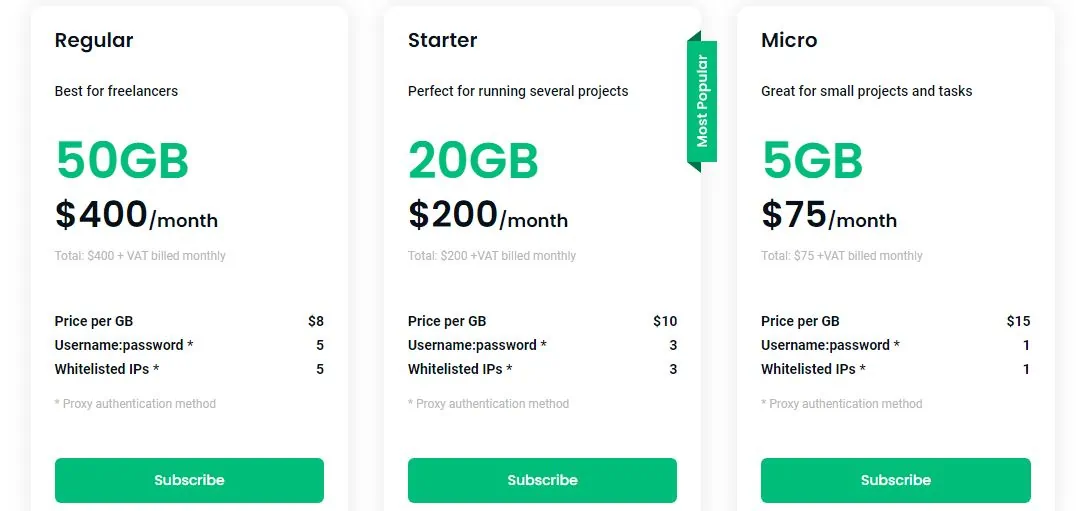
Pricing for Telegram proxies varies widely depending on proxy type and volume. Here’s how all 16 providers compare at entry level:
| Provider | Residential Entry Price | Mobile Proxy | Static/ISP Entry | SOCKS5 |
|---|---|---|---|---|
| Bright Data | $8/GB PAYG | From $21/GB | $1.30/IP shared | Yes |
| GeoNode | $0.79/GB PAYG | N/A | $1.70/IP/mo | Yes |
| IPRoyal | $7.35/GB PAYG | 4G/5G available | $1.75/proxy | Yes |
| Decodo | $3.75/GB (3 GB plan) | From $2.25/GB | From $0.27/IP | Yes |
| SOAX | $3.60/GB (25 GB plan) | $99/port/mo unlim. | Available | Yes (UDP) |
| Webshare | Free (10 DC IPs) | N/A | Free + paid tiers | Yes |
| Oxylabs | $6/GB (5 GB plan) | $7.50/GB (4 GB plan) | $1.60/IP (10 IPs) | Yes |
| NodeMaven | $4.25/GB (2 GB plan) | Shared pool w/ residential | $2.99/IP/mo | Yes |
| NetNut | $3.53/GB (28 GB plan) | $99/mo (13 GB) | $99/mo (7 GB) | Yes |
| Proxy-Seller | From $0.70/GB | From $10/IP | From $1/IP | Yes |
| Rayobyte | $3.50/GB PAYG | $15/port/mo unlim. | $5/IP/mo | Yes |
| ProxyEmpire | $5.71/GB (7 GB plan) | From $1.25/GB | Available | Yes |
| Infatica | $4/GB PAYG | $8/GB PAYG | $150K+ ISP pool | Yes |
| LiveProxies | $45–$70/plan | Available | Available | Yes |
| Storm Proxies | $19/mo (1 port unlim.) | N/A | N/A | No (HTTP only) |
| Proxy-Cheap | $4.99/GB | $5.99/GB rotating | $2.12/IP/mo unlim. | Yes |
Pricing note: Residential proxy prices decrease significantly with volume. The figures above reflect entry-level rates. High-volume users (100+ GB/month) should request custom quotes from Bright Data, Oxylabs, and NetNut — per-GB rates can drop by 50–70% at enterprise tiers. Proxy-Seller and SOAX use JS-rendered sliders; verify exact pricing at their live sites.
Telegram Proxy Pros & Cons
Pros ✓
- Access Telegram from any country, including those with full blocks
- Manage multiple accounts without cross-IP contamination
- Run bots and automation without triggering IP-based bans
- Residential and mobile IPs closely mimic real user traffic
- SOCKS5 proxies work natively inside Telegram’s built-in settings
- No latency overhead compared to VPNs (proxies are protocol-specific)
Cons ✗
- Shared datacenter proxies get flagged and banned faster than residential
- Free proxy lists are unreliable and expose your traffic to the proxy operator
- Some providers don’t support SOCKS5 (Storm Proxies: HTTP only)
- High-volume automation still risks account bans regardless of IP quality
- Premium residential proxies can be expensive at scale ($6–$8/GB)
Bottom Line: For casual personal use, Webshare’s free plan or GeoNode’s $5 trial gives you everything you need. For professional multi-account work, Decodo’s residential proxies at $3.75–$2/GB with SOCKS5 support offer the best combination of performance and price. For high-volume mobile account creation, Rayobyte’s $15/month unlimited mobile port is hard to beat.
Telegram Proxy Provider Comparisons
Two comparisons that matter most: the best overall pick vs the best budget option, and residential vs mobile proxies for Telegram-specific use cases.
Decodo vs Webshare — Best Overall vs Best Budget
| Feature | Decodo | Webshare |
|---|---|---|
| Residential IP Pool | 115M+ | 80M+ |
| Residential Success Rate | 99.86% (Proxyway tested) | 99.27–99.75% (Proxyway tested) |
| Response Time | <0.6s global avg | 1.05–1.57s |
| SOCKS5 | Yes | Yes |
| Mobile Proxies | 10M+ from 700+ carriers | Not available |
| Free/Trial | 3-day trial, 100 MB | 10 IPs free forever |
| Entry Price (Residential) | $3.75/GB (3 GB plan) | Free (datacenter); PAYG residential |
| City Targeting | Yes | Country only |
| Proxyway Rating | 9.3/10 | 8.8/10 |
Winner for Performance: Decodo | Winner for Free Access: Webshare | Winner for Mobile Proxies: Decodo
Bright Data vs IPRoyal — Enterprise vs Flexible Budget
| Feature | Bright Data | IPRoyal |
|---|---|---|
| Residential IP Pool | 150M+ | 32M+ |
| Telegram Success Rate | 98–99% (documented) | 96–97% rotating; 99% mobile |
| SOCKS5 | Yes | Yes |
| Mobile Proxies | 4G/5G rotating | 4G/5G from real devices |
| Traffic Expiry | Monthly (subscription) | Never expires (PAYG) |
| Static IP for Account Mgmt | ISP from $1.30/IP shared | From $1.75/proxy |
| Entry Price | $8/GB PAYG; $499/mo subscription | $7.35/GB PAYG (1 GB) |
| KYC Required | Yes (video call for individuals) | No |
| Proxyway Rating | 9.3/10 | 8.5/10 |
Winner for Volume and Enterprise: Bright Data | Winner for Flexibility and Low Entry Cost: IPRoyal | Winner for Non-Expiring Traffic: IPRoyal
🏆 Choose Decodo or Bright Data When:
- You need the highest possible success rate on Telegram
- You’re running bots or automation at scale
- You need mobile proxies from real carrier networks
- Speed and response time matter for your use case
🔍 Choose Webshare, IPRoyal, or GeoNode When:
- You need to start free or with minimal upfront cost
- You have unpredictable usage and need non-expiring traffic
- You’re managing a small number of personal Telegram accounts
- You want to test before committing to a premium plan
Provider Ratings Breakdown
The table below rates each provider across six criteria most relevant to Telegram use. Scores are from 1–5. The Overall Rating reflects weighted performance across all criteria.
| Provider | SOCKS5 | IP Quality | Mobile Proxies | Price/Value | Coverage | Ease of Use | Overall |
|---|---|---|---|---|---|---|---|
| Decodo | 5 | 5 | 5 | 5 | 5 | 5 | 4.9 / 5 |
| Bright Data | 5 | 5 | 5 | 3 | 5 | 3 | 4.5 / 5 |
| Oxylabs | 5 | 5 | 5 | 3 | 5 | 4 | 4.5 / 5 |
| Webshare | 5 | 4 | 2 | 5 | 4 | 5 | 4.2 / 5 |
| IPRoyal | 5 | 4 | 4 | 5 | 4 | 4 | 4.2 / 5 |
| SOAX | 5 | 4 | 5 | 3 | 5 | 4 | 4.2 / 5 |
| NodeMaven | 5 | 5 | 3 | 4 | 4 | 4 | 4.1 / 5 |
| NetNut | 5 | 5 | 4 | 3 | 4 | 3 | 4.0 / 5 |
| GeoNode | 5 | 4 | 2 | 5 | 4 | 5 | 4.0 / 5 |
| Rayobyte | 5 | 4 | 5 | 4 | 3 | 4 | 4.0 / 5 |
| Infatica | 5 | 4 | 4 | 4 | 4 | 4 | 4.0 / 5 |
| Proxy-Seller | 5 | 4 | 4 | 4 | 5 | 3 | 4.0 / 5 |
| ProxyEmpire | 5 | 4 | 4 | 4 | 4 | 4 | 3.8 / 5 |
| LiveProxies | 5 | 4 | 3 | 3 | 3 | 4 | 3.7 / 5 |
| Proxy-Cheap | 5 | 3 | 3 | 5 | 3 | 4 | 3.7 / 5 |
| Storm Proxies | 1 | 3 | 2 | 4 | 2 | 5 | 3.5 / 5 |
Decodo leads on every criterion — fast residential proxies, 10M+ mobile IPs, SOCKS5 across all products, and the most competitive per-GB pricing among providers with 99%+ success rates. Storm Proxies scores lowest primarily because it doesn’t support SOCKS5, which limits its usefulness for native Telegram proxy configuration. GeoNode punches above its weight on price/value and coverage for its tier.
Are Telegram Proxies Legit, Safe & Worth It?
Legitimacy & Safety
- ✓ All 16 providers in this list are legitimate commercial proxy services with documented business registrations.
- ✓ Residential proxy sourcing from reputable providers (Bright Data, Decodo, Oxylabs, IPRoyal) is ethically handled — IPs come from users who have given informed consent via browser extensions or reward apps.
- ✓ SOCKS5 proxies encrypt the connection between your device and the proxy server — your messages are not readable by the proxy operator.
- ✓ Telegram’s end-to-end encryption applies even over a proxy — your message content is protected at the app level regardless of which proxy you use.
- ✓ Providers like Infatica (ISO 27001) and Bright Data (SOC, GDPR) have independently audited security practices.
Long-Term Reliability
The providers in this list have multi-year track records. Decodo (formerly Smartproxy, founded 2018) has been operating for 7+ years. Bright Data (founded 2014) is the oldest and most established in the market. Even newer entrants like NodeMaven and ProxyEmpire (both 2020) have 5+ year histories with documented user bases. Using any of these is considerably lower-risk than free proxy lists, which rotate operators frequently and have no accountability.
Reality check: No proxy makes Telegram accounts invincible. If you send spam, add people to groups without permission, or run aggressive automation, Telegram will ban the account — and a good proxy only extends how long it takes. Proxies protect your IP, not your behavior. Use them to maintain legitimate accounts and access Telegram from restricted regions, not to violate Telegram’s terms of service at scale.
Worth It? Final Verdict
✓ YES — Use a Telegram Proxy If:
- You’re in a country where Telegram is blocked and you need reliable access
- You manage multiple Telegram channels or accounts professionally
- You run bots or automation that would trigger IP bans on a single IP
- You want to separate your home IP from your Telegram activity for privacy
- You’re building tools that interact with Telegram programmatically
✗ NO — Skip a Telegram Proxy If:
- You only use Telegram casually in a non-restricted country
- You’re tempted by free proxy lists — they will expose your traffic
- You want a proxy to enable spam or terms-of-service violations
- You need voice or video on a single port with no SOCKS5 support (Storm Proxies)
Our recommendation: If you’re just starting out, test Webshare’s free 10-proxy plan or GeoNode’s $5 trial. If you need serious performance for multi-account or bot work, Decodo’s 3-day / 100 MB free trial is the lowest-risk way to verify Telegram connectivity before committing to a paid plan.
Best Telegram Proxies — Frequently Asked Questions
What type of proxy works best with Telegram?
SOCKS5 residential or mobile proxies work best with Telegram. SOCKS5 is the protocol Telegram supports natively in its settings (Settings → Data and Storage → Use Proxy), and it handles all traffic including UDP for voice calls. Residential IPs from real ISPs look like genuine user traffic to Telegram’s detection systems, which makes them far less likely to be flagged or banned than datacenter IPs. Mobile proxies (4G/5G carrier IPs) offer the highest trust level and are the best option for account creation.
Can I use a free proxy for Telegram?
Yes — with serious caveats. Webshare offers 10 permanent free datacenter proxies that genuinely work for basic Telegram unblocking. Free public proxy lists from random websites are a different story: they typically ban within hours, may expose your Telegram traffic to the proxy operator, and have no guaranteed uptime. For anything beyond casual personal testing, a paid residential proxy is worth the cost. Even $0.79/GB from GeoNode is a major step up in reliability and safety from a free list.
What is the difference between MTProto and SOCKS5 for Telegram?
MTProto is a Telegram-specific proxy protocol built into the app — it only hides Telegram traffic, is free, and is volunteer-run. SOCKS5 is a general-purpose proxy protocol that hides all traffic from apps configured to use it, gives you broader anonymity, and can be used with Telegram bots, web scrapers, and other tools. MTProto is fine for simple country-level unblocking. SOCKS5 from a residential proxy provider is the right choice for multi-account management, automation, and any situation where IP quality and persistence matter.
Does Telegram block proxies?
Telegram blocks specific IPs and subnet ranges, not proxy protocols themselves. Datacenter IPs — especially from cloud providers like AWS or DigitalOcean — are most commonly blocked because they appear in bulk and are easy to identify. Residential and mobile IPs assigned by real ISPs to real users are much harder to detect and block. High-quality residential proxies from providers like Decodo, Oxylabs, or Bright Data have 97–99% Telegram success rates because their IPs look exactly like genuine residential traffic.
How many Telegram accounts can I manage per IP?
One dedicated IP per account is the safest approach. Telegram links accounts to both phone numbers and IP addresses. If multiple accounts share an IP and one gets banned, Telegram often bans the other accounts associated with that IP in the same session. For large-scale account management (50+ accounts), use rotating residential proxies and assign a sticky session per account during login. IPRoyal’s static residential proxies at $1.75/proxy are the most cost-effective option for dedicated-IP-per-account setups.
Are Telegram proxies legal?
In most countries, using a proxy to access Telegram is completely legal. Proxies are standard internet tools used by businesses, developers, and privacy-conscious users worldwide. In countries where Telegram itself is illegal (very rare), using a proxy to access it enters a legal gray area — but in the vast majority of cases, bypassing geo-restrictions with a proxy falls under normal internet usage. Always check local regulations if you’re operating in a country with significant internet restrictions.
What’s the best proxy for Telegram in Iran, China, or Russia?
For Iran and China: Residential proxies from providers with large global pools work well. Decodo (115M+ IPs, 195 locations), Oxylabs (175M+ IPs), and Bright Data (150M+ IPs) all cover these markets. SOAX is particularly strong for Iran and nearby regions (Middle East and Central Asia IP depth). For Russia (when Telegram is blocked episodically), SOAX has 2M+ documented Russian residential IPs. Decodo also has strong Russian coverage as part of its 115M+ global pool.
Can I use a proxy for Telegram bots?
Yes. Most Telegram bot libraries (python-telegram-bot, Telethon, Pyrogram) support SOCKS5 proxy configuration through their client settings. You simply pass the proxy host, port, and credentials when initializing the client. Rotating residential proxies work well for bots that send many requests — the rotation prevents any single IP from accumulating enough behavior to trigger Telegram’s rate limits. Decodo and Oxylabs both offer unlimited concurrent sessions, which is important for bots running parallel operations.
How do I set up a SOCKS5 proxy in Telegram?
On mobile: open Telegram → Settings → Data and Storage → Use Proxy → Add Proxy → select SOCKS5 → enter your proxy host, port, and credentials. On desktop: Settings → Advanced → Connection Type → Use custom proxy. You’ll need the proxy server address, port number, and username/password or IP-authenticated access from your provider’s dashboard. All providers in this list offer these credentials in a standard format that works directly in Telegram.
What are the best Telegram proxies for a small budget?
Three options stand out from our tested telegram proxy list at low cost:
- Webshare: 10 free datacenter proxies permanently — no cost at all to start.
- GeoNode: $5 trial gives 10 GB over 3 days; residential PAYG at $0.79/GB after that.
- IPRoyal: PAYG residential from $7.35/GB with traffic that never expires — buy 1 GB and use it at your own pace.
Do proxies protect Telegram message content?
Telegram messages in secret chats are end-to-end encrypted — even Telegram’s servers can’t read them. Regular cloud chats are encrypted in transit but stored on Telegram’s servers. A SOCKS5 proxy encrypts the connection between your device and the proxy server, hiding your IP from Telegram. However, a proxy does not add additional encryption to your messages beyond what Telegram already provides. If end-to-end encryption for all messages is your priority, use Telegram’s Secret Chat feature, which is independent of proxy configuration.
What happens if my Telegram proxy IP gets banned?
If you’re using a rotating residential proxy from a provider like Decodo, Bright Data, or Oxylabs, the system automatically assigns a new IP on the next rotation — you’re unlikely to even notice a ban. If you’re using a static IP, you’ll need to request a replacement from your provider. All providers in this list offer IP replacement options: IPRoyal allows you to pause traffic and request a new IP; Decodo offers IP refresh on its ISP plans; Bright Data has dedicated IP options with a clean pool. Providers with large pools (100M+ IPs) recover from bans fastest.
Final Verdict
Needs vary widely — from “I just want to unblock Telegram during a trip” to “I’m managing 500 accounts and running bots 24/7.” The best Telegram proxies in this guide cover the full spectrum. None of them are wrong choices — they each make sense for a specific user profile and budget.
If you’re picking one to start with right now, Decodo is the safest bet: fastest residential proxies in the market, 99.86% success rate, SOCKS5 across all products, 10M+ mobile IPs for account creation, and a 3-day / 100 MB trial that costs nothing to test. For free access, Webshare is the only real option that holds up for casual use. For enterprise-scale work, Bright Data and Oxylabs are the infrastructure providers that serious Telegram operations use.
✓ What We Love About the Best Picks
- SOCKS5 support in native Telegram settings — works without third-party software
- Residential and mobile IPs that match real user traffic patterns
- Free or low-cost trials that let you test before committing
- Non-expiring PAYG traffic options (IPRoyal, ProxyEmpire, Rayobyte)
- Transparent, independently verified performance benchmarks
- Wide country coverage including blocked Telegram markets
✗ What Could Be Better
- Storm Proxies’ HTTP-only limitation cuts it out of native Telegram SOCKS5 setup
- Some providers still use JS-rendered pricing sliders (Proxy-Seller, SOAX) — not transparent without visiting the site
- Enterprise minimums ($99–$499/mo) at NetNut and Bright Data exclude casual users
- Free datacenter proxies (Webshare) get banned faster than residential — tradeoff for zero cost
Ready to Set Up Your Telegram Proxy?
Decodo gives you the fastest residential proxies available, SOCKS5 support, mobile IPs from 700+ carriers, and a 3-day free trial with 100 MB — enough to test your exact Telegram setup before paying a cent.