
10 Best Datacenter Proxy Providers in 2026
Compare the top datacenter proxy providers of 2026 — tested on IP pool size, speed, subnet diversity, pricing, and real-world success rates for scraping, SEO monitoring, and ad verification at scale.
⚡ Quick Verdict
Datacenter proxies outperform residential on raw speed and cost — but only if you pick a provider with enough subnet diversity and clean IPs. Residential proxies get all the attention, but for high-volume scraping, SEO monitoring, and ad verification on targets that don’t fingerprint aggressively, datacenter proxies deliver 10–50x faster response times at a fraction of the per-GB cost. The eight to ten providers below were evaluated on IP pool depth, subnet variety (C-class diversity), protocol support, and real pricing — not just what the marketing page claims. Bright Data leads on enterprise depth and global coverage. IPRoyal wins on budget PAYG pricing. Rayobyte is the pick for maximum subnet diversity. Your best choice depends on volume, target sensitivity, and how much subnet variety your use case demands.
Bright Data — 1.3M+ DC IPs, 3000+ subnets, 98 countries, enterprise-grade tools
IPRoyal — $1.75/GB PAYG, SOCKS5, unlimited bandwidth, auto replacement
Oxylabs — 99.9% uptime, 0.26 s avg response, 2M+ dedicated proxies
Rayobyte — 300K+ IPs across 20K unique C-class subnets, 25 PB/mo bandwidth
You need to run 50,000 requests against a price-monitoring target by morning. Residential proxies would work — but at $5–8/GB and 1–2 second response times, the bill and the clock both become a problem fast. Datacenter proxies solve both. A quality datacenter IP pool delivers sub-300ms responses at $0.50–1.50/GB, making large-scale scraping jobs economically viable instead of prohibitively expensive.
The catch is subnet diversity. If all your datacenter IPs share the same /24 subnet, a single block by the target wipes out your entire pool at once. Good providers spread their IPs across thousands of unique C-class subnets — which is the single most important technical metric to check before buying.
Datacenter proxies also excel where residential proxies struggle: ad verification, SEO rank tracking, academic research, and any use case where the target website isn’t running sophisticated bot detection. On these targets, the speed advantage is enormous and the per-request cost is a fraction of what you’d pay for residential IPs.
This guide covers ten providers we’ve evaluated specifically for datacenter proxy quality — IP pool size, subnet diversity, protocol support, pricing model, and real-world reliability. Pricing figures come from each provider’s official pages and brand knowledge files, verified in May 2026.
What Are Datacenter Proxies?
A datacenter proxy is a proxy server whose IP address is assigned to a commercial data center — not an ISP or home user. The IP comes from a cloud hosting provider, a dedicated server farm, or a colocation facility. When you route traffic through it, target websites see the data center’s IP instead of your own.
Three things define how useful a datacenter proxy network is:
- IP Pool Size — More IPs mean more concurrent requests, more rotation options, and less chance of burning through your entire pool on a single target. Enterprise providers like Bright Data and Oxylabs offer 1–2 million datacenter IPs; budget providers may offer a few thousand.
- Subnet Diversity — IPs from many different /24 subnets (C-class blocks) are much harder to block at scale. A provider with 300,000 IPs across 20,000 unique subnets (Rayobyte) is fundamentally different from one with 300,000 IPs across 300 subnets — even if the pool size looks the same.
- Protocol Support — HTTP/HTTPS covers most web scraping needs. SOCKS5 handles non-HTTP traffic (gaming, APIs, data streams). Some use cases specifically require SOCKS5 — make sure your provider offers it before committing.
Datacenter Proxies vs Residential Proxies: The Core Trade-Off
Datacenter proxies are faster, cheaper, and easier to scale — but they’re more detectable because their IP ranges are registered to known hosting providers, not to households. Most anti-scraping systems maintain lists of known data center IP ranges and block them outright on sensitive targets. For targets without aggressive bot detection, datacenter proxies are the economically rational choice. For targets with sophisticated protection (Google, Amazon, major social platforms), you need residential or ISP proxies.
Who Needs Datacenter Proxies?
✓ Ideal Users for Datacenter Proxies
- High-Volume Web Scrapers — If you’re running hundreds of thousands of requests per day against targets that don’t have residential-grade bot detection, datacenter proxies cut your cost by 80–90% versus residential. The speed advantage also means you complete jobs faster.
- SEO Rank Trackers — Tools like Semrush, Ahrefs, and custom rank-tracking scripts regularly ping search engines with simulated queries. Many search engines tolerate datacenter IPs for standard queries — and the speed advantage matters when you’re checking thousands of keywords daily.
- Ad Verification Teams — Verifying that ads appear correctly in different regions, that competitor ads are running as reported, and that affiliate offers are displayed accurately benefits enormously from fast, cheap datacenter IPs. Most ad networks don’t block datacenter IPs the way content platforms do.
- Price Intelligence Platforms — B2B e-commerce monitoring, travel fare aggregation, and retail price comparison tools often target sites that allow automated access with proper rate limiting. Datacenter proxies are the cost-efficient backbone for this type of work.
- Developers and QA Teams — Testing how a web application behaves from different geographic locations, verifying CDN behavior, or stress-testing rate limits all benefit from fast, disposable datacenter IPs across multiple countries.
- Brand Protection Teams — Monitoring counterfeit listings, unauthorized resellers, and trademark violations across e-commerce platforms and marketplaces is a volume-intensive task well suited to datacenter proxies.
✗ Not Ideal For
Datacenter proxies are NOT the right tool if you:
- Need to scrape Google, Amazon, Instagram, or other platforms with sophisticated bot detection — you’ll get blocked constantly and waste budget
- Are managing social media or e-commerce accounts — platforms flag datacenter IPs immediately and ban the account, not just the request
- Require a consistent identity over weeks or months — datacenter IPs are frequently recycled and the range history may carry a bad reputation
- Are targeting ticketing sites (Ticketmaster, StubHub) or sneaker platforms — these aggressively block datacenter ranges
10 Best Datacenter Proxy Providers — Tested & Ranked
Here are our top picks for the best datacenter proxy providers, evaluated on pool size, subnet diversity, pricing, protocol support, and real-world reliability. Each section covers what makes the provider stand out — and where it falls short.
1. Bright Data — Best Overall Datacenter Proxy Network
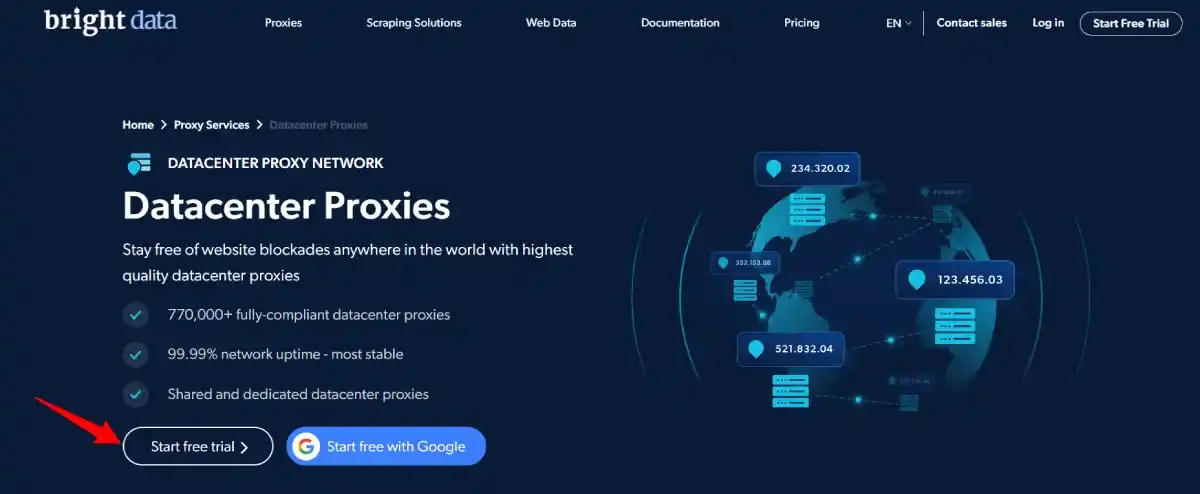
Bright Data is the benchmark for enterprise datacenter proxy infrastructure. Its datacenter pool starts at 1,300,000+ IPs across approximately 98 countries and 3,000+ subnets — making it one of the deepest and most geographically diverse datacenter networks available. The platform offers three distinct billing modes (shared IPs per-IP, dedicated IPs per-IP, and bandwidth-based per-GB), which gives you the flexibility to match pricing to your actual usage pattern instead of being forced into a single model.
What separates Bright Data from the field isn’t just pool size — it’s the surrounding infrastructure. The datacenter proxies integrate directly with Bright Data’s Web Unlocker API and Scraping Browser, so you can escalate from a simple datacenter IP to an AI-powered unblocking layer without switching providers. The platform also benchmarks at sub-300ms response times: Proxyway independently tested Bright Data’s datacenter proxies at 0.26 seconds average response time — among the fastest in the industry.
Pricing starts at $0.60/GB (PAYG bandwidth-based), or $1.40/IP per month for shared datacenter IPs (minimum 10 IPs). Dedicated datacenter IPs start at $2.20/IP per month. Subscription plans with bandwidth billing start at $499/month. The active promo code RESIGB50 gives 50% off for the first three months on new accounts. A 7-day free trial is available for companies.
Pros ✓
- 1.3M+ datacenter IPs, 98 countries — largest enterprise DC pool in this list
- Three billing modes: per-IP (shared), per-IP (dedicated), per-GB (bandwidth)
- 0.26 s avg response time (Proxyway independent benchmark)
- HTTP, HTTPS, SOCKS5 — all protocols supported
- Integrates with Web Unlocker API and Scraping Browser for escalation
- ISO 27001 certified; ethically sourced; GDPR compliant
- 7-day free trial for companies
Cons ✗
- Most expensive entry point in this list — subscription from $499/month
- KYC required (video call for some business types)
- Datacenter IPs blocked by Amazon (5.83% success) — expected for DC proxies
2. Smartproxy — Best Datacenter Proxy for Mid-Market Buyers
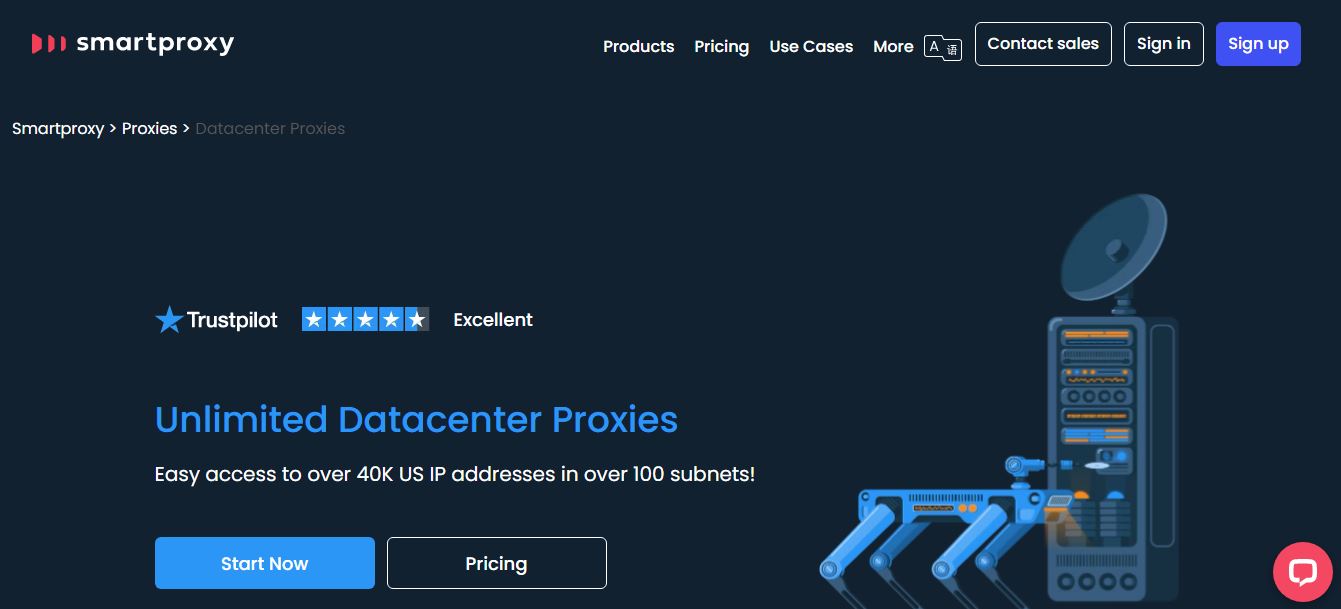
Smartproxy occupies the mid-market space between enterprise providers like Bright Data and budget options like IPRoyal. Its dedicated datacenter proxy network covers around 40,000 US IPs spread across 100+ subnets, with fixed pricing that makes budgeting predictable. Unlike many providers that push you toward per-GB billing on datacenter proxies, Smartproxy’s dedicated datacenter plans use per-IP monthly pricing with unlimited bandwidth — which means you know exactly what you’re paying and you don’t get a surprise bill at the end of the month.
The 7-day free trial is a genuine test window: you get enough time to run realistic scraping workloads against your actual targets and verify that the IPs work before committing. Smartproxy’s dashboard is one of the cleaner proxy management interfaces in the market, and the documentation is solid for developers integrating proxies into existing pipelines. The main limitation is protocol support — Smartproxy’s datacenter proxies support HTTP/HTTPS but not SOCKS5, which rules it out for non-HTTP use cases.
Pricing runs at approximately $8.5/GB on the bandwidth-based plan, or fixed per-IP on dedicated plans. Plans start at around $75/month for 5 IPs with unlimited bandwidth. The 7-day free trial requires no credit card on initial signup.
Pros ✓
- 40K US dedicated datacenter IPs across 100+ unique subnets
- Unlimited bandwidth on dedicated plans — no surprise overage charges
- 7-day free trial — enough time to test real workloads
- Clean, developer-friendly dashboard with solid documentation
- Fixed monthly pricing makes budget planning simple
Cons ✗
- No SOCKS5 support — HTTP/HTTPS only
- US-only for dedicated datacenter IPs — limited geo-coverage vs enterprise options
- Smaller subnet count (100+) compared to Rayobyte or Bright Data
3. Nimble — Best AI-Powered Datacenter Proxy Network
Nimble’s differentiation is its smart AI routing layer — instead of forcing you to manage which proxy type to use for which target, the platform automatically selects the best IP (datacenter, residential, or ISP) based on the target’s bot-detection behavior. For teams that don’t want to run A/B tests between proxy types on each target, this automation is genuinely useful. The datacenter entry point starts at $300/month with coverage across 12 countries, and the per-GB rate runs at $8/GB across proxy types.
Nimble’s “Pipelines” product packages datacenter proxies with structured data extraction, so you get clean JSON out the other end instead of raw HTML. This appeals to data teams that want a managed data pipeline rather than a raw proxy feed. The main downside is cost: at $300/month entry for datacenter and $8/GB bandwidth, Nimble is priced for teams that value the AI routing intelligence enough to pay for it — not buyers looking for the cheapest datacenter GBs.
Coverage spans 12 countries for datacenter proxies specifically, with broader geo-coverage when the platform routes to residential IPs. HTTP, HTTPS, and SOCKS5 all supported.
Pros ✓
- AI routing automatically selects best proxy type per target
- All-in-one: datacenter, residential, and ISP under one platform
- Pipelines product delivers structured data, not just raw HTML
- HTTP, HTTPS, SOCKS5 all supported
- Consistent $8/GB pricing across all proxy types — no surprise tiers
Cons ✗
- $300/month datacenter entry is steep for budget buyers
- DC coverage limited to 12 countries — not a global option
- Less transparent pool size data than other providers
4. ProxySeller — Best Budget Datacenter Proxies with SOCKS5
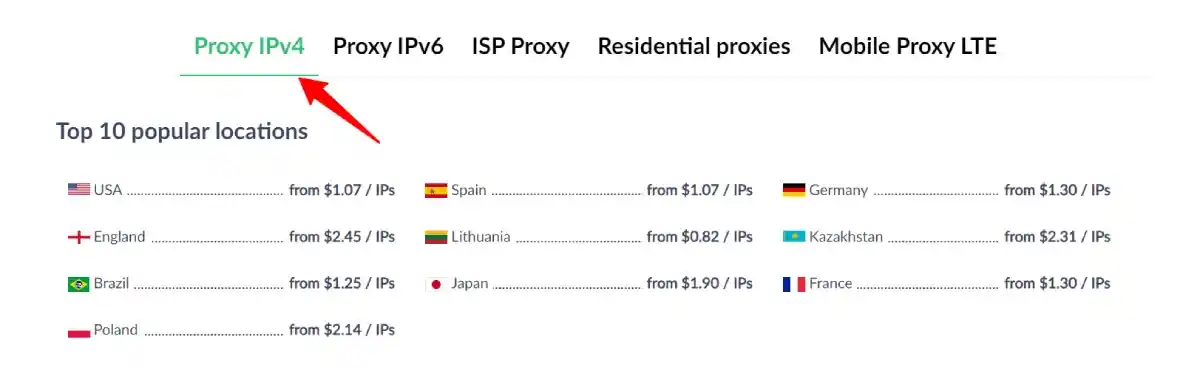
ProxySeller covers both IPv4 and IPv6 datacenter proxies with full HTTP/HTTPS/SOCKS5 protocol support across 40+ countries — a broader geographic footprint than most budget providers. The 7-day trial gives you a real window to test whether the IP quality works for your specific targets before committing to a monthly plan. Pricing around $7/GB positions ProxySeller between enterprise options and the cheapest budget plays, but the combination of SOCKS5 support and 40-country coverage adds real value at that price point.
IPv6 datacenter proxies are one of ProxySeller’s differentiators — many providers only offer IPv4 at the datacenter level, but some scraping targets and APIs respond differently (or are cheaper to serve) on IPv6. ProxySeller’s IPv6 pool gives developers an option that most other providers don’t. The 7-day trial applies to both IPv4 and IPv6 datacenter IPs, which is generous compared to providers that trial only one product type. Proxy-Seller has 10+ years of operation and carries a Trustpilot rating of approximately 4.7/5.
Authentication supports both username/password credentials and IP whitelisting. SDK libraries available in five programming languages make integration straightforward for development teams.
Pros ✓
- Both IPv4 and IPv6 datacenter proxies available
- HTTP, HTTPS, and SOCKS5 — full protocol coverage
- 40+ countries — broad geographic footprint for a budget provider
- 7-day trial on datacenter IPs
- 10+ years operating; ~4.7/5 Trustpilot rating
- SDKs in 5 programming languages
Cons ✗
- Pricing pages are JS-slider-rendered — verify live before budgeting
- Pool size not publicly disclosed — less transparency than enterprise providers
- No free trial (only 7-day paid trial)
5. Limeproxies — Best for Private Dedicated Datacenter Proxies
Limeproxies is one of the older datacenter proxy providers still active in 2026, and it’s built its niche around private dedicated proxies with clean IP history. Its pool covers 50+ global locations with three tiers: private (exclusive-use), shared, and public datacenter proxies — giving buyers the flexibility to choose between cost efficiency and exclusivity. The private tier is particularly useful when you need IPs that haven’t been abused by other users, which is a real concern with shared datacenter pools.
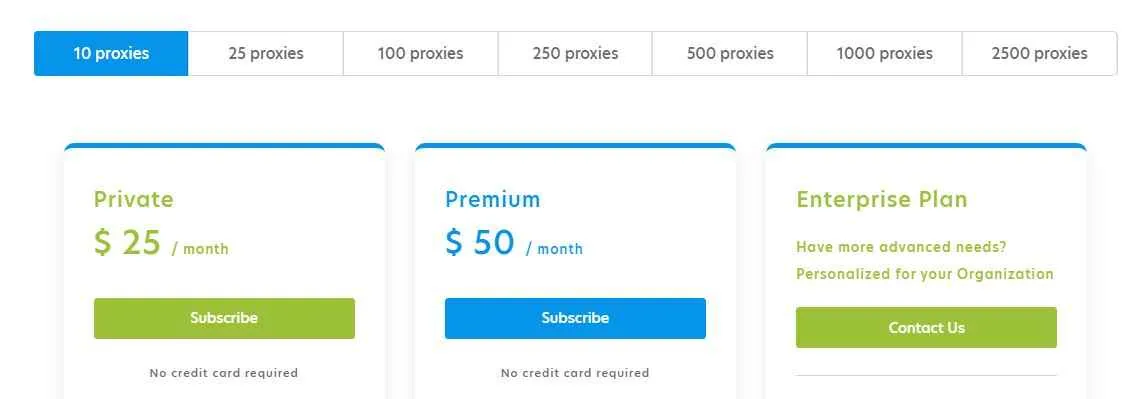
At $50/month entry pricing, Limeproxies sits in the mid-range budget tier. The 3-day money-back guarantee is short by industry standards — most providers offer 7+ days — so you’ll want to test against your specific targets quickly. Speed is a genuine strength: Limeproxies uses a premium routing infrastructure with 1 Gbps port speeds on most datacenter IPs. The dashboard is basic compared to modern platforms like Bright Data or Oxylabs, but the proxy setup process is simple enough that most users won’t find the lack of features a problem.
HTTP, HTTPS, and SOCKS5 supported. IPv4 and IPv6 available on most plans. Best suited for buyers who want clean, dedicated datacenter IPs without the enterprise price tag.
Pros ✓
- Private (exclusive-use), shared, and public DC proxy tiers
- 50+ global locations — solid geographic spread
- 1 Gbps port speeds on premium tiers
- HTTP, HTTPS, SOCKS5; IPv4 and IPv6
- Clean dedicated IP history — good for targets that score IP reputation
Cons ✗
- Only a 3-day money-back guarantee — shorter than most competitors
- Basic dashboard compared to modern platforms
- Pool size not as large as enterprise providers
6. IPRoyal — Best Budget Datacenter Proxies with PAYG Flexibility
IPRoyal is the budget pick for datacenter proxies, and its PAYG model makes it the most flexible entry point in this list. You pay per IP, not per GB — and datacenter plans start at $1.39/IP on a 90-day plan. Bandwidth is unlimited, which eliminates the bandwidth overage risk that bites buyers of per-GB datacenter plans at other providers. The auto-replacement feature means IPRoyal automatically swaps out flagged or blocked IPs without you needing to manually submit replacement requests.
SOCKS5 and HTTPS are both supported, covering the two most common datacenter use cases. IPRoyal’s datacenter coverage spans 60+ locations across six continents — broader than many budget providers that offer only US or US+EU datacenter IPs. The 24-hour refund window on datacenter proxies is tight, but the low entry cost means you’re not risking much to test. Proxyway rates IPRoyal at 8.5/10 overall, and the datacenter product shares the same quality infrastructure as the residential network.
One genuine differentiator: the non-expiring PAYG traffic model (on residential) also carries over in spirit to datacenter — you buy IPs for the duration you need (24 hours, 30, 60, or 90 days) rather than committing to a recurring monthly subscription. Promo code PROXYWAY30 gives 30% off.
Pros ✓
- $1.39/IP starting on 90-day datacenter plans — lowest per-IP entry in this list
- Unlimited bandwidth on all datacenter plans — no surprise bills
- Auto-replacement of blocked or flagged IPs
- SOCKS5 + HTTPS supported
- 60+ locations across six continents
- Duration-based billing (24h, 30, 60, 90 days) — not forced into monthly
Cons ✗
- Only 24-hour refund window — shorter than most competitors
- Pool size smaller than enterprise providers
- ISP targeting for residential requires minimum $2,000 spend unlock
7. Oxylabs — Best Enterprise Datacenter Proxies for Speed & Uptime
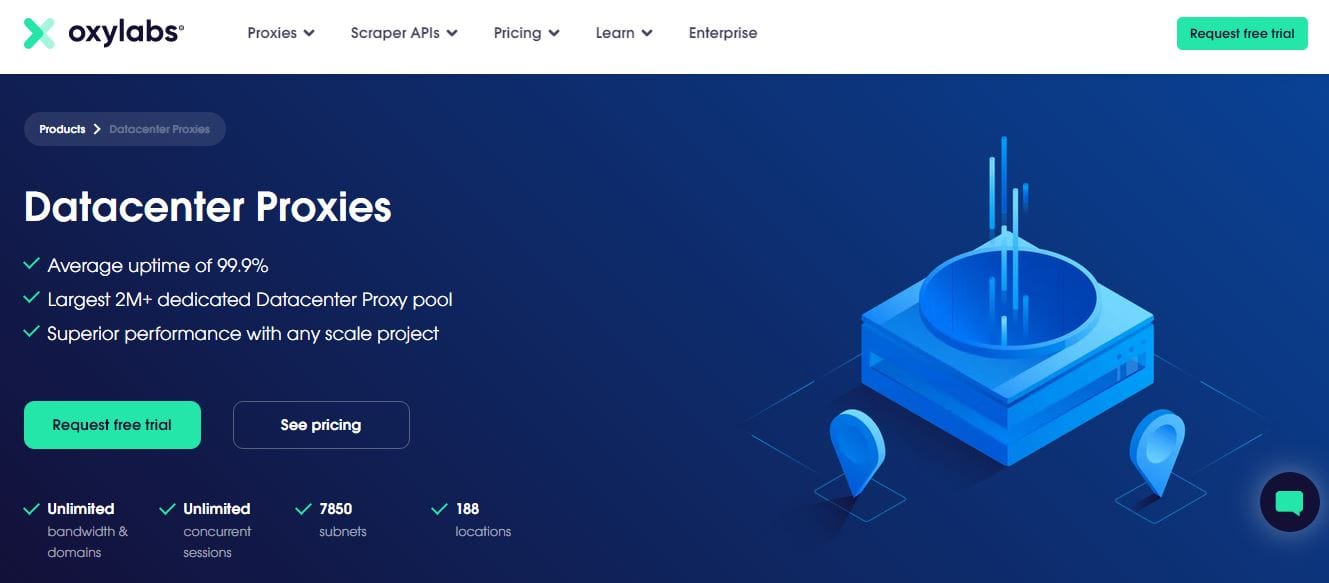
Oxylabs’ datacenter proxy product comes in three formats — Shared DC, Dedicated DC, and Rotating DC — each targeting a different use case. The Dedicated DC pool covers 2M+ IPs across 188 locations, making it the largest dedicated datacenter pool in this list. Oxylabs benchmarks at 99.9% uptime and sub-500ms response times across its datacenter infrastructure, backed by an SLA that enterprise customers can hold them to. The platform earned Proxyway’s Best Enterprise Provider award in 2025 across its full proxy product line.
Datacenter pricing starts at $12/month for 10 shared IPs, or $6.75/month for 3 dedicated IPs. Oxylabs also offers a Rotating Datacenter product — IPs rotate from a pool with each request, which improves success rates on targets that rate-limit by IP but don’t do deep residential fingerprinting. The 7-day free trial for companies is available; new users also get 5 free datacenter IPs with no credit card required. Promo code proxyway35 takes 35% off the first purchase.
Oxylabs also carries product insurance — a unique-in-the-industry feature where purchases are insured. Compliance certifications include EWDCI membership, and support is available in Russian, English, Chinese, and Lithuanian.
Pros ✓
- 2M+ dedicated datacenter IPs across 188 locations — largest DC pool in this list
- Three DC product formats: Shared, Dedicated, and Rotating
- 99.9% uptime SLA — enterprise-grade reliability guarantee
- 5 free datacenter IPs available (no credit card)
- 7-day free trial for company accounts
- Product insurance — unique to Oxylabs in the proxy market
Cons ✗
- $180/month entry for meaningful dedicated DC scale
- No PAYG option — subscription required for datacenter
- KYC required before using services
8. Rayobyte — Best for Subnet Diversity and High-Volume Scraping
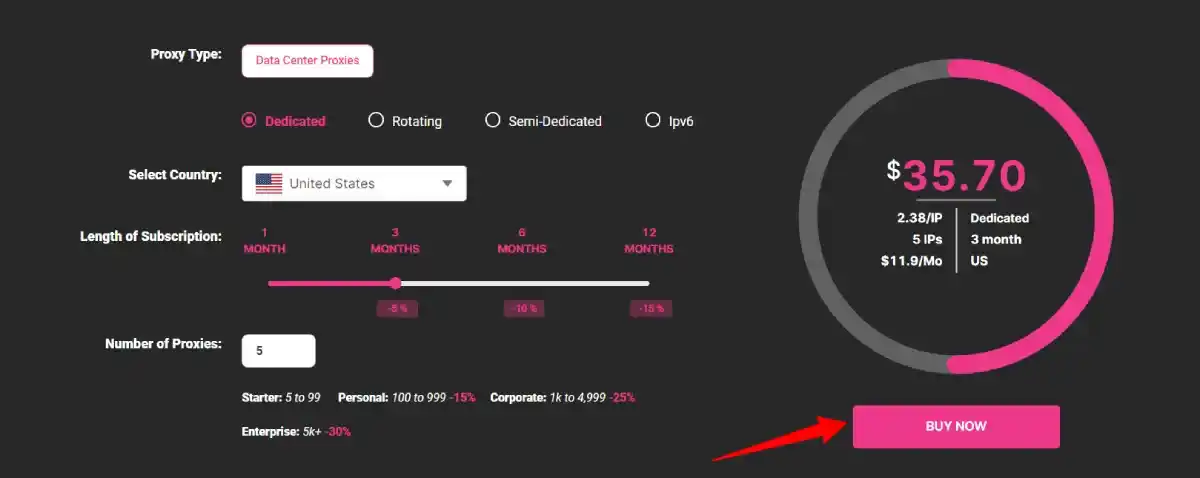
Rayobyte (formerly Blazing SEO) is the subnet diversity specialist in this list. Its 300,000+ datacenter IPs span 20,000 unique C-class (/24) subnets — a ratio that makes it dramatically harder for targets to block the entire Rayobyte pool with a single subnet block. Most providers with 300K IPs spread them across a few hundred subnets; Rayobyte spreads them across 20K. That difference is what prevents the “entire pool blocked in one click” failure mode that ruins large-scale scraping projects.
The 25 PB/month total bandwidth capacity means Rayobyte can support extremely high-volume operations without throttling. Entry pricing starts with a 50 MB trial — enough to validate IP quality and subnet distribution on your specific targets before committing. Rayobyte specializes in US datacenter IPs, which is where its subnet depth is concentrated. International coverage exists but is thinner.
Rayobyte is particularly popular with SEO agencies and data aggregation firms that run large-scale rank-tracking and content scraping workloads. The combination of subnet diversity and high bandwidth cap makes it the preferred choice when you need to sustain high request volumes against targets that actively block datacenter IP ranges by subnet.
Pros ✓
- 20,000 unique C-class subnets — highest subnet diversity in this list
- 300K+ datacenter IPs with 25 PB/month bandwidth capacity
- 50 MB trial available — low-risk entry point
- Ideal for high-volume SEO and scraping workflows
- Experienced team (formerly Blazing SEO) with a strong reputation in the SEO community
Cons ✗
- Primarily US-focused — international datacenter coverage is thinner
- Less prominent for residential proxy use cases if you need escalation
- Dashboard and documentation less polished than enterprise competitors
9. Ghostealth — Best Entry-Level Datacenter Proxies with 60-Minute Trial
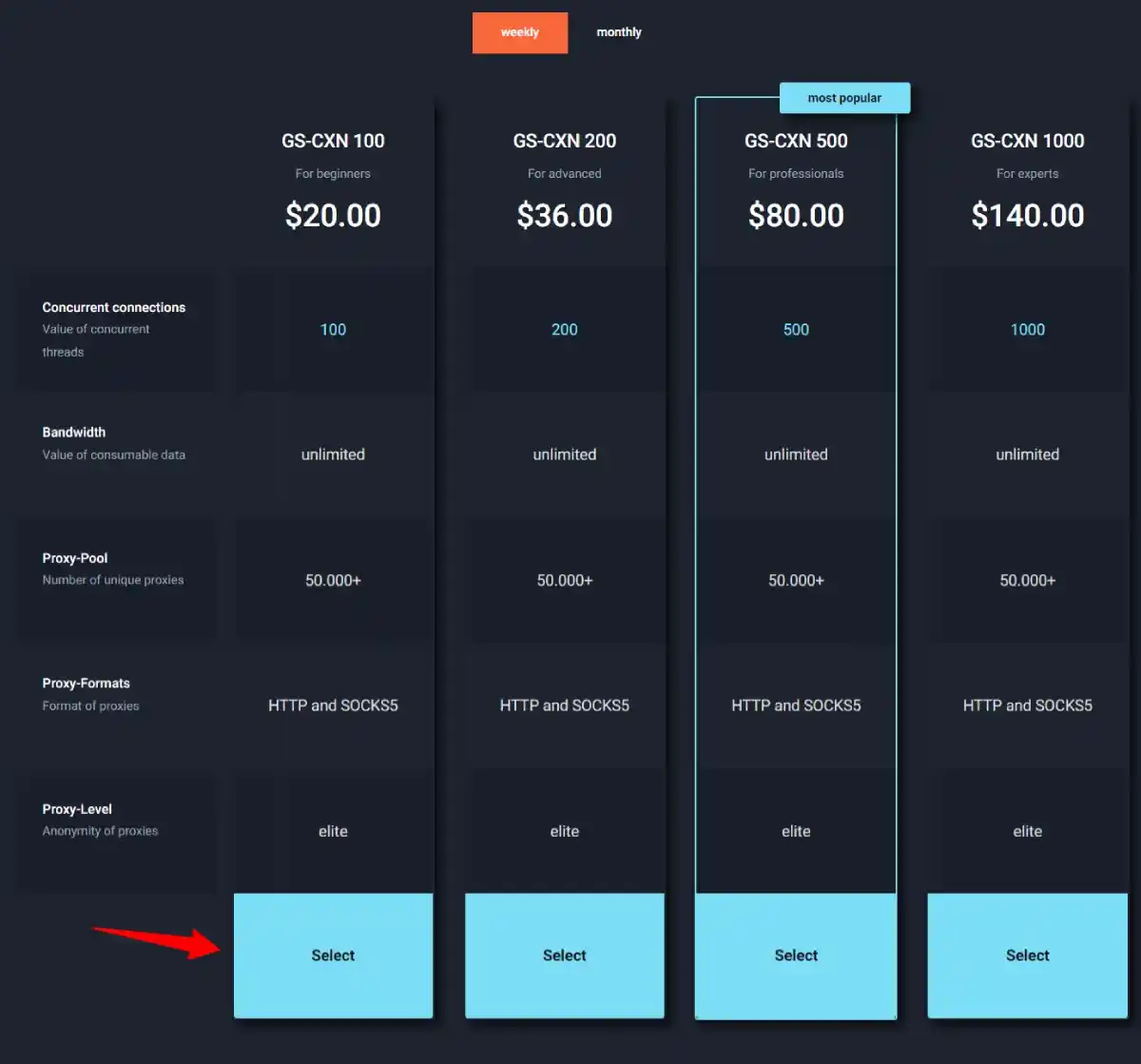
Ghostealth rounds out this list as a lean datacenter proxy provider with a 60-minute trial — one of the few providers that lets you test the product before paying anything, albeit on a very short window. Its 50,000 IPv4 datacenter IPs with unlimited bandwidth on all plans makes it attractive for buyers who want predictable costs without bandwidth caps. Entry pricing at $20/month is among the lowest in this list for an IPv4-only datacenter product.
The unlimited bandwidth model is Ghostealth’s key selling point for volume buyers: once you’ve bought the IPs, you don’t pay extra no matter how much traffic you push through them. This makes Ghostealth particularly cost-effective for high-transfer workloads like downloading large amounts of public data or running continuous monitoring jobs.
The limitation is scale: at 50,000 IPs and IPv4-only, Ghostealth is a budget-tier option that works well for small-to-medium scraping operations but doesn’t have the pool depth or geographic spread of enterprise providers. The 60-minute trial is genuine — you get real IPs to test with — but you need to run your evaluation efficiently in that window.
Pros ✓
- 60-minute trial — test before you buy
- Unlimited bandwidth on all plans — no per-GB overage risk
- $20/month entry — one of the lowest absolute entry costs in this list
- 50K dedicated IPv4 IPs
- Simple setup and straightforward pricing
Cons ✗
- IPv4 only — no IPv6 datacenter proxies
- 50K IP pool is small relative to enterprise options
- Limited geographic diversity compared to providers with 60+ country coverage
- 60-minute trial is short — requires efficient testing
10. MyPrivateProxy — Best for Dedicated Private Proxies with Long Track Record
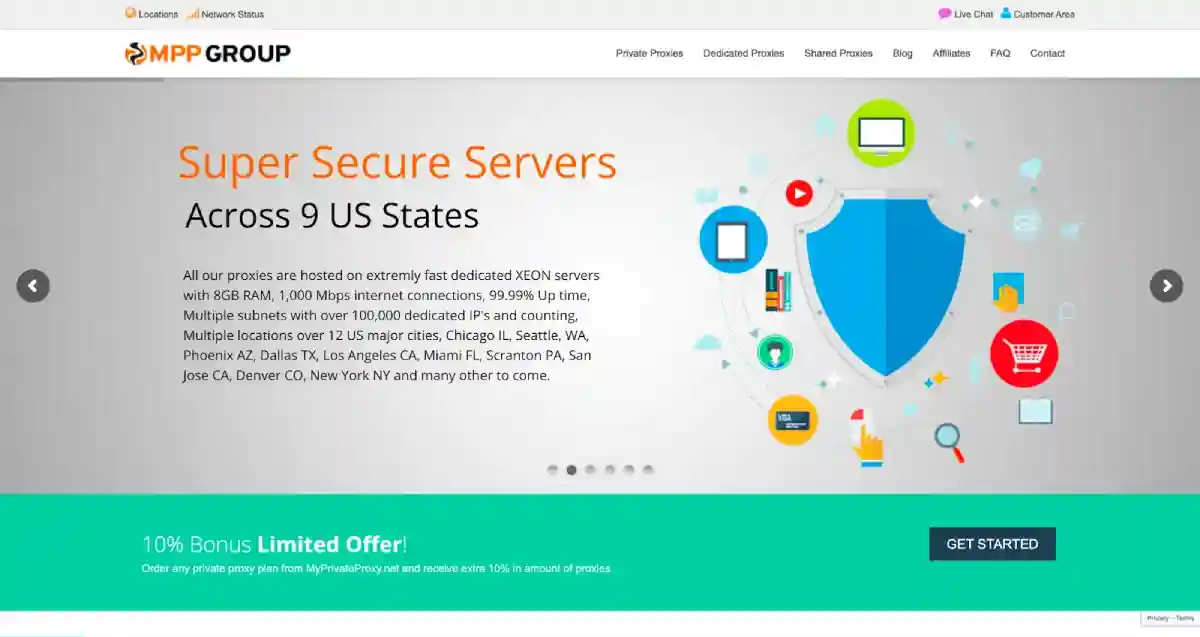
MyPrivateProxy has been operating datacenter proxy infrastructure since before most current providers existed — it’s one of the original dedicated proxy services and has a genuine track record spanning over a decade. Its infrastructure runs across 220 dedicated servers in 24 datacenters, and the proxy pool is private in the true sense: IPs are assigned exclusively to one customer at a time, not shared across multiple buyers. This clean IP history is valuable for use cases where IP reputation scoring matters.
The 3-day money-back guarantee gives you a real (if short) testing window. Pricing for private proxies starts at around $2.49/proxy per month for US IPs, with bulk discounts at higher quantities. MyPrivateProxy supports HTTP/HTTPS and SOCKS5, and the proxy format is straightforward to integrate into existing tools. The product is deliberately simple — no AI routing, no managed pipelines, no enterprise dashboard — just reliable dedicated proxies at a competitive per-IP price.
Best suited for buyers who want private dedicated IPs with a clean reputation history and don’t need the complexity of enterprise platforms. SEO tool users and developers building proxy-dependent applications are MyPrivateProxy’s core user base.
Pros ✓
- 220 dedicated servers across 24 datacenters — genuine owned infrastructure
- Private (exclusive-use) IPs — no shared pool contamination
- 10+ year track record — one of the most established DC proxy providers
- HTTP, HTTPS, SOCKS5 supported
- 3-day money-back guarantee
Cons ✗
- 3-day money-back is shorter than most competitors (7+ days)
- No modern enterprise features (AI routing, managed pipelines, scraping browser)
- Less geographic coverage than providers with 60–100+ country datacenter IPs
How to Choose the Right Datacenter Proxy Provider
Every provider in this list offers datacenter proxies — but the quality and suitability vary significantly based on your specific use case. Here are the five factors that actually determine whether a datacenter proxy provider will work for you.
Subnet Diversity — The Factor Most Buyers Overlook
IP pool size alone doesn’t tell you how blockable a proxy network is. A provider with 300K IPs across 300 subnets loses its entire US pool to a single subnet block. A provider with 300K IPs across 20,000 subnets (Rayobyte) loses only a fraction. For any target that actively blocks datacenter ranges by subnet — and most sophisticated ones do — subnet diversity is as important as pool size.
Protocol Support: HTTP vs SOCKS5
HTTP/HTTPS proxies handle web traffic and work with virtually all scraping tools (Scrapy, Playwright, Puppeteer, curl). SOCKS5 is needed for non-HTTP protocols — raw TCP/UDP connections, gaming traffic, certain API calls, and tools that require lower-level network access. IPRoyal, Bright Data, Oxylabs, ProxySeller, and Limeproxies all support SOCKS5 on datacenter proxies. Smartproxy’s datacenter product is HTTP/HTTPS only — check this before choosing.
Bandwidth Model: Per-IP vs Per-GB
Per-IP pricing (with unlimited bandwidth) suits high-transfer workloads: video downloads, large file scraping, continuous monitoring. Per-GB pricing suits low-transfer, high-request workloads: lightweight API calls, HTML page scraping where you only need a few KB per request. Calculate your expected GB/month before choosing a billing model — at high volumes, per-IP unlimited can be dramatically cheaper than per-GB.
Geographic Coverage: Do You Need International DC IPs?
US datacenter proxies are the most common and cheapest. European datacenter IPs (UK, DE, FR, NL) are widely available. APAC and LatAm datacenter coverage varies significantly by provider. If your scraping targets are geo-sensitive (pricing that changes by country, content that’s region-restricted), confirm that your provider has datacenter IPs in the specific countries you need — not just “global coverage” marketing language.
Trial and Refund Policy
Datacenter proxy quality is use-case-specific. IPs that work perfectly for one target may be blocked immediately on another. Always test before committing to a multi-month plan. Bright Data and Oxylabs offer 7-day free trials for companies. Rayobyte offers a 50 MB trial. Ghostealth offers a 60-minute trial. IPRoyal and ProxySeller offer 24-hour or 7-day trial periods. Avoid providers with no trial or refund window — the industry standard is at least 3 days.
Bottom line: For enterprise-scale work with maximum pool depth, use Bright Data or Oxylabs. For the best subnet diversity on high-volume scraping, Rayobyte. For budget buyers who need SOCKS5, IPRoyal or ProxySeller. For a clean dedicated IP with a long track record, MyPrivateProxy. Always verify subnet diversity, not just raw IP count, before signing up.
Datacenter Proxy Pricing: Side-by-Side Comparison
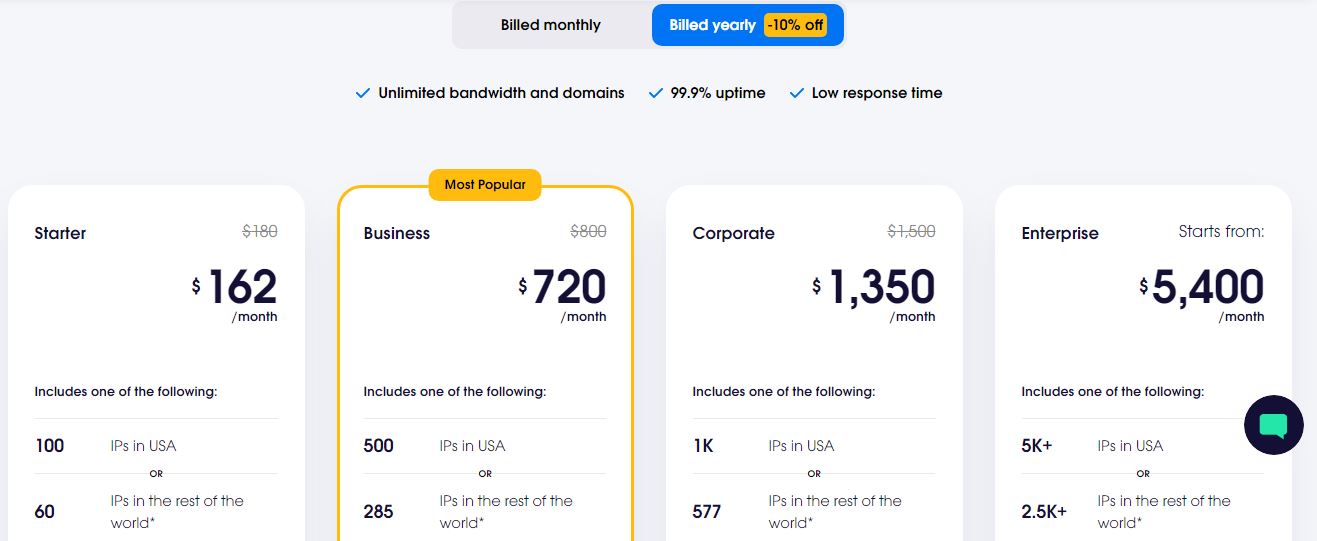
The table below compares all ten providers on the metrics that matter most for datacenter proxy selection. Prices reflect the entry-level datacenter plans. All data sourced from provider knowledge files and official pricing pages (May 2026).
| Provider | IP Pool | Countries | Entry Price | Bandwidth | Protocol | Trial |
|---|---|---|---|---|---|---|
| Bright Data | 1.3M+ IPs | 98 | $0.60/GB PAYG; $1.40/IP/mo shared | Per-GB or per-IP | HTTP, HTTPS, SOCKS5 | 7-day (companies) |
| Smartproxy | 40K US IPs | US focus | ~$8.5/GB; $75/mo (5 IPs, unlimited BW) | Unlimited per IP | HTTP, HTTPS | 7-day free |
| Nimble | Not disclosed | 12 | $8/GB; $300/mo entry | Per-GB | HTTP, HTTPS, SOCKS5 | Contact sales |
| ProxySeller | Not disclosed | 40+ | ~$7/GB; ~$1.35/IP IPv4 | Per-GB or per-IP | HTTP, HTTPS, SOCKS5 | 7-day paid trial |
| Limeproxies | Not disclosed | 50+ | $50/mo entry | Unlimited per IP | HTTP, HTTPS, SOCKS5 | 3-day money-back |
| IPRoyal | Large pool, 60+ locations | 60+ | $1.39/IP (90-day); $1.75/GB residential | Unlimited per IP | HTTP, HTTPS, SOCKS5 | 24-hour refund |
| Oxylabs | 2M+ dedicated IPs | 188 | $12/mo (10 shared IPs); $6.75/mo (3 dedicated) | Per-IP or per-GB | HTTP, HTTPS, SOCKS5 | 7-day (companies); 5 free IPs |
| Rayobyte | 300K+ IPs, 20K subnets | US primary | Custom; 50 MB trial available | 25 PB/mo capacity | HTTP, HTTPS, SOCKS5 | 50 MB trial |
| Ghostealth | 50K IPs | Limited | $20/mo entry | Unlimited per IP | HTTP, HTTPS | 60-min free trial |
| MyPrivateProxy | 220 dedicated servers, 24 DCs | US & select | ~$2.49/IP/mo | Unlimited per IP | HTTP, HTTPS, SOCKS5 | 3-day money-back |
Pricing note: Datacenter proxy pricing drops significantly at volume. A provider charging $2.20/IP at 10 IPs may drop to $1.30/IP at 1,000 IPs (Bright Data’s scale). Always check the volume tier that matches your actual usage — the entry price is rarely what you’ll actually pay. Promo codes listed (RESIGB50, PROXYWAY30, proxyway35) are subject to expiry — verify before purchasing.
Datacenter Proxies: Pros & Cons
Datacenter proxies solve specific problems extremely well — and fail on others. Here’s what to expect before committing to a datacenter proxy plan.
Pros ✓
- Speed: Sub-300ms response times from top providers (Bright Data at 0.26 s, Oxylabs at comparable benchmarks) — 10–50x faster than residential proxies on average
- Cost: $0.60–2.00/GB on bandwidth-based plans, versus $5–10/GB for residential — dramatic cost advantage for high-volume work
- Unlimited bandwidth options: Per-IP plans from IPRoyal, Limeproxies, Smartproxy, and Ghostealth eliminate per-GB billing risk entirely
- Scale: Bright Data and Oxylabs offer 1–2 million datacenter IPs — unlimited headroom for the largest scraping operations
- Protocol flexibility: Most providers support HTTP, HTTPS, and SOCKS5 — covering web scraping, raw TCP, and non-HTTP use cases
- Predictable pricing: Per-IP billing models make budgeting exact — no surprise GB overage charges
Cons ✗
- Detectability: Data center IP ranges are publicly listed by cloud providers — most sophisticated anti-bot systems block them by default
- Shared reputation risk: Shared datacenter pools carry the history of all previous users — if prior users abused the IPs, you inherit the blocks
- Subnet block risk: Providers with low subnet diversity can lose their entire pool to a single subnet block on a major target
- Not for social platforms: Instagram, Facebook, Twitter/X, and LinkedIn block datacenter ranges aggressively and immediately
- Fails on premium targets: Amazon, Google, and Cloudflare-protected sites block most datacenter IPs — you need residential or ISP proxies for these
Bottom Line: Datacenter proxies are the right tool when speed and cost matter more than bypass capability. Use them for targets that don’t actively block data center IPs — ad verification, price comparison on mid-tier e-commerce, SEO rank tracking on most search engines, and any internal or partner API that allows automated access. Switch to residential or ISP proxies for Google, Amazon, and social platforms.
Datacenter vs Residential Proxies: Which Should You Choose?
The most common decision buyers face is whether to use datacenter or residential proxies. The answer depends on your target, volume, and budget — not on which type sounds more premium. Here’s how they compare across the metrics that matter.
| Factor | Datacenter Proxies | Residential Proxies |
|---|---|---|
| Speed | Sub-300ms (Bright Data: 0.26 s avg) | 1–2 s average (Decodo: 0.65 s, fastest) |
| Cost | $0.60–2.00/GB or $1–3/IP/mo | $3–8/GB (entry); $1.75–4/GB at volume |
| Detectability | High — DC IP ranges publicly known | Low — looks like real home user traffic |
| Block Rate on Google | Near 100% blocked outright | 91–99% success rate (Oxylabs, Bright Data) |
| Block Rate on Amazon | ~5–15% success (mostly blocked) | 93–97% success rate on residential |
| Best For | Ad verification, price monitoring (mid-tier), SEO, dev/QA testing | Social media, major e-commerce, SERP scraping, account management |
| Pool Size | 50K–2M+ (per provider) | 32M–400M+ (per provider) |
Winner for Speed & Cost: Datacenter proxies | Winner for Success on Hard Targets: Residential proxies | Winner for Account Management: ISP/Static Residential
| Factor | Bright Data Datacenter | Oxylabs Datacenter |
|---|---|---|
| DC Pool Size | 1.3M+ IPs | 2M+ dedicated IPs |
| Countries | ~98 | 188 |
| Entry Price (shared) | $1.40/IP (10 IPs, $14/mo) | $1.20/IP (10 IPs, $12/mo) |
| PAYG Available | Yes — $0.60/GB | No — subscription required |
| Uptime SLA | 99.99% advertised | 99.9% SLA |
| Free Trial | 7-day (companies) | 7-day (companies); 5 free IPs |
| Proxyway Rating | 9.3/10 | 9.3/10 |
Winner for PAYG Flexibility: Bright Data | Winner for Geo-Coverage: Oxylabs | Winner for Entry Price: Oxylabs (shared tier)
🏆 Choose Datacenter Proxies When
- Speed is your primary constraint — you need sub-300ms responses
- Budget is limited — you need to scrape at $0.60–2/GB, not $5–8/GB
- Your target doesn’t use sophisticated bot detection
- You’re doing ad verification, SEO monitoring, or price comparison at scale
- You need unlimited bandwidth with predictable per-IP pricing
🔍 Choose Residential Proxies When
- Your target actively blocks datacenter IP ranges (Google, Amazon, social media)
- You’re managing social or marketplace accounts
- You need high success rates on fingerprint-heavy targets
- Your use case requires appearing as a real home user
- You need city-level geo-targeting with genuine residential IPs
Datacenter Proxy Provider Ratings Breakdown
We rated each provider on six criteria relevant to datacenter proxy use cases. Scores reflect pricing competitiveness, pool depth, subnet diversity, protocol support, trial generosity, and overall platform quality.
| Provider | Pool & Subnets | Speed | Price | Protocol Support | Trial / Refund | Overall |
|---|---|---|---|---|---|---|
| Bright Data | 4.8/5 | 4.9/5 | 3.5/5 | 5.0/5 | 4.5/5 | 4.7/5 |
| Oxylabs | 4.9/5 | 4.9/5 | 3.8/5 | 4.8/5 | 4.7/5 | 4.6/5 |
| Rayobyte | 4.7/5 | 4.5/5 | 4.2/5 | 4.5/5 | 4.0/5 | 4.4/5 |
| Smartproxy | 3.8/5 | 4.5/5 | 4.0/5 | 3.5/5 | 4.8/5 | 4.1/5 |
| IPRoyal | 3.7/5 | 4.2/5 | 4.8/5 | 4.5/5 | 3.5/5 | 4.1/5 |
| ProxySeller | 3.5/5 | 4.3/5 | 4.5/5 | 4.8/5 | 4.0/5 | 4.2/5 |
| Limeproxies | 3.5/5 | 4.3/5 | 4.2/5 | 4.5/5 | 3.2/5 | 3.9/5 |
| Nimble | 3.3/5 | 4.4/5 | 3.3/5 | 4.5/5 | 3.0/5 | 3.7/5 |
| Ghostealth | 3.0/5 | 3.8/5 | 4.5/5 | 3.5/5 | 4.2/5 | 3.8/5 |
| MyPrivateProxy | 3.2/5 | 4.0/5 | 4.3/5 | 4.5/5 | 3.5/5 | 3.9/5 |
| Overall Best | Bright Data (enterprise) · IPRoyal (budget) · Rayobyte (subnet diversity) | 4.7/5 | ||||
Rating Summary: Bright Data and Oxylabs tie at the enterprise tier — both at 9.3/10 on Proxyway for their full proxy products, with datacenter proxies as a strong secondary offering. Rayobyte wins specifically on subnet diversity, which is the critical metric for high-volume scraping resilience. IPRoyal and ProxySeller lead on budget datacenter use cases with SOCKS5 support. Smartproxy is the cleanest mid-market option if you don’t need SOCKS5.
Datacenter Proxy FAQs
What is a datacenter proxy?
A datacenter proxy is a proxy server with an IP address assigned to a commercial data center — a cloud hosting facility, a dedicated server farm, or a colocation provider. Unlike residential proxies (which use IPs assigned by ISPs to home users), datacenter IPs are easily identified by most websites as coming from commercial infrastructure. They’re faster and cheaper than residential proxies but more easily blocked on sophisticated targets.
What’s the difference between shared and dedicated datacenter proxies?
Shared datacenter proxies are used by multiple customers simultaneously — you share the IP pool with other buyers. This lowers cost but means you inherit the reputation of whoever else uses those IPs. Dedicated datacenter proxies are assigned exclusively to you — no other customer uses the same IP. Dedicated proxies have clean reputation history and lower block rates, but cost more (typically 1.5–2x the price of shared).
Can datacenter proxies access Google and Amazon?
Generally, no. Google and Amazon aggressively block datacenter IP ranges — Proxyway testing showed Bright Data’s datacenter proxies achieving only 5.83% success on Amazon and near-zero on Google. For these targets, you need residential proxies (Oxylabs: 95.76% on Amazon, 91.76% on Google) or a managed SERP API that handles the unblocking automatically. Datacenter proxies work well on targets without sophisticated bot detection — mid-tier e-commerce, ad platforms, most news sites, and many internal APIs.
What is subnet diversity and why does it matter?
A subnet (or /24 CIDR block) is a group of 256 IP addresses that share the first three octets (e.g., 192.168.1.0–255). When a website blocks a subnet, all 256 IPs in that block are blocked at once. A provider with 300,000 IPs across 300 subnets can lose 1,000 IPs per subnet block. A provider with 300,000 IPs across 20,000 subnets (Rayobyte) loses only 15 IPs per block. Subnet diversity is the single most important metric for scraping resilience on targets that actively block datacenter ranges.
Do datacenter proxies support SOCKS5?
Most, but not all, datacenter proxy providers support SOCKS5. Providers in this list that confirm SOCKS5 on datacenter proxies include Bright Data, Oxylabs, IPRoyal, ProxySeller, Limeproxies, MyPrivateProxy, Nimble, and Rayobyte. Smartproxy’s dedicated datacenter product is HTTP/HTTPS only — a notable exception. Always confirm SOCKS5 support with your specific provider before purchasing if your use case requires it.
How much do datacenter proxies cost?
Pricing varies significantly by model:
- Per-GB bandwidth: $0.60–8/GB depending on provider and volume. Bright Data starts at $0.60/GB (PAYG).
- Per-IP shared: $0.90–2.20/IP per month (1,000-IP enterprise to 10-IP starter). Oxylabs entry at $1.20/IP/mo.
- Per-IP dedicated: $1.30–3.50/IP per month. Bright Data’s dedicated starts at $2.20/IP at 10 IPs.
- Per-IP with duration: IPRoyal charges by duration (24h, 30, 60, 90 days) starting at $1.39/IP.
Are IPv6 datacenter proxies better than IPv4?
Not universally — it depends on your target. Most of the internet still runs on IPv4, and many scraping targets only accept IPv4 connections. IPv6 is useful in specific cases: some services charge differently for IPv4 vs IPv6 traffic, some APIs are IPv6-only, and IPv6 ranges are enormous (impossible to block exhaustively). ProxySeller offers both IPv4 and IPv6 datacenter proxies. For most standard web scraping, IPv4 is sufficient and more widely compatible.
What are the best datacenter proxies for web scraping?
For enterprise-scale scraping with maximum pool depth: Bright Data or Oxylabs. For the best subnet diversity on high-volume scraping workloads: Rayobyte (300K IPs across 20K subnets). For budget scraping with SOCKS5: IPRoyal or ProxySeller. For AI-powered routing that automatically switches from datacenter to residential when needed: Nimble. Always test your specific targets before committing — a provider that works on one target may be blocked on another.
How do I test datacenter proxy quality before buying?
Use a trial or money-back period to test against your actual targets — not just a generic IP check tool. Specifically check: (1) success rate on your target URL, (2) response time, (3) CAPTCHA frequency, (4) how quickly IPs get blocked after repeated requests. Bright Data and Oxylabs offer 7-day trials for companies. Rayobyte offers a 50 MB trial. Ghostealth gives 60 minutes free. IPRoyal has a 24-hour refund window. Use the trial budget on real workloads, not demos.
Can I use datacenter proxies for social media?
No — not reliably. Instagram, Facebook, Twitter/X, LinkedIn, and TikTok all aggressively block known datacenter IP ranges. These platforms maintain lists of cloud hosting IP ranges and flag or ban accounts that connect from them. For social media automation, account management, or ad verification on social platforms, you need residential or ISP (static residential) proxies. ISP proxies are particularly good for account management because they look residential but are stable (non-rotating).
What is the difference between rotating and static datacenter proxies?
Static (dedicated) datacenter proxies give you the same IP every session — useful for maintaining a consistent identity or IP-whitelisted access. Rotating datacenter proxies assign a new IP from the pool with each request (or on a timer) — useful for scraping workloads where you want to distribute requests across many IPs to avoid rate limiting. Oxylabs offers a “Rotating Datacenter” product specifically for this use case. Most per-IP plans are static; per-GB bandwidth plans are typically rotating.
Is Bright Data the best datacenter proxy provider?
Bright Data is the best for enterprise use cases that need the largest pool, the most flexible billing model (PAYG, shared, dedicated, bandwidth), and integration with advanced tools like Web Unlocker and Scraping Browser. But it’s also the most expensive entry point. For pure datacenter proxy value, IPRoyal (unlimited bandwidth, SOCKS5, $1.39/IP), Rayobyte (subnet diversity), and ProxySeller (SOCKS5 + 40 countries + IPv6) are strong alternatives depending on your use case and budget.
Final Verdict
Datacenter proxies are the fastest, cheapest way to run large-scale automated requests — as long as you pick the right provider for your target and your volume. The ten providers in this list range from enterprise-grade infrastructure (Bright Data, Oxylabs) to budget-first options (IPRoyal, Ghostealth) to specialists in subnet diversity (Rayobyte) and AI routing (Nimble). None of them is universally best — the right pick depends on whether you optimize for pool depth, cost, subnet diversity, or protocol flexibility.
✓ Top Picks by Use Case
- Bright Data — Best overall: 1.3M+ DC IPs, three billing modes, PAYG from $0.60/GB, 7-day trial
- Oxylabs — Best for enterprise speed: 2M+ dedicated IPs, 99.9% uptime SLA, 188 countries
- Rayobyte — Best subnet diversity: 300K+ IPs across 20K unique C-class subnets, 25 PB/mo
- IPRoyal — Best budget PAYG: $1.39/IP, unlimited bandwidth, SOCKS5, auto-replacement
- Smartproxy — Best mid-market: 40K US IPs, unlimited bandwidth, 7-day free trial
- ProxySeller — Best for IPv4 + IPv6 with SOCKS5: 40+ countries, 7-day trial
- Nimble — Best for AI routing: auto-selects between DC/residential/ISP per target
- MyPrivateProxy — Best private dedicated: clean IP history, 10+ year track record
✗ When to Skip Datacenter Proxies Entirely
- Your targets include Google, Amazon, or major social platforms — you’ll get blocked
- You’re managing social media accounts — datacenter IPs trigger immediate bans
- You need city-level residential geo-targeting for accurate local data
- Your scraping target runs Cloudflare or Akamai bot management — residential is required
- You need to pass browser fingerprinting checks — use ISP proxies + Scraping Browser instead
Ready to Scale Your Web Scraping with Datacenter Proxies?
Start with Bright Data’s 7-day free trial — test datacenter proxy performance on your actual targets before committing to a plan. Use code RESIGB50 for 50% off your first three months.
Try Bright Data Free — Best Datacenter Proxy Network →