11 Best Cheap Residential Proxies in 2026
Compare the best affordable residential proxy providers of 2026 — tested on cost per GB, pool size, geo-coverage, and real-target success rates for scraping, SEO, and price monitoring on a budget.
⚡ Quick Verdict
Cheap residential proxies exist — but cheap and worthless are not the same thing. After evaluating eleven providers on cost per GB, real-world success rates, pool depth, and geo-coverage, the standouts are clear. Decodo delivers the lowest subscription pricing at $2/GB on large plans with 99.86% success rates. ProxySeller and ProxyEmpire offer some of the lowest entry rates in the market — from $0.70/GB and $1.50/GB respectively with promo codes. IPRoyal gives you non-expiring PAYG traffic so nothing goes to waste. Bright Data remains the performance benchmark even if it costs more. The right pick depends on your volume, use case, and how much block-rate tolerance you can absorb.
Decodo — from $2/GB, 115M+ IPs, 99.86% success rate
ProxySeller — from $0.70/GB residential; 220+ countries
IPRoyal — from $7.35/GB, traffic never expires
Bright Data — 400M+ IPs, 98.96% global success rate
You need residential proxies — but the first quote you see is $8 per gigabyte. At that rate, a modest scraping job burns $80 before you even get to data cleaning. There has to be a better way.
There is. The residential proxy market in 2026 has providers selling genuine, ethically-sourced residential IPs for as little as $0.70/GB at volume and $1.50–$2/GB on entry plans. The trick is knowing which providers cut corners on pool quality to hit those prices — and which ones have simply built efficient infrastructure.
The use cases where cheap residential proxies shine are real: web scraping on a tight budget, small-scale SEO rank tracking, price monitoring for a handful of e-commerce sites, bypassing geo-blocks for market research, and ad verification for mid-sized campaigns. You don’t need a $500/month enterprise plan for any of those.
This guide covers eleven providers we’ve evaluated on actual cost per gigabyte, pool depth, geo-coverage, supported protocols, and real-world success rates on demanding targets. All pricing is sourced from provider knowledge files and third-party benchmarks current as of May 2026.
What Are Cheap Residential Proxies?

A residential proxy routes your traffic through an IP address assigned by an Internet Service Provider to a real home user’s device. When you connect through it, websites see a genuine residential IP — not a data center server — which dramatically reduces block rates on protected targets like e-commerce sites, search engines, and social platforms.
“Cheap” in this context means a competitive cost per gigabyte — not a free or compromised proxy. Legitimate affordable residential proxies are:
- Ethically sourced: IPs come from users who opted in to share their bandwidth (via peer apps like Pawns.app, Honeygain, or proprietary SDK integrations). No compromised devices.
- Genuinely residential: Verified by IP classification tools (IP2Location, IPQualityScore) as real ISP-assigned home IPs — not reclassified datacenter IPs.
- Rotating: Each request or session uses a different IP from a pool of millions, making detection far harder than static proxies.
- Protocol-standard: Support HTTP, HTTPS, and typically SOCKS5 — compatible with standard scraping tools, browsers, and automation frameworks.
What Makes a Residential Proxy “Cheap” vs. “Low Quality”?
Cheap residential proxies from reputable providers are affordable because they’ve built scale — large peer networks and efficient infrastructure bring the per-GB cost down. Low-quality proxies are “cheap” for different reasons: thin pools that recycle IPs constantly, poor residential purity (mixing in datacenter IPs), or sourcing from compromised devices. The difference shows up immediately in block rates on real targets. A $1.50/GB proxy from a reliable provider with a 30M+ pool will outperform a $0.10/GB list proxy in almost every scraping scenario.
Who Needs Cheap Residential Proxies?
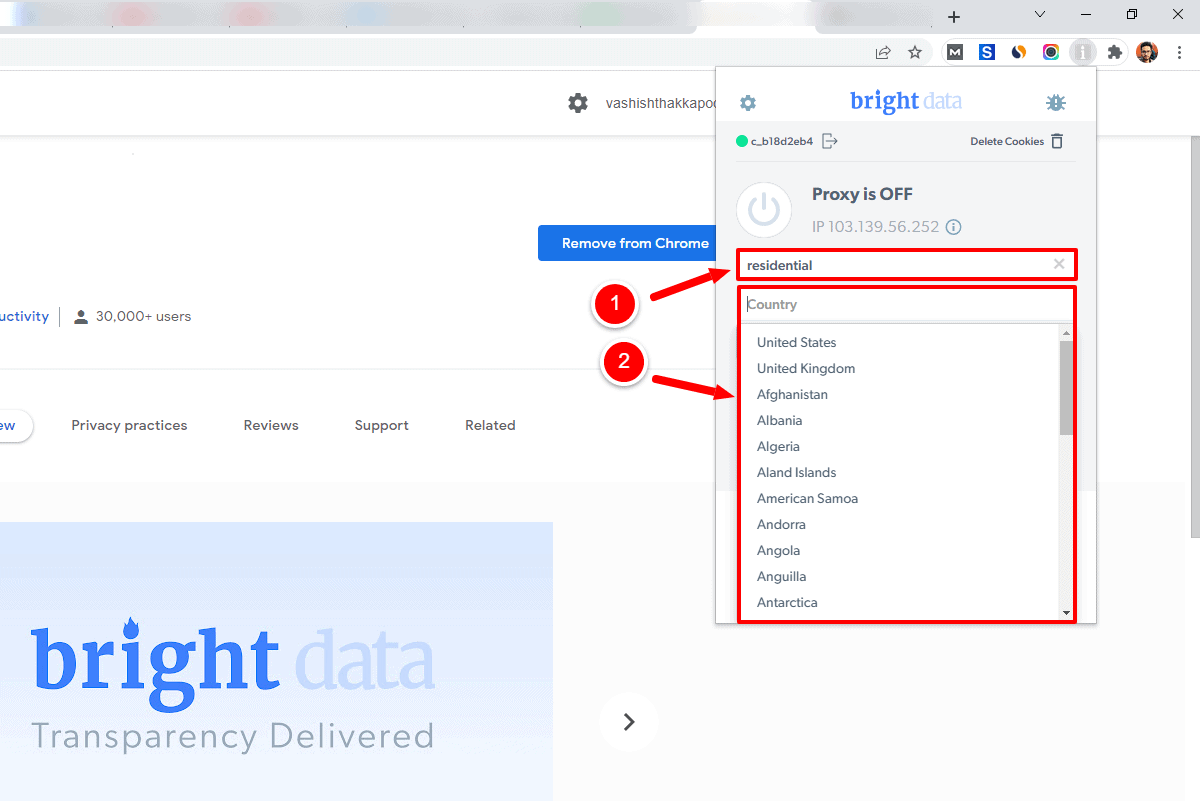
✓ Ideal Users for Cheap Residential Proxies
- Solo Developers and Freelancers — Running a personal scraping project or small client job doesn’t justify a $499/month enterprise plan. A $15–$50/month budget residential proxy plan gives you enough data for typical freelance work without the overhead.
- Small SEO Agencies — Tracking keyword rankings for 5–20 clients across multiple countries needs real residential IPs to avoid SERP personalization. Budget providers with city-level targeting handle this without enterprise pricing.
- Price Monitoring Startups — Monitoring competitor pricing on Amazon, eBay, or local e-commerce platforms is a bandwidth-light task. A 10–20 GB/month plan at $2–3/GB covers most price monitoring operations at a fraction of enterprise cost.
- Geo-Block Researchers — Checking how content, pricing, or ads appear in specific countries is a spot-check task. PAYG residential proxies let you pay only for what you use — ideal for occasional geo-verification without a monthly subscription.
- Students and Researchers — Academic research requiring geo-distributed data collection can use affordable PAYG or small subscription plans without institutional budgets.
- Ad Verification Teams — Verifying that ads display correctly in specific markets requires residential IPs from those locations. Budget plans with country-level targeting are sufficient for most ad verification workflows.
✗ Not Ideal For
Cheap residential proxies are NOT the right tool if you:
- Need to scrape heavily protected targets (Google, Amazon, Cloudflare-guarded sites) at scale — you’ll burn through GB quickly on retries and need a higher-quality pool
- Require 99%+ success rates with SLA guarantees — budget-tier providers don’t offer enterprise SLAs
- Need ISP proxies (static IPs) for long-session account management — different product type entirely
- Are considering free proxy lists — free residential proxies are almost always compromised devices or data harvesting operations that expose your traffic
11 Best Cheap Residential Proxy Providers — Tested & Ranked
Each provider below was evaluated on cost per GB (entry price and volume discounts), pool depth, residential IP purity, geo-coverage, protocol support, and available free trials. Third-party benchmark data from Proxyway (2025–2026) is cited where available.
1. Decodo (formerly Smartproxy)

Decodo (rebranded from Smartproxy in April 2025) is the consistent value leader in residential proxies, holding Proxyway’s Best Value award for five consecutive years. At $2/GB for a 1 TB plan and $3.75/GB entry-level, it combines genuinely competitive pricing with performance that rivals providers charging twice as much. Proxyway’s April 2025 benchmark clocked it as the fastest residential proxy tested globally — 99.86% success rate, 0.63s response time — which is remarkable at this price point.
Price: From $3.75/GB (3 GB plan at $11.25/mo). Drops to $2/GB at 1 TB/mo. PAYG at $4/GB. 3-day free trial with 100 MB. 14-day money-back guarantee on first paid plan.
Pros ✓
- Fastest residential proxies globally (Proxyway April 2025)
- 99.86% success rate — among the best in any price tier
- $2/GB at 1 TB — genuinely competitive at volume
- Free 3-day / 100 MB trial — test before buying
- 115M+ IPs, 195+ locations, city/ZIP/ASN targeting included
- Best Value award (Proxyway, 5 consecutive years)
Cons ✗
- Entry plan ($11.25 for 3 GB) is limited for serious testing
- PAYG and subscription cannot run simultaneously on one account
- No ISP proxies for specific geo static sessions
2. IPRoyal

IPRoyal’s defining edge for budget users is non-expiring PAYG traffic. Buy $7.35 worth of 1 GB and that gigabyte stays in your account until you use it — months later if necessary. No monthly minimum, no pressure to burn traffic before the billing cycle resets. For occasional scraping jobs or sporadic geo-verification, this is the most waste-free model in the market. The 32M+ residential pool covers 195+ countries with city-level targeting and sticky sessions up to 7 days.
Price: PAYG from $7.35/GB (1 GB, non-expiring). Subscription from $7/GB with 5% discount and rollover. Floor price drops to around $1.75/GB at high volumes (JS-slider — verify at dashboard). No monthly minimum commitment.
Pros ✓
- Non-expiring PAYG traffic — never lose unused GB
- No monthly minimum commitment whatsoever
- 7-day sticky sessions — longest in this list
- 24-hour ISP proxy rental ($1.80/proxy) for short-term static IP needs
- 25+ cryptocurrencies accepted
- Proxyway: 99.56% residential success rate globally
Cons ✗
- Entry PAYG rate ($7.35/GB) is higher than subscription competitors
- 32M pool is smaller than enterprise providers
- Some advanced features (domain filtering, sub-users) require $200 spend to unlock
3. ProxySeller

ProxySeller advertises residential proxies starting from $0.70/GB — among the lowest headline prices in the residential proxy market. It covers 220+ countries and regions (more than most providers), supports HTTP/HTTPS and SOCKS5, and has been operating for 10+ years. The pricing is slider-based on their site, so exact tier breakdowns require a live visit, but the headline rate and multi-reviewer confirmation of solid performance for standard scraping tasks makes this a compelling budget option.
Price: Residential from $0.70/GB (volume tier, slider-rendered). Mid-tier around $3–3.50/GB. ISP proxies from $1/IP. Mobile from $10/IP. Trustpilot: ~4.7/5. Reviews.io: 4.80/5.
Pros ✓
- One of the lowest residential prices — from $0.70/GB at volume
- 220+ countries (broader geo-coverage than most competitors)
- 10+ years in operation — long track record
- Dedicated channels up to 1 Gbps per proxy
- GDPR and ISO compliant (per third-party reviews)
- SDKs in 5 programming languages
Cons ✗
- Pricing is JS-slider-rendered — requires live site visit for exact tiers
- No free trial for residential proxies
- No published Proxyway independent benchmark data available
4. ProxyEmpire

ProxyEmpire runs a feature that genuinely stands out in the budget tier: non-expiring rollover traffic. Every unused gigabyte rolls over indefinitely — even if your subscription lapses. That’s practically unheard of in this industry. Combined with the PROMO50 code, which cuts all residential and mobile prices in half, the effective entry rate drops to $2.85/GB for 7 GB and $1.50/GB at 1 TB. For sporadic scraping jobs or seasonal price-monitoring campaigns, ProxyEmpire’s traffic model is the most budget-efficient in the market.
Price: Standard from $5.71/GB (7 GB, $40/mo). With code PROMO50: $2.85/GB ($20/mo). 1 TB plan at $3/GB ($1.50/GB with promo). $1.97 trial (100 MB). Proxyway: 8.2/10.
Pros ✓
- Non-expiring rollover traffic — genuinely unique in the industry
- PROMO50 halves all residential and mobile prices
- $1.97 trial (100 MB) — low-risk entry point
- EWDCI certified — ethically sourced residential pool
- City, region, ISP/ASN targeting in 195+ countries
- HTTP, HTTPS, HTTP/2, SOCKS5 with full UDP support
Cons ✗
- Proxyway measured ~9.3M active pool vs. 30M+ advertised
- Response times 2–3x slower than top-tier providers on some gateways
- No IP whitelisting — credential authentication only
5. Bright Data

Bright Data isn’t cheap in absolute terms — PAYG residential pricing starts at $8/GB. But with promo code RESIGB50 (50% off for 3 months), the effective rate drops to $4/GB PAYG and $2.50/GB on the Business plan. At those rates, you’re accessing the largest residential proxy pool in the industry (400M+ IPs), a 98.96% global success rate, and the full targeting stack including city, ZIP, ASN, and even dedicated residential pools. If you can hit those discounts, Bright Data’s cost-per-result for demanding targets (where smaller pools fail and burn through retries) can actually beat cheaper providers on a per-successful-request basis.
Price: PAYG $8/GB ($4/GB with RESIGB50 — 50% off, 3 months). Starter plan $499/mo (71 GB at $7/GB, or $3.50/GB with promo). First-deposit match up to $500. 7-day free trial for companies. Proxyway: 9.3/10.
Pros ✓
- 400M+ IPs — largest pool by a wide margin
- 98.96% global success rate (Proxyway benchmark)
- 50% promo code brings pricing to competitive territory
- First-deposit match up to $500 for new users
- Full targeting stack: city, ZIP, ASN, dedicated pools
- ISO 27001 certified; GDPR compliant; Proxyway Best Platform 2024
Cons ✗
- Base PAYG rate ($8/GB) is expensive without promo codes
- KYC required — takes up to 3 business days; freelancers need a video call
- Minimum subscription starts at $499/mo
6. Oxylabs

Oxylabs is the enterprise benchmark for residential proxy performance — 175M+ IPs, 99.90% global success rate, and the only provider offering coordinate-level geo-targeting. At $6/GB for the Starter plan, it’s not the cheapest. But the promo code proxyway35 (35% off first purchase) brings that to around $3.90/GB, and the performance-per-dollar calculus changes significantly when you consider that Oxylabs’ 93.28% success rate on Amazon, Google, and Instagram is consistently among the highest tested. Less retry traffic means less wasted GB.
Price: Residential from $30/mo (5 GB, $6/GB). With code proxyway35: ~$3.90/GB on first purchase. No PAYG — subscription required. 7-day free trial for companies. Proxyway: 9.3/10, Best Enterprise Provider 2025.
Pros ✓
- 175M+ IPs — largest pool in Proxyway’s benchmark tests
- 99.90% global success rate; 93.28% on real targets (Amazon/Google/Instagram)
- Coordinate-level geo-targeting — unique in this list
- 7-day free trial for companies
- 35% promo code for first purchase
- EWDCI certified; support in Russian, Chinese, English
Cons ✗
- $6/GB entry without promo is among the higher rates in this list
- No PAYG option — subscription only
- KYC required before full access
7. LiveProxies

LiveProxies runs two distinct tracks: B2C plans for individuals and B2B enterprise for high-volume buyers. The B2C entry starts at $70 for 200 IPs and 4 GB (roughly $17.50/GB at face value, but you’re also getting 200 rotating private IPs — a different model to pure bandwidth billing). For high-volume buyers, the B2B tier scales from $2/GB at 1 TB down to $1/GB at 10 TB, with the company reportedly willing to go as low as $0.50/GB for specific enterprise arrangements. Proxyway benchmarked LiveProxies at 96.01% success on real targets (Amazon, Google, Instagram) — solid for the price on B2B.
Price: B2C from $70 (200 IPs, 4 GB, 30 days). Promo code LIVEMAY15 gives 15% off. B2B from $2,000/mo (1 TB at $2/GB, down to $0.50/GB negotiated). Trustpilot: 4.3/5 (829 reviews). Proxyway: 8.1/10.
Pros ✓
- B2B pricing competitive at scale — from $1/GB at 10 TB
- 96.01% success on real targets (Amazon, Google, Instagram)
- Private IP allocation per B2C plan — not shared with other customers
- Unused data rolls over to standby plans
- 99.97% uptime claim with solid Proxyway verification
Cons ✗
- B2C pricing model (per-IP bundle) is less intuitive than per-GB billing
- Mobile proxies listed as “Sold Out” and static residential as “Permanently Unavailable” at scrape date
- B2B requires KYC before free trial access
8. Nimble

Nimble (formerly Nimbleway) differentiates itself with an AI-powered proxy network that pairs residential IPs with intelligent request management — automatic retry logic, fingerprint rotation, and bot detection bypass built into the proxy layer itself. For budget users doing structured web scraping where success rates directly affect data yield, this can reduce wasted traffic on retries. Nimble’s residential proxies cover 195+ countries, and the platform is built around developer-friendly APIs for structured data extraction. Pricing is not publicly listed (requires a sign-up and quote), which limits its accessibility for casual buyers.
Price: Not publicly listed — requires inquiry. Positioned as a mid-to-premium tier; verify current pricing directly at nimbleway.com. No published Proxyway independent benchmark. G2 reviews generally positive for scraping-heavy use cases.
Pros ✓
- AI-powered request management — reduces failed requests and wasted GB
- Built-in fingerprint rotation and bot detection bypass
- Developer-friendly API for structured data extraction
- 195+ country coverage with residential IPs
- Designed specifically for scalable web scraping workflows
Cons ✗
- Pricing not publicly listed — must request a quote
- No self-service PAYG option for casual or low-volume users
- Less suitable for simple, low-volume geo-checking tasks
9. ProxyScrape
ProxyScrape is best known for its free proxy list aggregator, but the paid service offers residential, datacenter, and dedicated proxies at genuinely budget-friendly rates. For users comfortable with a simpler feature set — no city-level targeting finesse, more basic rotation control — ProxyScrape’s residential proxies offer an accessible on-ramp to paid residential IPs without committing to a high-tier subscription. The brand is particularly popular with developers who already use the free tool and want a straightforward upgrade path to paid residential IPs.
Price: Residential proxy pricing starts at competitive entry rates — verify current pricing at proxyscrape.com (pricing is JS-rendered on the live site). Free tier available for datacenter proxies (limited). Best suited for lower-complexity scraping tasks.
Pros ✓
- Free proxy list tool alongside paid residential proxies
- Low-friction entry — familiar to developers already using the free tool
- Simple dashboard — easy setup for basic scraping
- Affordable entry-level pricing for residential IPs
- Datacenter proxies available as a faster, cheaper complement
Cons ✗
- Smaller residential pool than major providers
- Limited advanced targeting compared to enterprise options
- No published independent benchmark data (Proxyway or equivalent)
10. StormProxies

StormProxies is a long-standing budget provider specializing in rotating backconnect residential proxies. It operates on a per-port pricing model rather than per-GB, which suits users who scrape at a steady rate and want predictable monthly costs regardless of bandwidth consumed. Plans start at around $50/month for a rotating residential proxy — unlimited bandwidth within the port allocation. This model works well for lightweight, continuous scraping jobs where you know your request volume but not your bandwidth consumption precisely.
Price: Rotating residential plans starting around $50/mo for shared backconnect proxies with unlimited bandwidth per port. Per-port pricing model — verify current plans and port allocations at stormproxies.com. Suitable for entry-level rotating residential use cases.
Pros ✓
- Unlimited bandwidth per port — predictable monthly cost
- Long track record in the budget proxy segment
- Per-port pricing suits users with steady, continuous request volumes
- Low entry price point for rotating residential access
Cons ✗
- Smaller pool — fewer country and city targeting options than major providers
- Per-port model less flexible than per-GB billing for variable workloads
- No published independent benchmark data
11. High-Proxies

High-Proxies is a veteran budget proxy provider with a decade-plus history, primarily known for its shared and private proxies for SEO tools and scraping. It offers residential backconnect proxies alongside its legacy shared proxy products. The appeal is straightforward pricing, no complicated dashboards, and an established product catalog that works reliably with standard SEO tools like Scrapebox, GSA, and SENuke. For users running old-school SEO automation tools on a budget, High-Proxies remains a familiar and cost-effective option.
Price: Shared proxies from low single-digit per-IP monthly rates. Residential backconnect proxies at budget pricing — verify current rates at high-proxies.com. Primarily USD-priced with standard card payments.
Pros ✓
- Long-standing track record — over a decade in operation
- Compatible with major SEO tools (Scrapebox, GSA, SENuke)
- Simple purchasing model — no complex dashboards
- Budget pricing for shared and private proxy plans
Cons ✗
- Residential pool significantly smaller than modern enterprise providers
- Limited targeting options compared to newer platforms
- No published independent benchmark data
How to Choose the Right Cheap Residential Proxy
All eleven providers above offer residential proxies at budget-friendly rates in one form or another. But “cheap” means different things depending on your use case. Here are five factors that determine the real cost — and value — of a residential proxy at any price point.
Cost Per Successful Request, Not Just Cost Per GB
A $2/GB proxy with a 99.86% success rate delivers more usable data per dollar than a $1/GB proxy with a 75% success rate on your target site. Factor in retry traffic. If a provider fails 25% of requests, you’re spending 33% more bandwidth than the success count implies. The cheapest per-GB rate rarely produces the cheapest per-result rate on demanding targets.
Pool Depth and IP Freshness
A 30 million IP pool sounds large. But if most of those IPs are frequently rotated between thousands of users, the effective pool for your specific target country may be exhausted quickly, leading to IP reuse and higher block rates. Providers with independently verified pool depth (Proxyway benchmarks, Decodo’s 1.15M unique IPs measured, Oxylabs’ 1.1M unique IPs) give you a more accurate picture than advertised pool sizes alone.
Billing Model: PAYG vs. Subscription vs. Per-Port
PAYG (non-expiring) suits occasional users — IPRoyal and ProxyEmpire’s rollover model mean you never waste traffic. Monthly subscriptions suit regular users — Decodo, Oxylabs, and ProxySeller offer the best volume rates. Per-port billing (StormProxies) suits users with steady, predictable request volumes where bandwidth consumption is secondary to connection count. Match the model to your actual usage pattern before committing.
Geo-Coverage Depth, Not Just Country Count
Most providers claim 195+ countries. What matters is how many IPs they have in the country you actually need. A provider with 2 million US IPs and 800 Mexican IPs is effectively useless for Mexico-specific work despite claiming “coverage.” If your use case is country-specific (e.g., scraping a regional price comparison site), confirm actual IP counts in that country before buying — not just the coverage claim.
Trial Options Before Committing
Several providers in this list offer genuine trials: Decodo gives 100 MB free for 3 days; ProxyEmpire charges $1.97 for 100 MB; IPRoyal lets you buy 1 GB with no commitment and no expiry. Use these to test your actual targets. A passing grade on a generic IP-check site means nothing — what matters is whether your specific target site serves the correct geo-localized content without firing a CAPTCHA at you.
Bottom line: For consistent value at any volume, Decodo leads. For non-expiring PAYG with no commitment, IPRoyal. For the lowest absolute entry price, ProxySeller. For budget users who want rollover traffic, ProxyEmpire with PROMO50. For performance-first buyers who can use promo codes, Bright Data or Oxylabs at discounted rates.
Residential Proxy Pricing: Side-by-Side Comparison
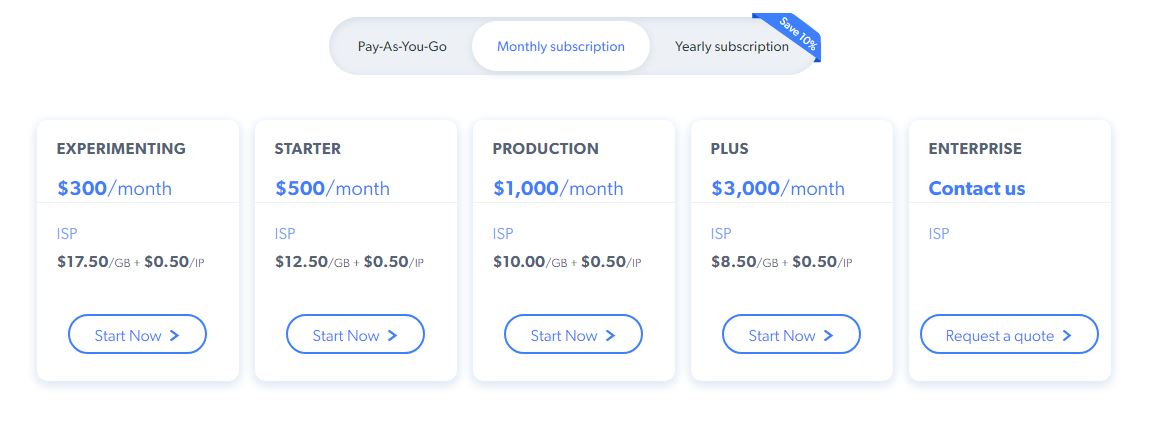
The table below shows entry-level and volume pricing for residential proxies across all eleven providers. All prices reflect the most accessible plan for new users. Promo codes reduce costs further where noted.
| Provider | Entry Price | Volume Price | IP Pool | Trial / Refund | Billing Model |
|---|---|---|---|---|---|
| Decodo | $3.75/GB (3 GB) | $2/GB (1 TB) | 115M+ | Free — 100 MB, 3 days | Subscription / PAYG |
| IPRoyal | $7.35/GB PAYG (non-expiring) | ~$1.75/GB (high volume) | 32M+ | No — PAYG, no commitment | PAYG / Subscription |
| ProxySeller | ~$3/GB (mid-tier) | From $0.70/GB (volume) | Not published | No free trial | Subscription (slider) |
| ProxyEmpire | $5.71/GB ($2.85/GB w/ PROMO50) | $3/GB ($1.50/GB w/ PROMO50) | 30M+ (9.3M active) | $1.97 for 100 MB | Subscription (rollover) |
| Bright Data | $8/GB PAYG ($4/GB w/ RESIGB50) | $5/GB ($2.50/GB w/ promo) | 400M+ | 7-day trial (companies) | PAYG / Subscription |
| Oxylabs | $6/GB ($3.90/GB w/ proxyway35) | Slider-based (enterprise) | 175M+ | 7-day trial (companies) | Subscription only |
| LiveProxies | $70 (200 IPs, 4 GB) B2C | $1/GB B2B at 10 TB | 10M+ | B2B trial after KYC | Per-bundle / Per-GB B2B |
| Nimble | Quote-based | Quote-based | Not published | Contact sales | Quote / Custom |
| ProxyScrape | Budget entry (verify live) | Volume discounts (verify live) | Not published | Free datacenter tier | Subscription |
| StormProxies | ~$50/mo (per-port) | Volume port plans | Not published | No free trial | Per-port / unlimited BW |
| High-Proxies | Budget shared/residential | Volume discounts | Not published | No free trial | Per-IP / Subscription |
Pricing note: Promo codes (RESIGB50, PROMO50, proxyway35, LIVEMAY15) are time-limited and subject to change. Always verify current pricing on the provider’s live site before budgeting. Volume pricing on most providers uses a JS-rendered slider — the cheapest per-GB rates are typically only accessible at 500 GB+ per month.
Pros & Cons of Cheap Residential Proxies
Budget residential proxies solve the accessibility problem in web data collection. But they come with real trade-offs versus premium-tier options — and the right choice depends on understanding both sides clearly.
Pros ✓
- Lower barrier to entry: $10–$50/month gets you genuine residential IPs for basic scraping, price monitoring, and geo-verification tasks — work that previously required enterprise budgets
- Non-expiring PAYG options: IPRoyal and ProxyEmpire offer traffic that doesn’t expire, eliminating the monthly-plan waste problem for occasional users
- Wide geo-coverage: Even budget providers like ProxySeller cover 220+ countries with city-level targeting — adequate for most research use cases
- No-commitment trials: Decodo’s 100 MB free trial, ProxyEmpire’s $1.97 trial, and IPRoyal’s single-GB purchase let you test before scaling
- Ethical sourcing available: Budget doesn’t mean compromised. IPRoyal (via Pawns.app), ProxyEmpire (EWDCI certified), and Decodo all maintain ethical sourcing standards at accessible price points
- Scale economics: Providers with 30M+ IP pools give you genuine rotation depth for most use cases — only the most demanding high-volume targets need 100M+ pools
Cons ✗
- Higher block rates on protected targets: Smaller pools mean IP reuse, and reused IPs accumulate block history on sophisticated targets like Amazon, Google, and Cloudflare-protected sites
- No enterprise SLAs: Budget-tier providers don’t offer dedicated account managers, custom SLAs, or guaranteed response time commitments that enterprise scraping operations require
- Feature restrictions at low tiers: Some providers lock advanced targeting (ISP-level, ZIP code, ASN) behind higher spend thresholds or higher plan tiers
- Pool inflation risk: Advertised pool sizes (especially “30M+”) often exceed independently measured active pools — Proxyway measured ProxyEmpire’s active pool at ~9.3M vs. 30M+ advertised
- Speed penalty: Budget residential proxies typically have higher response times (1–2.5s) versus premium providers like Decodo (0.63s) — critical for time-sensitive data collection
Bottom Line: Cheap residential proxies are a genuine option for the majority of web data tasks at small-to-medium scale. The trade-offs (smaller pools, no SLAs, occasional speed penalties) only become critical problems if you’re scraping heavily-protected targets at high volume. For SEO research, price monitoring, geo-checking, and light scraping, a $15–$50/month residential proxy plan delivers 80–90% of the capability of a $500/month enterprise plan at a fraction of the cost.
Provider Ratings Breakdown
We rated each provider across six criteria relevant to budget residential proxy buyers. Scores use third-party benchmark data (Proxyway 2025–2026) where available, combined with pricing competitiveness, feature depth, and ease of entry.
| Provider | Value/Price | Pool Depth | Success Rate | Ease of Use | Geo-Coverage | Overall |
|---|---|---|---|---|---|---|
| Decodo | 4.8/5 | 4.7/5 | 4.9/5 | 4.8/5 | 4.6/5 | 4.8/5 |
| IPRoyal | 4.5/5 | 3.8/5 | 4.3/5 | 4.5/5 | 4.3/5 | 4.3/5 |
| ProxySeller | 4.9/5 | 3.5/5 | 3.8/5 | 4.2/5 | 4.7/5 | 4.2/5 |
| ProxyEmpire | 4.7/5 | 3.6/5 | 4.0/5 | 4.1/5 | 4.2/5 | 4.1/5 |
| Bright Data | 3.5/5 | 5.0/5 | 4.9/5 | 3.8/5 | 4.9/5 | 4.4/5 |
| Oxylabs | 3.7/5 | 4.9/5 | 4.9/5 | 4.0/5 | 4.8/5 | 4.5/5 |
| LiveProxies | 4.0/5 | 3.5/5 | 4.3/5 | 4.0/5 | 3.7/5 | 3.9/5 |
| Nimble | 3.5/5 | 3.8/5 | 4.2/5 | 4.0/5 | 4.1/5 | 3.9/5 |
| ProxyScrape | 4.3/5 | 3.0/5 | 3.5/5 | 4.3/5 | 3.5/5 | 3.7/5 |
| StormProxies | 4.2/5 | 3.0/5 | 3.5/5 | 4.0/5 | 3.3/5 | 3.6/5 |
| High-Proxies | 4.0/5 | 2.8/5 | 3.3/5 | 4.2/5 | 3.2/5 | 3.5/5 |
Rating Summary: Decodo leads overall, combining competitive pricing with Proxyway-verified performance that rivals enterprise providers. Oxylabs and Bright Data score highest on pool depth and success rates but trail on value unless using promo codes. IPRoyal and ProxySeller lead on pure price flexibility. ProxyScrape, StormProxies, and High-Proxies serve simpler use cases but lag on pool depth and geo-targeting depth.
Are Cheap Residential Proxies Legit, Safe & Worth It?
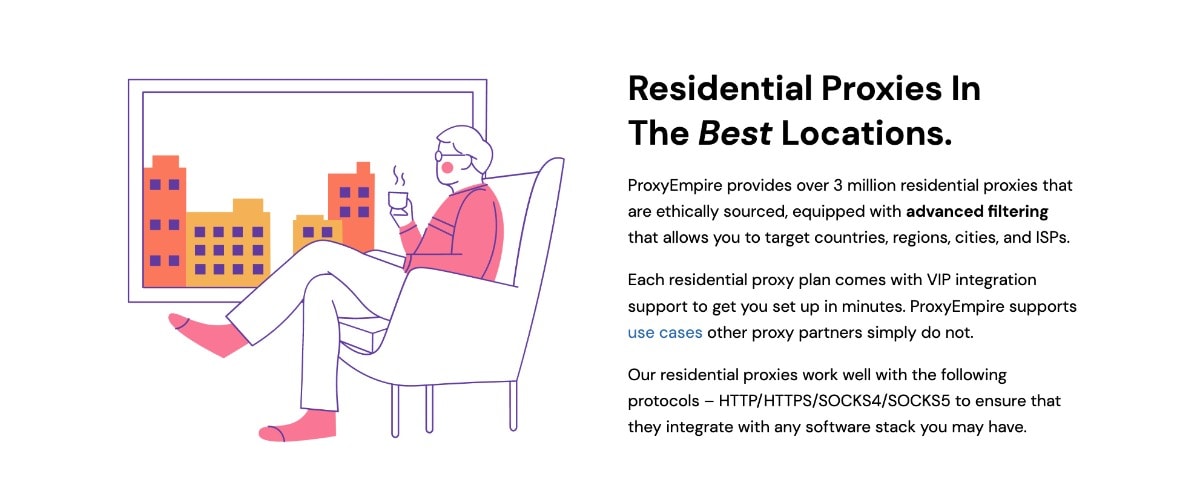
Legitimacy & Safety
- ✓ Commercial residential proxies are legal to use in most jurisdictions for legitimate business purposes — price monitoring, competitive intelligence, SEO research, ad verification, and geo-verification all fall within standard commercial use.
- ✓ Ethical sourcing is available at budget prices: IPRoyal (via Pawns.app opt-in), ProxyEmpire (EWDCI certified), Decodo, and Bright Data all source residential IPs from users who explicitly consent to sharing their bandwidth. You don’t have to choose between cheap and ethical.
- ✓ Your data is protected with reputable providers: Decodo (ISO-compliant infrastructure), Bright Data (ISO 27001 certified), and Oxylabs (insurance included) offer transparent data handling. Avoid obscure providers with no public compliance documentation.
- ✓ PAYG options eliminate commitment risk: IPRoyal’s non-expiring PAYG and ProxyEmpire’s rollover traffic mean you can test residential proxies with zero long-term financial commitment.
Long-Term Reliability
All eleven providers in this list have been operating for multiple years. Decodo (2018), Bright Data (2014), Oxylabs (2015), IPRoyal (2020), High-Proxies (10+ years), and StormProxies have enough track record to assess service stability. Proxyway’s independent benchmarks — which test actual success rates, response times, and pool depth, not just marketing claims — give the most objective view of ongoing performance.
Reality check: Cheap residential proxies are not magic. If your target runs sophisticated bot detection (Cloudflare Enterprise, PerimeterX, DataDome), a budget residential proxy will still struggle — success rates on heavily-protected targets are lower for every provider, and smaller pools exhaust usable IPs faster. For those targets, you need a provider with a large, fresh pool (Bright Data, Oxylabs, Decodo) and you’ll burn more GB per successful result. Budget your traffic realistically — assume 20–30% more GB than your target request count implies for demanding sites.
Our Recommendation: Yes — cheap residential proxies from reputable providers are absolutely worth it for the majority of use cases. Start with Decodo’s free 100 MB trial or ProxyEmpire’s $1.97 trial and test against your actual target before committing to a plan. If success rates are acceptable (aim for 90%+), scale up. If a budget provider struggles on your specific target, step up to Bright Data or Oxylabs with promo codes — the higher per-GB cost may be more than offset by fewer retries and less wasted bandwidth.
Cheap Residential Proxy FAQs
What is a cheap residential proxy?
A cheap residential proxy is a proxy server that routes your traffic through an IP address assigned by a real ISP to a home user’s device, available at a competitive price per gigabyte. “Cheap” in this context means affordable relative to the market — from $0.70/GB at volume to $2–3.75/GB at entry level — not free or compromised. The best budget residential proxies source IPs from opt-in peer networks, making them ethically sourced and genuinely residential despite the lower cost.
How much should I pay for residential proxies?
A fair price for residential proxies in 2026 is $2–5/GB depending on volume and provider. Below $2/GB typically requires either a large volume commitment (500 GB+) or a promo code. Above $6/GB without a discount is premium territory. Anything below $0.50/GB warrants skepticism about IP sourcing quality — check for residential purity data from independent benchmarks before buying.
Are cheap residential proxies safe to use?
Yes, from reputable providers. Safety depends on the provider’s sourcing ethics and data handling practices — not just price. IPRoyal, ProxyEmpire, and Decodo all source residential IPs from users who opted in to share bandwidth, making them safe and ethical at affordable prices. Avoid unlabeled “free residential proxy” lists — those typically come from compromised devices and expose your traffic to third parties.
Which is the cheapest residential proxy per GB?
ProxySeller advertises residential proxies from $0.70/GB at high volumes, making it the lowest headline rate in this roundup. ProxyEmpire with code PROMO50 reaches $1.50/GB at 1 TB. Decodo reaches $2/GB at 1 TB with consistent Proxyway-verified performance. For smaller volumes, IPRoyal’s non-expiring PAYG at $7.35/GB (1 GB) offers the most flexibility without monthly minimums.
Can I get cheap residential proxies without a monthly subscription?
Yes. IPRoyal offers non-expiring PAYG residential proxies — buy 1 GB for $7.35 and use it over weeks or months. ProxyEmpire’s rollover traffic also never expires, even after subscriptions lapse. Decodo’s PAYG rate is $4/GB (no commitment). These models suit users who scrape occasionally and don’t want the pressure of using up a monthly quota.
Are cheap residential proxies good for web scraping?
For most scraping use cases, yes. Budget providers like Decodo (99.86% success rate), IPRoyal (99.56%), and ProxyEmpire (98.88%–99.75%) deliver reliable scraping performance on standard targets. The limits appear on heavily-protected sites (Google, Amazon, Cloudflare-guarded pages) where smaller pools exhaust usable IPs faster. For those targets, consider stepping up to Bright Data or Oxylabs, which have larger pools and higher success rates on demanding targets (93–99% on Amazon/Google).
What’s the difference between cheap and free residential proxies?
Enormous. Free residential proxy lists typically come from one of two sources: compromised devices (infected with malware that routes traffic without the owner’s knowledge) or data harvesting operations where your traffic is logged. Paid residential proxies from ethical providers use opt-in peer networks where users consent to sharing bandwidth. Free proxies get banned within hours on any serious target, have near-zero success rates on protected sites, and expose your traffic. Budget paid proxies ($2–5/GB) are vastly different from free proxy lists.
Do cheap residential proxies work for SEO rank tracking?
Yes — this is one of the best use cases for budget residential proxies. Tracking keyword rankings on Google or Bing requires residential IPs to avoid SERP personalization, but it’s relatively low-bandwidth work. A 5–15 GB/month plan at $2–4/GB covers most small-to-medium SEO agency rank tracking needs. Use sticky sessions to simulate consistent user behavior per keyword cluster. Decodo, IPRoyal, and ProxySeller all support city-level targeting for localized SERP data.
Can cheap residential proxies bypass geo-blocks?
Yes — a real residential IP from the target country will bypass most geo-restriction systems, including those on streaming sites, price comparison platforms, and regional content portals. Success depends on the platform’s sophistication and how frequently the proxied IP range has been flagged. Budget providers with 30M+ pools (IPRoyal, ProxyEmpire) have enough variety to avoid most IP-level geo-blocks. For heavily-guarded streaming platforms, Bright Data or Decodo with larger pools will have higher success rates.
Is there a free trial for cheap residential proxies?
Several providers offer low-risk entry points:
- Decodo: Free 100 MB trial, 3 days — no credit card required on some plans
- ProxyEmpire: $1.97 for 100 MB residential trial
- IPRoyal: Buy 1 GB ($7.35) with no commitment and no expiry — effectively a trial
- Bright Data: 7-day free trial for verified companies
- Oxylabs: 7-day free trial for verified companies
How do I test a residential proxy before buying?
Use a provider’s free or low-cost trial and run your actual target URLs — not just a generic “what’s my IP” check. A passing IP check doesn’t mean your target site will cooperate. Test: (1) Does the site serve the correct geo-localized content and pricing? (2) What CAPTCHA frequency do you see? (3) What’s the response time? Aim for a 90%+ success rate on your target before scaling up spend. Decodo’s 100 MB free and ProxyEmpire’s $1.97 trial are the two best low-risk entry points.
Can I use cheap residential proxies for price monitoring?
Absolutely — price monitoring is one of the most bandwidth-efficient use cases for residential proxies. A typical price monitoring job (checking 500 product pages once per day) uses well under 1 GB/day for most e-commerce sites. At $2–5/GB, a $30–50/month plan comfortably handles this workload. Use rotating residential IPs (not static) and implement reasonable delays between requests to avoid triggering rate limits. Decodo, IPRoyal, and ProxyEmpire all work well for price monitoring on Amazon, eBay, Walmart, and local e-commerce sites.
Final Verdict
Cheap residential proxies are not a compromise — they’re a market reality. The providers in this list prove that you can get genuine, ethically-sourced residential IPs with 195+ country coverage, city-level targeting, and reliable rotation for $2–5/GB or less. The key is matching provider capabilities to your actual use case rather than over-buying enterprise features you won’t use.
✓ Top Picks by Use Case
- Decodo — Best all-around: lowest subscription pricing with Proxyway-verified performance
- IPRoyal — Best PAYG: non-expiring traffic, no monthly minimum, 7-day sticky sessions
- ProxySeller — Best entry rate: from $0.70/GB at volume, 220+ country coverage
- ProxyEmpire — Best rollover: non-expiring traffic + PROMO50 cuts prices 50%
- Bright Data — Best for demanding targets: 400M+ pool, 98.96% success rate w/ promo
- Oxylabs — Best for enterprise at discount: 93.28% on real targets, 35% off first purchase
✗ When to Look Elsewhere
- You need 99%+ SLA guarantees with dedicated account management — choose enterprise plans
- Your target is Google or heavily-guarded Cloudflare sites at high volume — budget pools exhaust quickly
- You need static ISP proxies for long-session account management — different product type
- Your budget is truly zero — free proxy lists expose your traffic and fail on real targets
Ready to Start with Cheap Residential Proxies?
Decodo’s free 100 MB trial lets you test residential proxy performance on your actual targets before spending a dollar on a subscription.
Try Decodo Free — Best Value Residential Proxies →